稀缺回报资产

Search documents
中金:港股近期跑输A股 结构缺亮点及资金面暂处弱势
Zhi Tong Cai Jing· 2026-01-13 02:09
Group 1 - The core viewpoint of the report is that while A-shares have experienced a strong start to 2026 with a "16 consecutive days of gains," Hong Kong stocks have been notably absent from this rally, primarily due to a lack of attractive sectors and a weak liquidity environment [1][2] - The driving force behind the A-share market's performance is the "excess liquidity" chasing "scarce return assets," with small-cap stocks outperforming larger ones, and valuation expansion being the main contributor to the gains [2][3] - The report identifies four key sectors in Hong Kong stocks—dividends, internet, innovative pharmaceuticals, and new consumption—that are unique and irreplaceable compared to A-shares, despite their current lack of market attention [1][6] Group 2 - The underperformance of Hong Kong stocks is attributed to three main factors: the lack of market focus on its unique structural advantages, a weak liquidity environment, and a reflection of a weakening fundamental backdrop [3][4] - The report highlights that the liquidity environment for Hong Kong stocks faces multiple constraints, including uncertainty regarding the strength of southbound capital flows and an increasing demand for IPO financing, which could exceed HKD 400 billion in 2026 [4][5] - Despite the overall market outlook favoring A-shares, Hong Kong stocks still present unique structural opportunities that could attract long-term investment, particularly in sectors like innovative pharmaceuticals and high-dividend stocks [6]
中金:港股和A股谁“错”了?
Xin Lang Cai Jing· 2026-01-12 01:18
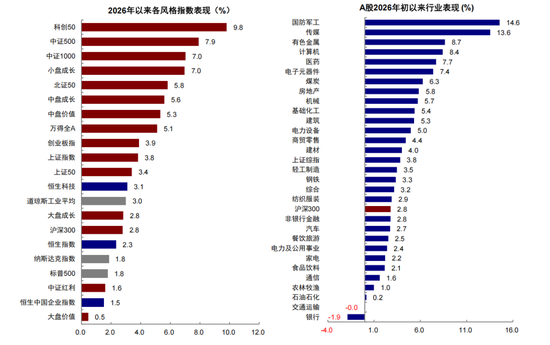
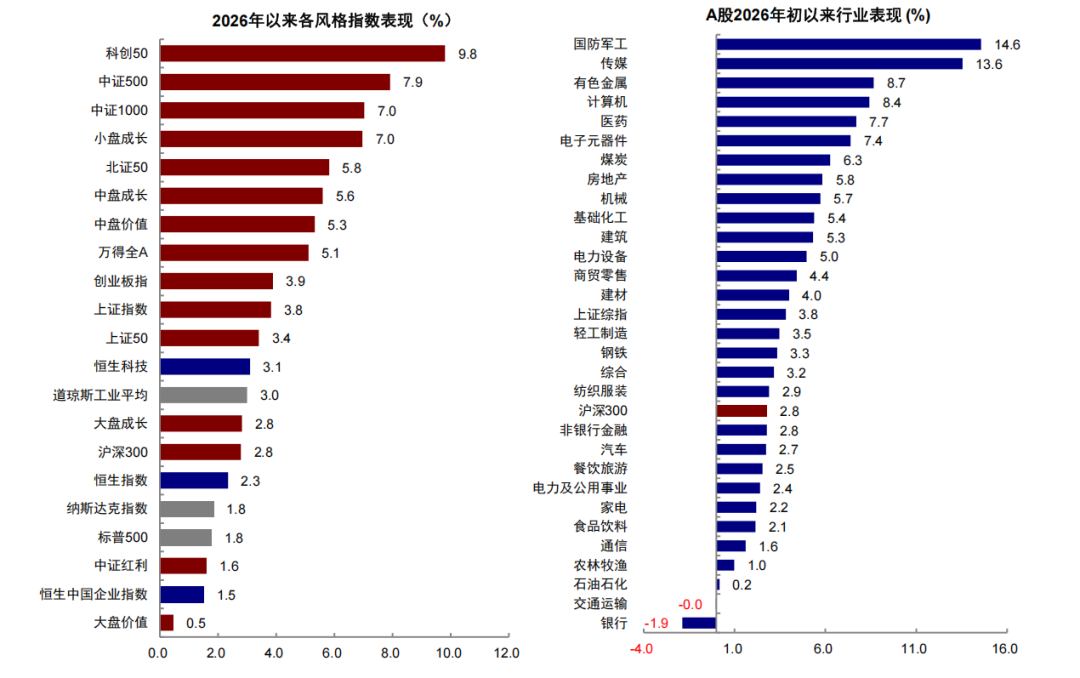
Group 1 - The core driver of the A-share market's strong performance at the beginning of 2026 is the "excess liquidity" chasing "scarce return assets," rather than significant changes in the macroeconomic fundamentals [2][11] - The A-share market has shown a clear structural preference for sectors like commercial aerospace, non-ferrous metals, and brain-computer interfaces, with small-cap stocks outperforming large-cap stocks [2][3] - The A-share market's gains have primarily been driven by valuation expansion, while traditional consumer stocks have lagged behind due to their closer correlation with domestic demand fundamentals [2][5] Group 2 - The Hong Kong stock market has underperformed due to a lack of attractive structural opportunities and a weaker funding environment, reflecting a deteriorating fundamental backdrop [10][13] - The absence of significant inflows from southbound capital has been noted, with December's average daily inflow dropping to 10.9 million HKD, significantly lower than the 60 million HKD average for the entire year [18][20] - The Hong Kong IPO market remains active, with a total of 2,858 million HKD raised in 2025, but the overall market performance has been muted compared to A-shares [20][21] Group 3 - Historical analysis indicates that the "spring market" effect is more pronounced in A-shares than in Hong Kong stocks, with A-share indices showing an average increase of 4.6% during the period from early December to early March, compared to only 0.5% for Hong Kong stocks [23][24] - The A-share market has consistently outperformed the Hong Kong market in terms of sector performance, particularly in technology, military, and home appliance sectors, which have shown average gains around 10% [23][24] Group 4 - The structural differences between A-shares and Hong Kong stocks lead to varying earnings growth rates, with A-shares expected to see a growth rate of 4%-5% in 2026 compared to 3% for Hong Kong stocks [30] - A-shares benefit from a more favorable micro liquidity environment, while Hong Kong stocks face multiple constraints, including potential declines in southbound capital inflows [33][34] - The unique structural opportunities in Hong Kong, such as high dividend yields and sectors like internet and innovative pharmaceuticals, provide a complementary investment avenue despite the overall market underperformance [35][36]

中金:2026年A股大概率优于港股 跟随信用扩张方向布局
智通财经网· 2026-01-12 00:36
Group 1 - The core view is that A-shares are expected to outperform Hong Kong stocks in 2026 due to relative advantages in fundamentals and liquidity, while Hong Kong stocks still hold structural appeal [1][34] - A-shares are projected to have an overall profit growth rate of approximately 4%-5% in 2026, compared to about 3% for Hong Kong stocks, driven by differences in sector composition [34][42] - Key sectors for A-shares include technology hardware, manufacturing, and cyclical industries, while Hong Kong stocks are characterized by dividend, internet, innovative pharmaceuticals, and new consumption sectors, which are less favored in the current market [1][42] Group 2 - The strong performance of A-shares at the beginning of the year is attributed to excess liquidity chasing scarce return assets, rather than significant changes in macro fundamentals [2][12] - The market structure has shown that small-cap stocks have significantly outperformed large-cap stocks, continuing the trend from 2025 [2][3] - A-shares have seen record high margin trading balances and daily trading volumes, indicating strong investor interest and liquidity [8][9] Group 3 - Hong Kong stocks have lagged due to a lack of attractive structural opportunities and weaker liquidity, reflecting a deteriorating fundamental outlook [12][15] - The absence of significant foreign capital inflows and the impact of high U.S. Treasury yields have constrained Hong Kong's liquidity environment [17][20] - The IPO market in Hong Kong remains active, with a total of 2,858 million HKD raised in 2025, but the demand for capital is expected to increase further in 2026 [23][24] Group 4 - The historical cross-year effect shows that A-shares tend to perform better than Hong Kong stocks during the spring season, with A-shares averaging a 4.6% increase compared to 0.5% for Hong Kong stocks over the past 20 years [27][28] - The analysis indicates that A-shares have a higher probability of positive returns during the spring season, particularly in sectors like technology and consumer goods [28][29] Group 5 - The liquidity environment for A-shares is expected to benefit from domestic micro liquidity changes, while Hong Kong stocks face multiple constraints [40][41] - The structural characteristics of Hong Kong stocks, such as dividends and innovative sectors, provide unique investment opportunities that are not easily replicated in A-shares [42][46] - The investment strategy should focus on sectors aligned with credit expansion, including AI, dividends, cyclical, and consumption sectors, with A-shares generally having an advantage in technology and cyclical sectors [45][46]
中金:港股和A股谁“错”了?
中金点睛· 2026-01-11 23:58
Core Viewpoint - The strong performance of A-shares at the beginning of 2026 is primarily driven by "excess liquidity" chasing "scarce return assets," rather than significant changes in the macroeconomic fundamentals [2][3][5]. Group 1: A-share Market Dynamics - The A-share market has seen a 16-day consecutive rise, with small-cap stocks outperforming large-cap stocks, continuing the trend from 2025 [3][5]. - The main contributors to the A-share gains are valuation expansions, with sectors like commercial aerospace and materials leading the charge [5][8]. - A-share trading volumes have reached historical highs, with a single-day turnover exceeding 30 trillion yuan, indicating strong market activity [5][8]. Group 2: Hong Kong Market Performance - The Hong Kong market has lagged behind, primarily due to a lack of attractive structural opportunities and weaker capital flows [9][11]. - Key sectors in Hong Kong, such as dividends, internet, and new consumption, are not currently in the market's focus, leading to underperformance [11][19]. - The Hong Kong IPO market remains active, with significant fundraising, but the overall market sentiment is subdued compared to A-shares [17][19]. Group 3: Capital Flow and Liquidity - Domestic capital flows have favored A-shares, with southbound capital flows slowing down significantly since late 2025 [15][19]. - The liquidity environment for A-shares is more favorable, benefiting from domestic microeconomic conditions, while Hong Kong faces constraints from external factors [28][30]. - The anticipated inflow of southbound capital in 2026 may not match the record levels seen in 2025, as A-shares attract more attention [30][32]. Group 4: Structural Differences and Future Outlook - A-shares are expected to have a higher overall profit growth rate of 4%-5% in 2026, compared to Hong Kong's 3%, driven by stronger sectors like technology and manufacturing [25][26]. - The structural advantages of Hong Kong, including its focus on dividends and innovative drugs, provide unique investment opportunities, even as A-shares outperform overall [30][32]. - The ongoing credit cycle and its impact on market dynamics will guide investment strategies, with a focus on sectors like AI, dividends, and cyclical stocks [33].

专访中金刘刚:2026年投资需均衡配置,宜跟随信用扩张的方向
Sou Hu Cai Jing· 2025-12-25 07:25
Core Viewpoint - Investors are facing a complex situation as the global economic cycle approaches a critical turning point by the end of 2025, with strong long-term growth potential from AI but high valuations and expectations, while traditional economic sectors show weak credit expansion and overall return pressure [1] Investment Strategy - The investment strategy for 2026 should shift from "single-sided bets" to "balanced allocation," embracing certain growth directions like AI hardware while retaining high-dividend assets as a hedge [2][5] Scarce Assets Redefined - The core characteristic of the 2026 market environment will be excess liquidity chasing scarce return assets, with the ability of these assets to expand being a key variable [5][6] AI Hardware Focus - AI-related assets, particularly in the hardware sector supported by government policies, remain a clear investment direction despite high short-term expectations and valuations [6][9] High Dividend Assets - High-dividend assets are crucial hedging tools in an environment of credit contraction, providing stable returns when overall credit is under pressure [7] Strong Cyclical Sectors - Strong cyclical sectors may benefit from U.S. fiscal expansion and monetary easing, potentially boosting demand for commodities like copper, aluminum, and machinery [7] Hong Kong Stock Market Opportunities - The Hong Kong stock market, driven by both mainland and overseas liquidity, presents structural opportunities, with a predicted divergence in the flow of southbound funds [8] Fund Flow Dynamics - Long-term allocation funds, such as insurance capital, are expected to steadily increase holdings in high-dividend assets, while trading funds may fluctuate based on A-share market activity [8] Portfolio Recommendations - A balanced portfolio is recommended, with 10% to 20% of funds allocated to high-dividend assets, adaptable based on individual risk preferences [8] Industry Selection - The Hong Kong market's structural advantages remain prominent, with high dividends being a core attraction, while AI hardware benefits from policy support [9]