乘用车

Search documents
行业深度 | 2025Q2:盈利分化加剧 优质赛道韧性突显【民生汽车 崔琰团队】
汽车琰究· 2025-09-14 11:05
Group 1 - The core viewpoint of the article highlights the differentiation in the passenger car market, driven by scale effects and high-end product offerings, leading to profitability improvements [2] - In Q2 2025, the wholesale sales of passenger cars reached 7.111 million units, a year-on-year increase of 13.0% and a quarter-on-quarter increase of 11.8% [29] - The wholesale sales of new energy passenger cars were 3.629 million units, up 33.9% year-on-year and 26.3% quarter-on-quarter, indicating strong growth in this segment [29] - The revenue of sample enterprises in the passenger car sector reached 673.96 billion yuan, reflecting a year-on-year increase of 13.8% and a quarter-on-quarter increase of 20.2% [42] - The overall gross margin for passenger car companies was 15.0%, showing a slight decline compared to the previous year and quarter, with variations in performance among different companies [2] Group 2 - The automotive parts sector saw revenue growth, with Q2 2025 revenue reaching 266.42 billion yuan, a year-on-year increase of 15.7% and a quarter-on-quarter increase of 14.5% [3] - The gross margin for the parts sector was 18.2%, an increase of 0.6 percentage points year-on-year and 0.7 percentage points quarter-on-quarter, benefiting from scale effects and reduced raw material costs [3] - The net profit growth for the parts sector was 11.9% year-on-year and 18.5% quarter-on-quarter, indicating improved profitability [3] Group 3 - The motorcycle segment experienced significant growth, with Q2 2025 sales reaching 297,000 units, a year-on-year increase of 23.9% and a quarter-on-quarter increase of 44.9% [4] - Revenue for the motorcycle sector was 17.28 billion yuan, reflecting a year-on-year increase of 20.5% and a quarter-on-quarter increase of 20.1% [4] - The gross margin for key motorcycle companies was 23.3%, showing a slight decline year-on-year but an increase quarter-on-quarter [4] Group 4 - Investment recommendations include focusing on high-quality domestic brands in the passenger car sector, such as Geely, Xpeng, Li Auto, BYD, and Seres [4] - In the parts sector, recommendations include companies involved in intelligent driving and smart cockpits, such as Bertel and Jifeng [4] - For motorcycles, leading companies like Chunfeng Power and Longxin General are recommended [7]


周观点 | 机器人Q4迎重磅催化 看好T链核心主线【民生汽车 崔琰团队】
汽车琰究· 2025-09-14 11:05
Key Points - The article highlights the performance of the automotive sector, with a focus on passenger car sales and the impact of new policies on the market [2][45] - It emphasizes the strong performance of the automotive sector in the stock market, outperforming the broader market indices [3] - The article suggests a core investment portfolio, recommending several key automotive companies [4][11] - It discusses the upcoming catalysts in the robotics sector, particularly related to Tesla's Optimus V3 [5][17] - The article notes the significant new model launches in the passenger car segment, which are expected to drive sales [6][12] - It provides investment recommendations across various segments, including passenger cars, components, and robotics [7][19] Automotive Sales Data - In the first week of September 2025, passenger car sales reached 368,000 units, down 9.5% year-on-year and down 29.8% month-on-month [2][45] - New energy vehicle sales were 221,000 units, up 3.1% year-on-year but down 23.6% month-on-month, with a penetration rate of 60.2%, an increase of 4.8 percentage points [2][45] Market Performance - The automotive sector in A-shares rose by 3.9% from September 8 to September 12, outperforming the CSI 300 index, which increased by 2.9% [3] - Sub-sectors such as automotive parts and services saw significant gains, while passenger cars experienced a slight decline of 0.8% [3] Investment Recommendations - The article recommends focusing on high-quality domestic brands that are accelerating in smart technology and globalization, including Geely, Xpeng, Li Auto, BYD, and Xiaomi [4][14] - It also highlights specific companies in the automotive parts sector and robotics that are expected to benefit from industry trends [7][19] Robotics Sector Insights - The robotics sector is anticipated to see significant catalysts in Q4 2025, particularly with the release of Tesla's Optimus V3 [5][17] - The article notes that the production of Optimus V3 is expected to ramp up quickly, with a target of producing hundreds of prototype units by the end of 2025 [5][17] New Model Launches - Several new models are set to launch in September, including vehicles from Chery, NIO, and Geely, which are expected to boost sales in the high-end market segment [6][12] Component and Technology Trends - The article discusses the low valuation of automotive components and the expected growth in the new energy vehicle supply chain [15][16] - It highlights the importance of smart driving technology and the potential for significant growth in this area [15][16]


汽车行业系列深度十一:盈利分化加剧,优质赛道韧性突显
Minsheng Securities· 2025-09-14 07:09
Investment Rating - The report maintains a positive investment rating for the automotive industry, particularly highlighting opportunities in the passenger vehicle and component sectors [6]. Core Insights - The automotive industry is experiencing a divergence in profitability, with high-quality segments demonstrating resilience amid increasing competition and market pressures [1][2][3]. - The passenger vehicle segment is benefiting from scale effects and a shift towards high-end models, with wholesale sales reaching 7.111 million units in Q2 2025, a year-on-year increase of 13.0% [1]. - The component sector is witnessing sustained revenue growth, particularly in intelligent and lightweight segments, with Q2 2025 revenue at 266.42 billion yuan, up 15.7% year-on-year [2]. - The commercial vehicle sector, especially heavy trucks, is showing signs of recovery, with Q2 2025 wholesale sales of heavy trucks at 274,000 units, a year-on-year increase of 18.3% [3]. - The motorcycle segment is also thriving, with sales of 297,000 units in Q2 2025, reflecting a year-on-year growth of 23.9% [4]. Summary by Sections 1. Industry Overview - The automotive sector's fund holding ratio decreased to 6.25% in Q2 2025, indicating a cautious market outlook despite strong demand [12][19]. 2. Passenger Vehicles - The passenger vehicle segment is driven by policy support and a focus on high-end models, with significant sales growth in new energy vehicles, which saw a 33.9% increase in wholesale sales year-on-year [1][39]. - The average selling price (ASP) is showing divergence, influenced by the product mix and market positioning [1]. 3. Components - The components sector is experiencing robust revenue growth, with intelligent driving and automotive electronics leading the way, and a gross margin of 18.2% in Q2 2025, up from the previous quarter [2][3]. 4. Commercial Vehicles - Heavy trucks are recovering with a 1.0% year-on-year revenue increase, while buses are benefiting from both domestic and export demand, with a 7.6% increase in wholesale sales [3]. 5. Motorcycles - The motorcycle market is thriving, particularly in the mid-to-large displacement category, with a revenue increase of 20.5% year-on-year in Q2 2025 [4]. 6. Investment Recommendations - The report recommends investing in high-quality autonomous brands such as Geely, XPeng, Li Auto, BYD, and others, as well as key players in the component sector focusing on intelligent driving and new energy vehicle supply chains [5].




乘用车板块9月12日跌1.12%,长城汽车领跌,主力资金净流出12.09亿元
Zheng Xing Xing Ye Ri Bao· 2025-09-12 08:31
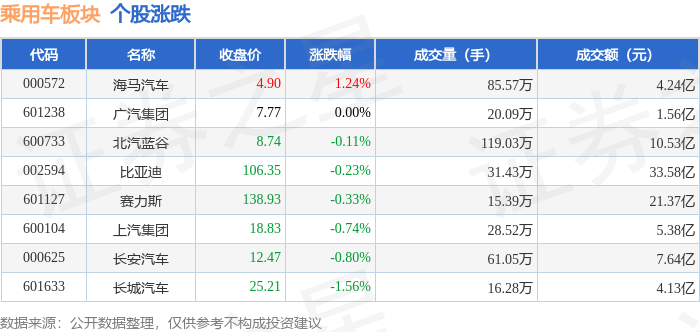
Market Overview - The passenger car sector experienced a decline of 1.12% on September 12, with Great Wall Motors leading the drop [1] - The Shanghai Composite Index closed at 3883.69, up 0.22%, while the Shenzhen Component Index closed at 12996.38, up 0.13% [1] Individual Stock Performance - The following table summarizes the closing prices, percentage changes, trading volumes, and transaction amounts for key stocks in the passenger car sector: - Great Wall Motors (601633) closed at 25.21, down 1.56% with a trading volume of 162,800 shares and a transaction amount of 413 million [1] - BYD (002594) closed at 106.35, down 0.23% with a trading volume of 1,314,300 shares and a transaction amount of 3.358 billion [1] - Changan Automobile (000625) closed at 12.47, down 0.80% with a trading volume of 610,500 shares and a transaction amount of 764 million [1] Capital Flow Analysis - The passenger car sector saw a net outflow of 1.209 billion from institutional investors, while retail investors contributed a net inflow of 734 million [1] - The following table details the capital flow for individual stocks: - Great Wall Motors had a net outflow of 82.743 million from institutional investors, but a net inflow of 83.516 million from retail investors [2] - BYD experienced a net outflow of 468 million from institutional investors, with a net inflow of 333 million from retail investors [2] - Changan Automobile had a net outflow of 257 million from institutional investors, with a net inflow of 178 million from retail investors [2]
上汽集团跌2.06%,成交额7.50亿元,主力资金净流出5841.98万元
Xin Lang Zheng Quan· 2025-09-12 06:32
Core Viewpoint - SAIC Motor Corporation has experienced a decline in stock price and significant net outflow of funds, indicating potential challenges in the market [1][2]. Company Overview - SAIC Motor Corporation, established on April 16, 1984, and listed on November 25, 1997, is headquartered in Shanghai. The company engages in the research, production, and sales of vehicles (including passenger and commercial vehicles), components, logistics, automotive services, and financial services [2]. - The revenue composition of SAIC Motor includes 60.75% from vehicle sales, 30.38% from components, 6.71% from service trade and others, and 2.15% from financial services [2]. Stock Performance - Year-to-date, SAIC Motor's stock price has decreased by 10.12%, with a recent 5-day decline of 2.31%. However, the stock has increased by 0.98% over the past 20 days and by 20.31% over the last 60 days [2]. - As of September 12, the stock price was reported at 18.58 CNY per share, with a market capitalization of 213.58 billion CNY [1]. Fund Flow - On September 12, there was a net outflow of 58.42 million CNY in principal funds, with large orders accounting for 23.28% of purchases and 20.62% of sales [1]. Shareholder Information - As of June 30, 2025, SAIC Motor had 163,800 shareholders, a decrease of 23.10% from the previous period, with an average of 70,672 circulating shares per shareholder, an increase of 30.04% [2]. - The company has distributed a total of 150.94 billion CNY in dividends since its A-share listing, with 9.11 billion CNY distributed over the last three years [3]. Institutional Holdings - As of June 30, 2025, Hong Kong Central Clearing Limited is the fifth-largest circulating shareholder, holding 344 million shares, an increase of 103 million shares from the previous period [3].
长城汽车跌2.07%,成交额4.81亿元,主力资金净流出5375.27万元
Xin Lang Zheng Quan· 2025-09-12 06:30
Group 1 - The core viewpoint of the news is that Great Wall Motors' stock has experienced fluctuations, with a recent decline of 2.07% and a year-to-date drop of 3.09% [1] - As of June 30, 2025, Great Wall Motors reported a revenue of 923.35 billion yuan, reflecting a year-on-year growth of 0.99%, while the net profit attributable to shareholders decreased by 10.48% to 63.37 billion yuan [2] - The company has distributed a total of 346.96 billion yuan in dividends since its A-share listing, with 89.50 billion yuan distributed in the last three years [3] Group 2 - The stockholder count for Great Wall Motors reached 178,500 as of June 30, 2025, marking an increase of 18.73% from the previous period [2] - The main business revenue composition of Great Wall Motors includes 86.79% from vehicle sales, 6.35% from spare parts sales, and 4.03% from molds and others [1] - The company is categorized under the automotive industry, specifically in the passenger vehicle sector, and is involved in various concept sectors including complete vehicles and autonomous driving [1]
乘用车板块9月11日涨0.7%,北汽蓝谷领涨,主力资金净流出6.56亿元
Zheng Xing Xing Ye Ri Bao· 2025-09-11 08:43
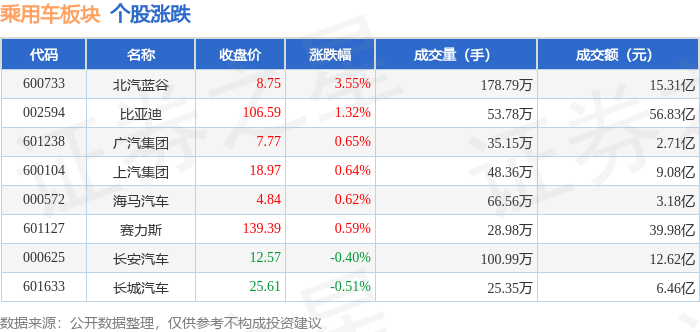
Market Overview - The passenger car sector increased by 0.7% on September 11, with Beiqi Blue Valley leading the gains [1] - The Shanghai Composite Index closed at 3875.31, up 1.65%, while the Shenzhen Component Index closed at 12979.89, up 3.36% [1] Individual Stock Performance - Beiqi Blue Valley (600733) closed at 8.75, up 3.55% with a trading volume of 1.7879 million shares and a transaction value of 1.531 billion [1] - BYD (002594) closed at 106.59, up 1.32% with a trading volume of 537,800 shares and a transaction value of 5.683 billion [1] - GAC Group (601238) closed at 7.77, up 0.65% with a trading volume of 351,500 shares and a transaction value of 271 million [1] - SAIC Motor (600104) closed at 18.97, up 0.64% with a trading volume of 483,600 shares and a transaction value of 908 million [1] - Changan Automobile (000625) closed at 12.57, down 0.40% with a trading volume of 1.0099 million shares and a transaction value of 1.262 billion [1] - Great Wall Motors (601633) closed at 25.61, down 0.51% with a trading volume of 253,500 shares and a transaction value of 646 million [1] Fund Flow Analysis - The passenger car sector experienced a net outflow of 656 million from institutional investors, while retail investors saw a net inflow of 692 million [1] - Beiqi Blue Valley had a net inflow of 138 million from institutional investors, while retail investors had a net outflow of 305,220 [2] - BYD experienced a net outflow of 122 million from institutional investors, but a net inflow of 143 million from retail investors [2] - GAC Group saw a net outflow of 13.15 million from institutional investors, with a net inflow of 22.63 million from retail investors [2]



今年8月中国品牌乘用车共销售新车176.6万辆
Bei Jing Shang Bao· 2025-09-11 06:52
北京商报讯(记者 刘晓梦)9月11日,中国汽车工业协会发布的数据显示,今年8月中国品牌乘用车共 销售新车176.6万辆,环比增长10.1%,同比增长21%,占乘用车销售总量的69.5%。 ...
199.5万辆! 8月全国乘用车零售销量再创新高
Mei Ri Jing Ji Xin Wen· 2025-09-10 13:29
Core Insights - The retail sales of passenger cars in China reached 14.741 million units from January to August 2023, marking a year-on-year increase of 9.5% [1] - In August 2023, retail sales hit a record high of 1.995 million units, up 4.6% year-on-year and 8.2% month-on-month [1] - The market is stabilizing with a shift towards reduced discounts and promotions, as indicated by the Secretary-General of the China Automobile Dealers Association [1] Passenger Car Market Performance - In August, 23 models saw price reductions, compared to 29 last year and 25 in 2023, indicating a stable market [1] - The promotional intensity for new energy vehicles (NEVs) remained at a high level of 10.7%, up 2.5 percentage points from last year, while traditional fuel vehicles maintained a promotional intensity of 22.9%, up 0.9 percentage points [1] New Energy Vehicle (NEV) Market - The retail penetration rate of NEVs exceeded 50% for five consecutive months, with August seeing a retail penetration rate of 55.2%, up 1.5 percentage points year-on-year [4][3] - In August, wholesale sales of NEVs reached 1.282 million units, a year-on-year increase of 22.3%, with a wholesale penetration rate of 52.2% [3] Domestic Brand Performance - Domestic brands maintained steady growth with retail sales of 1.32 million units in August, up 9% year-on-year and 8.6% month-on-month, capturing a market share of 65.7% [2] - The market share of domestic brands for the first eight months of 2023 was 64%, an increase of 6.2 percentage points from the previous year [2] Traditional and Luxury Vehicle Market - In August, retail sales of traditional joint venture brands fell by 2% to 470,000 units, with German brands losing 2.4 percentage points in market share [2] - Luxury vehicle sales in August were 210,000 units, down 5% year-on-year but up 21% month-on-month, with a market share of 10.5% [2] Range-Extended Electric Vehicle (REEV) Market - REEV wholesale sales in August dropped by 9.5% year-on-year to 99,000 units, while retail sales saw a slight increase of 0.3% [5] - The REEV market is experiencing a downturn after years of rapid growth, with a decline in market share from 10.27% in 2024 to 8.81% in 2023 [6] Future Outlook - The REEV market is expected to face challenges in regaining high growth due to advancements in pure electric vehicle technology and charging infrastructure [7] - The core selling point of "no range anxiety" for REEVs is diminishing as pure electric vehicles improve in range and cost [7]
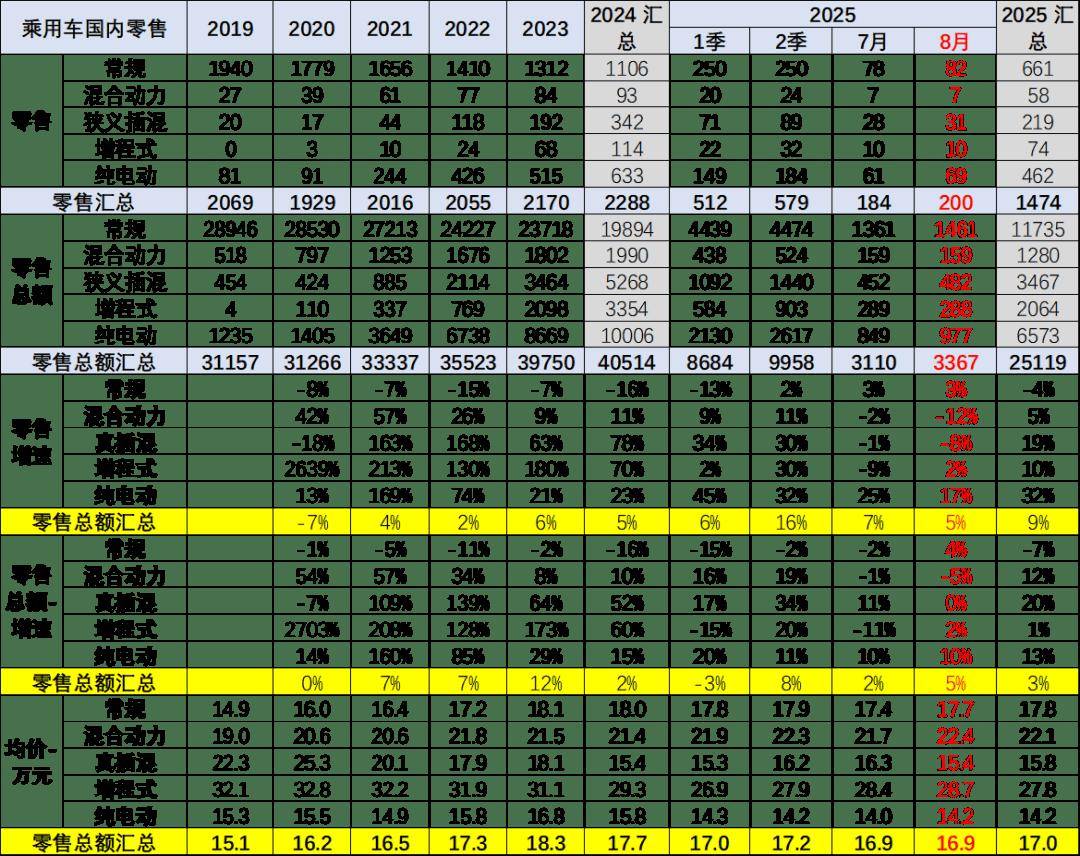
全国乘用车市场价格段分析-8月
Sou Hu Cai Jing· 2025-09-10 11:41
Core Viewpoint - The Chinese passenger car market is experiencing a shift with a decrease in average prices, which is expected to stimulate growth in the mid-to-low-end segments and enhance overall market penetration [1][2][5]. Market Performance - In August, the national retail sales of passenger cars reached 2 million units, marking a year-on-year increase of 4.6% and a month-on-month increase of 8.2%. Cumulatively, 14.74 million units have been sold this year, reflecting a 9.5% year-on-year growth [1]. - The average price of passenger cars in August was 169,000 yuan, remaining stable compared to the same period last year, while the average price for the first eight months of 2025 is projected to be 170,000 yuan, down from 171,000 yuan in 2024 [1][3]. Price Trends - The average price of conventional fuel vehicles has risen from 150,000 yuan in 2019 to 183,000 yuan in 2023, but is expected to decline to 170,000 yuan by August 2025 due to a faster shrinkage in high-end fuel vehicle sales [1][3]. - The average price of new energy vehicles has also decreased significantly, from 184,000 yuan in 2023 to 159,000 yuan in August 2025, indicating a vibrant consumer interest in this segment [1][3]. Market Structure - The decline in average prices is attributed to an increase in the sales of entry-level pure electric vehicles, while the share of higher-priced hybrid and range-extended vehicles has decreased [4][10]. - The penetration rate of new energy vehicles is expected to reach 48% in 2024 and 55.2% by August 2025, indicating a strong growth trajectory for this segment [9]. Consumer Behavior - The decrease in average prices is seen as beneficial for market growth, particularly in promoting the adoption of passenger vehicles among lower-income consumers, as China's car ownership per thousand people remains relatively low [2][5]. - The mid-to-low-end market is expected to recover significantly in 2024 due to policies encouraging vehicle scrappage and trade-ins, which will further drive down average prices [2][5]. Brand Performance - The average price of luxury vehicles in the first eight months of 2025 is 361,000 yuan, slightly down from 364,000 yuan in 2024, while the average price for joint venture brands is 175,000 yuan, up by 0.2% from the previous year [12]. - Domestic brands are seeing a significant push in the new energy segment, with pure electric and narrow hybrid models performing well, while traditional fuel vehicles are facing downward pressure [12].