
汽车安全技术

Search documents
雷军明晚开播,小米汽车首次公开整套安全体系
Sou Hu Cai Jing· 2026-02-26 09:15
Core Viewpoint - Xiaomi is focusing on the safety of its vehicles, with a dedicated live stream led by CEO Lei Jun to discuss the company's safety systems and technology [2][3]. Group 1: Safety Initiatives - The live stream will feature experts discussing Xiaomi's comprehensive safety system, including active and passive safety, battery safety, and intelligent driving safety [3]. - Lei Jun has previously addressed safety concerns through live streams, showcasing Xiaomi's technological capabilities in research, testing, and manufacturing [3]. - The upcoming SU7 model will include significant safety upgrades, such as a 2200MPa ultra-strong steel embedded roll cage and nine airbags, with additional side airbags for rear passengers [3]. Group 2: Research and Development Investment - Xiaomi plans to invest 200 billion yuan (approximately $28.5 billion) in research and development over the next five years, focusing on battery and intelligent driving technologies [4]. - The company has filed 132 patents related to battery technology, achieving a cell-to-pack (CTB) battery volume efficiency of 77.8% [4]. - The 800V high-voltage platform allows for a charging efficiency of "5 minutes for a range of 220 kilometers" [4]. Group 3: Delivery Goals - Xiaomi aims to deliver 550,000 vehicles by 2026, indicating a strong commitment to scaling its automotive operations [4].


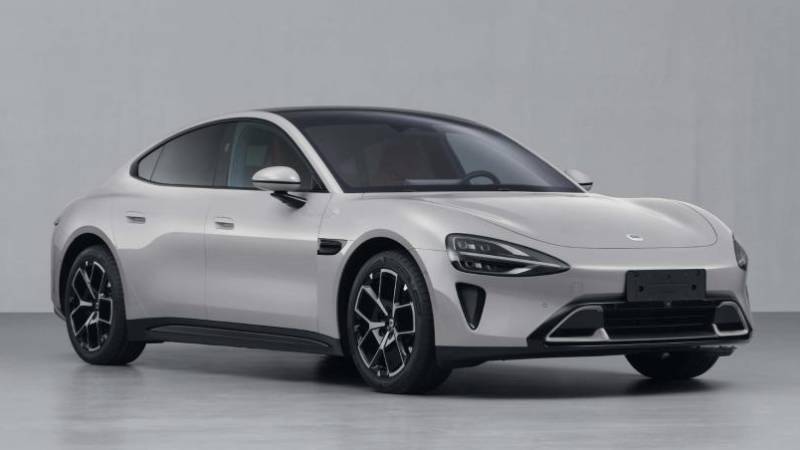
又是隐藏式门把手!东风奕派起火致一死三伤,声明避谈“车门打不开”
新浪财经· 2026-02-08 08:00
Core Viewpoint - The article discusses a serious safety incident involving the Dongfeng Yipai 007, where hidden door handles failed to open during a fire, resulting in one death and three injuries. The company’s response has been criticized for not addressing the door handle issue directly [4][6][10]. Group 1: Incident Details - A video showed a Dongfeng Yipai 007 catching fire after a collision, with passengers unable to open the rear doors from the outside, leading to a tragic outcome [4][6]. - The official statement from Dongfeng Yipai claimed the accident occurred on March 19, 2025, and was due to a high-speed collision with a truck, but did not address the door handle issue [4][6][8]. Group 2: Company Response and Safety Features - Dongfeng Yipai's customer service explained that the 2024 Yipai 007 features a mechanical interior door handle and an electric hidden exterior handle, which does not pop out during a collision for safety reasons [8][9]. - The company has stated that future models will include electric release doors with mechanical backup options, but there is currently no announcement regarding changes to the hidden door handle design [9]. Group 3: Sales and Brand Impact - Dongfeng Yipai has struggled with low sales, with monthly figures hovering around 5,000 units in 2025, dropping to about 3,000 in November and December [11][13]. - In August 2025, Dongfeng integrated its brands to form Dongfeng Yipai Technology, which saw a significant sales increase, with 2025 total sales reaching 275,000 units, a 28% growth [13][15]. - The recent safety incident may negatively impact Dongfeng Yipai's brand image and sales, despite previous improvements in performance [10][16].


小米汽车前机舱加强结构相关专利获授权
Zheng Quan Shi Bao Wang· 2026-01-23 05:38
Core Viewpoint - Xiaomi Auto Technology Co., Ltd. has recently been granted a patent for a "front cabin reinforcement structure," which aims to enhance vehicle safety by absorbing collision energy through a designated energy-absorbing zone [1] Group 1: Patent Details - The patent describes a front cabin reinforcement structure that includes an energy-absorbing zone designed to deform during a collision, thereby absorbing energy and reducing the amount transmitted to the passenger compartment [1] - This innovation allows for the use of lighter and thinner materials in the front cabin reinforcement structure, which can lead to reduced costs and weight for the vehicle [1]
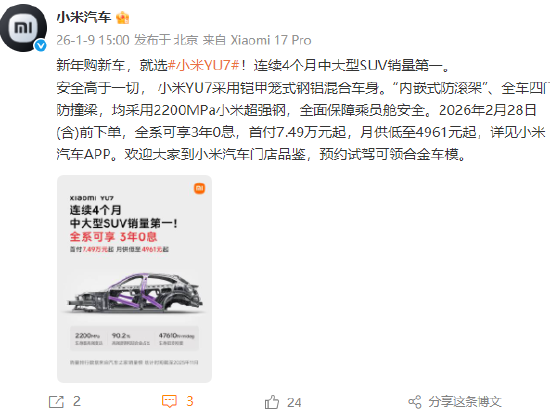
小米汽车:小米YU7连续4个月中大型SUV销量第一
Xin Lang Cai Jing· 2026-01-09 07:10
Group 1 - The core message is that Xiaomi's Yu7 SUV has maintained the top sales position in the mid-to-large SUV segment for four consecutive months [1][4] - Xiaomi emphasizes safety as a priority, highlighting the Yu7's armored cage structure made of a steel-aluminum hybrid body [1][4] - The vehicle features an embedded roll cage and four door crash beams, all constructed with 2200MPa ultra-strong steel to ensure passenger cabin safety [1][4] Group 2 - A promotional offer is available for orders placed by February 28, 2026, which includes three years of zero interest financing [1][4] - The starting down payment for the Yu7 is set at 74,900 yuan, with monthly payments beginning at 4,961 yuan [1][4] - Customers are encouraged to visit Xiaomi's automotive stores for test drives and can receive a metal car model as a gift for scheduling a test drive [1][4]
雷军新年首播拆解YU7,正面回应小字营销、绿化带战神、7000法务等网络争议
Sou Hu Cai Jing· 2026-01-04 08:23
Core Viewpoint - The live broadcast by Lei Jun and Xiaomi executives addressed recent controversies surrounding the company, including issues related to product marketing and safety concerns regarding Xiaomi's vehicles [1][3]. Group 1: Product Safety and Technology - The live broadcast showcased Xiaomi's automotive technology, including the integrated die-casting and thermal management systems of the Xiaomi YU7 [3]. - Xiaomi's engineers explained the safety redundancy of the car door locks, which are equipped with three power sources and mechanical controls to ensure functionality in extreme conditions [3]. Group 2: Marketing Controversies - Lei Jun denied the existence of a "7000 legal team," calling it an unfounded rumor [3]. - Regarding the "small font marketing" issue, Lei Jun acknowledged the criticism and stated that Xiaomi would improve the clarity of product annotations in the future [3]. - The company responded to the "Green Belt Warrior" controversy, attributing it to malicious editing and labeling by individuals with ulterior motives [5]. Group 3: Performance Claims - Lei Jun addressed the criticism regarding the claim of "charging only once for 1300 kilometers," clarifying that the statement was based on actual performance and not an exaggeration [5]. - The company defended its claim of stopping from 200 km/h, explaining that it was intended to demonstrate the braking performance of the Xiaomi SU7 Ultra [7]. Group 4: Sales Performance and Future Goals - Xiaomi reported delivering 410,000 vehicles in 2025 and set a target of 550,000 for 2026, with plans to launch four new models, including updated versions of the SU7 [11].

中国汽车碰撞专属 “数字人”来了!
Zhong Guo Qi Che Bao Wang· 2025-12-15 02:02
Core Viewpoint - The automotive industry is accelerating its transition to intelligence, leading to increasingly complex collision safety testing scenarios, highlighting the limitations of traditional crash test dummies in terms of biomimicry and damage data output [1] Group 1: Development of Digital Human Models - The Tianjin Inspection Center has successfully developed a standardized digital human model representing the 50th percentile of Chinese males, addressing long-standing technical challenges and establishing a new automotive safety testing system tailored to Chinese physical characteristics [1][5] - Digital human models have become a new type of anthropomorphic testing equipment, showcasing significant advantages in new scenarios such as high-angle collisions and intelligent driving, thus becoming a key competitive area in global automotive safety technology [3] Group 2: Challenges in Domestic Automotive Safety Testing - The domestic automotive safety testing field faces two major bottlenecks: existing digital human models are often based on single volunteer images, lacking a unified standard for widespread application, and mainstream models are based on Western body types, which do not accurately simulate the impact injuries of the Chinese population [3][5] Group 3: Technological Innovations - The project team at Tianjin Inspection Center has integrated multiple innovative technologies throughout the model development process, including geometric model construction, finite element model configuration, and validation work [6] - The geometric model construction phase utilized AI algorithms for batch processing of medical images, resulting in a human geometric model that accurately reflects the 50th percentile body parameters of Chinese individuals, characterized by realism, representativeness, and standardization [6][8] Group 4: Model Validation and Application - The finite element model construction employed refined modeling techniques to accurately reflect the physiological structure details and ensure the model's ability to represent the overall and local response characteristics of the human body under mechanical loads [8] - The standardized digital human model developed by Tianjin Inspection Center is the first fully parameterized biomechanical finite element model in China's automotive safety field, adaptable to various collision scenarios and intelligent driving, providing a high-level virtual testing tool for the automotive industry [9]


安全永远是汽车的首要准则
Huan Qiu Wang Zi Xun· 2025-11-14 04:20
Core Viewpoint - The automotive industry is witnessing a shift towards prioritizing safety over performance, as evidenced by new regulations aimed at controlling acceleration capabilities in electric vehicles [1][2][3]. Group 1: Industry Trends - The trend of high acceleration performance has become a marketing strategy for many car manufacturers, with vehicles achieving 0-100 km/h in under 5 seconds now common in the 200,000 yuan electric vehicle segment [1]. - Consumer interest in performance metrics such as acceleration and driving experience is increasing, with these factors becoming key considerations for ordinary buyers [1]. Group 2: Regulatory Changes - The Ministry of Public Security has proposed new regulations that require vehicles to have a default acceleration time of no less than 5 seconds, aiming to enhance safety and reduce the risks associated with high-performance vehicles [2]. - The proposed regulations include features such as "pedal misstep suppression" and "power circuit disconnection" to mitigate the risks of driver error and enhance vehicle safety [2]. Group 3: Safety Focus - The new regulations also address distracted driving by mandating the disabling of entertainment features when the vehicle exceeds 10 km/h, promoting a safer driving environment [3]. - The emphasis on safety technology and innovation is expected to shift the focus of automotive companies from speed to safety, fostering a more mature automotive industry in China [3].
中国汽研:筑牢汽车指数安全技术内核,助力全球汽车安全协同发展
Zhong Guo Qi Che Bao Wang· 2025-11-11 09:29
Core Viewpoint - China Automotive Engineering Research Institute Co., Ltd. (China Automotive Research) has actively engaged in international industry exchanges and professional cooperation, achieving significant recognition and awards in the field of automotive safety technology [2][6]. Group 1: International Recognition and Achievements - China Automotive Research's automotive safety technology research team participated in the "SHIFT 2025" international conference in Malaysia, where they received the "ASEAN Safety Excellence Contribution Award" [2][6]. - The team also obtained the ASEAN New Car Assessment Program (ASEAN NCAP) testing authorization for 2026-2030 from the Malaysian Institute of Road Safety Research (MIROS) [2][6]. - A joint research outcome was released, focusing on motorcycle dummy targets and CPD child targets based on ASEAN road characteristics [2][8]. Group 2: Technical Collaboration and Knowledge Sharing - The head of the automotive safety technology center at China Automotive Research delivered a keynote speech on "Electric Vehicle Safety, Technology, and Evaluation," promoting advanced safety technologies and evaluation systems for new energy vehicles [5]. - A collaborative intent was established with the University of Virginia's Center for Applied Biomechanics (UVA-CAB) to advance research in injury biomechanics [2][13]. Group 3: Regional Safety Standards and Cooperation - The second China-Malaysia Automotive Road Traffic Safety Seminar was held, focusing on deepening safety cooperation and establishing clear standards for automotive safety in the ASEAN region [10]. - The Malaysian Road Safety Research Institute provided a comprehensive interpretation of safety evaluation systems for passenger cars, commercial vehicles, and motorcycles, aiding Chinese automotive companies in entering the ASEAN market [10]. - Four Chinese automotive companies were awarded the "ASEAN Road Safety Excellence Contribution Enterprise Award" for their outstanding safety performance [10]. Group 4: Future Directions and Commitments - China Automotive Research aims to enhance its role as a "testing technology lighthouse" and integrate Chinese wisdom and solutions into the global automotive safety system [14]. - The organization is committed to collaborating with top international academic institutions to address new safety challenges in the automotive industry [14].


车圈圆桌派|辅助驾驶事故又现!企业该做些啥?
Bei Ke Cai Jing· 2025-10-28 06:41
Core Viewpoint - Recent accidents related to intelligent assisted driving have raised significant public concern, prompting a strong emphasis on safety in the development of smart connected vehicles, as highlighted by government officials at the 2025 World Intelligent Connected Vehicle Conference [1][3]. Group 1: Regulatory Developments - The Ministry of Industry and Information Technology (MIIT) has emphasized "safety first, quality foremost" in its approach to new energy vehicle safety [1]. - The National Market Supervision Administration is establishing a reporting system for fire accidents involving new energy vehicles and a remote upgrade reporting system [1]. - A public consultation on the mandatory national standard for "Safety Requirements for Intelligent Connected Vehicles' Combined Driving Assistance Systems" is ongoing, with a focus on human-machine interaction, functional safety, and data recording [1][3]. Group 2: Industry Response - Automakers are required to collaborate with partners to enhance driver state monitoring systems, upgrade hardware like steering wheel capacitive sensing devices, and develop algorithms for real-time monitoring of driver hand and gaze status [3][6]. - The new standards necessitate a shift from indirect detection methods to more precise monitoring of driver engagement, raising the bar for the accuracy of driver monitoring systems [3][7]. Group 3: Technology Upgrades - The standards will drive upgrades in sensor performance and computing platforms, with a need for higher computational power to support advanced functionalities like Navigation on Autopilot (NOA) [8][10]. - The introduction of 4D millimeter-wave radar or laser radar is expected to enhance the detection of typical hazardous scenarios, addressing limitations of pure visual solutions [8][10]. Group 4: Market Implications - The mandatory national standard sets a unified safety baseline for combined driving assistance systems, which is expected to enhance product safety and encourage investment in technology development [9][10]. - The push for standardization is anticipated to accelerate the adoption of safety technologies in mid- to low-end vehicles, expanding the market for safety manufacturers [4][10].

2025世界NCAP大会落地中国:见证中国汽车产业崛起与全球话语权提升
Zhong Guo Qi Che Bao Wang· 2025-09-29 04:10
Core Insights - The 2025 World NCAP Conference will be held in Shanghai from October 15-17, marking a significant event for the global automotive safety industry [3] - China's automotive industry has evolved from a "standard follower" to a "rule participant," showcasing its transformation and innovation-driven growth [4][9] - The C-NCAP has developed a comprehensive evaluation system that includes safety, intelligence, and sustainability, reflecting the industry's progress towards a more proactive safety approach [5][10] Industry Developments - The C-NCAP has been recognized internationally, receiving dual accreditation from Euro NCAP and ASEAN NCAP, and is actively collaborating with Latin NCAP [4] - The 2024 version of C-NCAP will enhance occupant protection testing and introduce virtual assessment technologies, marking a significant upgrade in testing methodologies [4] - China's new energy vehicle production reached 12.888 million units in 2024, with a sales volume of 12.866 million units, achieving a penetration rate exceeding 40% [6] Global Positioning - The conference will address critical topics such as the role of NCAP in enhancing vehicle safety and fleet safety from a global perspective [5] - China's automotive industry is positioned as a leader in the global market, contributing 70% of global power battery capacity and 50% of new energy vehicle patents [6] - The C-NCAP's evolution reflects China's advancements in automotive safety technology, transitioning from learning from international standards to contributing its own innovations [9][10]
