工业机器人

Search documents
智能早报丨安世中国反击荷兰断供;9月份中国工业机器人产量7.63万套
Guan Cha Zhe Wang· 2025-11-03 02:11
Group 1: Anshi China and Nexperia - Anshi China has announced that it has established sufficient inventory and accused Nexperia Netherlands of maliciously defaming its management, claiming that Nexperia's assertion of contract payment issues is baseless [1][3] - Nexperia Netherlands has unilaterally decided to stop supplying wafers to Anshi China's packaging and testing factory (ATGD) starting October 26, 2025, despite owing ATGD approximately 1 billion RMB [1][3] - Anshi China has built a robust inventory of finished and in-process products to meet customer demand until the end of the year and is actively validating new wafer production capacity to ensure long-term supply resilience [3] Group 2: Industrial Robotics in China - In September, China's industrial robot production reached 76,300 units, marking a year-on-year increase of 28.3% [4] - The cumulative production from January to September reached 595,000 units, surpassing the total production for the previous year [4] Group 3: Cambrian Technology - Cambrian Technology announced the addition of its wholly-owned subsidiaries as implementation entities for fundraising projects related to large model chip and software platforms [5] - The company plans to use 100 million RMB to increase capital for its Shanghai subsidiary and 8 million RMB each for its subsidiaries in Anhui and Xi'an, without affecting the overall investment amount or operational stability [5] Group 4: TSMC Price Increase - TSMC has reportedly initiated a four-year price increase plan for advanced processes below 5nm, with expected increases ranging from 3% to 10% [6][7] - This price adjustment is seen as a response to rising production costs and inflation, with expectations that it will trigger a new wave of chip price increases across the industry [7] Group 5: Future of AI and Mobile Devices - Elon Musk predicts that in five to six years, most content consumed by humans will be generated by AI, leading to a transformation in mobile devices into AI interaction nodes [8] - He suggests that traditional operating systems and apps will become obsolete, with devices primarily serving as display and audio playback units integrated with AI capabilities [8] Group 6: OpenAI's Revenue and Losses - OpenAI's CEO Sam Altman expressed optimism about the company's revenue, claiming it exceeds the previously reported 13 billion USD [9] - Despite significant revenue generation and partnerships with major companies, OpenAI is still facing substantial losses, with estimates suggesting a quarterly loss exceeding 12 billion USD [9]



杨国福回应“豆芽一斤28元”;南航通报安全员参加体能测试猝死;马斯克最新预测:五年后传统手机和APP将消失丨邦早报
创业邦· 2025-11-03 00:11
Core Insights - The article discusses various recent events and developments across different industries, highlighting key issues and trends that may impact investment opportunities and risks. Group 1: Food Industry - Yang Guofu's response to the high price of mung bean sprouts, which reached 28.8 yuan per pound, indicating a lack of uniform pricing across stores due to cost issues [2]. Group 2: Automotive Industry - Li Auto's product line head detailed the "MEGA 2024" fire incident, revealing that a battery insulation fault was reported four hours before the incident, and the company had contacted the driver [4]. - BMW announced that by 2027, half of its M series models will be electric or hybrid, showcasing its commitment to transitioning to new energy vehicles [19]. Group 3: Technology and AI - OpenAI's internal conflicts were exposed, with allegations against Sam Altman for misleading behavior, leading to a loss of trust from the board [10]. - Microsoft CEO Satya Nadella stated that power shortages are becoming a bottleneck for AI computing expansion, resulting in many AI chips remaining unused in warehouses [18]. - Geoffrey Hinton warned that tech giants may need to lay off workers to profit from AI, indicating a potential shift in the labor market due to automation [19]. Group 4: Robotics and Manufacturing - China's high-tech manufacturing sector saw a 9.6% year-on-year increase in value added, with industrial robot production significantly contributing to this growth, reaching 76,300 units in September, a 28.3% increase year-on-year [22]. Group 5: Investment and Financing - Yika Technology announced a $150 million investment agreement to support its global business growth [21]. - Whatnot completed a $225 million Series F funding round, doubling its valuation to $11.5 billion since earlier this year [21].


一线观察|上市公司数量四年增加一半,这个城市产业升级有哪些密码?
Di Yi Cai Jing· 2025-11-02 06:01
Core Insights - Dongguan is transitioning from a traditional manufacturing hub to a high-tech manufacturing center, with a focus on self-owned brands and innovation [1][6][10] - The city's GDP reached 931.89 billion yuan in the first three quarters of this year, reflecting a year-on-year growth of 4.5% [1] - The number of listed companies in Dongguan has increased significantly, with 63 companies listed by mid-2025, up from 44 in 2021, and a total market value exceeding 497.1 billion yuan [5][10] Industry Trends - The manufacturing sector in Dongguan is experiencing a shift towards high-value industries, with significant growth in electronic information manufacturing (8.4%), electrical machinery (8.2%), and chemical manufacturing (11.6%) [2] - The rise of the "national trend" in consumer goods is exemplified by companies like Pop Mart, which reported a 245% year-on-year revenue increase in Q3 [2][3] - The toy industry is evolving, with companies moving from simple OEM production to developing their own brands and IPs, as seen with firms like Ha Yi Dai [3][9] R&D and Innovation - Dongguan's listed companies are increasing their R&D investments, with a total of 37.1 billion yuan spent in the first half of 2025, a growth of over 30% from the previous year [8] - Companies like TOSY Robotics are leading the way in innovation, showcasing advanced robotics that can adapt and learn in real-time [8] - The focus on brand development is crucial for companies to break free from low-value manufacturing, as demonstrated by companies like Wei Shi Technology [9] Market Dynamics - The labor market is changing, with younger workers preferring flexible job options over traditional factory work, necessitating a shift towards automation and smart manufacturing [6][10] - Dongguan's manufacturing sector is adapting to fast-changing consumer demands, particularly in the context of the Greater Bay Area's dynamic market [10] - Government policies are supporting this transition, with initiatives aimed at fostering strategic industrial clusters and promoting digital transformation in manufacturing [10]
国产工业机器人凭借“智造”硬实力加速“出海”闯世界 “中国造”闪耀全球舞台
Yang Shi Wang· 2025-11-02 04:24
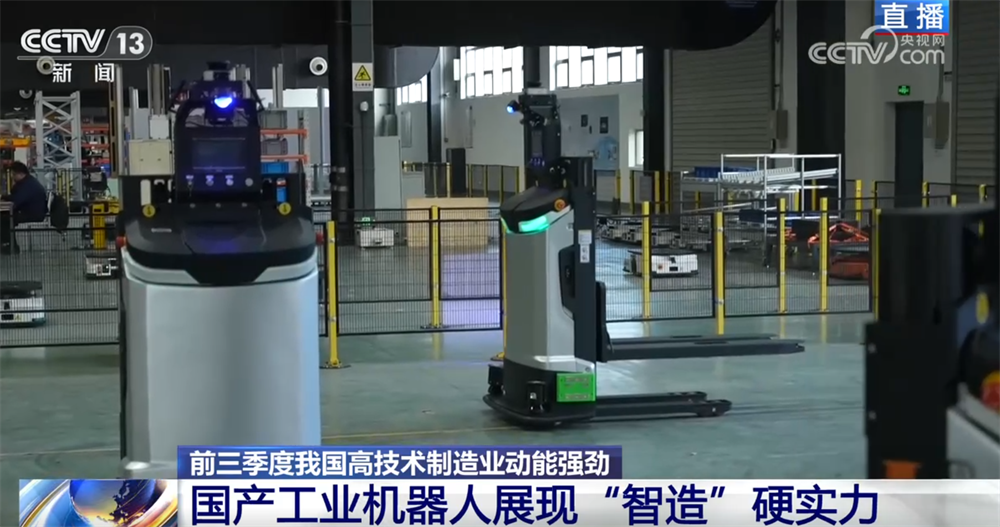
Core Insights - The production of industrial robots in China has reached 595,000 units in the first three quarters of this year, surpassing the total production for the entire previous year, with a significant increase in domestic production rate [1] - The development of advanced control algorithms and motion planning technologies has enhanced the precision and capabilities of domestic robots, providing them with a competitive edge in the market [3] Group 1: Technological Advancements - Technicians have developed core control algorithms and advanced motion planning technologies, significantly improving the operational precision of robots [3] - A new software platform for intelligent mobile robots has been launched, along with the establishment of a dedicated research institute for embodied intelligence [3] Group 2: Product Performance - A newly launched industrial robot features a reach of 2.7 meters, capable of lifting up to 270 kilograms with a positioning accuracy of ±0.06 millimeters, making it suitable for both traditional and new energy vehicle manufacturing [5][6] - The robot's structural enhancements have increased its rigidity by 170%, allowing it to weld a single point in as little as 2.2 seconds [6] Group 3: Market Expansion - The performance of Chinese robots in the global market has been impressive, with exports to over 40 countries, showcasing the quality and adaptability of Chinese-made robots [10][12] - Chinese intelligent equipment is steadily entering the global high-end manufacturing stage, demonstrating the strength of "China's intelligent manufacturing" [12]
四中全会精神在基层 | 小物件、大作为——从零部件“向新”看湖南制造业提质升级
Zhong Guo Zheng Quan Bao· 2025-11-01 14:28
Group 1 - Hunan Shenyi Precision Parts Co., Ltd. specializes in precision components, supplying fasteners for major engineering projects and national key equipment [1][8] - The company has achieved domestic substitution of various fasteners for key engineering machinery enterprises in Hunan, contributing to the advancement of the engineering machinery industry [1][8] - The manufacturing sector in Hunan is seeing a rise in "small and beautiful" enterprises focusing on specialized and innovative manufacturing, aligning with the national strategy for a modern industrial system [3][6] Group 2 - Hongpeng Aviation Power Group is developing aviation engines from modified automotive engines, targeting the low-altitude economy with a focus on cost-effectiveness and airworthiness [3][6] - The company has achieved EASA certification for its D160 heavy oil piston engine and is pursuing CAAC certification, reflecting its commitment to independent and controllable domestic production [3][6] - Strictly Intelligent Technology Co., Ltd. emphasizes innovation in industrial robotics and machine vision, aiming to enhance technology integration within the manufacturing sector [6][8] Group 3 - The fastener industry is crucial in manufacturing, with applications across various sectors, including automotive and infrastructure, highlighting the importance of seemingly minor components [8] - Shenyi Precision has collaborated with steel companies to develop weather-resistant steel rivets, showcasing advancements in corrosion resistance, precision, strength, and toughness [8] - The continuous improvement in precision parts reflects the broader trend of technological innovation and the shift towards high-end, intelligent manufacturing [8]
31省份三季报出炉:年底冲刺,谁是增长黑马?
2 1 Shi Ji Jing Ji Bao Dao· 2025-10-31 13:43
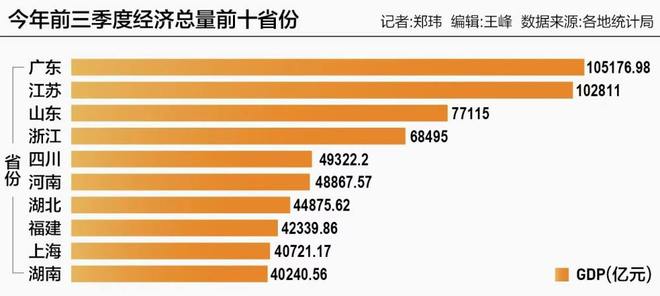
Economic Overview - As of October 31, all 31 provinces in China have released their Q3 reports for 2025, revealing significant changes in the economic landscape as the year-end approaches [1] - Guangdong, Jiangsu, and Shandong remain the top three provinces by GDP, with Guangdong leading at 105,176.98 billion yuan, followed by Jiangsu at 102,811 billion yuan, and Shandong at 77,115 billion yuan [1][5] Economic Growth - Central and western provinces, such as Hubei and Tibet, have shown impressive GDP growth rates, with Hubei achieving 6.0% and Tibet 7.1%, the highest in the country [1][8] - Hubei's GDP growth is supported by strong performance in consumption, investment, and exports, with a notable 30.8% increase in export value [9][10] Industrial Development - The industrial sector, particularly high-tech manufacturing, has been a key driver of GDP growth across multiple provinces [11] - Guangdong's industrial output increased by 3.5%, with advanced manufacturing and high-tech manufacturing growing by 5.4% and 6.4%, respectively [5][6] - Jiangsu's high-tech industry also performed well, with a 11.7% increase in output, contributing significantly to overall industrial growth [6] Policy Initiatives - Guangdong has introduced measures to boost industrial investment, focusing on sectors like solid-state batteries and electric vertical takeoff and landing vehicles [2][14] - Sichuan has announced policies to incentivize industrial project completion, offering up to 1.5 million yuan in rewards for successful projects [2][15] Export Performance - High-tech products have driven export growth, with Hubei's exports of electromechanical products reaching 2,191.7 billion yuan, a 19.8% increase [10] - In Henan, exports of new energy vehicles and lithium batteries surged, with electric vehicle exports alone growing by 262.1% [12] Market Trends - The demand for high-tech products, such as the "new three samples," is increasing both domestically and internationally, prompting industrial expansion [13] - Companies are adapting to market demands by increasing production capacity and investing in technology [13]
上交所:科创板592家公司合计首发募集资金总额9345.64亿元
Zheng Quan Ri Bao Wang· 2025-10-31 13:04
Core Insights - As of October 2025, there are a total of 592 companies listed on the Sci-Tech Innovation Board, with significant representation from the integrated circuit sector, which comprises 121 companies, accounting for a substantial portion of A-share listed companies in the same category [1] - The biotechnology sector has 115 listed companies focusing on treatments for diseases such as cancer, AIDS, hepatitis B, and hepatitis C, establishing itself as a major listing venue globally outside of the US and Hong Kong [1] - The renewable energy sector includes 17 photovoltaic companies and 20 companies in the power battery supply chain, indicating a strong momentum in green economic development [1] - Other industries such as industrial robotics and rail transit have also begun to take shape on the board [1] Financial Highlights - The total amount of funds raised by the 592 companies on the Sci-Tech Innovation Board is 934.564 billion yuan, with an average fundraising amount of 1.581 billion yuan per company [1] - The largest fundraising amount recorded is 53.23 billion yuan by SMIC, while the median fundraising amount is 999.5 million yuan [1] Special Listings - The board includes 57 companies that were unprofitable at the time of listing, 8 companies with special equity structures, 7 red-chip companies, 22 companies listed under the fifth set of standards, and 1 company that transitioned from another board [1] - Among the 57 unprofitable companies, 22 have achieved "U-list removal," and 35 have entered the Sci-Tech Growth tier [1]
ABB顶级芯片专家,离开瑞典回国
半导体芯闻· 2025-10-31 10:18
Core Viewpoint - The article highlights the return of Pang Zhibo, a leading expert in industrial chips and robotics from ABB, to China to join Peking University as a tenured professor, emphasizing his significant contributions to the field and the potential impact on China's advanced manufacturing and robotics sectors [2][4]. Group 1: Background and Achievements - Pang Zhibo has been a senior principal scientist at ABB, overseeing over 800 developers and 80 technology products globally [2]. - He has made significant contributions to interdisciplinary research in intelligent robotics and autonomous systems, including the development of the "Cloud-Fog Automation" paradigm and integrated design methods [4]. - His work has led to the application of numerous advanced technologies in leading products, resulting in hundreds of thousands of installations and generating hundreds of millions of euros in revenue for companies [4]. Group 2: Research and Publications - Pang holds 25 patents in Europe and the United States, has published over 200 international journal and conference papers, and has been a keynote or invited speaker at more than 50 international conferences [5]. - He serves in leadership roles within IEEE, including as an executive committee member and associate editor for several IEEE journals [5]. Group 3: Academic and Professional Timeline - Pang Zhibo's academic career includes positions at Peking University as a full professor, KTH Royal Institute of Technology as an adjunct professor, and a senior principal scientist at ABB [6]. - He obtained his PhD from KTH in July 2013 and his bachelor's degree in engineering from Zhejiang University in June 2002 [7].

埃夫特三季度研发投入同比增长88.18%,聚焦主航道与创新突破
Quan Jing Wang· 2025-10-31 03:08
Core Insights - The company reported a revenue of 193.58 million yuan in Q3 2025, with a total revenue of 702.04 million yuan for the first three quarters, despite still being in a loss position, although the loss margin has narrowed compared to the first half of the year [1] - The company has significantly increased its R&D investment, with a year-on-year growth of 88.18% in Q3, and a total R&D expenditure of 145.32 million yuan for the first three quarters, representing 20.70% of its revenue [2] - The company has successfully formed a diverse product lineup with over 80 models across 9 series, and has launched new humanoid robots YobotR1 and YobotW1, while also working on the iteration of YobotR2 [3] - The construction of a super factory has commenced, with a total investment of nearly 1.9 billion yuan, aiming to produce 50,000 high-performance industrial robots annually in its first phase and 100,000 upon full completion [4] - The company is focusing on the transition from "automation" to "intelligence" in the industrial robot sector, aiming to solidify its market position through advanced technology and ecosystem development [5] Financial Performance - Q3 2025 revenue reached 193.58 million yuan, while total revenue for the first three quarters was 702.04 million yuan [1] - R&D investment for the first three quarters was 145.32 million yuan, a significant increase of 85.35% year-on-year [2] R&D and Innovation - R&D investment in Q3 increased by 88.18% year-on-year, indicating a strong commitment to innovation [1][2] - The company achieved major breakthroughs in the automotive sector, securing bulk orders from leading domestic electric vehicle manufacturers [2] Product Development - The company has launched new humanoid robots and is working on the next iteration, YobotR2, enhancing performance and adaptability [3] - The heavy-duty SCARA robot won the "2025 Mechanical Industry Leadership Award," showcasing the company's technological strength [3] Strategic Initiatives - The super factory project aims to establish a world-class manufacturing facility, marking a significant step towards high-end manufacturing in the domestic robot industry [4] - The company plans to leverage its technological foundation and application scenarios to accelerate the deployment of robotic technology across various industries [5]

埃斯顿前三季度净利润同比翻番 持续深化全球布局
Zheng Quan Shi Bao Wang· 2025-10-31 00:26
Core Insights - The company reported a revenue of 3.804 billion yuan for the first three quarters of 2025, marking a year-on-year increase of 12.97%, with a net profit of 29.0039 million yuan, up 143.48% [1] - In Q3 2025, the company achieved a revenue of 1.255 billion yuan, reflecting a 4.78% year-on-year growth, and a net profit of 22.3217 million yuan, which is a significant increase of 232.35% [1] - The net cash flow from operating activities reached 293 million yuan, showing a remarkable growth of 150.92% [1] Group 1: Market Position and Innovation - The company is a leader in China's industrial automation sector, consistently ranking first in domestic industrial robot shipments and competing with international brands in the high-end market [1] - The company has developed a 1.2-ton robot product, utilizing a dual-reduction gearbox solution, which represents a significant innovation in the industry [1] - The company holds a 10.5% market share in China as of the first half of 2025, contributing to a domestic industrial robot market localization rate of 55.3% [1] Group 2: Global Expansion - The company has established a European headquarters in Switzerland and has set up subsidiaries in Italy and Germany, along with a manufacturing base in Poland [2] - The company has a comprehensive range of 96 industrial robot products covering loads from 3 to 1200 kg, certified by international standards such as CE and UL [2] - The company has participated in various international exhibitions to showcase its innovations in robotics and automation, enhancing its global strategic presence [2] Group 3: Technological Advancements - The company's subsidiary launched the second-generation humanoid robot Codroid02, featuring fully integrated joint modules developed in-house [3] - Codroid02 is capable of performing both heavy lifting tasks and precision work, with the ability to continuously expand its skill set through online learning [3] - This development addresses the challenges of implementing humanoid robots in practical scenarios, offering new possibilities for the industry [3]