在线音频

Search documents
云姨夜话|“耳朵经济”迎新“声”,腾讯音乐喜马拉雅走到这一步
Qi Lu Wan Bao· 2025-06-11 08:44
Group 1 - Tencent Music plans to acquire 100% of Himalaya's shares, marking a significant move in the online audio industry as Himalaya has struggled to go public despite multiple attempts [2][3] - The online audio market in China is projected to reach a scale of 123.6 billion yuan by 2027, with a compound annual growth rate of 19.3% [2] - Himalaya's revenue sources include subscriptions, advertising, and live broadcasts, with subscription revenue being the mainstay of its business [3] Group 2 - Himalaya has undergone several rounds of financing, with notable investors including Tencent and Xiaomi, but has faced challenges in its pursuit of an IPO [3] - The company has reduced its workforce by 39% from 2021 to 2023, indicating operational challenges [3] - The podcasting trend is gaining traction in the financial sector, with over 20 public funds launching dedicated podcast channels to engage audiences [4]



腾讯音乐豪掷205亿“收编”喜马拉雅!音频江湖要变天?
Jin Rong Jie· 2025-06-11 07:54
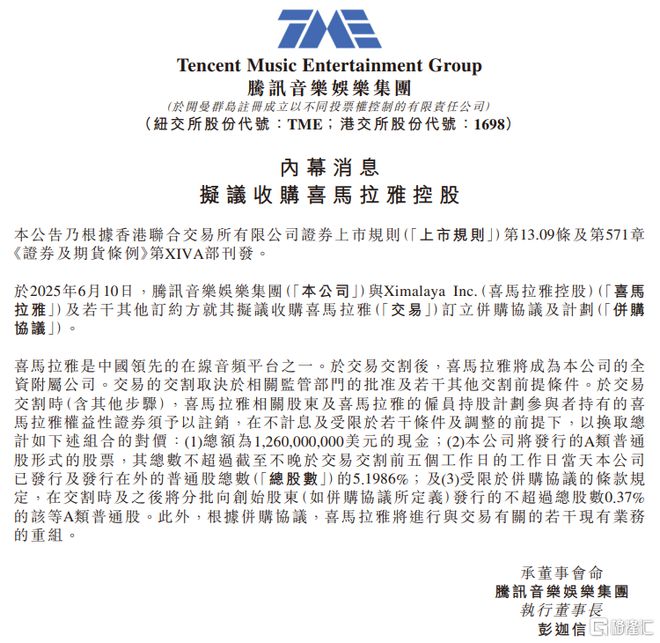
Core Viewpoint - Tencent Music has announced a plan to fully acquire China's largest online audio platform, Ximalaya, for a total cash consideration of $1.26 billion, alongside stock options, bringing the total deal value to approximately $2.86 billion, equivalent to about 20.5 billion RMB [2][4]. Group 1: Acquisition Details - The acquisition agreement includes a cash payment of $1.26 billion and the issuance of Tencent Music's Class A ordinary shares, amounting to a stake of approximately 5.5686% in Tencent Music for Ximalaya's shareholders [2][3]. - The total consideration for the transaction is approximately $2.86 billion, which translates to around 20.5 billion RMB [4]. - The deal is subject to regulatory approvals and other closing conditions [2]. Group 2: Strategic Implications - Tencent Music aims to strengthen its position in the audio economy by acquiring Ximalaya, which will help build a competitive moat against rivals like ByteDance [7]. - The acquisition allows Tencent Music to enhance its long audio content strategy, as it has been relatively weak in this area, while Ximalaya is the largest online audio platform in China with a rich content ecosystem [7][10]. - Ximalaya holds a 25% market share in China's online audio industry, significantly higher than its closest competitor at 13% [8]. Group 3: Financial Performance and Challenges - Ximalaya has faced challenges in its IPO attempts, with failed listings in both the US and Hong Kong, leading to a decline in its valuation from $4.3 billion in 2021 to under $3 billion in this deal [11][12]. - The company's revenue growth has stagnated, with revenues increasing from 5.857 billion RMB in 2021 to 6.163 billion RMB in 2023, reflecting a slowdown in growth rate from approximately 3.5% to 1.7% [11]. - Ximalaya's adjusted net profit improved to 224 million RMB in 2023 after losses in previous years, attributed to cost-cutting measures and operational efficiency [11]. Group 4: Market Dynamics - The online audio market is highly competitive, with platforms like NetEase Cloud Music and short video platforms posing significant challenges to Tencent Music [6][9]. - The user overlap between Ximalaya and Tencent Music is relatively low, which may provide opportunities for cross-promotion and user base expansion post-acquisition [11]. - The integration of Ximalaya into Tencent Music's ecosystem is expected to create synergies and enhance the overall content offering, potentially leading to a stronger competitive position against rivals [9][12].
4次上市未果,曾估值300亿,喜马拉雅“卖身”!
Ge Long Hui· 2025-06-11 07:25
Core Insights - The leading online audio platform, Ximalaya, has been acquired by Tencent Music Entertainment Group for a total consideration of approximately $1.29 billion, which includes $1.26 billion in cash and about 5.57% equity [1][2] Company Overview - Ximalaya was founded in 2012 and has become a well-known online audio platform over its 13 years of operation [4] - The company has attempted to go public four times but has not succeeded, with its valuation previously reaching as high as $30 billion [4][7] Financial Performance - Ximalaya has undergone 12 rounds of financing, raising nearly $15 billion, with a peak valuation of $4.3 billion in 2020 [6] - The company reported cumulative losses of approximately $4.8 billion from 2018 to 2022, with losses decreasing to $296 million in 2022 [8][9] - In 2023, Ximalaya achieved a net profit of $5.3 billion, primarily through cost-cutting measures, including a significant reduction in workforce by 39.26% [9] User Engagement and Revenue Growth - Revenue growth has slowed significantly, with revenue increasing from $8.4 billion in 2021 to $8.6 billion in 2023, reflecting a growth rate decline from 43.7% to just 1.7% [10] - Monthly active users grew from 267 million in 2021 to 302 million in 2023, with growth rates dropping from 8.7% to 3.9% [10] Strategic Implications - Tencent Music's recent financial performance, with Q1 2025 revenue of approximately $10.1 billion, supports the acquisition and potential synergies between the two companies [10][11] - The founders of Ximalaya emphasized the need for collaboration in response to industry changes, stating that the merger will enhance innovation and user experience while maintaining brand identity and strategic direction [12][13]
腾讯音乐并购喜马拉雅,重塑全场景“耳朵经济”
Di Yi Cai Jing· 2025-06-11 06:28
Core Viewpoint - The acquisition agreement between Ximalaya and Tencent Music Entertainment Group is a strategic move aimed at optimizing resource allocation in the long audio industry, transitioning from chaotic competition to orderly development [1][3][12] Group 1: Acquisition Details - Tencent Music will acquire Ximalaya for $1.26 billion in cash and up to 5.1986% of Tencent Music's Class A common stock, with Ximalaya's founders receiving up to 0.37% of Tencent Music's Class A common stock post-transaction [1] - The deal reflects a long-term value creation strategy, integrating Ximalaya's founding team into the new structure [1] Group 2: Industry Context - The long audio sector has seen intense competition, with platforms vying for talent, content rights, and subsidies, leading to a chaotic environment [3] - The merger is expected to address the overlapping user base between Tencent Music's Lazy Listening and Ximalaya, prompting both companies to explore differentiated development paths [3][12] Group 3: Financial Implications - Ximalaya has achieved profitability for nine consecutive quarters, with an adjusted net profit of 224 million yuan in 2023 and projected profits exceeding 500 million yuan in 2024 [6] - The acquisition is anticipated to positively impact Tencent Music's financial metrics, although it may incur integration-related costs in the short term [6] Group 4: Market Opportunities - The online audio market in China is projected to exceed 51 billion yuan by 2028, with a compound annual growth rate of 19.3% [8] - The merger is seen as a response to the evolving content industry, which is undergoing significant transformations, including fragmented attention spans and the rise of AI-driven content distribution [6][8] Group 5: Future Outlook - Ximalaya will maintain its brand, product independence, and core management team post-acquisition, ensuring stability for its creator ecosystem [9][11] - The collaboration is expected to enhance user experience by providing a one-stop platform for music, audiobooks, and podcasts, leveraging Tencent Music's technological capabilities [12]

腾讯音乐收购喜马拉雅VC/PE几家欢喜几家愁:索尼音乐亏近千万美元 Medai Star折价31.4%退出
Xin Lang Zheng Quan· 2025-06-11 05:44
Core Viewpoint - Tencent Music Entertainment Group announced the acquisition of 100% equity in the online audio "unicorn" Himalaya for a total consideration of approximately $28.57 billion, which reflects a significant decline from its previous valuations [1][3]. Group 1: Acquisition Details - The acquisition includes $1.26 billion in cash, issuance of A-class common stock not exceeding 5.5686% of total equity to Himalaya shareholders, and performance-based equity incentives of up to 0.37% for founding shareholders [1]. - The equity portion of the deal is valued at approximately $1.597 billion based on Tencent Music's current market capitalization [1]. Group 2: Financial Performance - From 2018 to 2022, Himalaya reported a cumulative adjusted net loss of 3.057 billion yuan, although it achieved a profit of 242 million yuan in 2023, primarily through significant layoffs [2]. - The average monthly active user growth rate has slowed considerably, with growth rates of 8.70% and 3.91% for 2022 and 2023, respectively, compared to double-digit growth from 2019 to 2021 [2]. Group 3: Investor Sentiment - Many venture capital and private equity investors have lost patience with Himalaya, as the acquisition price of $28.57 billion is roughly equivalent to its valuation during the E-2 round of financing in 2020 [3]. - Investors such as Sony Music and others who entered in later funding rounds are facing significant losses, with the largest loss reported by Medai Star International Limited at 31.4% [3]. Group 4: Strategic Implications for Tencent Music - The acquisition allows Tencent Music to fill gaps in its content ecosystem, particularly in long audio formats like audiobooks and podcasts, and to leverage synergies with Himalaya's user scenarios in automotive and smart hardware [4]. - Post-acquisition, Tencent Music will integrate its platforms, creating an audio ecosystem with over 500 million monthly active users across various formats [4].
200亿并购喜马拉雅,腾讯音乐再扩音频市场版图
Huan Qiu Lao Hu Cai Jing· 2025-06-11 03:43
Group 1 - Tencent Music Entertainment Group announced a merger agreement with Ximalaya, involving a total consideration of approximately $2.84 billion, which includes $1.26 billion in cash and equity [1] - Ximalaya, founded in 2012, is the largest online audio platform in China, with an average monthly active user base of approximately 303 million by the end of 2023 [1][2] - Ximalaya holds a 60.5% market share in mobile listening time and a 25% market share in online audio revenue as of 2023 [1][2] Group 2 - Ximalaya's revenue sources include subscriptions and advertising, with subscription revenue consistently accounting for over 50% of total revenue from 2021 to 2023 [2] - Ximalaya attempted to go public multiple times but ultimately chose to be acquired by Tencent Music [2] - Ximalaya's revenue figures from 2021 to 2023 were 5.857 billion, 6.061 billion, and 6.163 billion yuan, respectively, with adjusted net profits showing a turnaround from a loss of 721 million yuan in 2021 to a profit of 224 million yuan in 2023 [2] Group 3 - Tencent Music reported a total revenue of 7.36 billion yuan in Q1 of the current year, reflecting an 8.7% year-over-year growth, with an adjusted net profit of 2.23 billion yuan, up 22.8% year-over-year [3]
腾讯音乐收购喜马拉雅的“背面”
3 6 Ke· 2025-06-11 03:00
Group 1 - Tencent Music's acquisition of Ximalaya is valued at approximately $2.9 billion, consisting of $1.26 billion in cash and stock options [1] - Ximalaya holds a significant position in the online audio market, with a 60.5% market share in mobile listening time and 25% in online audio revenue in 2023 [2][3] - The acquisition is expected to enhance Tencent Music's market capitalization and user base, positioning it for a new phase of growth [3] Group 2 - Ximalaya's diverse content ecosystem complements Tencent Music's offerings, allowing for a more complete content strategy [4] - The integration of Ximalaya's content, including audiobooks and radio dramas, addresses the growing demand for varied audio content in the "ear economy" [5] - Tencent Music can leverage its resources to provide Ximalaya with new monetization opportunities, including advertising and AI-driven content production [6][7] Group 3 - The acquisition is seen as a "win-win" scenario, alleviating financial pressure on Ximalaya while providing Tencent Music with strategic advantages [9] - Tencent Music's capabilities in AI can enhance Ximalaya's content creation and distribution, driving innovation and efficiency [8][7] - The partnership is expected to help both companies navigate the challenges of a competitive market and find new growth avenues [9]
200亿,喜马拉雅卖了
投中网· 2025-06-11 02:36
Core Viewpoint - The acquisition of Ximalaya by Tencent Music for approximately $2.847 billion marks a significant shift in the online audio industry, reflecting the challenges faced by Ximalaya in achieving a successful IPO and the need for strategic partnerships in a rapidly evolving market [2][20][28]. Summary by Sections Acquisition Details - Tencent Music announced its plan to fully acquire Ximalaya for a total price of approximately $2.847 billion, which includes $1.26 billion in cash and up to 5.57% in stock [3][25]. - This acquisition price represents a significant discount compared to Ximalaya's previous valuation of $4.345 billion in 2020, equating to a 65.5% reduction [4][26]. Company Background - Founded in 2012, Ximalaya has grown to become the largest online audio platform in China, with over 300 million monthly active users and a vast content library [16][17]. - The company initially gained traction by focusing on content quality and building a diverse content ecosystem, which attracted significant investment from various venture capital firms [12][14]. Financial Performance - Ximalaya's revenue increased from 5.86 billion yuan in 2021 to 6.16 billion yuan in 2023, but the growth rate has slowed considerably [21]. - Despite achieving profitability in 2023 with a net profit of 224 million yuan, the company faced challenges due to intense competition from rivals like Tencent Music and ByteDance [23][27]. Strategic Implications - The acquisition is seen as a response to the ongoing changes in the industry and technology, with Ximalaya's founders emphasizing the importance of resource sharing and enhancing user experience [28]. - Post-acquisition, Ximalaya plans to maintain its brand, product independence, and core management team, indicating a strategy to leverage Tencent Music's resources while preserving its operational identity [29].

OpenAI推出o3-pro;腾讯音乐收购喜马拉雅丨新鲜早科技
2 1 Shi Ji Jing Ji Bao Dao· 2025-06-11 02:32
Group 1: Major Developments in Technology - OpenAI launched its strongest reasoning model, o3-pro, on June 11, which integrates all available tools from ChatGPT and is recommended for complex questions requiring high reliability [2] - Apple faced criticism for the design of iOS 26, which was described as unattractive by users, but the company clarified that it is still a testing version and improvements may come in the final release [6] Group 2: Mergers and Acquisitions - Tencent Music Entertainment Group announced a plan to acquire the leading online audio platform, Himalaya, for a total consideration of $1.26 billion, which includes cash and shares [3] Group 3: Automotive Industry Updates - Several major Chinese automotive companies, including FAW Group and Dongfeng Motor Group, committed to a unified payment term of no more than 60 days [4] Group 4: Financing and Investment - Anysphere Inc. completed a $900 million financing round, raising its valuation to $9.9 billion, driven by the popularity of its AI programming assistant, Cursor [11] - Beijing Zhiliang Technology Co., Ltd. secured several hundred million yuan in D+ round financing to accelerate the development of satellite and cellular communication chips [12] - Shenzhen Photon Leap Technology Co., Ltd. announced the completion of a $100 million angel round financing to enhance AI imaging algorithm development [10] Group 5: New Product Launches - Meituan launched its first AI coding agent product, NoCode, which integrates a self-developed model with a scale of hundreds of billions of parameters [13]
12.6亿美元,腾讯音乐要收购喜马拉雅了
母基金研究中心· 2025-06-11 01:46
Core Viewpoint - Tencent Music has announced a merger agreement with Ximalaya, which will make Ximalaya a wholly-owned subsidiary after the transaction closes [1][5]. Group 1: Transaction Details - The transaction involves the cancellation of equity securities held by Ximalaya's shareholders and employee stock plan participants in exchange for $1.26 billion in cash and Tencent Music shares [2][5]. - Tencent Music will issue Class A common stock not exceeding 5.1986% of the total shares outstanding as of five business days before the transaction closes, along with an additional issuance of up to 0.37% of total shares to founding shareholders post-transaction [5]. - The completion of the transaction is subject to regulatory approvals and other closing conditions [5]. Group 2: Market Reaction - Following the announcement, Tencent Music's stock surged over 11% in pre-market trading, and by the end of the trading day, it had increased by 2.43% in Hong Kong [4]. Group 3: Ximalaya's Future Plans - Ximalaya will undergo a restructuring of certain existing businesses related to the transaction, while maintaining its brand, product independence, core management team, and strategic direction [6]. - Ximalaya has committed to fulfilling all contracts with partners and ensuring customer rights are protected [6]. - The company aims to embrace AI to lead industry transformation [7]. Group 4: Tencent Music's Market Position - Tencent Music is the largest online music platform in China, holding approximately 70% market share, and has developed a comprehensive music entertainment ecosystem [8]. - In Q1, Tencent Music reported total revenue of 7.36 billion yuan, a year-on-year increase of 8.7%, with adjusted net profit rising by 22.8% to 2.23 billion yuan [8]. - Online music service revenue grew by 15.9% to 5.80 billion yuan, with the number of paying users increasing by 8.3% to 12.29 million [8].