
火箭制造

Search documents
研报 | 可回收技术有望降低火箭发射成本,全球大厂正加速推进布局
TrendForce集邦· 2025-12-22 09:01
Core Insights - The article discusses the increasing demand for satellite deployment by Starlink and the U.S. Space Force, leading to a shift in rocket manufacturers like SpaceX towards full rocket recovery technology [2][6] - The average launch cost for expendable rockets is between $110 million and $180 million, while partially reusable rockets cost around $6.7 million. Full recovery technology aims to reduce costs to between $2 million and $5 million [6][7] Group 1: Rocket Types and Costs - Expendable rockets have a complex structure and do not require recovery fuel, but their costs are significantly higher [3] - Partially reusable rockets, like SpaceX's Falcon 9, lower launch costs to approximately $6.7 million but still have limitations on payload capacity due to fuel reservation for recovery [3][7] - Fully reusable rockets, such as SpaceX's Starship, aim to drastically reduce costs to $2 million to $5 million, although they require additional investment in specialized recovery platforms [3][6] Group 2: Technological Developments - SpaceX is leading the commercial rocket launch sector in the U.S. and has made advancements in using liquid methane for its Starship's second stage to reduce cleaning times and overall launch costs [7] - The China National Space Administration (CNSA) is also actively developing its rocket launch plans, focusing on the Long March series to execute national-level missions while optimizing recovery efficiency [7] - Challenges remain in the recovery technology, such as the need for additional fuel in partially reusable rockets and the costs associated with building recovery platforms for fully reusable rockets [7]


国泰海通证券:跨年行情资金从再平衡转向再配置 看好AI应用/商业航天/海南自贸/内需消费
智通财经网· 2025-12-21 22:57
Core Viewpoint - The report from Guotai Junan Securities indicates a significant decline in average daily trading volume and turnover rate, with a shift in market focus towards domestic consumption and technology themes, while external factors like interest rate changes are stabilizing market risk appetite [1] Group 1: AI Applications - The domestic computing architecture capabilities have significantly improved, with product iterations accelerating, reinforcing the investment narrative in AI [2] - Notable advancements include the release of the "Huagang" GPU architecture by Moore Threads, which boasts a 50% increase in computing density and a tenfold improvement in energy efficiency [2] - Ant Group's AI health application "Antifufu" has reached 15 million monthly active users, leading the health management AI application sector [2] Group 2: Commercial Aerospace - The upcoming launch of the Long March 12A rocket and the completion of ground verification for the Tianlong 3 rocket highlight advancements in China's commercial aerospace sector [3] - The National Space Administration has issued a plan to support the high-quality and safe development of commercial aerospace from 2025 to 2027, focusing on new technologies and applications [3] - It is projected that China's satellite launch demand will increase more than tenfold by 2030 compared to 2024 [3] Group 3: Hainan Free Trade Zone - The official launch of the full island closure in Hainan has begun, with Siemens Energy establishing a significant foreign investment project [4] - On the first day of customs supervision, zero-tariff imports amounted to 360 million yuan, primarily for crude oil and aviation equipment [4] - The establishment of Siemens Energy (Hainan) Co., Ltd. marks a significant step in the development of Hainan's free trade port [4] Group 4: Domestic Consumption - The central government has initiated actions to boost consumption, including plans to increase income for urban and rural residents [5] - New consumption scenarios are emerging, such as sports events and ice tourism, with significant economic impacts observed in regions like Jiangsu and Liaoning [5] - The consumption scale for ice sports is expected to exceed 187.5 billion yuan in the 2024-2025 season, reflecting a 25% year-on-year growth [5]

SpaceX估值攀升,马斯克身家首超6000亿美元
Xin Lang Cai Jing· 2025-12-16 04:18
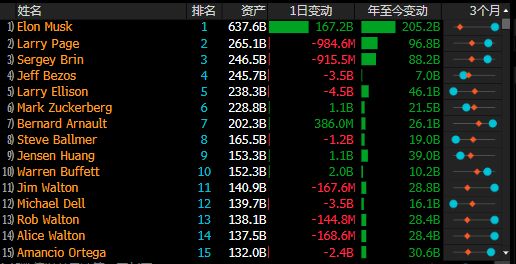
Core Insights - Elon Musk's net worth has reached approximately $637.6 billion, marking the first time the Bloomberg Billionaires Index has recorded an individual's wealth exceeding $600 billion [1] - SpaceX's valuation has recently reached about $800 billion, making it the highest-valued private company globally [2] Summary by Category Individual Wealth Rankings - Elon Musk: $637.6 billion, with a change of $167.2 billion over the past year and an increase of $205.2 billion overall [2] - Larry Page: $265.1 billion, with a decrease of $984.6 million [2] - Sergey Brin: $246.5 billion, with a decrease of $915.5 million [2] - Jeff Bezos: $245.7 billion, with a decrease of $3.5 billion [2] - Larry Ellison: $238.3 billion, with a decrease of $4.5 billion [2] - Mark Zuckerberg: $228.8 billion, with an increase of $1.18 billion [2] - Bernard Arnault: $202.3 billion, with an increase of $386 million [2] - Steve Ballmer: $165.5 billion, with a decrease of $1.2 billion [2] - Jensen Huang: $153.3 billion, with an increase of $1.18 billion [2] - Warren Buffett: $152.3 billion, with an increase of $2 billion [2] Company Valuation - SpaceX has achieved a valuation of approximately $800 billion, solidifying its position as the highest-valued private company in the world [2]
SpaceX启动IPO投行遴选,马斯克或成首位万亿美元富豪
Xin Lang Cai Jing· 2025-12-15 13:33
Core Insights - SpaceX is seeking to go public in the second half of next year with a target valuation of approximately $1.5 trillion, comparable to Saudi Aramco's record valuation of about $1.7 trillion in 2019 [1] - Elon Musk holds about 42% of SpaceX, positioning him to potentially become the world's first trillionaire [1] - SpaceX executives are in the process of selecting Wall Street bankers to provide advisory services for the IPO, marking a significant step towards the public offering [1] Financial Highlights - The latest internal stock price for SpaceX is set at $421 per share, reflecting a company valuation of $800 billion, which is double the valuation of approximately $400 billion earlier this year [1] - The funds raised from the IPO are intended for increasing the launch frequency of the Starship rocket, deploying AI data centers in space, and advancing both unmanned and manned missions to Mars [1]
浙商证券:卫星应用需求释放 火箭供给有望突破
智通财经网· 2025-12-15 07:05
Core Insights - The deployment of data centers in low Earth orbit (LEO) is emerging as a promising option for technology companies' future computing strategies, especially as China's low Earth orbit satellite constellation approaches a peak launch period [1][2]. Group 1: Satellite Internet and Space Computing - Satellite internet, which utilizes a network of satellites to provide global broadband access, is expected to enhance military communication networks and expand ground user service capabilities [1]. - Space computing is anticipated to address current data center challenges related to heat dissipation and power supply, with space-based data centers capable of utilizing high-intensity solar energy, achieving five times the efficiency of terrestrial systems [1]. Group 2: Launch Demand and Industry Growth - The construction progress of China's low Earth orbit constellations is lagging behind expectations, leading to a rapid increase in rocket launch demand, with projections indicating a rise from 54 launches in 2025 to 860 by 2030, reflecting a compound annual growth rate (CAGR) of 74% [2][3]. - The total number of satellites planned for launch in the next five years is approximately 16,000, with significant implications for the rocket launch industry [3]. Group 3: Rocket Cost and Capacity Expansion - The cost of rocket launch capacity is decreasing, with private rocket companies expected to achieve launch costs as low as 20,000 yuan/kg, nearing the cost of SpaceX's Falcon 9 [4]. - The industry is currently in a phase of capacity expansion, with both state-owned and private enterprises ramping up production capabilities, including new manufacturing facilities and increased launch frequencies [4]. Group 4: Industry Supply Chain and Key Players - The rocket industry is characterized by a supply-demand imbalance, with a focus on high-value and high-barrier companies. Key suppliers include Hangyang Co. (liquid oxygen fuel), Plater (3D printed parts), and Srey New Materials (copper alloys for engines) [5]. - Potential main manufacturers include Aerospace Power (listed platform for the Sixth Academy) and Aerospace Engineering (listed platform for the First Academy) [5].

商业航天深度报告(火箭篇):卫星应用需求释放,火箭供给有望突破
ZHESHANG SECURITIES· 2025-12-14 11:56
Investment Rating - The report rates the industry as "Positive" [1] Core Insights - The demand for satellite applications is expected to release, leading to a breakthrough in rocket supply [1] - The construction of low Earth orbit (LEO) satellite constellations is progressing slower than anticipated, resulting in a rapid increase in rocket launch demand [5][19] - The cost of rocket launch capacity is continuously decreasing, and the industry capacity is expanding [4][32] Summary by Sections 1. Low Earth Satellite Communication: Multi-Scenario Applications Leading Industry Growth - Satellite internet is a new type of network that provides broadband internet access globally through a certain number of satellites, enhancing military communication networks and expanding service coverage for ground users [5][10] - The construction of low Earth satellite constellations is facing "frequency occupation and orbit preservation" pressures, with significant demand in China [5][21] 2. Rocket Sector: Demand Explosion, Supply Breakthrough, Moving Towards High Frequency and Low-Cost Commercial Closure - The number of planned satellite launches in China is expected to reach approximately 16,000 over the next five years, leading to a rapid increase in rocket launch frequency from 54 times in 2025 to 860 times in 2030, with a CAGR of 74% [24][25] - By 2029, the demand for space computing in China is projected to correspond to 6,800 rocket launches, with a global total of 15,000 launches [27] - The national team is continuously expanding capacity, and private rocket companies are expected to see concentrated test launches by the end of this year [29][32] 3. Key Industry Chain Targets - The report highlights several key suppliers and potential main manufacturers in the rocket industry, including: - Hangyang Co., Ltd. as a liquid oxygen fuel supplier [38] - Plater Technology as a 3D printing parts supplier for rockets [38] - Aerospace Power as the only listed platform of the Sixth Academy of Aerospace Science and Technology [38]


杭州造火箭了!
Hang Zhou Ri Bao· 2025-12-11 02:40
Core Viewpoint - The article highlights the ambitious plans of Hangzhou Arrow Aerospace Technology Co., Ltd. to launch the first fully "Hangzhou-made" reusable rocket, "Qiantang Arrow," by the end of next year, aiming for a successful sea recovery operation, marking a significant milestone in China's commercial space industry [1][3]. Group 1: Rocket Development and Features - The "Qiantang Arrow" is designed to be 22 stories high and reusable up to 20 times, with a launch weight of 575 tons and a diameter of 4.2 meters [2][3]. - The company successfully completed China's first full-size stainless steel rocket sea recovery test in May, demonstrating the feasibility of their technology [2][3]. - The company aims to control launch costs at 20,000 yuan per kilogram, making commercial launches more competitive [3]. Group 2: Investment and Production Capacity - The total investment for the project is 5.2 billion yuan, with plans to achieve an annual production capacity of 25 rockets [3]. - The production base is strategically located in Hangzhou due to its proximity to the sea and existing industrial support [5]. Group 3: Market Opportunities and Future Vision - The target market extends beyond satellite launches to include point-to-point transportation, space tourism, space station construction, deep space exploration, and potential asteroid defense [4]. - The company is part of a broader movement to transition commercial space from state-led projects to market-driven operations, focusing on cost control and innovation [3][4]. Group 4: Local Industry Ecosystem - Hangzhou has developed a comprehensive aerospace industry network, with local companies providing essential components such as rocket fuel, precision manufacturing, and technological support [5]. - The favorable business environment in Hangzhou allows for rapid project initiation, enhancing the company's focus on technological innovation [5].

Elon Musk的SpaceX计划在2026年IPO,目标估值超1万亿美元
Sou Hu Cai Jing· 2025-12-11 01:34
有趣的是,SpaceX的估值立即使其接近其著名的电动汽车同行特斯拉股份有限公司(Tesla),该公司 在上市15年后,目前市值为1.39万亿美元。特斯拉2010年的首次公开募股对该公司的估值约为22亿美 元。SpaceX的首次公开募股将使这家火箭制造商跻身于万亿美元俱乐部,目前全球只有10家公司的估 值达到或超过万亿美元。 埃隆·马斯克(Elon Musk)的太空运输公司SpaceX计划在未来一年通过首次公开募股(IPO)筹集250亿 美元,此举将使其估值超过1万亿美元,使SpaceX成为世界上最有价值的公司之一,这在很大程度上要 归功于其星链(Starlink)卫星互联网业务的快速扩张以及推出直连移动服务的计划。 SpaceX目前正与银行就预计于2026年6月或7月进行的首次公开募股进行接洽。根据Crunchbase的数据, SpaceX是仅次于ChatGPT的全球第二大最有价值的私营初创公司。 自2002年成立以来,SpaceX的估值大幅飙升,当时这家初创公司的估值仅为2700万美元。然而,由于 Fidelity和Google的重大投资,该公司的估值到2015年跃升至约120亿美元。Starlink卫星星 ...
蓝箭航天披露朱雀三号火箭一级回收验证细节
Xin Hua She· 2025-12-06 08:47
Core Viewpoint - The successful launch of the Zhuque-3 reusable rocket by Blue Arrow Aerospace marks a significant milestone in China's aerospace industry, particularly in the development of first-stage recovery technology [1]. Group 1: Technical Achievements - The Zhuque-3 rocket completed its first-stage separation and conducted a vertical recovery flight verification, showcasing advanced recovery technology [1]. - The rocket successfully navigated the challenging "supersonic re-entry aerodynamic gliding phase," which requires high demands on structural thermal protection systems, aerodynamic layout design, and attitude control capabilities [1]. - Data collected during the flight will support future iterations and improvements of the rocket models [1]. Group 2: Precision Control - The rocket achieved high-precision guidance control for landing at the designated recovery site during both the re-entry ignition phase and the aerodynamic gliding phase [1]. - The verification included the composite control strategy of the cold gas reaction control system and grid fins, as well as the correctness of the corresponding guidance algorithms [1]. Group 3: Industry Implications - This test further solidifies China's engineering practice foundation in the liquid oxygen-methane reusable rocket technology route, exploring feasible paths for first-stage recovery [1].
文昌有座“火箭工厂”
Hai Nan Ri Bao· 2025-12-06 01:21
Core Insights - The article highlights the establishment of China's first reusable rocket factory by the company Xingji Hongyuan, aiming to transform rockets from one-time use to a reusable model, similar to commercial flights [1][2] Group 1: Factory Overview - The factory, located in Wenchang, Hainan, features a height of 22 meters and a total area of 5,700 square meters, capable of accommodating six rockets simultaneously [1] - The facility employs advanced "seamless flooring" technology for high strength and crack resistance, essential for handling heavy rocket components [1] - The factory is designed to withstand severe coastal weather, with robust structural elements that enhance its durability [1] Group 2: Production Capacity and Investment - The factory has an initial production capacity of 6 to 12 rockets per year, which is expected to increase to 36 rockets per year after the second phase of expansion [2] - The total investment in the factory is approximately 450 million yuan, with additional projects including a 106 million yuan offshore recovery platform and a 350 million yuan general-purpose power system testing base [2] Group 3: Future Developments - The first model of the dual-curve three rocket is scheduled to arrive at the factory in the first half of next year for assembly and testing [3] - The factory will also serve as a "public space platform" for global commercial aerospace companies, offering comprehensive services [3]