
绿色产业

Search documents
北京新能源汽车保有量超119万辆
Zhong Guo Xin Wen Wang· 2025-09-15 13:17
Group 1 - The number of new energy vehicles in Beijing has exceeded 1.19 million, nearly three times the amount at the end of the 13th Five-Year Plan [1] - Nearly half of the citizens replacing their vehicles are choosing to switch from gasoline cars to electric vehicles [1] - Beijing aims to become an international benchmark city for green economy, promoting a green transformation of its development model [1] Group 2 - The number of effective green technology invention patents in Beijing has reached 66,000, an increase of approximately 81% compared to 2020, ranking first in the country in both total and growth rate [1] - Beijing has achieved full coverage of clean production audits across primary, secondary, and tertiary industries, with 161 national-level green factories and 30 green supply chain management enterprises established [1] - The annual average growth rate of the added value of the new energy industry in the first three years of the 14th Five-Year Plan is 10.2% [1] Group 3 - The participation rate of Beijing residents in waste sorting remains stable at over 96%, with more than 98% of surveyed urban and rural residents sorting at least two types of waste, an increase of 25 percentage points since early 2020 [1]
寻路全球绿色经济新空间
Bei Jing Shang Bao· 2025-09-13 16:06
Group 1: Global Green Economy Development - The global green transition has entered a critical stage driven by innovation, focusing on sustainable development goals (SDGs) and global cooperation [1] - Future green bonds and SDGs bonds are expected to become important financial tools to achieve the UN's 2030 sustainable development agenda [1] - Emerging markets, particularly in Asia, Africa, and Latin America, are anticipated to become significant growth engines for China's green industry [1] Group 2: Carbon Market and Energy Transition - The expansion of the mandatory carbon market will create new growth points for enterprises by integrating various emission reduction costs and subjects into a unified management system [2] - The green low-carbon transition in the energy sector requires a multidisciplinary approach and tailored solutions for different projects and enterprises [2] - Artificial intelligence is emerging as a core engine driving the transformation of green energy and equipment manufacturing, enhancing efficiency and smart capabilities [2] Group 3: Zero Carbon Park Construction - The construction of zero carbon parks focuses on optimizing energy structure and improving energy efficiency through various steps, including energy supply and consumption accounting [3][4] - The core value of creating zero carbon parks lies in cost reduction and efficiency enhancement, which can improve economic benefits and brand image [4] - Zero carbon parks aim to foster green industries and create new economic growth drivers through technology development and industrial transformation [4]
以扩内需和产能治理带动价格修复
2 1 Shi Ji Jing Ji Bao Dao· 2025-09-11 00:09
Group 1: Price Data Overview - The August price data from the National Bureau of Statistics shows significant structural differentiation, with a slight year-on-year decline in CPI, but positive signals regarding economic transformation and structural optimization are evident [1][4] - CPI decreased by 0.4% year-on-year, primarily due to last year's high base and lower seasonal food prices, with food prices dropping by 4.3% year-on-year [1][2] - The decline in food prices reflects the strengthening of domestic agricultural supply capabilities, indicating support from the supply side rather than a contraction in demand [1] Group 2: Core CPI and Consumer Demand - The core CPI, excluding food and energy prices, rose by 0.9% year-on-year, marking the fourth consecutive month of growth, indicating a steady recovery in domestic consumption demand [2] - Service consumption, particularly in healthcare, education, and tourism, has shown significant price increases, contributing to the core CPI's rise [2] - Upgraded consumption remains robust, with notable price increases in gold and platinum jewelry, as well as household appliances, reflecting a growing pursuit of high-quality living among consumers [2] Group 3: Industrial Price Trends - Industrial prices are showing positive changes, with PPI stabilizing after eight months of decline, and the year-on-year decline narrowing by 0.7 percentage points [3] - The structural improvement in industrial prices indicates a marginal improvement in supply-demand relationships within certain industries, alongside ongoing optimization of industrial structure and growth of new drivers [3] - Key industry capacity governance measures are yielding results, leading to price increases in traditional raw material sectors like coal and steel, while new drivers are enhancing prices in high-tech and green industries [3] Group 4: Policy Implications and Future Outlook - Current price data reflects a significant structural characteristic of "supply optimization in traditional sectors and demand expansion in emerging sectors," highlighting the accelerated transition of China's economic drivers [4] - Macro policies need to remain precise and patient, ensuring stable supply and prices for essential goods while enhancing the internal driving force through improved consumption environments and high-quality supply [4] - Continued support for consumption and the construction of a unified national market are expected to promote steady recovery in consumer demand and stabilize low CPI levels, while industrial price recovery is anticipated to continue [4]
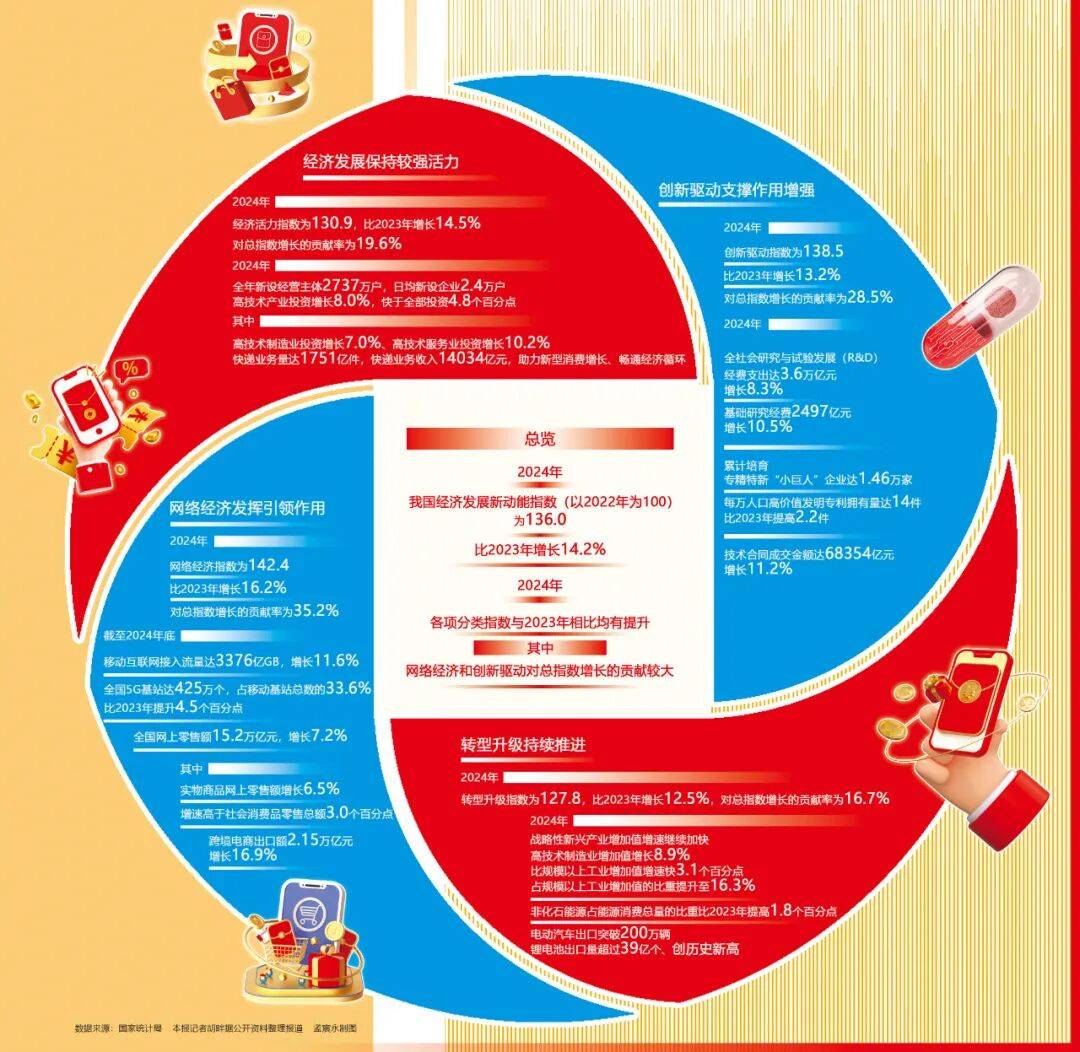
智库·数据丨创新与网络“双引擎”发力 2024年中国经济新动能指数大幅增长
Sou Hu Cai Jing· 2025-09-04 20:14
Core Insights - The economic development new momentum index for China in 2024 is projected to be 136.0, representing a 14.2% increase from 2023, indicating a significant shift towards high-quality development driven by innovation and the digital economy [1][4][10]. Group 1: Economic Resilience and Growth - In 2024, China's economy demonstrates strong resilience and vitality amidst complex internal and external environments, with the new momentum index reflecting a robust growth trajectory [4][10]. - The network economy index is particularly noteworthy, reaching 142.4 in 2024, a 16.2% increase from 2023, contributing 35.2% to the overall index growth [5][10]. Group 2: Digital Infrastructure and Consumption - By the end of 2024, the total number of 5G base stations in China is expected to reach 4.25 million, accounting for 33.6% of all mobile base stations, an increase of 4.5 percentage points from 2023 [6][10]. - The online retail sales in China are projected to reach 15.2 trillion yuan, with a growth rate of 7.2%, and the growth of physical goods online retail sales outpacing the total retail sales growth by 3.0 percentage points [6][10]. Group 3: Innovation and R&D Investment - The innovation-driven index is forecasted to be 138.5 in 2024, marking a 13.2% increase from 2023, contributing 28.5% to the overall index growth [6][10]. - Total R&D expenditure in China is expected to reach 3.6 trillion yuan in 2024, an 8.3% increase, with basic research funding growing at 10.5% [7][10]. Group 4: Economic Transformation and Quality Improvement - The economic vitality index and transformation upgrade index are projected to grow by 14.5% and 12.5% respectively in 2024, indicating a simultaneous increase in economic activity and quality [8][10]. - The proportion of non-fossil energy in total energy consumption is expected to rise by 1.8 percentage points, showcasing China's commitment to green transformation [8][10].

三大务实合作平台落户2025年上合组织峰会举办地天津
Xin Hua Wang· 2025-09-02 22:52
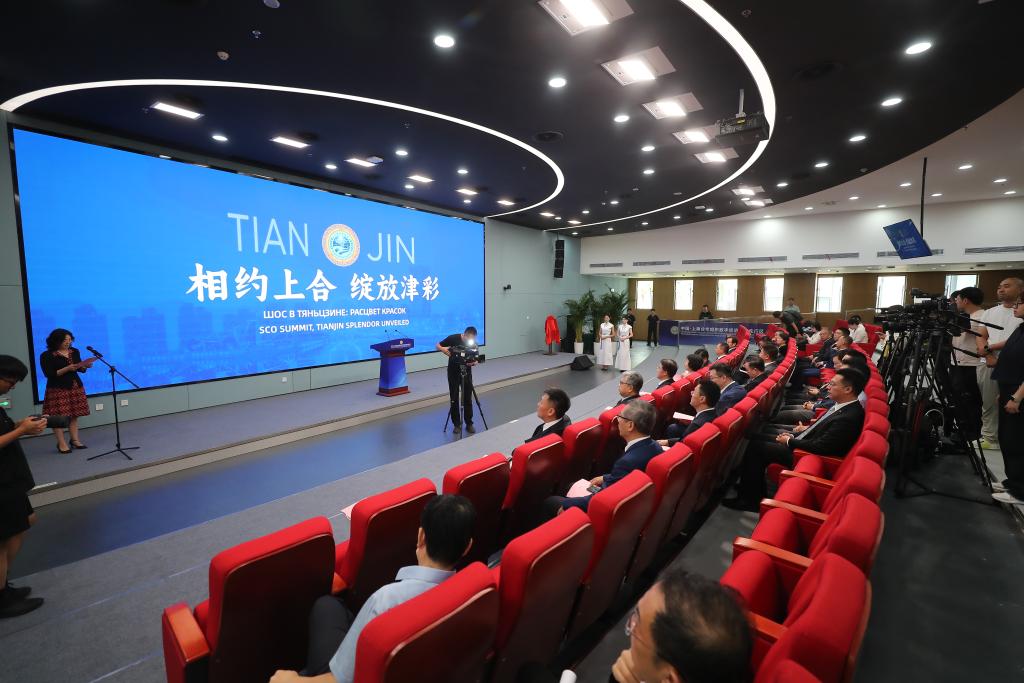
Core Points - Three practical cooperation platforms have been established in Tianjin, including the China-Shanghai Cooperation Organization (SCO) Green Industry Cooperation Platform, Digital Economy Cooperation Platform, and Vocational Technical Education Cooperation Center, marking a new chapter in international cooperation for the city [1][2] - The establishment of these platforms is part of the outcomes from the 2025 SCO Summit held in Tianjin, which resulted in eight major achievements, including the creation of six cooperation platforms [1][2] - The platforms aim to provide new opportunities for SCO member states and inject new momentum for regional sustainable development [1][2] Group 1: Green Industry Cooperation Platform - The Green Industry Cooperation Platform will promote policy exchange, project cooperation, and resource sharing among SCO countries, contributing to global green and low-carbon transformation [3] - It will be supported by the Tianjin Ziya Economic and Technological Development Zone, establishing a green industry development cooperation area [3] Group 2: Digital Economy Cooperation Platform - The Digital Economy Cooperation Platform will enhance supply-demand matching and deepen ecological cooperation among SCO countries, focusing on digital infrastructure and talent connectivity [3] - It aims to implement a series of landmark projects and "small but beautiful" livelihood projects to strengthen multi-dimensional cooperation among cities, enterprises, and think tanks [3] Group 3: Vocational Technical Education Cooperation Center - The Vocational Technical Education Cooperation Center will be based at Tianjin Vocational Technical Normal University, focusing on international cooperation in vocational education and training [4] - Key tasks include promoting industry-education integration, conducting international training, and enhancing the capabilities of vocational education teachers [4] Group 4: Strategic Importance of Tianjin - Tianjin's geographical position as a key node in the Belt and Road Initiative and its commitment to green and digital economic development highlight its strategic importance for international cooperation [2] - The establishment of these platforms reflects the central government's trust in Tianjin's capabilities and its recognition of the city's strengths in these areas [2]
上合组织天津峰会丨三大务实合作平台落户2025年上合组织峰会举办地天津
Xin Hua Wang· 2025-09-02 14:22
Core Points - Three practical cooperation platforms have been established in Tianjin, including the China-Shanghai Cooperation Organization (SCO) Green Industry Cooperation Platform, Digital Economy Cooperation Platform, and Vocational Technical Education Cooperation Center, marking a new chapter in international cooperation for the city [1][3][6] - The establishment of these platforms is part of the outcomes from the 2025 SCO Summit held in Tianjin, which resulted in eight major achievements, including the creation of six practical cooperation platforms [1][3] - The platforms aim to provide new opportunities for SCO member states and inject new momentum into regional sustainable development [1][3] Group 1: Cooperation Platforms - The Green Industry Cooperation Platform will promote policy exchange, project cooperation, and resource sharing among SCO countries, contributing to ecological civilization and global green transformation [6] - The Digital Economy Cooperation Platform will enhance supply-demand matching, deepen ecological cooperation, and attract diverse participants from SCO countries to strengthen digital infrastructure and talent connectivity [6] - The Vocational Technical Education Cooperation Center will focus on international cooperation in vocational education, integrating industry and education, and enhancing the capabilities of vocational education teachers [7] Group 2: Strategic Importance of Tianjin - Tianjin is positioned as a key hub for China's opening-up strategy, serving as a significant point for the Belt and Road Initiative and the New Eurasian Land Bridge Economic Corridor [3] - The city has made significant progress in green low-carbon development and has been approved as a national digital economy innovation development pilot zone, with a platform economy scale reaching 600 billion yuan [3][6] - The establishment of these platforms in Tianjin reflects the central government's trust and recognition of the city's strengths in these areas [3][6]
以提升产业发展质量维护产业安全(专题深思)
Ren Min Ri Bao· 2025-08-28 22:38
Core Viewpoint - Industrial security is emphasized as a core component of economic security, with a focus on enhancing resilience, technological self-reliance, and high-level openness to improve industrial development quality [1] Group 1: Industrial Scale Expansion - Steady expansion of industrial scale is crucial for industrial security, serving as a stabilizing factor during the transition from middle-income to high-income status [2] - China's manufacturing sector has maintained the largest global scale for 15 consecutive years, showcasing unique advantages in scale and system [2] - Achievements in various sectors, such as high-speed trains and advanced manufacturing, are linked to these scale and system advantages [2] Group 2: Industrial Quality Upgrade - Promoting quality upgrades in industries is essential to avoid low-level repetitive investments that can harm industrial security [3] - Digital transformation is highlighted as a key area, with Shenzhen's manufacturing value added projected to account for about one-third of its GDP in 2024 [3] - The focus on green low-carbon development and advanced industrial clusters is aimed at enhancing industrial safety and creating new growth sectors [3] Group 3: Enhancing Industrial Resilience - Strengthening industrial resilience is necessary for building a modern industrial system and ensuring industrial security [4] - Despite improvements, there are still vulnerabilities in the industrial chain that need to be addressed through technological advancements and diversified supply systems [4] - Monitoring and early warning systems for various risks are essential for enhancing governance resilience [4] Group 4: Expanding High-Level Openness - Expanding high-level openness is vital for improving industrial development quality in the context of deepening economic globalization [5] - China's foreign investment and global capacity layout have accelerated, particularly in relation to the Belt and Road Initiative [5] - Active engagement with international high-standard trade rules and international industrial cooperation is necessary for building a new type of collaborative framework [5]
绿色价格认证研究中心联合北京ESG研究院开展绿色发展案例征集活动
Zheng Quan Ri Bao Wang· 2025-08-19 06:29
Group 1 - The core initiative is the establishment of the Green Price Certification Research Center to support national ecological civilization and green low-carbon development [1] - A nationwide case collection activity is launched to gather valuable experiences from enterprises in green development, aiming to enhance the mechanism for social contribution and value accounting [1][2] - The deadline for the green development case collection is set for September 19, 2025 [1] Group 2 - Eligible applicants for the case collection include registered enterprises, institutions, universities, and social organizations in China, with no serious violations of green development or ESG standards in the past three years [2] - The cases submitted must have been implemented within the last three years, sustained for at least one year, and demonstrated significant social contributions and green development outcomes [2] - The evaluation criteria for the green development cases include systemic, innovative, effective, demonstrative, replicable, sustainable, and normative dimensions [2]
广州生态经济发展成效明显
Zhong Guo Fa Zhan Wang· 2025-08-05 09:05
Core Viewpoint - The "Guangzhou Economic Development Report (2025)" highlights the integration of ecological environment protection and economic development in Guangzhou, showcasing significant advancements in ecological economy through urban-rural integration and environmental improvements [1][2]. Group 1: Ecological Environment Protection and Economic Development - The ecological environment protection and industrial economic development are mutually reinforcing, with examples such as Baiyun Lake, which has transformed into a comprehensive park and national water scenic area, promoting green, low-carbon, and high-tech industries in the surrounding areas [1]. - Haizhu Wetland, recognized as the "World's Best Natural Protection Area," serves as an innovative demonstration base for green development, contributing to a fourfold increase in the surrounding area's GDP due to its ecological value [1]. Group 2: New Economic Models from Quality Ecological Products - The Zengcheng Forest Sea Tourism Resort has successfully rehabilitated abandoned mining sites, attracting over 600,000 visitors annually and generating economic benefits exceeding 200 million yuan through various leisure activities [2]. - The Malin Village in Huadu District focuses on "ecology," "economy," and "life," developing a rural ecological tourism area that integrates agriculture, cultural tourism, science education, training, and accommodation, leading to steady income growth for the village collective and residents [2]. Group 3: Transformation of Ecological Resources into Capital Assets - Dayuan Village in Baiyun District has innovated a "land reserve + asset package" model, enhancing local ecological services while upgrading residential, industrial, and ecological quality, saving over 100 million yuan in ecological restoration costs [2]. - The Jingxia area in Huangpu District has achieved nearly tenfold growth in collective assets and economic income over three years through a comprehensive land remediation approach that combines rural revitalization, scientific innovation, and ecological tourism [2].
风雨50年,中欧关系如何“穿越迷雾”?
2 1 Shi Ji Jing Ji Bao Dao· 2025-07-29 15:09
Core Points - The article emphasizes the importance of cooperation between China and Europe in new growth areas such as artificial intelligence, digitalization, and climate change, despite existing competitive relationships in traditional sectors [1] - The economic relationship between China and the EU has significantly evolved over the past 50 years, with bilateral trade reaching over $930 billion, including $785.8 billion in goods and $144.8 billion in services [2] - The article highlights the resilience of China-EU economic relations, which have adapted to various global challenges, including the financial crisis and the COVID-19 pandemic [2][3] Trade and Investment - By 2024, China and the EU are expected to be each other's second-largest trading partners, with a total trade volume exceeding $930 billion [2] - In the first quarter of this year, trade between China and the EU reached 1.3 trillion yuan, indicating a trade flow of over 10 million yuan per minute [2] - The EU is a significant source of foreign investment in China, with cumulative investments exceeding $150 billion, while Chinese investments in the EU are close to $110 billion, resulting in a total investment stock of $260 billion [2] Economic Challenges and Cooperation - The article discusses the increasing trade friction between China and the EU, driven by changes in the international economic environment and structural differences in competitiveness [3] - The EU's acknowledgment of its lag in advanced technologies like artificial intelligence compared to the US and China is noted as a factor contributing to current trade tensions [3] - The article suggests that maintaining an open mindset on both sides is crucial for addressing these challenges and enhancing bilateral economic ties [3] Climate Cooperation - The joint statement on climate change issued after the recent China-EU summit underscores the significance of green partnerships in their relationship [4] - The article points out that climate change discussions reflect a broader cooperation potential between China and Europe, especially in renewable energy technologies [5] - A memorandum for green technology cooperation was signed, committing to invest 15 billion euros over three years in areas like hydrogen and carbon capture [5] Future Outlook - The article concludes with a call for strengthening mutual trust and emphasizing a win-win cooperation model, despite rising tensions in trade and technology [7] - It highlights the importance of people-to-people exchanges and understanding as foundational to stabilizing China-EU relations [8] - The ongoing dynamics between the US and Europe are also mentioned as a factor that could influence China-EU relations, but the article suggests that structural complementarities still exist [9]