航空制造

Search documents
赶在7月9日前,泰国再做让步,寻求尽快与美达成协议
Hua Er Jie Jian Wen· 2025-07-07 04:48
Core Points - Thailand is making concessions to the U.S. by offering greater market access for agricultural and industrial products, and committing to increase purchases of U.S. energy and Boeing aircraft to reach a trade agreement before the July 9 deadline to avoid a 36% tariff threat from the Trump administration [1][2] - The latest proposal aims to reduce Thailand's trade surplus with the U.S. by 70% over five years, significantly accelerating the timeline compared to a previous ten-year plan [1][3] - Neighboring countries like Vietnam and Cambodia have already reached agreements with the U.S., increasing pressure on Thailand to secure favorable trade terms [1][3] Group 1: Trade Concessions - Thailand's new proposal includes commitments to provide greater market access for U.S. agricultural and industrial products, and to increase imports of U.S. energy and Boeing aircraft [2][4] - The proposal allows for the immediate cancellation of most import tariffs or non-tariff barriers, with gradual easing of restrictions on a few products [2] Group 2: Economic Context - The urgency for Thailand to finalize a trade agreement stems from economic pressures, including high household debt and weak domestic consumption, which could be exacerbated by high tariffs [6] - A favorable trade agreement is seen as crucial for protecting Thailand's trade-dependent economy from further downturns and alleviating investor concerns over political instability [6]
南方崛起|巴西:展翅向未来
Xin Hua Wang· 2025-07-06 07:21
Group 1: Brazil's Agricultural Transformation - Brazil has transitioned from a country facing hunger to becoming a major agricultural producer, with significant advancements in agricultural technology and practices [3][4]. - The establishment of the Brazilian Agricultural Research Corporation in 1973 marked a pivotal moment in agricultural modernization, leading to the development of solutions that have been applied to over 40 million hectares, saving farmers approximately $25 billion annually [4]. - From 2000 to 2020, Brazil's agricultural output grew at an average annual rate of about 8%, with crop yields doubling and livestock production increasing by over two times [5]. Group 2: Industrial Development and Aviation Sector - Brazil's aviation industry, represented by Embraer, has become a significant player in the global market, being the third-largest commercial aircraft manufacturer after Boeing and Airbus [6][8]. - The establishment of the Brazilian Aviation Technology Institute in 1950 laid the foundation for systematic talent development in the aviation sector, leading to the creation of over 9,000 aircraft by Embraer [7]. - The Brazilian aviation industry has faced challenges but has successfully adapted through strategic partnerships and market repositioning, enhancing its competitiveness [8]. Group 3: Renewable Energy and Environmental Initiatives - Brazil has made significant strides in renewable energy, with hydropower contributing about 10% of the country's electricity from the Itaipu Dam, one of the largest hydropower plants in the world [9][10]. - The country aims to balance agricultural and industrial growth with ecological preservation, with nearly 50% of its energy matrix coming from renewable sources [10][11]. - Recent policies have focused on sustainable development, including the "green stamp" initiative to promote environmentally friendly products and services [12]. Group 4: Social Development and Poverty Alleviation - Brazil's "Zero Hunger" and "Family Allowance" programs have significantly improved living conditions and reduced poverty, with approximately 20 million people lifted out of poverty between 2003 and 2011 [13][15]. - The transformation of cities like Guaribas exemplifies the positive impact of government initiatives on infrastructure and social services [14][15]. - Brazil's commitment to addressing hunger and poverty is reflected in its leadership role in the G20 and the establishment of a global alliance to combat these issues [15][16].
马来西亚航空集团(MAG)从空中客车采购20架空客A330 Neo飞机。
news flash· 2025-07-04 23:31
Group 1 - Malaysia Airlines Group (MAG) has placed an order for 20 Airbus A330 Neo aircraft [1]

美国恢复对华发动机出口,波音飞机也已重启交付中国航司
第一财经· 2025-07-04 06:18
Core Viewpoint - The article discusses the resumption of exports of critical aircraft components, including engines, from the U.S. to China, following a pause in June. This development is part of broader U.S.-China trade negotiations and reflects a commitment to implement agreements reached during high-level talks between the two nations [1][4]. Group 1: U.S.-China Trade Relations - The U.S. has agreed to allow companies like GE Aviation to resume exports of aircraft engines and other key components to China [1]. - Following the U.S.-China economic talks, both sides are working to implement the agreements made during the discussions, including the lifting of certain export restrictions [1][4]. Group 2: Aircraft and Engine Supply - The C919 aircraft, which relies on the LEAP-1C engine produced by a joint venture between GE and Safran, requires U.S. export licenses for its components [4]. - Despite the temporary suspension of exports, the delivery of C919 aircraft was not significantly impacted due to existing engine inventories [4]. - The Longjiang-1000A engine, which is China's first domestically developed engine with full intellectual property rights, is set to be the sole power source for the C919, currently undergoing test flights [5]. Group 3: Boeing Aircraft Deliveries - Boeing has resumed deliveries of aircraft to Chinese airlines, including the Boeing 737 MAX, which had previously been halted due to trade tensions [2][8]. - The first of these resumed deliveries included a 737 MAX that had been waiting in Zhoushan for delivery to Xiamen Airlines [7]. - Boeing's deliveries to China are crucial, as the country represents its largest overseas market, with significant numbers of new aircraft delivered in previous years [8].


美国恢复对华发动机出口,波音飞机也已重启交付中国航司
Di Yi Cai Jing· 2025-07-04 04:17
Group 1 - The export of American aircraft engines and components to China has resumed after a previous suspension, confirming the restoration of supply from companies like GE Aviation [2] - The C919 aircraft's delivery was not significantly impacted by the suspension of engine exports in June due to existing inventory held by COMAC [1][4] - The LEAP-1C engine, produced by a joint venture between GE Aviation and Safran, is the only overseas powerplant for the C919, highlighting the reliance on foreign technology in China's aviation sector [4] Group 2 - Boeing has resumed the delivery of aircraft to Chinese airlines, including the Boeing 737 MAX and 787, which had been temporarily halted due to trade tensions [3][6] - The exemption of tariffs on aircraft and certain engine components allows Chinese airlines to import planes at previous tax rates, which are 5% for narrow-body and 1% for wide-body aircraft [7] - In 2018, Boeing delivered a quarter of its new aircraft to China, indicating the significance of the Chinese market for Boeing's business [7] Group 3 - The Changjiang-1000A engine, China's first fully independent turbofan engine, is currently undergoing flight testing and awaits certification for commercial use [5] - The Chinese government has emphasized the need for self-sufficiency in aviation engine development, as highlighted in the "13th Five-Year" national strategic emerging industries development plan [4]

特朗普称美越达成贸易协议 美国对越南商品征关税至少20%
Hua Er Jie Jian Wen· 2025-07-02 18:54
Group 1 - The U.S. has reached a trade agreement with Vietnam, which includes a 20% tariff on all goods exported to the U.S. from Vietnam, higher than the current 10% baseline tariff but lower than the previously planned 46% "reciprocal tariff" [1][2] - Vietnam will also face a 40% tariff on goods that are transshipped through Vietnam to the U.S. from other countries [1] - The agreement allows Vietnam to open its market to U.S. products with zero tariffs, particularly benefiting U.S. SUVs and large engine vehicles [1] Group 2 - Following the announcement of the trade agreement, stocks of major apparel and footwear brands that source products from Vietnam saw significant gains, indicating reduced uncertainty in the apparel industry [2][4] - The S&P 500 index reached a new intraday high, reflecting positive market sentiment following the trade news [6] - Vietnam is set to purchase $8 billion worth of Boeing aircraft as part of the trade agreement, contributing to a rise in Boeing's stock price [9]
波音高层再“换血”,安全危机持续发酵
Xin Jing Bao· 2025-07-02 01:19
Core Viewpoint - Boeing is undergoing significant leadership changes, with the appointment of a new CFO amidst ongoing safety crises and operational challenges [1][2][3] Group 1: Leadership Changes - Boeing announced that Brian West will transition to a senior advisor role, while Jesus "Jay" Malave has been appointed as the new CFO, effective August 15 [1][2] - Malave has extensive experience in the aerospace sector, having previously served as CFO at Lockheed Martin and held senior roles at L3Harris Technologies and United Technologies [2] - The leadership changes come in the context of ongoing safety issues, including a recent accident involving the Boeing 787-8 aircraft [2][3] Group 2: Safety and Operational Challenges - Boeing has faced multiple safety incidents involving the 737-800 model, with at least six reported accidents in 2024 alone, although most did not result in casualties [5] - The company has been under scrutiny following a series of high-profile incidents, including the grounding of aircraft and production limitations imposed by the FAA [2][3] - Boeing's new safety and quality initiatives aim to restore its reputation and ensure the production of high-quality, safe commercial aircraft [4][5] Group 3: Financial and Strategic Outlook - The company has entered a cost-saving mode, implementing measures such as hiring freezes and suspending non-essential expenditures to preserve cash [3] - Boeing's leadership is focused on a recovery plan, with 2025 identified as a critical year for business revival following six consecutive years of losses [5][6] - The recent changes in leadership and operational strategies reflect Boeing's commitment to addressing its ongoing challenges and improving its financial health [1][3][5]
靖江以“绿”润笔描绘长江美画卷
Xin Hua Ri Bao· 2025-07-01 23:46
Group 1: Ecological Restoration and Biodiversity - The discovery of endangered species like the Yellow-breasted Bunting and Black-faced Spoonbill indicates the ecological health of the region, with these species relying on unpolluted aquatic life [1] - The restoration of 2.7 kilometers of the Yangtze River shoreline and the achievement of 100% Class III water quality at 10 monitoring points reflect significant improvements in water quality [3] - A total of 1,325 species of wild plants and animals have been monitored in the region, with the number of bird species on Ma Zhou Island increasing from 55 in 2021 to 223 [5] Group 2: Urban and Industrial Transformation - The transformation of the "industrial rust belt" into a scenic riverside area involved the removal of 12 enterprises and the reclamation of 7.1 kilometers of riverfront [2] - The city is focusing on high-tech industries such as aviation manufacturing and advanced equipment, aiming to enhance economic growth while maintaining environmental sustainability [2] - The establishment of various eco-friendly projects, including a circular economy industrial park and wastewater treatment centers, demonstrates a commitment to sustainable urban development [2] Group 3: Environmental Protection Initiatives - Ongoing soil pollution investigations and the implementation of a color-coded management system for new projects aim to ensure environmental safety and land restoration [3] - The city is actively engaged in pollution control efforts, including a comprehensive air quality monitoring system and enhanced dust control measures [3] - The promotion of ecological phosphorus reduction projects and river ecological restoration initiatives are part of the strategy to improve water quality in tributaries [3]
进出口银行广东省分行牵头8亿元天合租赁低空经济一号银团贷款签约成功
Zhong Guo Neng Yuan Wang· 2025-07-01 04:02
Core Viewpoint - The signing of the "Tianhe Leasing Low Altitude Economy No. 1 Syndicated Loan" marks a significant step in supporting the development of low-altitude economy in Guangdong Province, with a focus on expanding the fleet and market for general aviation leasing [1][2] Group 1: Company Overview - Tianhe Leasing, established in 2015 in the Guangdong Free Trade Zone, is the first leasing company in the region focused primarily on aircraft leasing [1] - The company has built a global business platform with partnerships with major airlines across various locations including Guangzhou, Tianjin, Fujian, Hong Kong, Ireland, and the Cayman Islands [1] Group 2: Financial Details - The syndicated loan amounts to 800 million yuan, specifically allocated for the import of six new H175 general aviation helicopters from Airbus Helicopters [1] - This financing is part of the broader strategy to enhance the fleet size and develop new market-oriented leasing services in the general aviation sector [1] Group 3: Industry Context - The low-altitude economy is identified as a new engine for high-quality economic development in Guangdong Province, as outlined in the "Guangdong Province Promoting High-Quality Development Action Plan for Low Altitude Economy (2024-2026)" [1][2] - The Export-Import Bank of China’s Guangdong branch has been actively supporting foreign trade and low-altitude economic development through tailored financing solutions and the establishment of a specialized aviation financing service team [2]
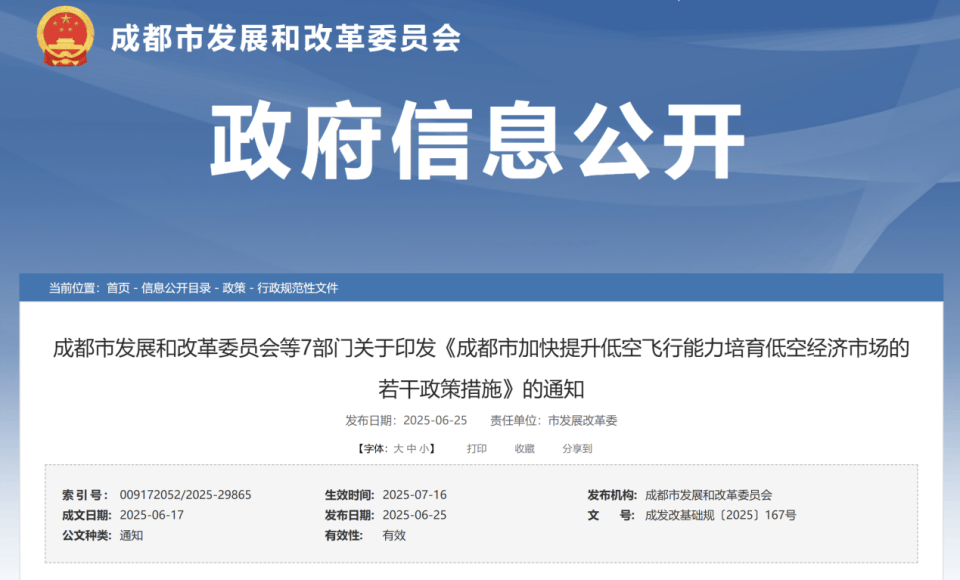
年度补贴高达3000万,“低空之城”争夺战打响
Sou Hu Cai Jing· 2025-07-01 02:12
Group 1: Policy Measures - Chengdu's "14 Measures for Low Altitude Economy" includes 14 policies focusing on infrastructure, service regulation, application scenarios, and industry support, with subsidies reaching up to 5 million yuan for various projects [1][2] - The policy introduces a "dual subsidy" for low-altitude passenger routes, providing up to 500,000 yuan for companies and ticket price subsidies for passengers based on distance [2][5] - Chengdu's commitment to infrastructure includes a 10% subsidy on actual construction investments for low-altitude facilities, with a maximum of 500,000 yuan per project [3][5] Group 2: Industry Development - Chengdu has established a complete low-altitude economy industry system with over 500 companies and 25 innovation platforms, supported by more than 60 universities and research institutions [2][6] - The city offers the highest rewards in the country for airworthiness certification, with subsidies of up to 3 million yuan per year for companies obtaining necessary certifications [5][6] - The low-altitude economy is expected to enhance logistics capabilities in Sichuan, addressing geographical challenges and contributing to the Chengdu-Chongqing economic circle [6][12] Group 3: National Trends - Nationwide, 42 eVTOL manufacturers have emerged, and 225 policies related to low-altitude economy have been implemented across various regions [7][9] - Shenzhen has positioned itself as a leader in low-altitude economy with legislative support and plans for extensive infrastructure development [9][10] - Hefei has established the first urban air traffic hub in the country, supporting eVTOL operations and logistics routes with significant subsidies [10][11] Group 4: Economic Impact - The development of low-altitude economy is expected to inject new momentum into urban economic growth, creating job opportunities and enhancing economic benefits [12][14] - Infrastructure development for low-altitude economy will not only meet industry needs but also promote sustainable urban development [14][15] - The integration of production, public services, and future transportation scenarios in low-altitude economy is seen as a strategic advantage for China in the global economic landscape [15]