
制造业

Search documents
中国工业利润三年跌势扭转,今年稳增长行动思路明确
第一财经· 2026-01-28 06:01
Core Viewpoint - In 2025, China's industrial profits showed a positive growth of 0.6%, reversing a three-year decline, with significant contributions from equipment manufacturing and high-tech industries, indicating an improvement in the industrial economic structure and quality [3][5][10]. Industrial Profit Improvement - The total profit of industrial enterprises above designated size reached 73,982 billion yuan in 2025, marking a 0.6% increase year-on-year, with a notable recovery in December where profits grew by 5.3% compared to November's decline of 13.1% [3][5]. - The profit growth trend was characterized by a "low first, high later" pattern, with significant policy effects from growth stabilization measures and "anti-involution" policies contributing to improved inventory and capacity utilization [5][10]. Cost and Expense Analysis - In 2025, the cost per 100 yuan of revenue for industrial enterprises was 85.31 yuan, an increase of 0.16 yuan year-on-year, while expenses decreased to 8.62 yuan, down 0.02 yuan [6]. - The average accounts receivable collection period decreased to 67.9 days by the end of December 2025, reflecting improved cash flow due to government actions to clear debts [6][10]. Profit Structure Improvement - In 2025, profits from small and medium-sized enterprises, as well as foreign-invested enterprises, turned positive, growing by 1.4% and 4.2% respectively, while state-owned and joint-stock enterprises also saw significant profit improvements [8]. - The manufacturing sector's profits increased by 5.0%, with equipment manufacturing and high-tech manufacturing being the main drivers, contributing 2.8 percentage points to overall profit growth [8][9]. High-Tech Manufacturing Growth - High-tech manufacturing profits rose by 13.3%, significantly outpacing the overall industrial profit growth, with smart electronic products and semiconductor-related industries showing remarkable profit increases [9]. - Specific sectors such as smart unmanned aerial vehicles and semiconductor manufacturing saw profits grow by 102.0% and 172.6% respectively, highlighting the rapid development in these areas [9]. Outlook for 2026 - Industrial profits are expected to continue their recovery in 2026, supported by stable domestic consumption, gradual investment recovery, and improved export quality [10]. - The "anti-involution" policies are anticipated to alleviate cost pressures and enhance profit margins, while ongoing industrial modernization efforts will further improve the operating environment for industrial enterprises [10][12].


首次突破14万亿元!江苏省2025年经济数据公布
Xin Lang Cai Jing· 2026-01-28 04:17
Economic Overview - The overall economic operation in Jiangsu Province is stable with progress, achieving a GDP of 142,351.5 billion yuan in 2025, a year-on-year growth of 5.3% [1] - The primary industry value added is 5,369.7 billion yuan, growing by 3.5%; the secondary industry value added is 60,038.2 billion yuan, increasing by 4.7%; and the tertiary industry value added is 76,943.7 billion yuan, rising by 5.8% [1] Agriculture - The total output value of agriculture, forestry, animal husbandry, and fishery is 9,526.1 billion yuan, with a year-on-year growth of 4.0% [1] - Grain planting area is 82,303,000 acres, with a total grain output of 763.05 billion jin, an increase of 1.03 billion jin [1] Industrial Production - The industrial added value above designated size increased by 6.5%, with the manufacturing sector growing by 6.7% and equipment manufacturing increasing by 8.8% [2] - The profit of industrial enterprises above designated size increased by 8.8% from January to November [2] Service Sector - The tertiary industry added value grew by 5.8%, with significant contributions from wholesale and retail, transportation, and information technology services [2] - The revenue of the service industry above designated size increased by 8.3% from January to November [2] Consumer Market - The total retail sales of social consumer goods reached 46,394.2 billion yuan, growing by 3.3% [3] - Sales of green and smart products showed strong growth, with new energy vehicles increasing by 21.2% [3] Fixed Asset Investment - Fixed asset investment decreased by 12.7%, with the first industry investment increasing by 1.7% while the second and third industries saw declines [4] - Equipment purchase investment grew by 9.1%, accounting for 21.0% of total investment [4] Price Trends - The consumer price index decreased by 0.2%, with food prices dropping by 1.1% [5] - The industrial producer price index fell by 2.6%, consistent with the previous year [5] Income and Employment - Per capita disposable income reached 57,971 yuan, a growth of 4.6% [6] - The urban survey unemployment rate averaged 4.6%, slightly up from the previous year [6] Emerging Industries - High-tech industries accounted for 52.1% of industrial output, with a growth rate of 11.9% [7] - Online retail sales reached 1,373.91 billion yuan, growing by 7.8% [7] Conclusion - The economic performance in Jiangsu Province demonstrates resilience and vitality, with ongoing challenges and the need for strategic adjustments to ensure sustainable growth [8]
温彬:工业企业利润有望从阶段性修复向温和增长过渡
Di Yi Cai Jing· 2026-01-28 04:02
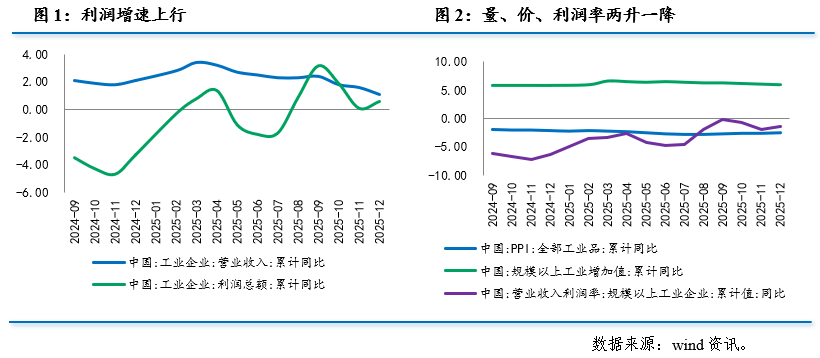
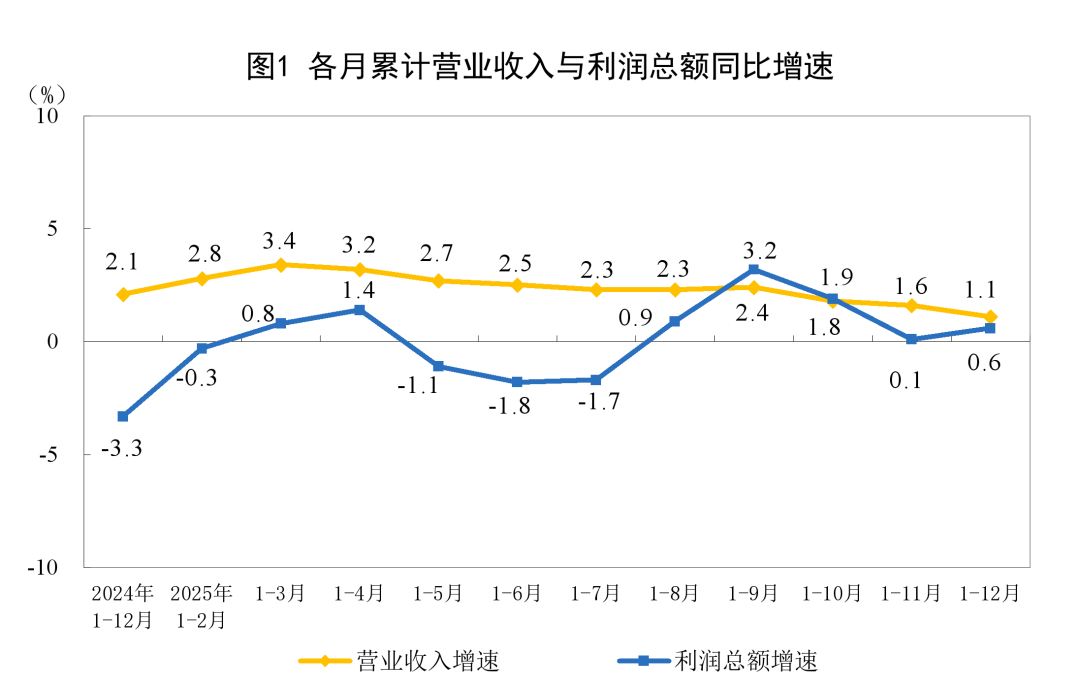
Core Insights - The overall profit growth of industrial enterprises in 2025 showed significant fluctuations but maintained a long-term positive trend, with a steady recovery in the profit foundation of enterprises [3][15]. Group 1: Profit Growth Overview - In 2025, the total profit of industrial enterprises above designated size reached 73,982 billion yuan, a year-on-year increase of 0.6%, with December showing a 5.3% increase year-on-year [1][15]. - The profit growth rate for December 2025 rebounded sharply from -13.1% in the previous month to 5.3%, an increase of 18.4 percentage points [2]. - For the entire year, the profit growth rate exhibited a "low first, high later, and fluctuating" trend, improving from -3.3% in 2024 [3]. Group 2: Sector Performance - In the mining sector, profits decreased by 26.2% year-on-year, but the decline narrowed by 1 percentage point compared to the previous month, indicating a continuous improvement over five months [6]. - The manufacturing sector saw a profit increase of 5% year-on-year, remaining stable compared to the previous month, with upstream raw material manufacturing profits growing by 10.6% [6][7]. - The equipment manufacturing sector contributed significantly to overall industrial profit growth, with a profit increase of 7.7%, driving a 2.8 percentage point increase in total profits for industrial enterprises [7]. Group 3: Inventory and Receivables - By the end of December, the nominal growth rate of finished goods inventory for industrial enterprises fell by 0.7 percentage points to 3.9%, indicating a reduction in inventory pressure due to improved sales [12]. - The average collection period for accounts receivable for industrial enterprises was 67.9 days, a decrease of 2.5 days from the previous value, reflecting improved cash flow management [14]. Group 4: Future Outlook - For 2026, industrial profits are expected to continue their recovery trend, supported by stable domestic consumption growth, gradual stabilization of investment, and improved export quality [18]. - The "anti-involution" policy is anticipated to ease cost pressures on enterprises, further supporting profit improvements [18].
2025年1—12月份仪器仪表制造业利润同比增长3.1%
Guo Jia Tong Ji Ju· 2026-01-28 03:46
Core Insights - In 2025, the total profit of industrial enterprises above designated size in China reached 73,982 billion yuan, a year-on-year increase of 0.6% [1] - The manufacturing sector saw a profit increase of 5.0%, while the mining sector experienced a significant decline of 26.2% [4] - The equipment manufacturing industry played a crucial role in supporting industrial upgrades, with profits rising by 7.7% [4] Summary by Category Overall Industrial Performance - The total revenue of industrial enterprises above designated size was 139.20 trillion yuan, up 1.1% from the previous year [2] - Operating costs increased by 1.3% to 118.75 trillion yuan, resulting in a profit margin of 5.31%, a slight decrease of 0.03 percentage points [2] - By the end of 2025, total assets reached 188.41 trillion yuan, a 4.3% increase, while total liabilities grew by 4.2% to 108.58 trillion yuan [2] Sector-Specific Performance - The profits of the black metal smelting and rolling industry surged by 300%, while the non-metallic mineral products industry saw a decline of 1.7% [2] - High-tech manufacturing profits increased by 13.3%, significantly outpacing the overall industrial growth [5] - The profits of the equipment manufacturing sector accounted for 39.8% of total industrial profits, marking a 2.6 percentage point increase from the previous year [4] Emerging Trends - The smart electronics sector drove a 48.0% profit increase in smart consumer device manufacturing, with specific industries like smart drones and vehicle devices seeing profits rise by 102.0% and 88.8%, respectively [5] - Traditional industries are also showing improvement, with sectors like biochemical pesticides and cultural information chemicals achieving profit growth above the industry average [6] - Small and medium-sized enterprises, as well as foreign-invested enterprises, reported profit growth of 1.4% and 4.2%, respectively, reversing previous declines [6]
V型反弹!12月工业企业利润增速大幅回升
Jin Rong Shi Bao· 2026-01-28 03:12
Core Insights - Overall, industrial enterprise profits are expected to show a "low first, high later, and fluctuating" trend in 2025, with a significant recovery in the medium to long term [2] - In 2026, industrial profits are anticipated to continue their recovery, transitioning from a phase of repair to moderate growth [2] Group 1: Profit Growth by Sector - Profit growth in 2025 is characterized by "two increases and one stable" among three major sectors: manufacturing is expected to grow by 5.0%, a significant rebound of 8.9 percentage points from 2024; the electricity, heat, gas, and water production and supply sector is projected to grow by 9.4%; while the mining sector is expected to decline by 26.2% [3] - Price improvements have offset the marginal decline in profit margins, allowing manufacturing profits to maintain positive growth [3] - The equipment manufacturing and high-tech manufacturing sectors are crucial for high-quality industrial development, with profits in the former expected to grow by 7.7% and in the latter by 13.3%, both exceeding the overall industrial profit growth of 12.7% [3] Group 2: Sector-Specific Profit Increases - The railway, shipbuilding, aerospace, and electronics industries are projected to see double-digit profit growth, with increases of 31.2% and 19.5% respectively; the smart electronics sector is expected to grow by 48.0% [4] - The semiconductor industry is experiencing rapid growth, with profits in integrated circuit manufacturing, semiconductor device manufacturing, electronic components, and sensors increasing by 172.6%, 128.0%, 49.1%, and 33.3% respectively [4] - In the healthcare sector, profits from genetic engineering drugs and vaccines, as well as biopharmaceuticals, are expected to rise by 72.7% and 37.1% respectively [4] Group 3: December Profit Recovery - In December 2025, profits for large-scale industrial enterprises rebounded by 5.3%, recovering from a 13.1% decline in November, indicating a "V-shaped rebound" [5] - This rebound is attributed to the combined effects of volume, price, and profit margin improvements, driven by effective growth policies and a recovery in both domestic and external demand [5] - December's industrial added value increased from 4.8% to 5.2% year-on-year, while the Producer Price Index (PPI) decline narrowed from 2.2% to 1.9%, contributing to improved revenue and profit margins [5] Group 4: Inventory and Receivables Management - By the end of December, industrial enterprise inventory growth slowed to 3.9%, and the average accounts receivable collection period decreased to 67.9 days, reflecting a proactive inventory reduction strategy amid weak demand [6] - Companies are adjusting production rhythms and focusing on order-based production to manage inventory effectively [6] Group 5: Future Outlook - Experts predict that as growth stabilization policies continue to take effect and overall demand gradually recovers, industrial enterprise profits are likely to maintain a recovery trend, supported by reduced cost pressures and optimized inventory structures [7]
2025年我国规模以上工业企业利润增长0.6%
Jin Rong Shi Bao· 2026-01-28 02:31
Core Viewpoint - In 2025, the total profit of industrial enterprises above designated size in China reached 73,982 billion RMB, marking a 0.6% increase from the previous year, reversing a three-year decline trend [1] Group 1: Profit Trends - The profit growth of industrial enterprises showed a "front low and back high, fluctuating" trend throughout 2025, with significant recovery in December, where profits increased by 5.3% year-on-year [1][4] - The manufacturing sector's profit grew by 5.0%, a substantial rebound of 8.9 percentage points compared to 2024, while the electricity, heat, gas, and water production and supply sector saw a profit increase of 9.4%. Conversely, the mining sector experienced a decline of 26.2% [2] Group 2: Sector Performance - The equipment manufacturing and high-tech manufacturing sectors provided solid support for high-quality industrial development, with profits in the equipment manufacturing sector rising by 7.7% and high-tech manufacturing profits increasing by 13.3%, significantly outpacing the overall industrial profit growth [3] - Notable profit growth was observed in specific industries, such as railways (31.2%), shipbuilding (19.5%), and smart electronic products (48.0%). The semiconductor industry saw exceptional growth, with profits in integrated circuit manufacturing increasing by 172.6% [3] Group 3: Price and Cost Dynamics - Profit growth in December 2025 rebounded from a 13.1% decline in November to a 5.3% increase, driven by improvements in pricing and profitability [4] - The Producer Price Index (PPI) decline narrowed from 2.2% to 1.9%, indicating a recovery in the industrial product price environment, which supported revenue levels [4] Group 4: Inventory and Receivables - By the end of December 2025, the nominal growth rate of finished goods inventory fell to 3.9%, and the average accounts receivable collection period was 67.9 days, reflecting a proactive inventory reduction strategy amid weak demand [5] Group 5: Outlook for 2026 - Experts anticipate that the profit recovery trend for industrial enterprises will continue into 2026, supported by ongoing growth policies and gradual demand recovery [6]
行稳致远开新局丨连续领跑37年,“再造一个新广东”底气何在?
Yang Guang Wang· 2026-01-28 01:56
Core Viewpoint - Guangdong is leveraging its strengths in innovation and infrastructure to drive economic growth and development, particularly in the context of the "14th Five-Year Plan" and the upcoming "15th Five-Year Plan" [2][28]. Economic Development - Guangdong's GDP has crossed significant milestones, reaching 14 trillion yuan by 2025, maintaining its position as the top economy in China for 37 consecutive years [6][14]. - The province's trade volume reached 9.49 trillion yuan in 2025, marking a 4.4% year-on-year increase, contributing 24.1% to the national foreign trade growth [21]. Innovation and Technology - Guangdong has established over 10 major national scientific research infrastructures, ranking third in the country, to enhance original innovation capabilities [13]. - R&D expenditure in Guangdong increased from 380 billion yuan in 2021 to 535 billion yuan by 2025, with the province leading in various innovation metrics for nine consecutive years [14]. Low-altitude Economy - The low-altitude economy in Guangdong is rapidly developing, with over 15,000 related enterprises and a market share of 95% for consumer drones [9]. - The province is working towards creating a comprehensive low-altitude economic network, facilitating applications in logistics and tourism [7][9]. Regional Integration - The construction of major infrastructure like the Hong Kong-Zhuhai-Macao Bridge has significantly improved connectivity within the Guangdong-Hong Kong-Macao Greater Bay Area, creating a "one-hour living circle" [15][17]. - Guangdong is enhancing regulatory alignment and cooperation with Hong Kong and Macao, facilitating smoother cross-border operations and business activities [17][21]. Agricultural Modernization - The "Hundred Counties, Thousand Towns, and Ten Thousand Villages" initiative is being implemented to promote high-quality agricultural development, with local specialties like the Jin You fruit significantly boosting farmers' incomes [22][23]. - Technological advancements in agriculture are attracting younger generations back to rural areas, transforming traditional farming practices [22][24]. Future Outlook - Guangdong aims for an average GDP growth of around 5% annually over the next five years, focusing on high-quality development and improved regional coordination [28]. - The province is positioned to capitalize on the "dual-zone" effect, enhancing its role in global supply chains through deeper cooperation with Hong Kong and Macao in various sectors [27][28].

“无知与轻率将让日本陷入孤立境地”(国际视点)
Ren Min Ri Bao· 2026-01-28 01:29
Group 1 - The Japanese government, under Prime Minister Kishi, is facing significant domestic and international backlash due to its recent militarization rhetoric and comments regarding Taiwan, which are perceived as provocative and irresponsible [2][3]. - Recent polls indicate a decline in public support for Kishi's cabinet, with approval ratings dropping by 10% to 57%, while disapproval ratings increased by 7% to 29% [2]. - The increase in defense spending and militarization efforts are causing concerns among various sectors, including education and healthcare, as these budgets are being squeezed [4]. Group 2 - The tourism sector is experiencing a downturn, with a reported 45% decrease in Chinese visitors to Japan by December 2025, leading to significant impacts on retail sales, particularly in department stores and markets [4]. - The manufacturing industry is also facing challenges, with experts expressing concerns over the long-term negative effects of Kishi's statements on Japan-China relations, which could lead to economic isolation [4]. - The overall sentiment among analysts and commentators is that Japan's current approach towards China is detrimental, potentially leading to economic and diplomatic stagnation [4].
【省统计局】2025年陕西重点领域投资亮点纷呈
Shan Xi Ri Bao· 2026-01-28 01:04
Core Insights - In 2025, Shaanxi province is set to accelerate investment in key areas, focusing on effective investment expansion and optimizing fixed asset investment structure, with industrial investment expected to grow by 9.4% year-on-year, significantly outpacing overall investment growth by 12.2 percentage points [1] Group 1: Investment Growth - Industrial investment in Shaanxi is projected to increase by 9.4%, contributing 3.1 percentage points to overall investment growth [1] - Mining industry investment is expected to grow by 3.6%, contributing 0.3 percentage points to total investment [1] - Manufacturing investment is anticipated to rise by 13.3%, contributing 2.3 percentage points to total investment [1] - Investment in electricity, heat, gas, and water production and supply is forecasted to grow by 6.2%, contributing 0.5 percentage points to total investment [1] - Industrial technological transformation investment is expected to maintain a robust growth rate of 6.1% year-on-year [1] Group 2: Private Investment - Private investment in Shaanxi is projected to grow by 4.6%, contributing 1.8 percentage points to total investment [1] - Industrial private investment is expected to increase by 11.3%, contributing 4.3 percentage points to total private investment [1] - Manufacturing private investment is anticipated to grow by 10.3%, contributing 2.8 percentage points to total private investment [1] - Infrastructure private investment is forecasted to rise by 5.5%, contributing 0.3 percentage points to total private investment [1] Group 3: Equipment and High-tech Investment - Equipment and tool purchase investment is expected to grow by 16.4%, exceeding overall investment growth by 19.2 percentage points, contributing 1.8 percentage points to total investment [2] - High-tech industry investment is projected to grow by 4.4%, surpassing overall investment growth by 7.2 percentage points [2] - High-tech manufacturing investment is expected to increase by 18.1%, exceeding overall investment growth by 20.9 percentage points, with electronic and communication equipment manufacturing investment growing by 40.3% [2] Group 4: Livelihood Investment - Investment in wholesale and retail is projected to grow by 58.9% [2] - Investment in the agricultural and food processing industry is expected to increase by 26.5% [2] - Investment in accommodation and catering is anticipated to rise by 20.9% [2] - Forestry investment is expected to grow by 17.4% [2] - Investment in electricity and heat production and supply is projected to increase by 5.7% [2] - Investment in the education sector is expected to grow by 4.7% [2]
透过6大关键词,看山东未来五年发展
Da Zhong Ri Bao· 2026-01-28 01:04
High-Quality Development - The draft outline prioritizes the construction of a modern industrial system and the consolidation of the real economy, emphasizing intelligent, green, and integrated development [1] - It highlights the importance of technological innovation in building a strong province, aiming to enhance comprehensive innovation capabilities and create a leading innovation ecosystem [1] - The plan outlines strategies to expand domestic demand, improve consumption quality, and promote effective investment [1] Comprehensive Deepening of Reform and Opening Up - The draft emphasizes economic system reform as a driving force, proposing reforms in key areas such as market unification, resource allocation, and the business environment to ensure sustainable high-quality development [2] - It focuses on institutional openness, implementing strategies for free trade zones and enhancing international trade [2] Infrastructure Construction - The draft outlines plans for a modern infrastructure system that is interconnected, intelligent, green, resilient, and efficient over the next five years [3] - It includes high-level construction of transportation networks and new energy systems, aiming for comprehensive connectivity and clean energy development [3] Common Prosperity - The draft proposes a comprehensive population service system covering all demographics and life stages, aiming to improve education, health, and social welfare [4] - It emphasizes enhancing employment quality, increasing income levels, and promoting rural modernization to support common prosperity [4] Coordinating Development and Security - The draft stresses the need for risk prevention and management, integrating safety into all aspects of economic and social development [5] - It outlines measures to strengthen national security, public health, and emergency management systems to support high-quality development [5] Major Engineering Projects - The draft highlights the importance of major engineering projects as a core support for high-quality development, with a focus on key indicators and technological innovation [6] - It emphasizes the selection of projects that have significant national or provincial impact and can drive technological breakthroughs and economic efficiency [6]