
私募

Search documents
罕见反超!9月证券类私募登记超股权类,量化成关键入场券
Feng Huang Wang· 2025-10-11 12:28
Core Insights - The private equity industry has significantly contracted in scale, with the number of registered private equity institutions dropping from over 1,000 in the same period of 2022 to just over 100 in the first three quarters of this year, indicating a shift away from the expansion phase [1] - In September, the number of newly registered securities private equity institutions (10) surpassed that of equity private equity institutions (4), breaking the trend of the previous eight months where equity private equity led [2][3] - The new registrations of securities private equity are characterized by a quantitative background, suggesting a growing interest in the secondary market among institutions [1][5] Industry Trends - The overall number of private equity registrations has stabilized after a sharp decline, with 111 registrations in the same period of 2024 compared to 381 in 2023 and 1,020 in 2022, indicating a transition to a phase of strict control and quality improvement [4] - The new private equity registrations this year exhibit three main characteristics: core teams with quantitative investment experience, members with public fund backgrounds, and well-known private equity executives starting their own firms [1][5] Quantitative Strategies - Despite a decrease in the proportion of quantitative products registered in September, stock strategy products still accounted for over 70% of the total, indicating a continued focus on equity markets [1][7] - In September, 652 private equity firms registered a total of 1,028 products, with quantitative products making up 35.41% of the new registrations, reflecting a temporary adjustment in risk appetite rather than a strategic shift [7][9] Notable Registrations - Among the 652 private equity firms registered in September, 47 were billion-yuan firms, and over half (345) were small firms with assets between 0-5 billion yuan [9] - The firm "Liwei" registered the most products in September, with 23, while other billion-yuan firms also contributed significantly to the new registrations [9][10]

私募掘金之路兴起!中欧瑞博、盛麒资产、持赢、观理等如何看?
Sou Hu Cai Jing· 2025-10-11 08:47
Core Viewpoint - The international gold price has significantly increased during the National Day and Mid-Autumn Festival holiday, reaching a historical high of over $4000 per ounce, with a cumulative increase of 4.72% during the holiday period [1][3]. Group 1: Market Performance - On October 8, the London spot gold price broke through $4000 per ounce, with a peak price of $4049.64 per ounce, while COMEX gold reached a maximum of $4081 per ounce, marking a new historical high [1]. - Year-to-date, international gold prices have risen by 52.94%, making it one of the best-performing asset classes this year [3][14]. Group 2: Investment Insights from Private Equity Managers - Various private equity managers, including Zhongou Ruibo, Guoyuan Xinda, and Hainan Sirui, have successfully captured the gold market trend through in-depth fundamental research, achieving impressive performance [1]. - Long-term views from private equity firms suggest that the current gold market is not a short-term trend but possesses long-cycle attributes, indicating substantial room for further growth [2][9][11]. Group 3: Economic and Geopolitical Factors - Factors driving the gold price increase include geopolitical tensions, central banks' increased gold holdings, distrust in the dollar's status as a reserve currency, and a global trend of interest rate cuts [14][19]. - The ongoing geopolitical conflicts and economic uncertainties are expected to further enhance gold's appeal as a safe-haven asset [10][15]. Group 4: Future Outlook - Private equity managers maintain a bullish long-term outlook on gold, with expectations of continued price increases, particularly in light of potential economic downturns and ongoing geopolitical tensions [7][19]. - The consensus among various fund managers is that the current gold price surge is likely to persist, with some predicting that the peak may occur in the coming months [10][11].
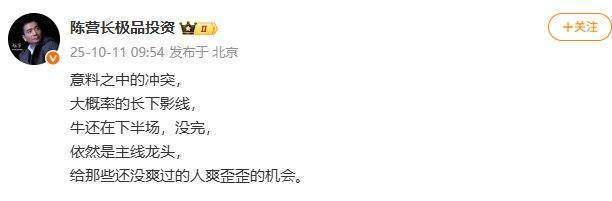
知名网红私募神农投资陈宇:大概率的长下影线,牛还在下半场,没完!依然是主线龙头,给那些还没爽过的人爽歪歪的机会
Sou Hu Cai Jing· 2025-10-11 04:02
Group 1 - The core viewpoint is that the bull market is entering its second half, characterized by high volatility and potential opportunities for those who have not yet capitalized on the market [1][3] - The market is expected to experience a significant downward shadow line, indicating that the main leading stocks will continue to be the focus for investors [1] - The phase ahead is seen as a good time for price differences among leading stocks, as the easy gains from the previous phase are no longer available [3] Group 2 - Opportunities in the innovative drug sector are beginning to spread to the healthcare sector, suggesting a shift in investment focus [3] - The low-hanging fruit in innovative drugs has already been picked, and future opportunities may lie in smaller companies rather than well-known stories [3] - Investors are advised to avoid widely discussed stocks that have been heavily promoted on platforms like Snowball [3]
但斌迎来“新身份”!李蓓、林园均买入“小登资产”?三季度私募人气榜出炉!
私募排排网· 2025-10-11 03:23
Core Viewpoint - The A-share market showed strong performance in Q3 2025, with the ChiNext Index leading with a 50.4% increase, followed by the Shenzhen Component Index at 29.25% and the Shanghai Composite Index at 12.73% [1][2]. Group 1: Popular Private Fund Managers - The top five popular private fund managers in Q3 2025 are Dan Bin, Lin Yuan, Li Bei, Wu Yuefeng, and Zhu Xiaokang, with half of the top 20 being managers of funds over 10 billion [1][3]. - Dan Bin's funds have shown significant performance, with 75 products averaging ***% returns this year, and he has increased his focus on overseas investments, particularly in AI-related stocks [5][6]. - Lin Yuan, ranked second, has shifted to invest in a batch of Sci-Tech Innovation Board stocks, despite previously stating he would avoid tech stocks, indicating a strategic pivot [7][8]. - Li Bei, ranked third, manages products that have also performed well, with a focus on macro hedging strategies [8]. Group 2: Popular Private Fund Companies - The top private fund companies in Q3 2025 include Longqi Technology, Japan Investment, and Ningbo Huafang Quantitative, with a significant number of quantitative funds [9][10]. - Ningbo Huafang Quantitative has been recognized for its strong performance, with 11 products averaging ***% returns this year [13]. - Guoyuan Xinda, ranked 11th, has also performed well with its composite strategy products entering the top 20 for popularity [13]. Group 3: Popular Private Fund Products - The most popular private fund products are dominated by quantitative long products, with the top five managed by various fund managers, including Zou Kai from Hunan Zijin Private Fund and Shi Jianghui from Guoyuan Xinda [14][15]. - Hunan Zijin Private Fund's product has shown exceptional performance, leading the rankings for returns this year [15][17].

10.11犀牛财经早报:私募9月份备案数量同比增超170% 今年券商发债规模同比增逾七成
Xi Niu Cai Jing· 2025-10-11 01:36
Group 1 - In September, the number of private equity securities funds registered increased by 171.24% year-on-year, despite a 10.22% decrease from August [1] - In the first three quarters, 25 bank wealth management subsidiaries conducted over 2,100 investigations into A-share listed companies, with more than 50% focusing on the Sci-Tech Innovation Board and the Growth Enterprise Market [1] - Securities firms accelerated their financing, with bond issuance reaching 1.26 trillion yuan, a year-on-year increase of 75.42% [1] Group 2 - Insurance capital institutions conducted a total of 14,128 investigations into A-share companies in the first three quarters, with a focus on electronic components and medical devices [2] - Qualcomm is under investigation for failing to legally declare its acquisition of Autotalks, potentially violating antitrust laws [2] - A new DNA search engine named MetaGraph has been developed, enhancing the ability to search vast biological databases [2] Group 3 - Beijing Universal Studios reported that a ride was temporarily halted due to safety protocols being triggered [3] - Zhongxin Jingyuan has initiated IPO counseling for its public stock offering on the Beijing Stock Exchange [3] Group 4 - Dahan Technology's controlling shareholder's 130 million shares were auctioned, resulting in a change of control for the company [4][5] - Inno Private Equity was warned by regulators for failing to conduct independent investment decisions and risk assessments [6] Group 5 - Bull Group's actual controller plans to reduce holdings by 36.17 million shares, valued at over 1.6 billion yuan [7] - Tao Li Bread's actual controller plans to transfer up to 2% of shares to a family member for asset planning [8] - Aipu Co., Ltd. announced the transfer of 29 million shares by its actual controller, with a total transaction value of 261 million yuan [9] Group 6 - Bohai Bank plans to publicly transfer debt assets worth approximately 499.37 billion yuan [9] - Dayu Biological announced a capital increase of 50 million yuan for its subsidiary to support new business growth [10] Group 7 - U.S. stock indices collectively fell, with the Dow down 1.9%, Nasdaq down 3.56%, and S&P 500 down 2.71%, marking significant declines influenced by trade tensions [11][12] - The semiconductor index dropped over 6%, with major companies like AMD and Qualcomm experiencing substantial losses [12] - Safe-haven assets such as U.S. Treasuries and gold saw increases, while oil prices hit a five-month low [12]
9月私募备案同比激增171%
Guo Ji Jin Rong Bao· 2025-10-10 13:36
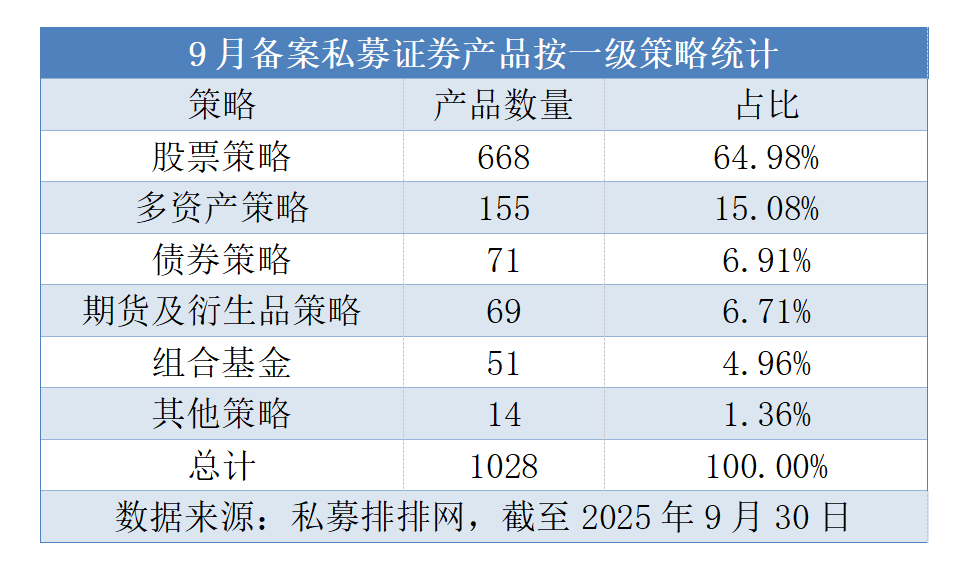
Core Insights - In September, a total of 1,028 private securities products were registered, representing a 10.22% decrease from August's 1,145 products, but a significant year-on-year increase of 171.24% compared to 379 products in the same month of 2024 [1] Strategy Distribution - Among the registered products, equity strategies dominated with 668 products, accounting for 64.98% of the total. Multi-asset strategies followed with 155 products (15.08%), while bond strategies (71 products, 6.91%) and futures and derivatives strategies (69 products, 6.71%) were nearly equal in scale. Combination funds were relatively niche with 51 products (4.96%) [1][2] Quantitative Products Performance - Quantitative products showed strong performance in September, with 364 products registered, making up 35.41% of the total. Within this category, equity strategies contributed the most, with 166 long-only quantitative products (45.6%) and 69 market-neutral equity strategies (18.96%). In the futures and derivatives category, quantitative CTA strategies stood out with 45 products (12.36%) [2][3] Manager Distribution - The majority of registered products came from leading private equity firms, indicating a growing industry concentration. The top firm, Liwei Private Equity, registered 23 products, followed by Maoyuan Quantitative (13 products) and Yinye Investment (12 products). Among the 27 firms that registered at least five products, 16 were over 10 billion in assets, while 4 were between 5 billion and 10 billion, with top firms accounting for 74.07% of the total [3][4] Market Trends - Since the "9.24" market event, the profitability of equity markets has gradually become apparent, and policies continue to support sectors like technology innovation and high-end manufacturing. This has enhanced the appeal of equity strategies, leading to a rise in investor willingness to allocate to equity assets, thus maintaining high registration numbers for these strategies [4] Competitive Landscape - The registration advantages of leading private equity firms reflect resource aggregation. Large firms with assets over 10 billion have stronger research capabilities, risk control systems, and brand reputation, making it easier for them to gain recognition and funding. In contrast, smaller firms struggle with fundraising and research resources, further reinforcing the trend of industry concentration [4]
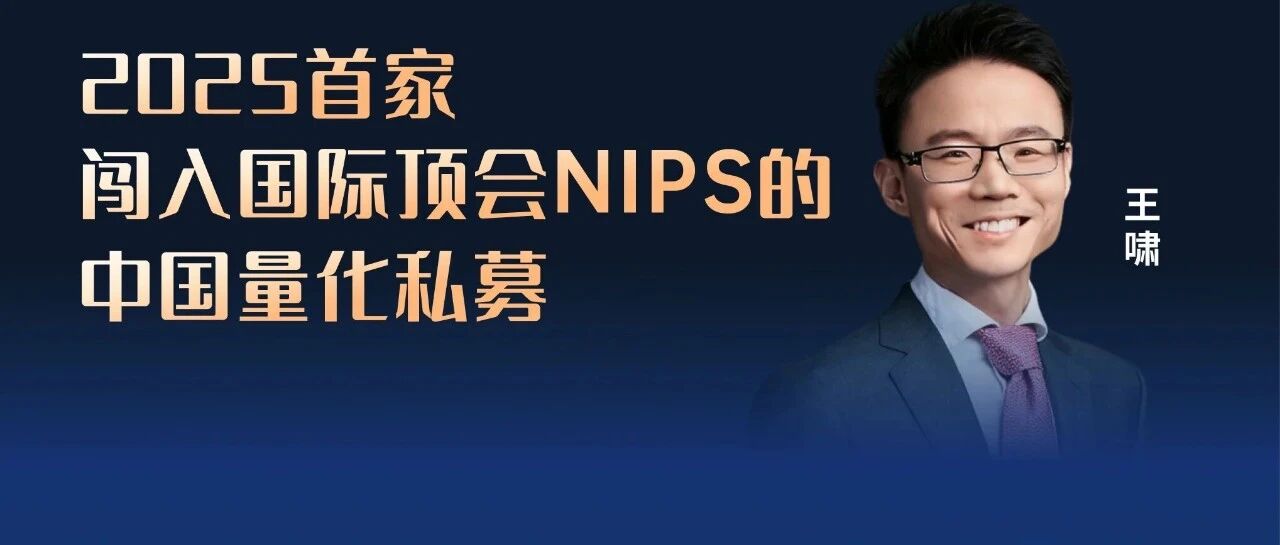
第二家DeepSeek?中国量化私募闯入国际AI顶会!旗下基金在逆势中领衔!深度揭秘念空!
私募排排网· 2025-10-10 03:31
本期揭秘的是 百亿量化私募念 空科技 , 念空科技旗下有念空私募、念觉私募。 今年5月19日,念空科技成立了AI公司全频思维(AllMind), 并向国际顶级学术会议NeurIPS投递了与上海交大计算机学院合作的大模型研究论文,探讨"自适应混合训练方法论"。念空科技也因此成为继 DeepSeek之后,第二家开展大模型底层理论研究并发表成果的私募机构。 在私募排排网发布的 百亿私募量化多头1-8月超额TOP10榜单中 , 念觉私募王啸管理的"念觉量臻量化精选优盛1号"以***%的超额收益夺得 第2( 点此看收益 )。 值得注意的是,该产品在8月份实现超额收益高达***%,在上榜产品中逆市领衔。 ( 点此看收益 ) 王啸是念空科技实际控制人/首席投资官,复旦大学物理学博士,具有15年以上量化策略研发、交易及风控经验。 下面,就让我们一起深入了解 念空科技发展历程、核心团队、核心优势、产品线 等内容。( 点此看念空科技旗下基金业绩一览表 ) 本文首发于公众号"私募排排网"。 (点击↑↑ 上图订阅专栏 ) 编者按 通常,投资者在了解私募时,会关注公司团队水平、策略运作、中长期业绩、风险控制等内容,为此,私募排排网推出 ...
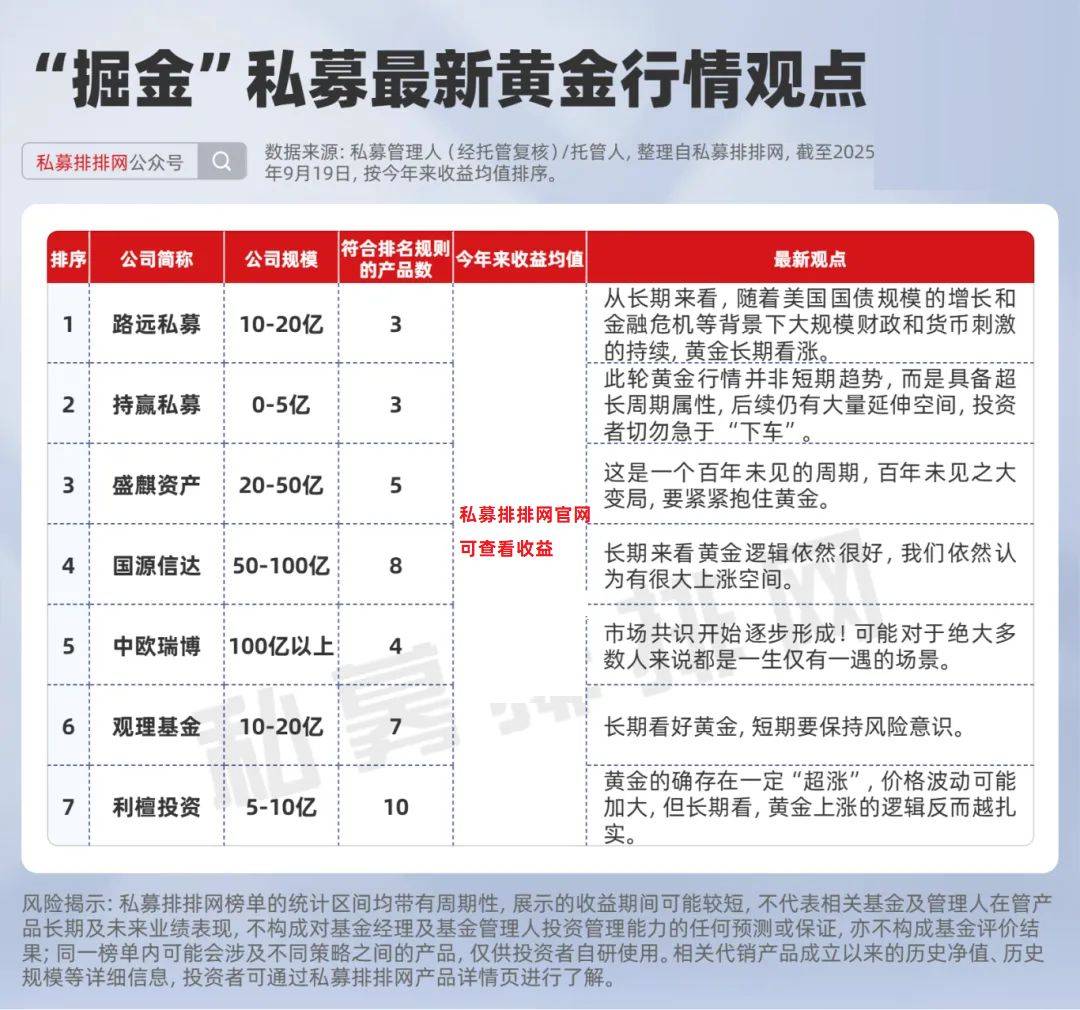
当黄金闪耀,私募“掘金”之路兴起!中欧瑞博、盛麒资产、持赢私募、观理基金等如何看?
私募排排网· 2025-10-10 00:00
Core Viewpoint - The article highlights the significant rise in international gold prices during the National Day and Mid-Autumn Festival holiday, with spot gold prices surpassing $4000 per ounce, marking a historical high. The increase is attributed to various macroeconomic factors and a growing consensus among investors regarding the long-term bullish outlook for gold [1][3]. Group 1: Market Performance - During the holiday period from October 1 to October 8, gold prices increased by 4.72%, with the highest price reaching $4049.64 per ounce [1]. - Year-to-date, international gold prices have risen by 52.94%, outperforming other asset classes [3]. Group 2: Investment Strategies - Several private equity managers, including Zhongou Ruibo and Guoyuan Xinda, have successfully positioned themselves to capitalize on the gold market trend through in-depth fundamental research [1]. - Long-term bullish views on gold are prevalent among private equity firms, with many suggesting that the current gold market is not a short-term trend but rather has long-cycle attributes, indicating further potential for price increases [2][12]. Group 3: Expert Opinions - Wu Weizhi from Zhongou Ruibo emphasizes that the market's perception of gold has shifted positively, with increasing recognition of the factors driving gold prices higher [4]. - Guoyuan Xinda's manager, Shi Jianghui, predicts that further interest rate cuts by the Federal Reserve will lead to increased investment in gold, as funds flow out of the bond market [7]. - Li Tan Investment highlights the long-term collapse of the dollar's credit system as a fundamental driver for gold's price increase, suggesting that geopolitical tensions and economic instability will continue to support gold prices [19][21]. Group 4: Future Outlook - The article suggests that the current gold price surge is part of a larger, unprecedented cycle, with many experts believing that this is a once-in-a-lifetime opportunity for investors [22]. - The ongoing geopolitical conflicts and economic uncertainties are expected to further enhance gold's appeal as a safe-haven asset, with predictions of continued price increases into late 2023 and beyond [10][12].

否认产品有清盘风险 将坚持长期持有策略
Nan Fang Du Shi Bao· 2025-10-09 23:13
Core Insights - Lin Yuan's investment products have experienced significant performance fluctuations, with some underperforming the CSI 300 index and even incurring losses this year [2][3] - Lin Yuan maintains a long-term investment strategy without additional risk control measures or adjustments to existing holdings, denying any risk of product liquidation [2][4] Performance Overview - Among the 263 private funds managed by Lin Yuan, 18 have disclosed performance, all of which have underperformed the CSI 300 index as of September 30 [3] - The best-performing fund, "Lin Yuan Investment No. 218," achieved a return of 8.38% year-to-date, while the CSI 300 index rose by 13.25% in the same period [3] - Several funds, including "Lin Yuan Investment No. 173" and "Lin Yuan Investment No. 21," reported losses, with the former down 23.80% since inception [3][4] Reasoning Behind Performance - Lin Yuan attributes the underperformance to short-term price declines of held assets rather than issues with industry allocation or stock selection [4][5] - The investment philosophy focuses on long-term value, with no adjustments made for short-term market fluctuations [5] Market Outlook - Lin Yuan plans to continue focusing on long-term opportunities in the consumer and pharmaceutical sectors, while avoiding participation in popular sectors like new energy and artificial intelligence due to valuation uncertainties [6] - The company believes that quality firms in consumer and pharmaceutical sectors can withstand economic cycles and ensure long-term profit growth [6] Response to Market Concerns - Lin Yuan denies rumors of liquidation risks for his products, stating that liquidation only occurs upon contract expiration and that there are no current products at risk of liquidation due to net asset value hitting stop-loss thresholds [6][8] - The company emphasizes a stable investor structure, with less than 20% of investments from external sources, mitigating liquidity issues [6] Industry Perspective - Analysts note that Lin Yuan's strategy reflects the challenges of long-term value investing amid short-term market volatility, particularly in the consumer and pharmaceutical sectors [8] - Investors are advised to consider their risk tolerance and investment horizon when selecting private funds, especially those focused on long-term value strategies [8]

林园被吐槽错过牛市
Shen Zhen Shang Bao· 2025-10-09 22:58
Group 1 - The core viewpoint of the articles highlights that Lin Yuan's investment products have underperformed in the recent market recovery, leading to dissatisfaction among some investors, despite support from others who advocate for long-term investment strategies [1][2]. - Lin Yuan's investment strategy focuses on sectors such as the "beauty economy" and the "silver economy," indicating a belief in the future demand for aesthetics and health-related products for the aging population [3]. - Data shows that out of 19 investment products managed by Lin Yuan, 10 have reported losses over the past year, with none outperforming the CSI 300 index, and the best-performing product lagging behind by 11 percentage points [2]. Group 2 - Lin Yuan is recognized as a staunch investor in Guizhou Moutai and is known for his value investment approach, favoring industries with strong profitability and monopolistic positions, particularly in consumer and pharmaceutical sectors [3]. - The investment logic is shifting fundamentally, with Lin Yuan suggesting that future scarcity will revolve around human happiness and longevity rather than traditional commodities [3]. - Lin Yuan remains optimistic about the Chinese stock market, asserting that many companies are still undervalued compared to historical levels, despite some indices reaching new highs [3].