
金融业

Search documents
72万亿元!A股“成绩单”亮相
Jin Rong Shi Bao· 2025-04-30 07:46
Group 1 - A-share listed companies reported a total revenue of approximately 71.92 trillion yuan in 2024, a year-on-year decrease of 0.22%, and a net profit attributable to shareholders of 5.21 trillion yuan, down 2.96% year-on-year [2] - Among the 5411 A-share listed companies, 4029 achieved profitability, with 2567 companies experiencing a year-on-year increase in net profit, representing about 48% [2] - The main board saw declines in both revenue and net profit, with decreases of 0.39% and 1.83% respectively, while the ChiNext and Sci-Tech Innovation Board showed positive revenue growth but declining net profits [2][3] Group 2 - In Q1 2025, A-share listed companies achieved a total revenue of 16.83 trillion yuan, a year-on-year decline of 0.38%, while net profit attributable to shareholders increased by 3.47% to 1.49 trillion yuan [4] - The ChiNext board experienced revenue and net profit growth of 6.05% and 15.40% respectively, contrasting with declines in the Sci-Tech Innovation Board and Beijing Stock Exchange [4] - The semiconductor, home appliance, and hardware equipment sectors saw revenue growth exceeding 15%, indicating a shift towards structural optimization in the A-share market [4]
安徽领跑长三角一季报,做对了什么?
2 1 Shi Ji Jing Ji Bao Dao· 2025-04-29 09:09
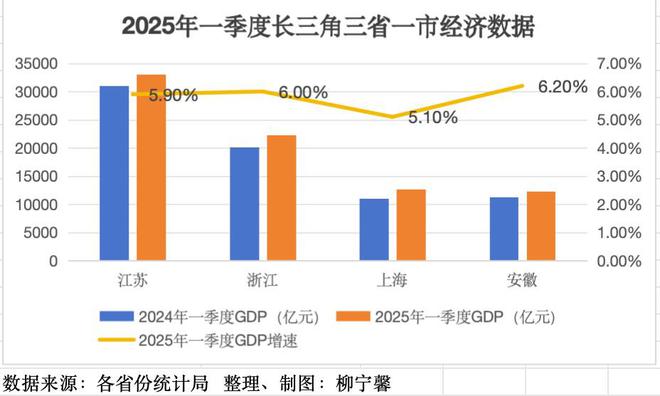
Economic Overview - The Yangtze River Delta (YRD) region achieved a GDP of 80,388.66 billion yuan in Q1, accounting for 25.22% of the national GDP, with an increase of 6,839.2 billion yuan compared to the same period last year [1] - By province, Jiangsu's GDP was 33,088.6 billion yuan (5.9% growth), Zhejiang's was 22,300 billion yuan (6.0% growth), Shanghai's was 12,735.06 billion yuan (5.1% growth), and Anhui's was 12,265 billion yuan (6.2% growth) [1] Industrial Growth - High-tech manufacturing is a key driver of economic growth in the YRD, with Anhui leading in industrial value-added growth at 9.2%, followed by Zhejiang (8.9%), Jiangsu (8.2%), and Shanghai (3.7%) [5] - In Q1, the high-tech manufacturing sector in Jiangsu saw a significant increase, with high-tech industries accounting for 51.4% of the province's industrial output [6] - Anhui's high-tech manufacturing value-added grew by 20.1%, with notable growth in the automotive sector, particularly in new energy vehicles [8] Foreign Trade Performance - The YRD's total import and export volume reached 38.7 trillion yuan in Q1, representing 37.6% of the national total, with Zhejiang contributing 12.9 trillion yuan and a growth rate of 7.3% [4] - Export growth rates for Anhui, Shanghai, Zhejiang, and Jiangsu were 17.3%, 12.6%, 11.1%, and 9.6%, respectively [4] Consumption Trends - Consumption growth varied across provinces, with Anhui (5.8%) and Jiangsu (5.6%) showing positive growth, while Shanghai experienced a decline of 1.1% in retail sales [10] - The YRD is focusing on boosting consumption in Q2, with various provinces implementing specific measures to stimulate consumer spending [12][13] Strategic Development - Experts suggest that the YRD should leverage its integrated development strategy to enhance regional cooperation and optimize the industrial structure, particularly in high-tech sectors [3][7] - There is a call for strengthening links with RCEP countries and enhancing the domestic unified market to drive further economic growth [3]

一季度湖北GDP为13543.49亿元 同比增长6.3%
Zhong Guo Jing Ji Wang· 2025-04-28 06:47
Economic Overview - In the first quarter, the province achieved a GDP of 13,543.49 billion yuan, with a year-on-year growth of 6.3% [1] - The primary industry added value was 828.69 billion yuan, growing by 3.2%; the secondary industry added value was 5,344.85 billion yuan, growing by 6.4%; and the tertiary industry added value was 7,369.95 billion yuan, growing by 6.5% [1] Agriculture - The agricultural sector's added value was 876.42 billion yuan, with a growth of 3.4% [1] - Key agricultural products showed stable production, with pork output at 968,400 tons, increasing by 6.2% [1] - Vegetable production reached 10,076,000 tons, growing by 3.8%, while fruit production increased by 10.1% to 284,500 tons [1] Industrial Production - The added value of large-scale industrial enterprises grew by 8.1%, accelerating by 0.4 percentage points compared to the previous year [1] - High-tech manufacturing saw a significant increase of 21.4%, contributing 36.4% to the growth of large-scale industry [1] - Major industries such as electrical, computer communication electronics, and chemicals experienced substantial growth rates, with electrical industry growing by 22.8% [1] Service Sector - The service sector's added value grew by 6.5%, with transportation and warehousing increasing by 13.7% [3] - The revenue of large-scale service enterprises reached 2,129.54 billion yuan, growing by 13.8% [3] - Financial institutions reported a deposit balance of 99,630.54 billion yuan, increasing by 8.7% year-on-year [3] Fixed Asset Investment - Fixed asset investment (excluding rural households) grew by 6.6%, with manufacturing investment increasing by 12.1% [4] - Infrastructure investment rose by 4.4%, while real estate development investment declined by 5.5% [4] - High-tech industry investment increased by 12.8%, with aerospace and computer equipment manufacturing seeing significant growth [4] Consumer Market - The total retail sales of social consumer goods reached 6,887.19 billion yuan, growing by 7.3% [5] - Sales of home appliances and furniture saw substantial increases, with growth rates of 21.1% and 26.3% respectively [5] - Online retail sales grew by 24.3%, indicating a strong shift towards e-commerce [6] Trade and Exports - The province's total import and export volume reached 1,743.1 billion yuan, with exports growing by 22.4% [7] - General trade accounted for 80.9% of the total trade volume, indicating a robust trade structure [7] - Machinery and electrical products exports increased by 19.2%, making up 54.7% of total exports [7] Employment and Income - The urban unemployment rate averaged 5.4%, remaining stable compared to the previous year [9] - The per capita disposable income for residents was 11,075 yuan, growing by 5.4% [10] - The income gap between urban and rural residents narrowed, with the ratio decreasing to 2.06 [10]
2025年4月政治局会议精神学习:以高质量发展的确定性应对不确定性
EBSCN· 2025-04-26 07:44
Group 1: Economic Policy and Strategy - The April Politburo meeting emphasized "high-quality development" to address uncertainties from external environments, focusing on achieving "four stabilizations": stabilizing employment, enterprises, markets, and expectations[3] - The meeting acknowledged a positive trend in the economy for Q1 2025 but highlighted the need to solidify this recovery amidst increasing external pressures[4] - Long-term strategies include deepening reform and opening up to solve developmental issues and maintaining a competitive position in international trade[3] Group 2: Employment and Enterprise Support - Employment is prioritized, with measures to increase the unemployment insurance fund's return ratio for companies affected by tariffs, aiming to stabilize jobs[8] - The expected number of college graduates in 2025 is 12.22 million, an increase of 430,000 from the previous year, indicating rising employment pressure[8] - The government plans to accelerate major projects to absorb employment, particularly in coastal areas, through initiatives like "work for relief"[9] Group 3: Consumption and Fiscal Policy - The meeting called for the development of service consumption to enhance economic growth, with service consumption accounting for 46.1% of total consumption in 2024, lower than in developed countries[12] - Policies to boost consumption include expanding the "old-for-new" subsidy program, which has shown positive effects on retail sales growth, with Q1 2025 showing a 4.6% increase year-on-year[13] - Fiscal policies will focus on increasing the issuance of special bonds and long-term bonds to support infrastructure and stabilize the economy, with 960.2 billion yuan in new local special bonds issued in the first quarter of 2025[20][23]
上海一季度地区生产总值增长5.1% 经济运行实现平稳开局
Zhong Guo Jing Ji Wang· 2025-04-24 05:50
Economic Performance - In the first quarter, Shanghai's GDP grew by 5.1% year-on-year, with the secondary and tertiary industries increasing by 2.9% and 5.6% respectively. The tertiary industry accounted for 80.8% of the total GDP [1] - The consumer price index (CPI) in Shanghai rose by 0.1% year-on-year, with consumer goods prices decreasing by 0.3% and service prices increasing by 0.6%. The core CPI, excluding food and energy, increased by 0.5% [1] - The number of new urban jobs added in Shanghai was 146,300, an increase of 7,600 compared to the previous year, with an average urban unemployment rate of 4.2% [1] Industry Growth - The information transmission, software, and IT services sectors, along with the financial industry, contributed over 60% to Shanghai's GDP growth, with the former growing by 13.0% and the latter by 9.4% [1] - Retail sales of new energy vehicles and communication equipment increased by 10.6% and 10.7% year-on-year, respectively, while energy-efficient home appliances and computers saw retail sales growth of 74.3% and 90.6% [2] - The three leading industries in Shanghai saw manufacturing output grow by 7.2% year-on-year, with integrated circuits, biomedicine, and artificial intelligence growing by 8.9%, 2.8%, and 13.2% respectively [2] - High-tech industrial output increased by 14.8% year-on-year, with strategic emerging industries growing by 3.7%, and new generation information technology industry output rising by 17.2% [2] Future Outlook - The economic performance in the first quarter reflects the effectiveness of macroeconomic policies, but the international environment remains complex and challenging, necessitating a solid foundation for continued economic recovery [3] - There is a need to fully implement new development concepts and accelerate the construction of a new development pattern to address international uncertainties and promote high-quality economic development [3]
上海,一季度成绩单出炉!
证券时报· 2025-04-23 13:57
优势领域增势强劲。 上海市统计局4月23日发布的数据显示,一季度全市实现地区生产总值1.27万亿元,按不变价格计算,同 比增长5.1%。其中,优势领域增势强劲,一季度全市信息传输、软件和信息技术服务业以及金融业增势强 劲,对全市GDP增长的贡献率合计超六成。 据统计,一季度上海市信息传输、软件和信息技术服务业增加值1726.09亿元,同比增长13.0%,高出全市 GDP增速7.9个百分点;金融业增加值2183.29亿元,同比增长9.4%,高出全市GDP增速4.3个百分点。 一季度,上海工业生产增长加快,先导产业持续发力。数据显示,全市工业增加值同比增长3.6%,规模以 上工业总产值同比增长3.5%,增速比上年全年加快2.8个百分点。计算机、通信和其他电子设备制造业产 值同比增长23.3%,铁路、船舶、航空航天和其他运输设备制造业增长22.6%,电气机械和器材制造业增 长9.0%。 人工智能、生物医药、集成电路是上海三大先导产业。据统计,一季度,三大先导产业制造业总产值同比 增长7.2%,增速快于全市规模以上工业总产值3.7个百分点。其中,人工智能制造业产值增长13.2%,集成 电路制造业增长8.9%,生物医药 ...

上海经济开门红!
第一财经· 2025-04-23 10:16
2025.04. 23 本文字数:3936,阅读时长大约6分钟 导读 : GDP增速双提升、主要指标"开门红"、多数指标增速加快,重点行业领域持续回升、就业物价保持稳 定…… 作者 | 第一财经 胥会云 今年一季度,上海实现地区生产总值(GDP)12735.06亿元,按不变价格计算,同比增长5.1%。这 一增速,较上海去年全年和去年一季度的GDP增速,均高出0.1个百分点。 此外,上海一季度信息传输、软件和信息技术服务业增加值同比增长13%,信息服务业营业收入、利 润分别增长13.2%和94.6%,华为海思等高速增长带动集成电路设计行业增长40%以上。 一季度,上海第三产业增加值占上海GDP的比重达到了80.8%。马海倩说,这一基本盘的稳步增长, 是上海经济平稳开局的重要保障。 稳增长,得益于上海优势行业的持续发力。比如,信息传输、软件和信息技术服务业,以及金融业, 一季度增势强劲,对全市GDP增长的贡献率合计超6成。其中,金融业拉动上海GDP增长1.7个百分 点,信息传输、软件和信息技术服务业拉动上海GDP增长1.5个百分点。 GDP增速双提升、主要指标"开门红"、多数指标增速加快,重点行业领域持续回升、就 ...
一季度北京GDP为12159.9亿元 同比增长5.5%
Zhong Guo Jing Ji Wang· 2025-04-23 01:11
中国经济网4月23日讯据北京市统计局消息,根据地区生产总值统一核算结果,全市实现地区生产总值 12159.9亿元,按不变价格计算,同比增长5.5%。分产业看,第一产业实现增加值16.6亿元,增长 1.2%;第二产业实现增加值1558.9亿元,增长6.0%;第三产业实现增加值10584.3亿元,增长5.4%。 一、农业生产规模继续扩大,种植业、牧业稳步增长 一季度,全市实现农林牧渔业总产值38.8亿元,按可比价格计算,同比增长2.2%。其中,实现农业(种 植业)产值15.2亿元,增长2.8%,蔬菜(含食用菌)播种面积和产量分别增长4.2%和2.3%;实现林业产值 11.1亿元,下降6.0%;受生猪和牛出栏增长带动,实现牧业产值10.6亿元,增长4.9%。 二、工业生产增长加快,高精尖领域表现活跃 五、市场消费继续恢复,"以旧换新"政策继续显效 一季度,全市市场总消费额同比增长1.0%。其中,服务性消费额在信息服务和文体娱乐服务等领域带 动下增长4.7%;实现社会消费品零售总额3458.6亿元,下降3.3%。社会消费品零售总额中,按消费形态 分,商品零售3129.9亿元,下降3.2%;餐饮收入328.7亿元,下降 ...
经济运行总体平稳、稳中有进 一季度广东GDP同比增长4.1%
Shen Zhen Shang Bao· 2025-04-22 22:39
Economic Overview - Guangdong's GDP for Q1 2025 reached 33,525.51 billion yuan, with a year-on-year growth of 4.1% [1] - The primary industry added value was 934.45 billion yuan (3.3% growth), the secondary industry was 12,002.53 billion yuan (3.7% growth), and the tertiary industry was 20,588.53 billion yuan (4.3% growth) [1] Industrial Performance - Industrial production showed steady growth, with the added value of large-scale industries increasing by 3.9%, accelerating by 1.1 percentage points compared to January-February [1] - Advanced manufacturing and high-tech manufacturing sectors grew by 5.9% and 5.3%, respectively, outpacing the overall industrial growth [1] - Production of high-tech products surged, with new energy vehicles, lithium-ion batteries for energy storage, industrial robots, and service robots increasing by 29.9%, 83.5%, 31.3%, and 10.8% respectively [1] Service Sector Growth - The added value of the service sector grew by 4.3%, accelerating by 1.5 percentage points compared to the previous year [2] - Key sectors such as information transmission, software and IT services, transportation, and finance saw growth rates of 7.4%, 7.1%, and 6.1% respectively, exceeding the overall service sector growth [2] - Revenue from large-scale service enterprises increased by 7.5%, with notable growth in transportation, IT services, and cultural sectors [2] Investment Trends - Fixed asset investment decreased by 6.2%, but the decline narrowed by 2.2 percentage points compared to January-February [2] - Infrastructure investment grew by 3.9%, with significant increases in railway and power supply investments at 11.0% and 8.9% respectively [2] - Industrial investment accounted for 38.0%, with automotive manufacturing investment soaring by 41.0% [2] Consumer Market Dynamics - Retail sales of consumer goods increased by 2.5%, with a notable acceleration in March at 5.8% [3] - Urban retail sales grew by 2.7%, while rural retail sales saw a modest increase of 0.5% [3] - Sales of upgraded and essential goods performed well, with significant growth in categories such as food, sports equipment, and daily necessities [3] Price Stability - The Consumer Price Index (CPI) fell by 0.4% year-on-year, with a slight decrease of 0.5% in March [4] - The Producer Price Index (PPI) decreased by 1.0%, with a 2.0% drop in the Industrial Producer Purchase Price Index (IPI) [4] Policy Implications - The Guangdong Provincial Bureau of Statistics indicated that the economy continues to recover, supported by proactive macroeconomic policies [4] - Emphasis on high-quality development and addressing external uncertainties is crucial for sustaining economic momentum [4]
浙江一季度GDP同比增长6% 经济结构进一步向新
Zheng Quan Shi Bao Wang· 2025-04-21 13:38
Economic Performance - In Q1 2025, Zhejiang's GDP reached 2.23 trillion yuan, with a year-on-year growth of 6.0%, surpassing the national average of 5.4% [1] - The industrial production growth rate increased from 8.0% in January-February to 8.9% in Q1, driven by policies promoting advanced manufacturing [1] - The service sector's value added grew by 5.7% in Q1, showing an acceleration compared to the previous year [1] Technological Innovation - Zhejiang has seen explosive growth in new products, with civilian drones, industrial robots, service robots, and integrated circuits increasing by 58.7%, 54.1%, 33.9%, and 26.2% respectively in Q1 [2] - R&D expenditure for large-scale industrial enterprises rose by 8.3% in January-February, outpacing revenue growth by 4.8 percentage points [2] Consumer Trends - Retail sales of quality consumer goods showed strong growth in Q1, with food, beverages, and tobacco sales increasing by 7.2%, 9.1%, and 17.9% respectively [2] - Upgraded consumer goods such as sports and entertainment products, jewelry, and wearable smart devices saw retail growth of 19.9%, 27.6%, and 72.1%, significantly higher than the overall retail growth rate [2] Private Sector Contribution - Private enterprises accounted for 1.05 trillion yuan in imports and exports in Q1, representing 81.1% of the province's total, with a year-on-year growth of 8.4% [2] - The contribution of private enterprises to Zhejiang's foreign trade increased by 0.8 percentage points compared to the previous year, outperforming both provincial and national averages [2]