医药生物

Search documents
国信证券晨会纪要-20251231
Guoxin Securities· 2025-12-31 01:18
Macro and Strategy - The fixed income investment strategy focuses on long-term bond wave operations, with a significant decline in default amounts in December, indicating a potential recovery in credit markets [7][8] - Domestic economic growth is expected to slow down, with GDP growth forecasted at approximately 4.3% for Q4 2025, remaining within the government's target range of around 5% [7][8] - The monetary policy meeting in Q4 removed references to "low price operation," indicating a shift in focus towards addressing supply-demand imbalances in the economy [8] Industry and Company - In the transportation sector, improvements in oil exchange rates are beneficial for the airline sector, while leading express companies are strengthening their competitive advantages [3][20] - The banking sector is expected to perform well leading up to the Spring Festival, with historical data showing a high success rate for bank stocks during this period [24][25] - The mechanical industry is seeing significant developments, with the establishment of a standardization committee for humanoid robots and ByteDance planning to invest $23 billion in AI [26][27] - The social services sector has seen a notable increase in duty-free sales in Hainan, with a 54.9% year-on-year growth, indicating strong consumer demand [33][34] - The express delivery industry is benefiting from price increases due to anti-involution policies, with major players like ZTO and YTO showing improved growth rates [22][23]



30日转债行业涨跌参半,估值环比抬升:转债市场日度跟踪20251230-20251231
Huachuang Securities· 2025-12-31 01:13
Report Industry Investment Rating No information provided in the given content. Core Viewpoints - On December 30, the convertible bond industry showed mixed performance in terms of gains and losses, with valuations rising on a month - on - month basis [1]. - The mid - cap growth style was relatively dominant in the market [1]. - The trading sentiment in the convertible bond market weakened [1]. - The convertible bond price center increased, and the proportion of high - price bonds rose [2]. - The convertible bond valuations increased [2]. - In the A - share market, more than half of the underlying stock industry indices declined, while in the convertible bond market, 14 industries rose [3]. Summary by Related Catalogs Market Overview - **Index Performance**: The CSI Convertible Bond Index rose 0.14% month - on - month, the Shanghai Composite Index remained unchanged, the Shenzhen Component Index rose 0.49%, the ChiNext Index rose 0.63%, the SSE 50 Index rose 0.06%, and the CSI 1000 Index rose 0.04% [1]. - **Market Style**: Mid - cap growth was relatively dominant. Large - cap growth rose 0.57%, large - cap value fell 0.13%, mid - cap growth rose 0.81%, mid - cap value rose 0.66%, small - cap growth rose 0.66%, and small - cap value rose 0.34% [1]. - **Fund Performance**: The trading sentiment in the convertible bond market weakened. The trading volume of the convertible bond market was 75.057 billion yuan, a 2.96% month - on - month decrease; the total trading volume of the Wind All - A was 2.161532 trillion yuan, a 0.18% month - on - month increase; the net outflow of the main funds in the Shanghai and Shenzhen stock markets was 23.828 billion yuan, and the yield of the 10 - year treasury bond decreased by 0.02 bp to 1.86% [1]. Convertible Bond Price - The overall weighted average closing price of convertible bonds was 134.53 yuan, a 0.09% month - on - month increase. Among them, the closing price of equity - biased convertible bonds was 202.44 yuan, a 1.47% increase; the closing price of bond - biased convertible bonds was 118.85 yuan, a 0.18% decrease; the closing price of balanced convertible bonds was 129.71 yuan, a 0.01% increase [2]. - The proportion of bonds with a closing price above 130 yuan was 59.95%, a 1.15 - percentage - point increase. The largest change in proportion occurred in the 120 - 130 (including 130) range, with a proportion of 28.01%, a 1.39 - percentage - point decrease. There were no bonds with a closing price below 100 yuan. The median price was 132.60 yuan, a 0.07% month - on - month decrease [2]. Convertible Bond Valuation - The fitted conversion premium rate of 100 - yuan par value was 33.54%, a 0.45 - percentage - point month - on - month increase; the overall weighted par value was 101.88 yuan, a 0.19% month - on - month decrease [2]. - The premium rate of equity - biased convertible bonds was 18.25%, a 1.38 - percentage - point increase; the premium rate of bond - biased convertible bonds was 86.78%, a 2.11 - percentage - point increase; the premium rate of balanced convertible bonds was 25.17%, a 0.42 - percentage - point increase [2]. Industry Performance - **Underlying Stock Market**: Among the A - share industries, the top three decliners were Commerce and Retail (-1.56%), Real Estate (-1.22%), and Utilities (-1.14%); the top three gainers were Petroleum and Petrochemical (+2.63%), Automobile (+1.35%), and Non - Ferrous Metals (+1.31%) [3]. - **Convertible Bond Market**: Among the convertible bond industries, the top three gainers were Automobile (+2.08%), Petroleum and Petrochemical (+1.25%), and Textile and Apparel (+0.77%); the top three decliners were Environmental Protection (-2.57%), National Defense and Military Industry (-1.23%), and Building Materials (-1.16%) [3]. - **By Category**: - **Closing Price**: The large - cycle category decreased by 0.38%, manufacturing increased by 0.54%, technology decreased by 0.24%, large - consumption increased by 0.10%, and large - finance decreased by 0.05% [3]. - **Conversion Premium Rate**: The large - cycle category decreased by 0.21 percentage points, manufacturing increased by 0.57 percentage points, technology increased by 0.028 percentage points, large - consumption increased by 0.63 percentage points, and large - finance increased by 0.79 percentage points [3]. - **Conversion Value**: The large - cycle category decreased by 0.74%, manufacturing increased by 0.17%, technology decreased by 0.36%, large - consumption decreased by 0.43%, and large - finance decreased by 0.20% [3]. - **Pure Bond Premium Rate**: The large - cycle category decreased by 0.55 percentage points, manufacturing increased by 0.81 percentage points, technology decreased by 0.16 percentage points, large - consumption increased by 0.12 percentage points, and large - finance decreased by 0.065 percentage points [4]. Industry Rotation - Industries such as Petroleum and Petrochemical, Automobile, and Non - Ferrous Metals led the gains. For example, Petroleum and Petrochemical had a daily increase of 2.63% in the underlying stock market and 1.25% in the convertible bond market; Automobile had a 1.35% increase in the underlying stock market and 2.08% in the convertible bond market [54].
医药业ESG披露率五连增 推进“三废”治理向绿而行
Chang Jiang Shang Bao· 2025-12-30 23:19
Core Viewpoint - The pharmaceutical industry is increasingly integrating ESG (Environmental, Social, and Governance) principles into its operations, with a notable rise in ESG report disclosures among listed companies, reflecting a commitment to high-quality development and sustainable practices [1][2]. Group 1: ESG Report Disclosure - In 2024, 495 pharmaceutical and biotechnology companies disclosed ESG reports, achieving a disclosure rate of 43.26% [1]. - The ESG report disclosure rates from 2019 to 2023 were 23.66%, 24.11%, 29.67%, 32.91%, and 39.19%, indicating a consistent upward trend [1]. - Companies in economically developed regions, such as Beijing, Shanghai, and Guangdong, generally outperform those in less developed areas like Guangxi and Shanxi in ESG practices [1]. Group 2: ESG Ratings Distribution - Among the companies that disclosed ESG reports in 2024, 13 received an AAA rating (2.63%), and 63 received an AA rating (12.73%) [2]. - The majority of ESG ratings are concentrated in the A, BBB, and BB categories, with 98 companies rated A (19.8%), 85 rated BBB (17.17%), and 128 rated BB (25.86%) [2]. - The median score for the pharmaceutical and biotechnology industry is 65.57, with the highest score being 84.06 from Darentang and the lowest being 50.69 from Digital Human [2]. Group 3: ESG Practices by Sub-Sectors - The chemical pharmaceutical sector had 157 companies disclose ESG reports, with ratings distributed as follows: 1 AAA, 14 AA, 37 A, 31 BBB, 49 BB, 24 B, and 1 CCC [3]. - The traditional Chinese medicine sector had 69 companies disclose ESG reports, with 6 rated AAA, 11 AA, and 8 A [3]. - The medical device sector had 131 companies disclose ESG reports, with 2 rated AAA, 15 AA, and 18 A [3]. Group 4: Environmental Management Practices - By 2025, the pharmaceutical industry is shifting from end-of-pipe management to comprehensive control of environmental practices, with leading companies establishing systematic management systems for waste treatment [4]. - Companies like Pizaihuang and Baiyi Shenzhou are implementing innovative practices for wastewater treatment and solid waste management, showcasing a commitment to environmental sustainability [4]. - R&D innovation is a core focus, with companies integrating ESG principles into their research processes, exemplified by Wantai Biologics' development of a nine-valent HPV vaccine [4]. Group 5: Corporate Initiatives and Investments - Yunnan Baiyao is leveraging AI in drug development and has established a business matrix across various health fields [5]. - Companies prioritize product quality and safety, with Zhifei Biological implementing animal welfare and ethical standards in its operations [5]. - Darentang has disclosed ESG reports for 18 consecutive years, achieving energy savings of 101.95 tons of standard coal through equipment upgrades [6]. Group 6: Green Transformation and Community Engagement - Yiyue Medical is accelerating its green transformation with an investment of 4.82 million in environmental initiatives, achieving a 100% compliance rate in waste emissions [7]. - The company has integrated green development principles into its operations and achieved ISO 14001 certification as a "Green Factory" [7]. - Yiyue Medical also engages in community support, contributing 1.47 million to various public welfare projects [8].
四大证券报头版头条内容精华摘要_2025年12月31日_财经新闻
Xin Lang Cai Jing· 2025-12-30 23:15
Group 1 - The Central Rural Work Conference was held in Beijing, focusing on the "three rural issues" and outlining the work plan for 2026 [1] - The 2026 "Two New" policy has been announced, expanding the scope of subsidies for digital and smart products [2][18] - The copper market has seen a significant price increase, with LME three-month copper rising over 40%, indicating strong market performance [3][19] Group 2 - The 2026 "Two New" policy includes updates on support areas and subsidy standards, with an initial allocation of 625 billion yuan for consumer goods replacement [10][25] - The personal housing sales tax rate has been reduced from 5% to 3% for properties sold within two years, effective January 1, 2026 [5][21][26] - The new VAT implementation regulations will take effect on January 1, 2026, aiming to enhance tax incentives [9][24] Group 3 - The stock market has seen over 2,800 A-share companies receiving broker research attention, with machinery, electronics, and biomedicine being the most favored sectors [4][20] - Huawei's chairman announced a strategic focus on seven business directions for 2026, emphasizing the development of the Harmony ecosystem [14][29] - The new display technology industry is projected to reach an output value of 800 billion yuan, capturing nearly 54% of the global market [8][23]
10家深企今年登陆港交所
Shen Zhen Shang Bao· 2025-12-30 23:03
Group 1 - The Hong Kong Stock Exchange (HKEX) welcomed 6 companies for listing on December 30, marking a total of over 110 IPOs for the year, with a fundraising scale exceeding 280 billion HKD, leading globally among exchanges [1] - From January 1 to December 30, 117 companies were listed on the Hong Kong stock market, an increase of 47 compared to the previous year, with a total fundraising amount of 285.69 billion HKD, representing a growth of 224.11% year-on-year [1] - Emerging industries are particularly favored, with the highest number of new listings coming from the pharmaceutical, software services, medical equipment and services, hardware, and non-ferrous metals sectors, totaling 20, 19, 8, 7, and 7 companies respectively [1] Group 2 - In terms of regional distribution, Shanghai led with 20 companies listed as H-shares, followed by Guangdong with 17 and Jiangsu with 14 [2] - Notable Shenzhen companies that went public in Hong Kong include Guanghetong, Fengcai Technology, Zhouliufu, Bama Tea, and Woan Robotics [2] - Looking ahead to 2026, the "A+H" listing model remains a focus, with 315 companies currently in the IPO process on the HKEX, including notable A-share companies like Nanhua Futures and Zhongwei Co., which have passed the hearing for H-share listings [2]
券商2025年调研路线图揭晓 三大板块最受青睐
Zhong Guo Zheng Quan Bao· 2025-12-30 21:15
Core Insights - The overall situation of broker research coverage of A-share listed companies is becoming clearer as 2025 approaches its end, with over 2,800 companies having received broker attention, indicating that more than half of the market's listed companies have been covered [1][2] - The most focused sectors include machinery, electronics, and biomedicine, each with over 290 companies receiving broker research [1][2] Machinery Sector - A total of 329 listed companies in the machinery sector received broker research, with notable companies including Huichuan Technology, Boke Co., and Weichuang Electric, each having over 100 research visits [3] - The machinery sector index has seen a cumulative increase of nearly 42% since the beginning of 2025, ranking among the top in 31 first-level industries [3] - Investment opportunities in the machinery sector for 2026 are centered around humanoid robots, with a focus on companies entering the Tesla supply chain and domestic leading companies in the sector [4] Electronics Sector - The electronics sector has been particularly favored by institutional investors, with over 320 companies receiving broker research in 2025 [2][3] - Investment opportunities for 2026 include new technologies and demands driven by the AI innovation cycle, particularly in the storage industry, which is entering an upward cycle [5] - The demand for AI chips and high-performance storage is expected to grow, benefiting semiconductor testing equipment and related companies [5] Biomedicine Sector - The biomedicine sector has seen 296 companies receiving broker research, with companies like Maiwei Biotech and Aibo Medical being popular among brokers [3] - The cumulative increase in the biomedicine sector since 2025 has narrowed to 12.44%, ranking lower among the 31 first-level industries [3] - For 2026, the focus remains on the innovative drug industry chain, driven by strong policy support and the increasing internationalization of domestic innovative drugs [6]

券商2025年调研路线图揭晓三大板块最受青睐
Zhong Guo Zheng Quan Bao· 2025-12-30 21:11
Group 1 - The core viewpoint of the articles highlights the significant interest from brokerages in A-share listed companies, with over 2800 companies receiving brokerage research in 2025, indicating that more than half of the market's listed companies have been under brokerage attention [1][2] - The mechanical equipment, electronics, and pharmaceutical biotechnology sectors are identified as the most favored by brokerages, with over 290 companies in each sector receiving research attention [1][2] - The mechanical equipment sector is particularly noted for investment opportunities in the humanoid robot industry chain, while the electronics sector is advised to focus on new technologies and demands driven by the AI innovation cycle [3][4] Group 2 - Crystal Optoelectronics, a company in the electronics sector, has been the most favored by brokerages, receiving 175 research visits, and is part of a sector that has seen a significant price increase of nearly 42% in 2025 [1][2] - The electronics sector has over 320 companies receiving brokerage research, with notable companies like Huaqin Technology and Luxshare Precision receiving more than 140 research visits each [2] - The pharmaceutical biotechnology sector has 296 companies under brokerage research, with a cumulative increase of only 12.44% in 2025, indicating a relative underperformance compared to other sectors [3][4] Group 3 - Investment opportunities in the humanoid robot sector are expected to grow, with a focus on companies entering the Tesla supply chain and those involved in core supply chain and standardization [3] - The electronics sector is anticipated to benefit from the AI-driven demand for high-performance storage and semiconductor testing equipment, suggesting a favorable outlook for related companies [4] - The pharmaceutical sector is expected to continue focusing on innovative drug companies, supported by favorable policies and increasing international market presence, which will attract more investor attention [4]





港股新股募资额重夺全球榜首 A股估值提升向一级市场传导压力
Mei Ri Jing Ji Xin Wen· 2025-12-30 19:02
Core Insights - The year 2025 is projected to be a fruitful year for both A-share and Hong Kong IPO markets, with A-shares seeing 115 new listings and raising over 130 billion yuan, nearly double the total from 2024, while Hong Kong's market had 117 new listings raising over 286 billion HKD, reclaiming the top position globally [1][5]. A-share Market Summary - A-share market had a total of 115 new IPOs in 2025, with a first-time approval rate of 95.61%, marking a slight increase from 100 IPOs in 2024 and halting a three-year decline [3][4]. - The total fundraising amount from these new listings reached approximately 130.97 billion yuan, with significant contributions from hardware, automotive, electrical equipment, machinery, chemicals, and semiconductor sectors [3]. - The leading underwriters for these new IPOs included Guotai Junan Securities, CITIC Securities, and Huatai United Securities, collectively sponsoring over half of the new listings [3]. - The geographical distribution of new listings showed that Jiangsu, Guangdong, and Zhejiang were the top provinces, contributing 28, 21, and 17 new IPOs respectively [3]. Hong Kong Market Summary - The Hong Kong IPO market saw 117 new listings in 2025, the highest since 2021, with total fundraising exceeding 286 billion HKD, marking a significant recovery in market activity [5][6]. - The leading sectors for new listings included pharmaceuticals, software services, and medical devices, with the highest fundraising amounts coming from electrical equipment and non-ferrous metals [6]. - Notably, 19 A-share companies successfully listed in Hong Kong, raising approximately 140 billion HKD, which is nearly half of the total fundraising in the Hong Kong market [6]. Institutional Competition and Policy Changes - The term "institutional competition" emerged as a key theme in 2025, with both A-share and Hong Kong markets implementing reforms to attract technology innovation companies [2][9]. - The A-share market introduced the "1+6" policy to enhance inclusivity for tech firms, while Hong Kong's "Special Line for Tech Companies" was launched to facilitate listings [2][9]. - The reforms aim to create a market ecosystem that can better identify and nurture long-term innovation [11]. Market Dynamics and Valuation Pressures - The booming secondary market led to a "new share" frenzy, with nearly 90% of new A-share listings seeing their prices double on the first day [12]. - However, the rising valuations in the secondary market have created pressure on the primary market, leading to discrepancies in pricing during mergers and acquisitions [13][14]. - Experts noted that the divergence in valuation logic between the secondary and primary markets could lead to stalled transactions, as sellers expect higher prices based on secondary market trends [13][14].
国信证券:从业绩变脸到价值修复
智通财经网· 2025-12-30 13:27
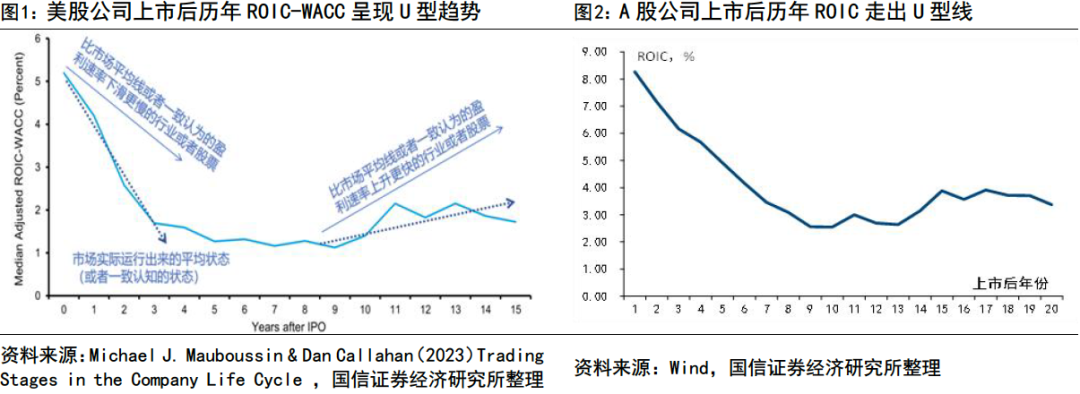
Core Insights - The report from Guosen Securities highlights the non-linear evolution of ROE growth in A-share IPOs, indicating that companies typically experience a decline followed by a rebound in profitability over an average of 9.32 years post-IPO [1][8][14]. Group 1: Investment Lifecycle and Trends - The "three-step" screening system identifies industries and stocks with long-term investment value by analyzing trends, benchmarking at the macro level, and selecting at the micro level [1][9]. - A total of 1273 stocks, approximately 23% of the sample, exhibited significant U-shaped characteristics in their ROE growth, with 241 identified as potential stocks in the pressure phase and 1032 as performance stocks in the recovery phase [2][12][13]. - The average IPO duration across the market is 12.63 years, with the average inflection point occurring at 6.62 years, which aligns with the identified 8-10 year critical threshold for profitability recovery [14]. Group 2: Industry Performance Analysis - In the pressure phase, industries such as media, utilities, and pharmaceuticals show strong defensive resilience, while in the recovery phase, sectors like power equipment, electronics, and home appliances demonstrate high elasticity in ROE recovery [2][25]. - The banking sector shows a significant proportion of stocks (40%) in the recovery phase, indicating strong profitability recovery certainty and operational stability [18][33]. - The telecommunications and pharmaceutical industries exhibit comprehensive leading advantages across both lifecycle phases, showcasing robust growth resilience [2][25]. Group 3: Micro-Level Stock Selection - The micro-level selection process focuses on identifying stocks within industries that outperform their sector averages, ensuring that selected stocks possess both industry support and superior alpha attributes [3][9]. - Specific stocks such as Guizhou Moutai and Huangtai Wine are identified as potential candidates in the pressure phase, while broader consumer goods have transitioned into the recovery phase, indicating a shift in operational efficiency [26][27][29]. - In the banking sector, banks like Jiangyin Bank and Chongqing Rural Commercial Bank are highlighted for their recovery trends that exceed industry averages, while others like China Merchants Bank are still in the pressure phase [33][34].

A股公告精选 | 10连板嘉美包装(002969.SH):如股票价格进一步异常上涨 或申请停牌核查
智通财经网· 2025-12-30 12:28
Group 1 - Deeply Housing A's controlling shareholder has decided to terminate the agreement to transfer 7.07% of the company's shares to Dongfang Asset, which will not lead to any changes in the controlling shareholder or actual controller of the company [1] - Wuzhou New Spring's controlling shareholder has reduced its stake by 2.73%, with a total of 9.99 million shares sold, and confirmed that there are no undisclosed significant matters affecting the company's stock price [2] - Baiwei Storage's subsidiary plans to acquire 380,066 shares of Niu Xin Semiconductor for 20 million yuan, representing 0.8446% of its total share capital, focusing on high-speed transmission and interconnection technology [3] Group 2 - Zhaofeng Co. plans to change part of its raised funds to invest in the industrialization of embodied intelligent robots and high-end precision components for automotive intelligent driving, with a total investment of 153 million yuan [4] - Tianpu Co. has seen its stock price increase by 718.39% from August 22 to December 30, leading to a suspension for verification due to significant deviation from the company's fundamentals [5] - Jingce Electronics has signed contracts to sell semiconductor front-end detection equipment worth a total of 571 million yuan [6] Group 3 - Jiamei Packaging has announced that it may apply for a suspension of trading if its stock price continues to rise abnormally, despite no significant changes in its fundamentals [7] - Zijin Mining expects a net profit of approximately 51 billion to 52 billion yuan for 2025, an increase of 59%-62% year-on-year, driven by rising sales prices of gold, copper, and silver [8][9] - Mingde Bio plans to acquire 100% equity of Wuhan Bikaier Rescue Supplies Co., which is expected to constitute a major asset restructuring [10] Group 4 - Shengxin Lithium Energy intends to acquire a 30% stake in Qicheng Mining for 2.08 billion yuan, with the latter's lithium mine development progressing [11] - Chaojie Co.'s controlling shareholder has completed a share reduction plan, reducing its stake to 45.37% without affecting the company's control [12] - Shichuang Energy's actual controller has undergone a change in indirect shareholding due to a divorce, but this will not affect the company's control [13] Group 5 - Yilake Co. plans to acquire 51% of Wuku Salt Lake for 4.605 billion yuan, which will become a subsidiary of the company upon completion of the transaction [14] - Various companies have reported significant contract wins, including Changjiang Electric Power's cash dividend distribution and multiple projects won by China Western Electric [18]