
渔业

Search documents
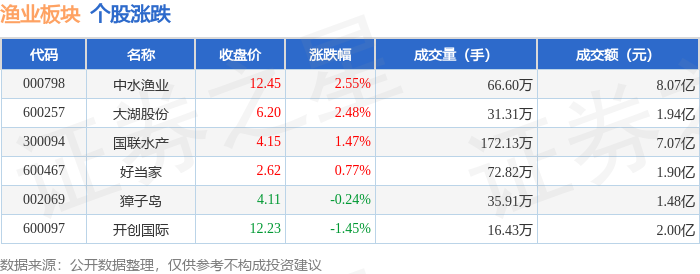
渔业板块12月1日涨1.07%,中水渔业领涨,主力资金净流出2526.28万元
Zheng Xing Xing Ye Ri Bao· 2025-12-01 09:01
Core Viewpoint - The fishery sector experienced a rise of 1.07% on December 1, with Zhongshui Fishery leading the gains, while the overall market indices also showed positive performance [1]. Group 1: Market Performance - The Shanghai Composite Index closed at 3914.01, up by 0.65% [1]. - The Shenzhen Component Index closed at 13146.72, up by 1.25% [1]. - The fishery sector stocks showed varied performance, with Zhongshui Fishery closing at 12.45, up by 2.55% [1]. Group 2: Individual Stock Performance - Zhongshui Fishery (000798) had a trading volume of 666,000 shares and a transaction value of 807 million yuan [1]. - Dahu Co. (600257) closed at 6.20, up by 2.48%, with a trading volume of 313,100 shares [1]. - Guolian Aquatic Products (300094) closed at 4.15, up by 1.47%, with a trading volume of 1,721,300 shares [1]. - Haodangjia (600467) closed at 2.62, up by 0.77%, with a trading volume of 728,200 shares [1]. - Zhangzidao (002069) closed at 4.11, down by 0.24%, with a trading volume of 359,100 shares [1]. - Kaichuang International (600097) closed at 12.23, down by 1.45%, with a trading volume of 164,300 shares [1]. Group 3: Fund Flow Analysis - The fishery sector saw a net outflow of 25.26 million yuan from institutional investors and a net outflow of 19.64 million yuan from speculative funds, while retail investors had a net inflow of 44.90 million yuan [1]. - Guolian Aquatic Products (300094) had a net inflow of 14.35 million yuan from institutional investors, while it experienced a net outflow of 7.10 million yuan from speculative funds [2]. - Dahu Co. (600257) had a net inflow of 3.71 million yuan from institutional investors, with a net outflow of 1.69 million yuan from speculative funds [2]. - Haodangjia (600467) faced a net outflow of 11.22 million yuan from institutional investors, but had a significant net inflow of 21.41 million yuan from retail investors [2].


“挪威三文鱼,刺身优选”合作项目在京启动
Bei Ke Cai Jing· 2025-12-01 08:06
Core Insights - The collaboration project "Norwegian Salmon, Sashimi Selection" was launched between the Norwegian Seafood Council and Hema Fresh in Beijing, focusing on enhancing the quality presentation, consumer experience, and awareness of Norwegian sashimi-grade salmon [1][2] - By the second quarter of 2025, China is projected to become the sixth largest market for Atlantic salmon globally, with Norwegian salmon exports to China reaching 76,901 tons in the first ten months of 2025, a 111% year-on-year increase, and export value hitting 6.811 billion Norwegian Krone, up 67% [1] Group 1 - The partnership aims to promote the healthy development and consumption upgrade of salmon in China [1] - The Norwegian Minister of Fisheries and Ocean Policy emphasized the importance of the relationship with Chinese partners and the expectation for deeper collaboration in trade and industry [1] - A recent study by the Norwegian Seafood Council indicates that household consumption has become the primary consumption scenario for salmon, accounting for approximately 60% of total consumption [1] Group 2 - The growth in demand for salmon is driven by significant changes in consumer structure, with trends such as household consumption and instant retail strongly influencing the increase [2] - The Norwegian Seafood Council plans to continue collaborating with leading retail partners in China to provide higher quality, traceable Norwegian seafood to consumers [2]
特朗普重返拉美,试图重新控制资源,中国要警惕了
Sou Hu Cai Jing· 2025-12-01 03:45
Group 1 - The core focus of the article is on the geopolitical struggle for resource control in South America, particularly in light of the recent political shifts towards the right in countries like Argentina and Bolivia, and the upcoming Chilean election [1][3][24] - The rise of right-wing leaders in South America, such as Argentina's Milei and Bolivia's right-wing factions, aligns with Trump's strategy to reshape resource control in the region, particularly targeting lithium and copper, which are crucial for global energy and manufacturing [3][5][11] - Chile's election is framed as a critical battleground for resource control, with the leading candidates representing starkly different approaches to resource management and foreign investment [7][9] Group 2 - The upcoming Chilean election features candidates with opposing views on resource management: leftist candidate Jara advocates for increased state control and regulation, while right-wing candidate Kast supports privatization and reduced foreign investment restrictions [9][15] - Chile holds nearly 40% of the world's lithium reserves, making it a key player in the global energy sector, and controlling these resources is a primary goal for Trump and U.S. interests [11][20] - Kast's rise in polls is attributed to his focus on public safety issues, which resonate with voters facing rising crime rates, and his policies may lead to increased foreign investment, particularly from U.S. capital [13][16] Group 3 - The potential election of Kast could lead to a favorable environment for U.S. companies in Chile, while simultaneously posing risks for Chinese enterprises already invested in the region, as Kast's pro-U.S. stance may prioritize American interests [18][22] - The article highlights the historical context of U.S. intervention in Latin America, suggesting that increased American influence could provoke domestic unrest and resistance among the Chilean populace [22][24] - The outcome of the Chilean election is not only a national political contest but also a significant part of the global resource competition, with implications for U.S.-China relations and the future of resource sovereignty in Latin America [24]

与会人员热议贯彻落实省委八届八次全会精神
Hai Nan Ri Bao· 2025-12-01 02:16
Core Points - The Hainan Provincial Committee's eighth plenary session emphasized the importance of implementing the spirit of the 20th National Congress and advancing the construction of the Hainan Free Trade Port [2][3] - The session outlined strategic plans for high-quality development and the establishment of a modern industrial system with Hainan characteristics [5][4] - The focus on technological innovation as a core driving force for the Free Trade Port's construction was highlighted, with specific plans for the "14th Five-Year Plan" period [5][6] Group 1: Strategic Development - The session approved key documents that provide a roadmap for high-standard construction of the Hainan Free Trade Port, aiming to make it a significant gateway for China's new era of opening up [2][3] - The emphasis on creating a "marine strong province" and fostering deep-sea technology innovation and modern marine industries was noted as a strategic goal [4] - The session called for the cultivation of new industries such as cross-border e-commerce and green transformation of traditional industries [5] Group 2: Technological and Economic Innovation - The importance of scientific and technological innovation was reiterated, with plans to enhance the province's innovation capabilities and reform technology management [5][6] - The session identified specific future industries for development, including biomanufacturing and hydrogen energy, to drive new productivity [5] - The establishment of a market supervision system aligned with the Free Trade Port's development was discussed to ensure regulatory compliance and promote growth [6] Group 3: Social and Community Development - The session emphasized the need for a high level of public safety and social stability as part of the Free Trade Port's construction [7] - Plans for improving education and ensuring that the benefits of the Free Trade Port reach all citizens were outlined, with a focus on building a modern education system [7][8] - The integration of vocational education with local industries and innovation was highlighted as essential for supporting the Free Trade Port's development [8]
研判2025!中国鱼子酱行业进入壁垒、发展历程、产业链、发展现状及发展趋势分析:国内鱼子酱消费仍处于培育阶段,绝大部分产品专供出口[图]
Chan Ye Xin Xi Wang· 2025-12-01 01:30
Core Viewpoint - Despite being the world's largest producer of caviar, China's caviar consumption is still in the cultivation stage due to cultural differences, market layout issues, and insufficient brand guidance. However, with rising income levels and an increasing number of high-net-worth families, caviar consumption is steadily growing, with projected sales of 56.9 tons in 2024, a year-on-year increase of 26.73% [1][14]. Industry Overview - Caviar, defined as fish roe from mature female sturgeon, is subject to strict international standards. Only sturgeon roe can be classified as true caviar, while roe from other fish species is considered substitutes [2][3]. Industry Barriers to Entry - High technical requirements and long-term R&D investments are necessary for sturgeon breeding, healthy ecological farming, and caviar processing. The breeding cycle for sturgeon can take 7-15 years, creating significant time and financial pressures for new entrants [5]. Development History - The introduction of high-quality sturgeon species in China began in 1999, leading to a significant growth phase for the caviar industry after the global ban on wild sturgeon products in 2010. This allowed China to transition from a follower to a key player in the global market [6][7]. Market Policies - The Chinese government has issued various policies to support the development of the aquaculture industry, including caviar, which provides guidance and resources for industry growth [8]. Industry Chain - The caviar industry chain includes upstream sturgeon farming, salt, processing equipment, and packaging materials. The midstream consists of caviar processing companies, while downstream includes restaurants, high-end supermarkets, and e-commerce platforms [9][10]. Current Development Status - The demand for caviar is increasing due to the growth of high-net-worth individuals and the expansion of consumer demographics. The market is diversifying, with new product types and sales channels emerging [12][14]. Competitive Landscape - The global caviar market is highly concentrated, with the top five companies holding a 56.7% market share. Hangzhou Qiantang Lake Sturgeon Technology Co., Ltd. is the industry leader, with a significant global presence and a market share of 35.4% in 2024 [15]. Future Development Trends - The caviar industry is expected to diversify product offerings and expand into new consumption scenarios, including pre-prepared dishes and functional health products. Environmental sustainability will also become a priority, with more companies adopting eco-friendly farming practices [18].

践行大食物观的福建实践和经验启示(深学笃行阐释习近平经济思想)
Ren Min Ri Bao· 2025-11-30 22:20
Core Viewpoint - The article emphasizes the importance of food security in China, highlighting the "big food concept" proposed by Xi Jinping, which integrates various agricultural resources to ensure a stable food supply for the large population of over 1.4 billion people [1][3][10]. Background - Fujian province is characterized by limited arable land, with per capita farmland only one-fourth of the national average. In the 1980s, the region faced food shortages and a lack of diverse agricultural products, relying heavily on imports from other provinces [2]. Development of the Big Food Concept - Xi Jinping introduced the "big food concept" in 1988, advocating for comprehensive agricultural development. This concept has evolved under the leadership of the central government, emphasizing the need to utilize various resources, including land, sea, and forests, to enhance food production [3][4][10]. Achievements in Fujian - Over 30 years, Fujian has successfully implemented the big food concept, leading to significant increases in food production and diversity. For instance, meat production reached 3.14 million tons in 2024, a 2.5-fold increase since the early 1990s, with poultry meat production increasing 13 times [4][5]. - The province has also become a leading producer of aquatic products, with a per capita consumption of over 220 kg, the highest in the country. The cultivation of edible fungi has expanded significantly, with over 50 species cultivated commercially [4][5]. Key Practices and Results - Fujian has developed a diversified food supply system by integrating marine, forest, and facility agriculture. This includes the establishment of "marine granaries" to enhance seafood supply and "forest granaries" to tap into forest resources for food production [5][7][8]. - The province has also focused on facility agriculture, with over 2.4 million acres dedicated to modern agricultural practices, significantly boosting the supply of key agricultural products [8]. Quality and Safety Assurance - The province has implemented stringent measures to ensure food safety, including a comprehensive traceability system for agricultural products. The overall compliance rate for major agricultural product inspections has remained above 99% [9]. Lessons Learned - The experience in Fujian highlights the importance of a systematic approach to agricultural development, leveraging local resources to enhance food security. It underscores the need for technological innovation, market orientation, and sustainable practices to achieve a balance between ecological and economic benefits [10][11][12].
第九届宁德(霞浦)大黄鱼产业创新发展大会举行
Zhong Guo Xin Wen Wang· 2025-11-30 01:19
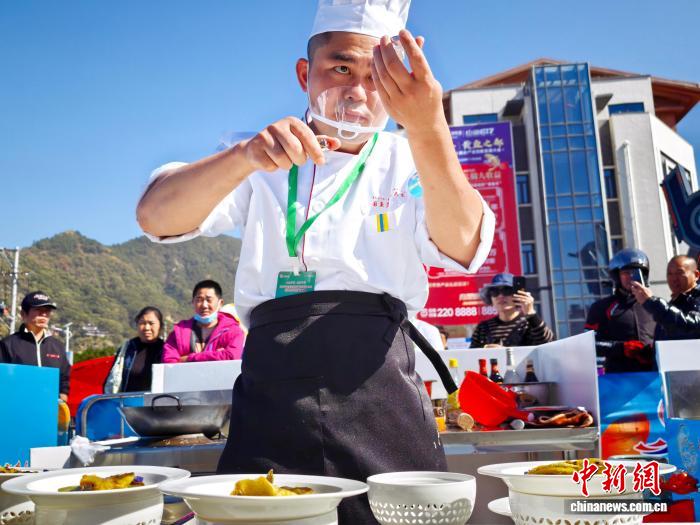
"当前,福建深耕'海'的文章、谋划'十五五'发展,大黄鱼产业迎来政策与市场机遇,也面临转型提质挑 战,亟需科研力量支撑。"福建省海洋与渔业局二级巡视员朱红表示,此次大会成果丰硕、平台优质, 将有力夯实产业创新基础、深化合作共赢。 据了解,本届大黄鱼产业创新发展大会涵盖线下、线上两大板块。线下板块作为本次活动的核心载体, 除启动仪式外,围绕"国鱼"IP举办万名鲜客品国鱼、线下大黄鱼销售促消费活动、国鱼烹饪创新大赛、 闽东特色美食嘉年华、宁台青年潮玩文化音乐荟等活动,实现产业展示、消费促进与文化交流的深度融 合;线上板块则聚焦品牌传播与产销对接,从11月1日起开展为期一个月的千家电商说国鱼、达人助力 活动以及大型电商平台销售活动,全方位激活产业活力。 中新网宁德11月29日电 (吴允杰)29日,福建省推进海洋经济高质量发展百场项目对接活动之"山海宁德 黄鱼之都"第九届宁德(霞浦)大黄鱼产业创新发展大会在福建省宁德市霞浦县举行,进一步提升宁德大 黄鱼品牌影响力,推动大黄鱼全产业链高质量发展。 据了解,本届大会以"创新·发展·品质·品牌"为核心目标,立足海洋经济高质量发展趋势,旨在通过一系 列创新举措与多元活动,全方 ...
从“文化符号”到“百亿产业” 宁德大黄鱼游出富民新路
Zhong Guo Xin Wen Wang· 2025-11-29 12:46
Core Insights - Ningde City has a deep cultural and economic connection with the large yellow croaker fish, which is integral to its identity and local economy [1][2][9] Industry Development - The large yellow croaker fish is a significant part of Ningde's culinary culture, with various traditional and innovative cooking methods being showcased at events like the "National Fish Cooking Innovation Competition" [4][6] - Ningde has been recognized as a "Culinary Landmark City for Large Yellow Croaker" by the Chinese Culinary Association, highlighting its efforts in brand building and culinary innovation [6] Economic Impact - The large yellow croaker industry in Ningde has evolved into a "billion-dollar industry," with the city producing approximately 21.49 million tons of large yellow croaker in 2024, accounting for about 80% of China's total production [9] - The total industrial chain value of the large yellow croaker in Ningde is projected to exceed 20 billion yuan [9] Technological and Market Innovations - Ningde is promoting the integration of the large yellow croaker industry with e-commerce, utilizing live streaming and other modern sales techniques to reach a broader customer base [7] - The city has 370 seafood processing enterprises, which are advancing from basic processing to more sophisticated products, enhancing market appeal and attracting younger consumers [7]
山东荣成:捕捞海参
Ren Min Wang· 2025-11-29 02:51
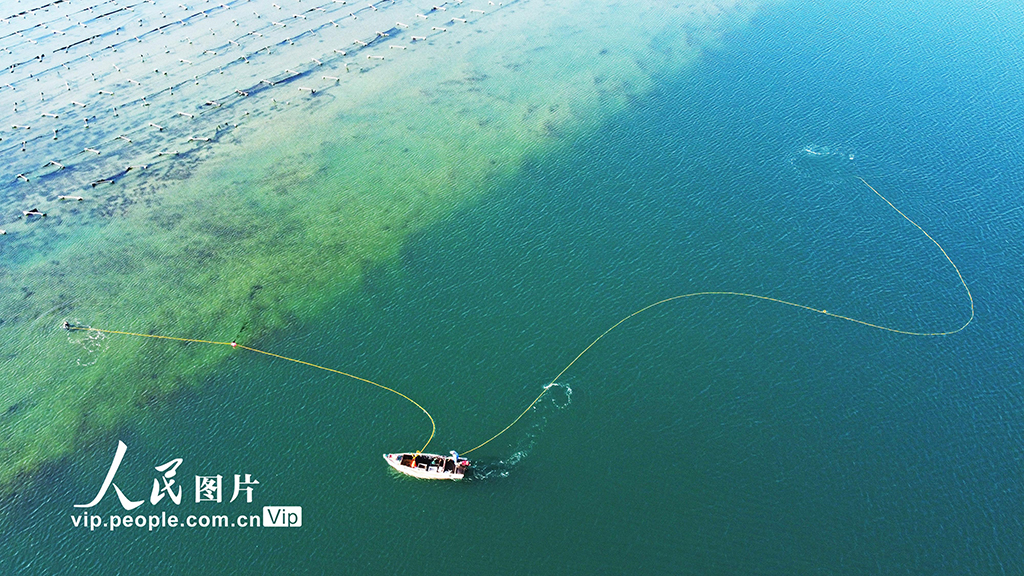
山东荣成:捕捞海参 山东荣成:捕捞海参【6】 山东荣成:捕捞海参【3】 山东荣成:捕捞海参【4】 山东荣成:捕捞海参【5】 山东荣成:捕捞海参【2】 ...
从“单村独斗”到“片区共生”:农业大省乡村振兴的组团发展样本
经济观察报· 2025-11-28 13:27
Core Viewpoint - Shandong province is implementing a "regionalization" approach to rural revitalization, integrating nearby villages to overcome challenges such as resource dispersion, weak industries, and population outflow, with 2,070 regional units established covering over 18,000 administrative villages [1][3][2] Group 1: Regionalization Concept - "Regionalization" involves grouping nearby villages with similar functions and development potential to plan and build collectively based on community needs [2][3] - The approach aims to address common issues in rural revitalization, such as small village sizes and limited resources, which hinder the integration of external factors [2][3] Group 2: Case Studies of Regionalization - The "Golden Mountain and Silver Sea" rural revitalization area in Yantai has established 17 supporting companies around the gold industry, generating over 6 million yuan in collective income and providing employment for over 1,000 villagers [7][8] - The Qingdao West Coast New Area's regionalization project integrates 10 villages, focusing on ecological preservation while promoting tourism and agriculture, resulting in over 60 million annual visitors and 100 million yuan in tourism revenue [12][13] Group 3: Mechanism Innovation - Mechanism innovation is crucial for activating development vitality, with Shandong employing cross-village cooperation, party leadership, and village-enterprise partnerships to enhance rural development [17][18] - In Feixian County, a new governance structure was established to promote differentiated development across four small regions, leading to significant economic growth and job creation [17][18] Group 4: Sustainable Development - The "Colorful Tomato" rural revitalization area in Shouguang focuses on creating a comprehensive tomato industry chain, achieving an annual production of 350,000 tons and significantly increasing local farmers' incomes [21][22] - The integration of modern agricultural practices and cooperative models has attracted young entrepreneurs back to rural areas, enhancing local economies and promoting sustainable growth [21][22][23]
