服务业

Search documents
国泰海通|宏观:PMI回落:主因外部扰动——2025年10月PMI数据点评
国泰海通证券研究· 2025-10-31 10:39
Core Insights - The manufacturing PMI for October 2025 is at 49.0%, a decrease of 0.8 percentage points from the previous month, indicating a contraction in the manufacturing sector [2] - External disturbances have led to a decline in manufacturing PMI, with new export orders and production indices showing significant drops, particularly in textiles, chemicals, and non-metallic mineral products [2][3] - The service sector remains stable, supported by holiday effects and promotional activities, while the construction sector shows signs of recovery due to government support for infrastructure projects [3] Manufacturing Sector - The manufacturing PMI has fallen below historical levels for this time of year, with external factors negatively impacting the external demand index [2] - New export orders and production indices have notably decreased, with specific industries like textiles and rubber products falling below critical thresholds [2][3] - The decline in the price index reflects external fluctuations, although some price support is noted from "anti-involution" measures [2] Non-Manufacturing Sector - The service sector's performance is buoyed by holiday spending and promotional events, with high activity in travel-related industries [3] - The construction sector's business activity index has slightly decreased, but government initiatives are expected to enhance support for infrastructure projects [3] - New orders and expectations in the construction sector are showing signs of recovery, indicating potential for improved economic conditions [3] Policy and Economic Outlook - Continuous macroeconomic policy support is essential, with a focus on managing expectations to stimulate domestic demand [3] - The "14th Five-Year Plan" emphasizes the need for an economy driven by domestic demand and consumption, aiming to create a positive cycle of expectation improvement leading to economic recovery [3]


2025年10月PMI数据解读:10月PMI:供需均有所放缓,新动能延续扩张
ZHESHANG SECURITIES· 2025-10-31 10:27
Group 1: PMI Overview - The manufacturing Purchasing Managers' Index (PMI) for October is 49.0%, a decrease of 0.8 percentage points from the previous month, indicating an economic slowdown[1] - The composite PMI output index stands at 50.0%, suggesting overall stability in production and business activities[1] - High-tech manufacturing and equipment manufacturing PMIs are at 50.5% and 50.2%, respectively, indicating continued expansion and support for the manufacturing sector[1] Group 2: Supply and Demand Dynamics - The production index for October is 49.7%, down 2.2 percentage points, reflecting a slowdown in manufacturing production[2] - New orders index recorded at 48.8%, a decline of 0.9 percentage points, indicating reduced demand in the manufacturing sector[3] - New export orders fell to 45.9%, significantly lower than seasonal expectations, influenced by ongoing trade tensions[3] Group 3: Price Index and Economic Resilience - The manufacturing purchase price index is at 52.5%, down 0.7 percentage points, while the factory price index is at 47.5%, also down 0.7 percentage points, indicating a general decline in price levels[7] - Despite the price index decline, new momentum-related industries show positive price trends, with equipment manufacturing prices rising for three consecutive months[7] - The composite PMI output index indicates economic resilience, with a slight decline of 0.6 percentage points, suggesting a convergence towards potential growth[10]
权威数读丨10月份PMI出炉,三大重点行业保持扩张
Xin Hua Wang· 2025-10-31 08:59
Core Viewpoint - The PMI index for October indicates that high-tech manufacturing, equipment manufacturing, and consumer goods industries continue to expand, significantly above the overall manufacturing level, reflecting sustained industry support and overall optimistic market expectations [1][3][5]. Group 1: PMI Data - The PMI for high-tech manufacturing, equipment manufacturing, and consumer goods industries are 50.5%, 50.2%, and 50.1% respectively, indicating continued expansion [5]. - The production and business activity expectation index stands at 52.8%, suggesting a positive outlook for market activities [5]. Group 2: Non-Manufacturing Sector - The non-manufacturing business activity index is at 50.1%, an increase of 0.1 percentage points from the previous month, indicating a return to the expansion zone [10]. - The service industry business activity index is at 50.2%, also up by 0.1 percentage points from last month, continuing its expansion [10].
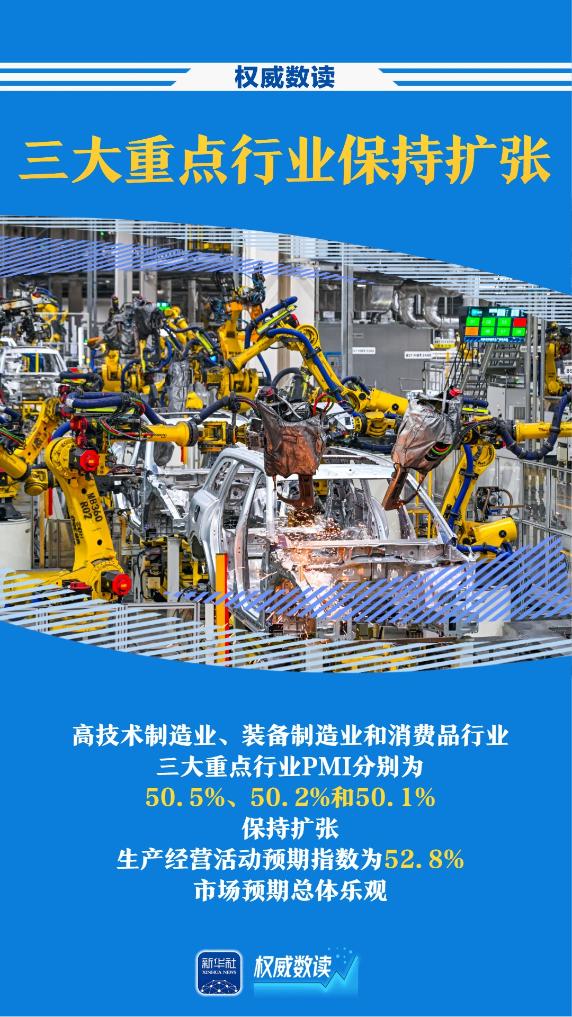
【数据发布】2025年10月中国采购经理指数运行情况
中汽协会数据· 2025-10-31 07:53
Group 1: Manufacturing PMI Overview - In October, the Manufacturing Purchasing Managers' Index (PMI) was 49.0%, a decrease of 0.8 percentage points from the previous month, indicating a decline in manufacturing activity [1][3] - The PMI for large, medium, and small enterprises were 49.9%, 48.7%, and 47.1% respectively, all below the critical point [3] - The production index was 49.7%, down 2.2 percentage points, suggesting a slowdown in manufacturing production [4] - The new orders index was 48.8%, down 0.9 percentage points, indicating a decrease in market demand [5] - The raw materials inventory index was 47.3%, down 1.2 percentage points, showing a continued reduction in inventory levels [5] - The employment index was 48.3%, down 0.2 percentage points, reflecting a slight decline in employment conditions in manufacturing [5] - The supplier delivery time index was at 50.0%, indicating stable delivery times compared to the previous month [5] Group 2: Non-Manufacturing PMI Overview - In October, the Non-Manufacturing Business Activity Index was 50.1%, an increase of 0.1 percentage points, indicating expansion [7] - The construction industry business activity index was 49.1%, down 0.2 percentage points, while the service industry index was 50.2%, up 0.1 percentage points [9] - The new orders index for non-manufacturing was 46.0%, unchanged from the previous month, indicating weak market demand [12] - The input prices index was 49.4%, up 0.4 percentage points, suggesting a narrowing decline in input prices [12] - The sales prices index was 47.8%, up 0.5 percentage points, indicating that sales prices remained below the previous month [12] - The employment index for non-manufacturing was 45.2%, up 0.2 percentage points, showing slight improvement in employment conditions [12] - The business activity expectation index was 56.1%, up 0.4 percentage points, indicating optimism among non-manufacturing enterprises regarding market prospects [13] Group 3: Comprehensive PMI Overview - The Comprehensive PMI Output Index was 50.0% in October, a decrease of 0.6 percentage points, indicating overall stability in production and business activities [16]
【权威解读】10月份制造业采购经理指数有所回落 非制造业商务活动指数略有回升
中汽协会数据· 2025-10-31 07:53
Group 1: Manufacturing Purchasing Managers Index (PMI) - In October, the manufacturing PMI decreased to 49.0%, down by 0.8 percentage points from the previous month, indicating a slowdown in production activities [1][2] - Both production index and new orders index fell to 49.7% and 48.8%, respectively, reflecting a decline in production and market demand [2] - Large enterprises maintained a PMI above the critical point, with indices at 50.9% for production and 50.1% for new orders, indicating sustained expansion in this segment [2][3] Group 2: Non-Manufacturing Business Activity Index - The non-manufacturing business activity index rose to 50.1%, an increase of 0.1 percentage points, indicating slight expansion [4][5] - The service sector's business activity index reached 50.2%, showing improvement, particularly in sectors like transportation and hospitality, which benefited from holiday effects [5] - The construction sector's business activity index slightly declined to 49.1%, but the business activity expectation index improved to 56.0%, suggesting a more optimistic outlook [5] Group 3: Comprehensive PMI Output Index - The comprehensive PMI output index stood at 50.0%, indicating overall stability in production and business activities across sectors [6]

三大重点行业保持扩张!国家统计局发布重要数据
Zhong Guo Zheng Quan Bao· 2025-10-31 05:42
Group 1: Manufacturing Sector - The manufacturing Purchasing Managers' Index (PMI) for October is reported at 49.0%, a decrease of 0.8 percentage points from the previous month, indicating a slowdown in manufacturing activity [1][2] - The production index and new orders index for manufacturing are at 49.7% and 48.8%, respectively, reflecting declines of 2.2 and 0.9 percentage points compared to last month [5] - Large enterprises maintain a PMI of 49.9%, while medium and small enterprises are at 48.7% and 47.1%, respectively, showing varying degrees of decline in economic sentiment [5] Group 2: Key Industries - High-tech manufacturing, equipment manufacturing, and consumer goods industries have PMIs of 50.5%, 50.2%, and 50.1%, respectively, indicating continued expansion and support for the overall manufacturing sector [5] - High-energy-consuming industries have a PMI of 47.3%, down 0.2 percentage points, suggesting a decline in economic activity within this sector [5] Group 3: Non-Manufacturing Sector - The non-manufacturing business activity index is at 50.1%, an increase of 0.1 percentage points from the previous month, indicating a slight expansion in the non-manufacturing sector [1][6] - The service sector's business activity index is reported at 50.2%, reflecting a slight increase and improved economic conditions in service-related industries [9] - The construction sector's business activity index is at 49.1%, a decrease of 0.2 percentage points, indicating a slight contraction in construction activities [10] Group 4: Market Expectations - The production and business activity expectation index for manufacturing is at 52.8%, indicating a generally optimistic outlook among manufacturers [6] - The business activity expectation index for the service sector is at 56.1%, suggesting strong confidence in future industry performance [10] - Overall, the non-manufacturing sector shows signs of stability, with positive changes in investment and consumption-related activities [11]
制造业PMI回落至49%,“反内卷”带动价格改善
第一财经· 2025-10-31 05:31
Core Viewpoint - The manufacturing PMI in October decreased to 49.0%, indicating a decline in manufacturing activity after two months of growth, influenced by pre-holiday demand release and a complex international environment [2][3] Manufacturing Sector - The manufacturing production index fell to 49.7%, down 2.2 percentage points from the previous month, indicating a slight contraction in production activities [6] - New export orders index dropped to 45.9%, a decrease of 1.9 percentage points, marking the second-lowest point this year, reflecting tightened export demand across major manufacturing sectors [7][8] - Large enterprises' PMI decreased to 49.9%, while medium and small enterprises saw PMIs of 48.7% and 47.1%, respectively, indicating varying levels of operational pressure across different enterprise sizes [10] Price Trends - The manufacturing sector experienced positive price changes, with the equipment manufacturing purchase price index and factory price index both rising for three consecutive months, reaching a new high since June 2024 [9][11] - The consumer goods manufacturing sector saw a decrease in purchase price index by 2.5 percentage points, indicating reduced cost pressures and stabilizing sales prices, which is beneficial for profit margins [11] Non-Manufacturing Sector - The non-manufacturing business activity index rose to 50.1%, indicating expansion, with significant activity in sectors related to consumer travel and services due to holiday effects [14] - The business activity expectation index for the service sector remained high at 56.1%, reflecting strong confidence among service enterprises regarding future development [14]

张家港前三季度经济运行数据出炉
Su Zhou Ri Bao· 2025-10-31 05:23
Economic Performance - Zhangjiagang's GDP for the first three quarters reached 242.4 billion, with a year-on-year growth of 5.4%, surpassing the national average of 5.2% and ranking fifth in Suzhou [1] - The total GDP ranks third among all county-level cities in Suzhou, indicating strong economic strength and stable development [1] Investment Highlights - Industrial investment in Zhangjiagang amounted to 21.83 billion, with a growth rate of 14.6%, ranking second in Suzhou [1] - Infrastructure investment saw a remarkable growth rate of 48.7%, also placing second in Suzhou [1] Service Sector Growth - The revenue from the scale above designated size in the service industry reached 14.9 billion, growing by 11.6%, ranking fourth in Suzhou [1] Construction Sector - The total output value of the construction industry was 17.851 billion, with a growth rate of 14.2%, ranking second in Suzhou [1] - The sales area of commercial housing increased by 3.3%, leading Suzhou [1] Future Outlook - Zhangjiagang plans to implement more effective measures to stabilize employment, enterprises, markets, and expectations, aiming to achieve the annual economic and social development goals and successfully conclude the "14th Five-Year Plan" [1]
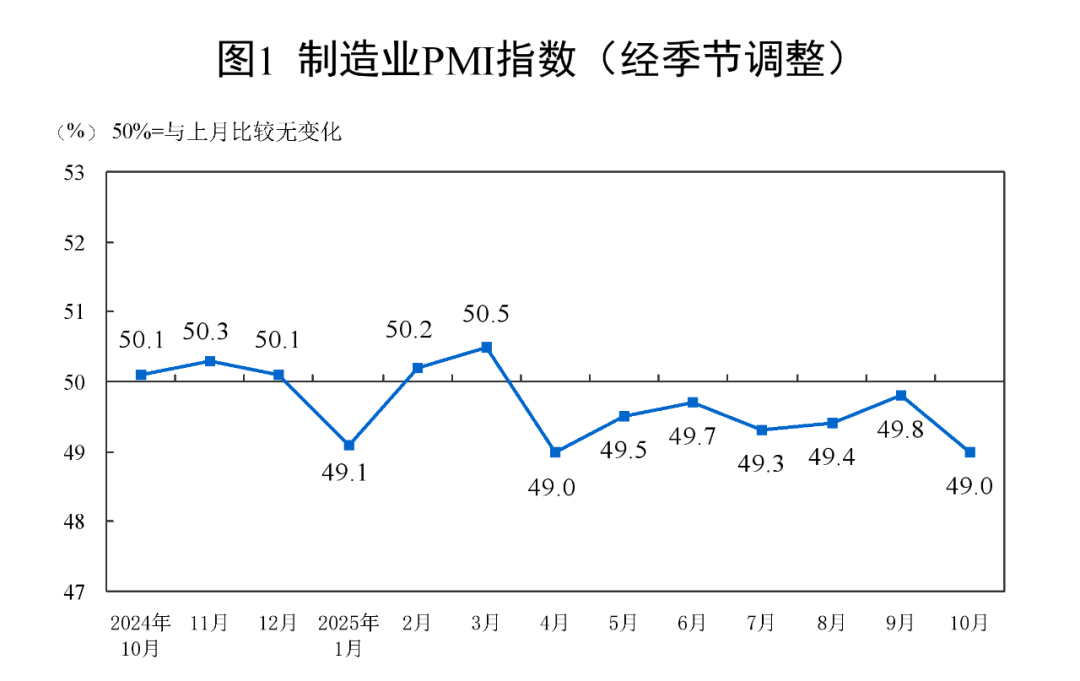
2025年10月中国采购经理指数为49.0%
Guo Jia Tong Ji Ju· 2025-10-31 05:00
Manufacturing PMI Overview - In October, the Manufacturing Purchasing Managers' Index (PMI) was 49.0%, a decrease of 0.8 percentage points from the previous month, indicating a decline in manufacturing activity [1] - The PMI for large, medium, and small enterprises was 49.9%, 48.7%, and 47.1%, respectively, all below the critical point, with declines of 1.1, 0.1, and 1.1 percentage points [1] - The production index was 49.7%, down 2.2 percentage points, suggesting a slowdown in manufacturing production [2] New Orders and Employment - The new orders index was 48.8%, a decrease of 0.9 percentage points, indicating a decline in market demand for manufacturing [2] - The raw materials inventory index was 47.3%, down 1.2 percentage points, showing a continued reduction in major raw material inventories [2] - The employment index was 48.3%, a slight decrease of 0.2 percentage points, reflecting a minor decline in employment levels within manufacturing [2] Non-Manufacturing PMI Overview - In October, the Non-Manufacturing Business Activity Index was 50.1%, an increase of 0.1 percentage points, indicating expansion in the non-manufacturing sector [3] - The construction industry index was 49.1%, down 0.2 percentage points, while the services industry index was 50.2%, up 0.1 percentage points [3] Non-Manufacturing Demand and Prices - The new orders index for non-manufacturing was 46.0%, unchanged from the previous month, indicating weak market demand [3] - The input prices index was 49.4%, an increase of 0.4 percentage points, suggesting a narrowing decline in input prices for non-manufacturing [4] - The sales prices index was 47.8%, up 0.5 percentage points, but still below the critical point, indicating lower sales prices compared to the previous month [4] Employment and Expectations in Non-Manufacturing - The employment index for non-manufacturing was 45.2%, an increase of 0.2 percentage points, indicating slight improvement in employment conditions [4] - The business activity expectation index was 56.1%, up 0.4 percentage points, reflecting optimism among non-manufacturing enterprises regarding market prospects [4] Composite PMI Overview - The Composite PMI Output Index was 50.0%, a decrease of 0.6 percentage points, indicating overall stability in production and business activities [5]

2025年10月中国采购经理指数运行情况
中国基金报· 2025-10-31 03:47
来源:统计微讯 国家统计局服务业调查中心 中国物流与采购联合会 一、中国制造业采购经理指数运行情况 10 月份,制造业采购经理指数( PMI )为 49.0% ,比上月下降 0.8 个百分点,制造业 景气水平有所回落。 从企业规模看,大、中、小型企业 PMI 分别为 49.9% 、 48.7% 和 47.1% ,比上月下 降 1.1 个、 0.1 个和 1.1 个百分点,均低于临界点。 从分类指数看,在构成制造业 PMI 的 5 个分类指数中,供应商配送时间指数位于临界 点,生产指数、新订单指数、原材料库存指数和从业人员指数均低于临界点。 生产指数为 49.7% ,比上月下降 2.2 个百分点,表明制造业生产有所放缓。 新订单指数为 48.8% ,比上月下降 0.9 个百分点,表明制造业市场需求有所回落。 10 月份,非制造业商务活动指数为 50.1% ,比上月上升 0.1 个百分点,升至扩张区 间。 原材料库存指数为 47.3% ,比上月下降 1.2 个百分点,表明制造业主要原材料库存量继 续减少。 从业人员指数为 48.3% ,比上月下降 0.2 个百分点,表明制造业企业用工景气度小幅回 落。 供应商配送 ...