石油石化

Search documents
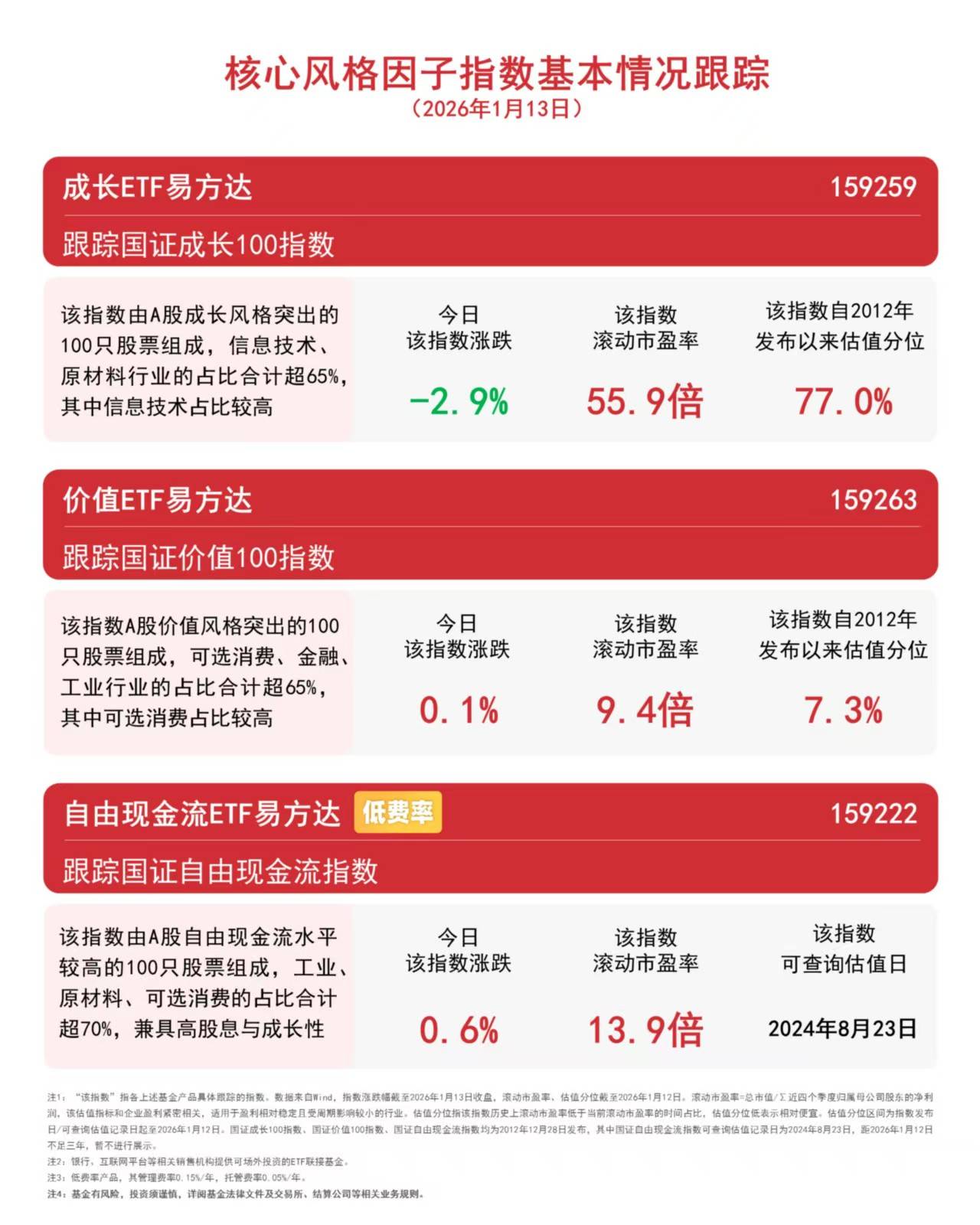
现金流指数逆势上涨,自由现金流ETF易方达(159222)获资金持续布局
Sou Hu Cai Jing· 2026-01-13 11:30
Group 1 - The technology growth sector is under pressure, while sectors such as non-ferrous metals and oil & petrochemicals show localized activity [1] - The Guozhen Free Cash Flow Index increased by 0.6%, the Guozhen Value 100 Index rose by 0.1%, and the Guozhen Growth 100 Index fell by 2.9% [1] - The E Fund Free Cash Flow ETF (159222) saw a net subscription of 40 million units throughout the day, continuing a trend of net inflows over the past seven trading days, totaling approximately 150 million yuan [1] Group 2 - The Guozhen Free Cash Flow Index selects stocks based on free cash flow rate, combining high dividend yield and growth potential [1] - The top five industries in the index are automotive, oil & petrochemicals, home appliances, transportation, and non-ferrous metals [1] - The E Fund Free Cash Flow ETF (159222) tracks this index, providing investors with opportunities to capitalize on related investment styles [1]

数据复盘丨重组蛋白、锂矿等概念走强 龙虎榜机构净买入25股
Zheng Quan Shi Bao Wang· 2026-01-13 11:01
Market Overview - The Shanghai Composite Index closed at 4138.76 points, down 0.64%, with a trading volume of 14816 billion yuan [1] - The Shenzhen Component Index closed at 14169.40 points, down 1.37%, with a trading volume of 21694.91 billion yuan [1] - The ChiNext Index closed at 3321.89 points, down 1.96%, with a trading volume of 10869.22 billion yuan [1] - The STAR 50 Index closed at 1469.57 points, down 2.8%, with a trading volume of 1044 billion yuan [1] - The total trading volume of both markets reached a historical high of 36510.91 billion yuan, an increase of 496.71 billion yuan from the previous trading day [1] Sector Performance - Among industry sectors, oil and petrochemicals, pharmaceuticals, non-ferrous metals, precious metals, and insurance showed the highest gains [3] - Concepts such as recombinant proteins, lithium mines, CRO, vitamins, and gold were actively traded [3] - The sectors with the largest declines included defense, electronics, communications, construction materials, machinery, real estate, and steel [3] Capital Flow - The net outflow of main funds from the Shanghai and Shenzhen markets was 1286.54 billion yuan, with the ChiNext experiencing a net outflow of 557.08 billion yuan [4][5] - Only three sectors, namely pharmaceuticals, beauty care, and oil and petrochemicals, saw net inflows of main funds, totaling 39.91 billion yuan, 1.15 billion yuan, and 0.82 billion yuan respectively [5] - The computer sector had the largest net outflow of main funds, amounting to 223.21 billion yuan [5] Individual Stock Performance - A total of 1977 stocks experienced net inflows, with 92 stocks receiving over 1 billion yuan in net inflows [6][7] - The stock with the highest net inflow was Haige Communication, with a net inflow of 17.57 billion yuan [7] - Conversely, 3188 stocks faced net outflows, with 371 stocks seeing over 1 billion yuan in net outflows [8][9] - The stock with the highest net outflow was Goldwind Technology, with a net outflow of 50.08 billion yuan [9] Institutional Activity - Institutional investors had a net buying of approximately 17.66 billion yuan, with 25 stocks being net bought and 14 stocks being net sold [10] - The stock with the highest net buying by institutions was China Satellite, with a net buying amount of about 6.79 billion yuan [10]
科技和资源品成为今年A股投资的两条核心主线,聚焦石化ETF(159731)低位配置价值
Mei Ri Jing Ji Xin Wen· 2026-01-13 09:47
Group 1 - The core viewpoint of the article highlights the positive outlook for the petrochemical industry, with a focus on the ongoing capital inflow into the petrochemical ETF and the anticipated market trends for 2026 [1] - The petrochemical ETF (159731) has seen a net inflow of 57.72 million yuan over the past four days, indicating strong buying interest [1] - CITIC Securities expresses optimism for the cross-year market, emphasizing the importance of focusing on future industry hotspots, AI, and the rising prices of resource products [1] Group 2 - The petrochemical industry is currently at the bottom of its cycle, with expectations for improvement in supply-demand dynamics and profitability due to supply-side structural reforms [1] - The basic chemical industry accounts for 59.2% and the oil and petrochemical industry for 32.6% of the Shenwan primary industry distribution, indicating a significant concentration in these sectors [1] - The article suggests that technology and resource products will be the two core investment themes for A-shares this year, with frequent sector rotation and style switching anticipated [1]

粤开市场日报-20260113-20260113
Yuekai Securities· 2026-01-13 09:28
Market Overview - The A-share market saw a majority of indices decline today, with the Shanghai Composite Index down by 0.64% closing at 4138.76 points, the Shenzhen Component down by 1.37% at 14169.40 points, the Sci-Tech 50 down by 2.80% at 1469.57 points, and the ChiNext Index down by 1.96% at 3321.89 points [1] - Overall, there were 1619 stocks that rose and 3726 stocks that fell, with a total market turnover of 36510 billion yuan, an increase of 496 billion yuan compared to the previous trading day [1] Industry Performance - Among the Shenwan first-level industries, the leading sectors included Oil & Petrochemicals, Pharmaceuticals & Biotechnology, Nonferrous Metals, Media, and Banking, with respective gains of 1.62%, 1.21%, 0.91%, 0.67%, and 0.65% [1] - Conversely, sectors such as Defense & Military, Electronics, Telecommunications, Computers, and Building Materials experienced declines, with losses of 5.50%, 3.30%, 2.88%, 1.92%, and 1.87% respectively [1] Sector Highlights - The top-performing concept sectors today included CRO, Selected Medical Services, Weight Loss Drugs, SPD, Lithium Extraction from Salt Lakes, Genetic Testing, Lithium Mining, Pharmaceutical Digitalization, Selected Insurance, Stem Cells, Synthetic Biology, Influenza, Gold & Jewelry, and Biotechnology [2]
【兴证策略】60大热门赛道:哪些拥挤度仍在低位?
Xin Lang Cai Jing· 2026-01-13 09:26
Core Insights - The article discusses the investment strategies for the year 2026, focusing on opportunities identified by top fund companies and managers in the market [1][124]. Group 1: Market Sentiment Indicator - The "Congestion Degree" is a unique indicator developed by the company to reflect trading sentiment in popular sectors, combining four dimensions: volume, price, funds, and analyst forecasts [3][126]. - This indicator quantitatively tracks changes in market sentiment and has strong implications for short-term stock price movements [3][126]. Group 2: TMT Sector Insights - The congestion levels for various TMT (Technology, Media, Telecommunications) segments are as follows: - Optical modules: congestion level is moderately low [10][131]. - Servers: congestion level is moderately high [8][133]. - Base stations: congestion level is moderate [10][135]. - Optical fiber and cables: congestion level is moderately high [10][136]. - IDC (Internet Data Center): congestion level is moderately high [10][136]. - Computer equipment: congestion level is high [10][139]. - Optical components: congestion level is high [10][140]. - RF components: congestion level is high [10][145]. - PCB (Printed Circuit Board): congestion level is moderate [10][146]. - IT services: congestion level is moderately high [10][147]. - Semiconductor materials: congestion level is high [10][157]. - Consumer electronics: congestion level is moderately low [10][172]. Group 3: Manufacturing Sector Insights - The congestion levels for various manufacturing segments are as follows: - Automotive parts: congestion level is high [10][181]. - Lithium batteries: congestion level is moderate [10][184]. - Wind power: congestion level is moderately low [10][187]. - Photovoltaic components: congestion level is high [10][197]. - Industrial robots: congestion level is high [10][199]. - Unmanned aerial vehicles: congestion level is high [10][200]. Group 4: Consumer and Pharmaceutical Sector Insights - The congestion levels for various consumer and pharmaceutical segments are as follows: - White goods: congestion level is low [10][207]. - Alcoholic beverages: congestion level is moderately low [10][209]. - Medical services: congestion level is moderately high [10][222]. Group 5: Financial and Real Estate Sector Insights - The congestion levels for various financial and real estate segments are as follows: - Real estate: congestion level is moderate [10][225]. - Insurance: congestion level is high [10][225]. - Banking: congestion level is low [10][226].
石油石化行业资金流入榜:中国海油等5股净流入资金超亿元
Zheng Quan Shi Bao Wang· 2026-01-13 08:54
Market Overview - The Shanghai Composite Index fell by 0.64% on January 13, with six industries experiencing gains, led by the oil and petrochemical sector, which rose by 1.62% [1] - The pharmaceutical and biological industry also saw an increase of 1.21% [1] - The defense and military industry and electronics sector faced the largest declines, with drops of 5.50% and 3.30% respectively [1] Capital Flow - The net outflow of capital from the two markets reached 162.743 billion yuan for the day [1] - Four industries experienced net inflows, with the pharmaceutical and biological sector leading at a net inflow of 4.348 billion yuan [1] - The oil and petrochemical industry followed with a net inflow of 586 million yuan [1] Oil and Petrochemical Sector - The oil and petrochemical industry rose by 1.62%, with a total net inflow of 586 million yuan [2] - Out of 47 stocks in this sector, 28 saw gains, including two that hit the daily limit [2] - The top stocks with significant net inflows included China National Offshore Oil Corporation (1.86 billion yuan), Sinopec (1.26 billion yuan), and Bohai Chemical (1.22 billion yuan) [2] Individual Stock Performance - The top performers in the oil and petrochemical sector included: - China National Offshore Oil Corporation: +3.57% with a turnover rate of 2.63% and a net inflow of 186.43 million yuan [2] - Sinopec: 0.00% change with a turnover rate of 0.26% and a net inflow of 125.57 million yuan [2] - Bohai Chemical: +10.14% with a turnover rate of 10.92% and a net inflow of 121.55 million yuan [2] - Conversely, the stocks with the largest net outflows included: - Intercontinental Oil and Gas: -0.56% with a net outflow of 1.6717 billion yuan [3] - China National Petroleum Corporation: +2.23% with a net outflow of 537.68 million yuan [3] - Zhongman Petroleum: +3.64% with a net outflow of 359.65 million yuan [3]



电子行业1月13日资金流向日报
Zheng Quan Shi Bao Wang· 2026-01-13 08:54
主力资金净流出的行业有27个,电子行业主力资金净流出规模居首,全天净流出资金370.10亿元,其次 是计算机行业,净流出资金为231.07亿元,净流出资金较多的还有国防军工、通信、电力设备等行业。 资金面上看,两市主力资金全天净流出1627.43亿元,今日有4个行业主力资金净流入,医药生物行业主 力资金净流入规模居首,该行业今日上涨1.21%,全天净流入资金43.48亿元,其次是石油石化行业,日 涨幅为1.62%,净流入资金为5.86亿元。 电子行业今日下跌3.30%,全天主力资金净流出370.10亿元,该行业所属的个股共476只,今日上涨的有 34只,涨停的有1只;下跌的有435只。以资金流向数据进行统计,该行业资金净流入的个股有92只,其 中,净流入资金超亿元的有9只,净流入资金居首的是兆易创新,今日净流入资金5.26亿元,紧随其后 的是京东方A、赛微电子,净流入资金分别为3.77亿元、2.85亿元。电子行业资金净流出个股中,资金 净流出超亿元的有93只,净流出资金居前的有领益智造、寒武纪-U、工业富联,净流出资金分别为 23.47亿元、22.80亿元、18.81亿元。(数据宝) 电子行业资金流入榜 | ...
226.97亿元主力资金今日撤离国防军工板块
Zheng Quan Shi Bao Wang· 2026-01-13 08:53
Market Overview - The Shanghai Composite Index fell by 0.64% on January 13, with six industries experiencing gains, led by the oil and petrochemical sector at 1.62% and the pharmaceutical and biotechnology sector at 1.21% [1] - The defense and military industry had the largest decline, dropping by 5.50%, followed by the electronics sector, which fell by 3.30% [1] Capital Flow Analysis - The net outflow of capital from the two markets reached 162.74 billion yuan, with only four industries seeing net inflows [1] - The pharmaceutical and biotechnology sector had the highest net inflow of 4.348 billion yuan, while the oil and petrochemical sector saw a net inflow of 586 million yuan [1] - The electronics industry experienced the largest net outflow, totaling 37.010 billion yuan, followed by the computer industry with a net outflow of 23.107 billion yuan [1] Defense and Military Industry Performance - The defense and military industry had 138 stocks, with only 11 stocks rising and one hitting the daily limit, while 126 stocks fell, including 20 that hit the daily limit [2] - The top stock for net capital inflow in this sector was Haige Communication, with a net inflow of 2.067 billion yuan, followed by Inner Mongolia First Machinery Group and Hongdu Aviation with net inflows of 191 million yuan and 93.939 million yuan, respectively [2] - A total of 44 stocks in the defense and military sector saw net outflows exceeding 100 million yuan, with the largest outflows from Aerospace Electronics, Aerospace Development, and Raytheon Defense, amounting to 4.706 billion yuan, 2.107 billion yuan, and 1.910 billion yuan, respectively [2] Top Gainers and Losers in Defense and Military Sector - The top gainers in the defense and military sector included Haige Communication (10.00% increase), Inner Mongolia First Machinery Group (4.30% increase), and Hongdu Aviation (2.39% increase) [3] - The top losers included Aerospace Electronics (-10.01% decrease), Aerospace Development (-10.00% decrease), and Raytheon Defense (-9.99% decrease) [4]


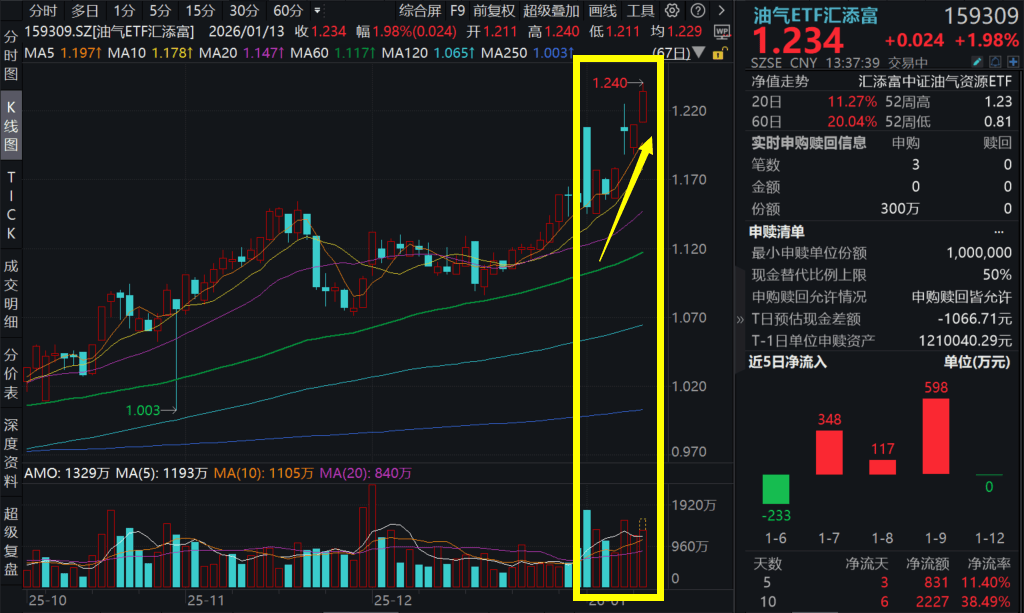
油气板块表现强势,中国海油涨超3%,油气ETF汇添富(159309)涨2%创新高!地缘风险推动油价回升,资源行情轮动到石油了?
Sou Hu Cai Jing· 2026-01-13 06:05
Core Viewpoint - The A-share market shows a mixed trend with the oil and gas sector experiencing significant inflows and price increases, particularly in the oil and gas ETF Huatai (159309), which reached a new high since its listing [1] Group 1: Market Performance - As of 13:38, the oil and gas ETF Huatai (159309) rose by 1.98%, hitting a new intraday high and attracting over 3.6 million yuan in capital [1] - The oil and gas sector saw most component stocks rise, with China National Offshore Oil Corporation (CNOOC) increasing over 3% and China Petroleum & Chemical Corporation (Sinopec) rising over 1% [5] Group 2: Geopolitical Factors - Concerns over the situation in Iran are supporting oil prices, with crude oil futures stabilizing near a one-month high [2] - Citic Futures indicates that geopolitical disturbances are likely to drive oil prices higher in the short term, despite a current oversupply in the global oil market [3] Group 3: Supply and Demand Dynamics - The OPEC+ group has decided to maintain its oil production levels, reflecting a desire to balance oil prices amid geopolitical tensions [4] - The International Energy Agency (IEA) projects a global oil demand increase of 860,000 barrels per day in 2026, with chemical feedstock demand expected to dominate this growth [6] Group 4: Investment Insights - The oil and gas sector is showing signs of recovery, with high dividend characteristics making it attractive for investors [6] - The oil and gas ETF Huatai (159309) focuses on the oil and gas industry chain, presenting long-term investment value amid external uncertainties [7]

【盘中播报】沪指涨0.04% 医药生物行业涨幅最大
Zheng Quan Shi Bao Wang· 2026-01-13 03:39
Market Overview - The Shanghai Composite Index increased by 0.04% as of 10:28 AM, with a trading volume of 995.73 million shares and a transaction value of 1,824.82 billion yuan, representing a 1.67% increase compared to the previous trading day [1] Industry Performance - The pharmaceutical and biological sector led the gains with a rise of 2.60%, followed by media at 2.07%, and oil and petrochemicals at 1.50% [1] - The defense and military industry experienced the largest decline at 5.76%, followed by electronics at 1.95%, and electric power equipment at 1.37% [2] Top Performing Stocks - In the pharmaceutical sector, Xinjianjiang surged by 30.00%, while in media, Liujin Technology rose by 25.66% [1] - The top performer in the oil and petrochemical sector was Bohai Chemical, which increased by 10.14% [1] - In the non-banking financial sector, Hualin Securities saw a rise of 10.02% [1] Declining Stocks - The largest decline in the defense and military sector was seen in Guolian Aviation, which fell by 14.12% [2] - In the electronics sector, Jiuzhiyang dropped by 13.00% [2] - The electric power equipment sector's top loser was Tongguang Cable, which decreased by 11.66% [2]