
量子科技

Search documents
A股异动丨中央定调6大未来产业之一!量子科技股走强,国盾量子涨超10%
Ge Long Hui A P P· 2025-10-27 02:53
Core Insights - The A-share market has seen a collective surge in quantum technology stocks, with notable increases in companies such as GuoDun Quantum and DaHua Intelligent [1][2] - The Central Committee of the Communist Party of China has proposed the development of emerging pillar industries, including quantum technology, as part of the 15th Five-Year Plan, which is expected to create several trillion-yuan markets [1] Company Performance - GuoDun Quantum (688027) rose by 10.54%, with a market capitalization of 47.6 billion and a year-to-date increase of 55.18% [2] - DaHua Intelligent (002512) increased by 10.09%, with a market cap of 5.462 billion and a year-to-date rise of 3.59% [2] - HengBao Co. (002104) reached a 9.99% increase, with a market cap of 15.8 billion and a year-to-date surge of 232.75% [2] - Other notable performers include GuangKu Technology (300620) up 5.85%, GuangXun Technology (002281) up 5.19%, and KeDa GuoChuang (300520) up 4.95% [2] Industry Trends - The proposed 15th Five-Year Plan emphasizes the acceleration of strategic emerging industries such as quantum technology, bio-manufacturing, hydrogen energy, and nuclear fusion, which are expected to become new economic growth points [1] - The plan aims to lay a forward-looking foundation for future industries, potentially reshaping China's high-tech sector over the next decade [1]





亚太股市,全线大涨!沪指涨超1%逼近4000点,芯片股领涨市场!中际旭创首次涨破500元关口
Mei Ri Jing Ji Xin Wen· 2025-10-27 02:37
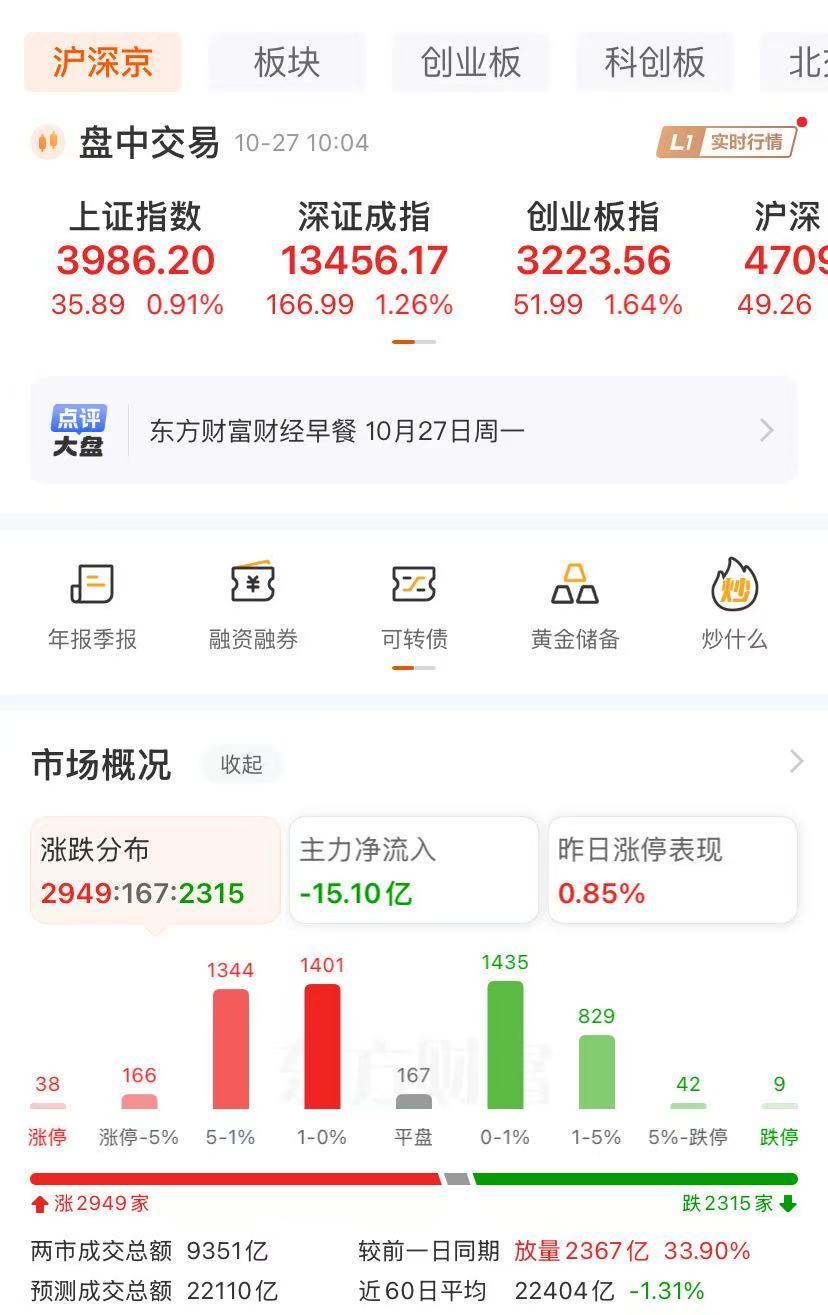
Market Performance - Global stock markets showed strong performance on October 27, with A-shares rising significantly, particularly the ChiNext Index which surged over 2% [1] - The Shenzhen Component Index increased by 1.26%, while the Shanghai Composite Index approached the 4000-point mark with a gain of over 1% [1] - Nearly 3000 stocks in the Shanghai, Shenzhen, and Beijing markets experienced price increases [1] Sector Highlights - Solid-state battery concept stocks saw a notable rise, with Guoxuan High-Tech hitting the daily limit, and several other companies like Hunan Youneng and Fangyuan shares rising over 10% [2] - Quantum technology stocks also gained momentum, with Guandun Quantum rising over 12% and Dahua Intelligent achieving three consecutive trading limit ups [2] - Computing hardware stocks continued their strong performance from the previous week, with Shijia Photon rising over 10% and Shengyi Electronics reaching a new historical high [3] Chip and Material Stocks - The storage chip sector remained active, with Puran shares soaring 10% to a new high, and other companies like Demingli and Xiangnong Chip Innovation also reaching new highs [5] - The photolithography sector opened significantly higher, with Tongcheng New Materials hitting the daily limit and several other companies rising over 10% [5] International Market Trends - The Hang Seng Index rose by 0.92%, and the Hang Seng Tech Index increased by 1.35%, with tech stocks continuing to rise [5] - Japanese and South Korean stock markets opened strongly, with the Nikkei 225 and KOSPI indices both gaining over 2% and reaching historical highs [5][6] - Notable individual stock performances included Kawasaki Heavy Industries rising over 6% and major South Korean firms like Hyundai Heavy Industries and Samsung Heavy Industries seeing gains of over 10% [6] Future Outlook - According to CITIC Securities, the A-share market has experienced significant volatility since the National Day and Mid-Autumn Festival, particularly in growth sectors like the ChiNext Index and the Sci-Tech Innovation 50 Index, which saw adjustments of around 10% [7] - Market sentiment has stabilized recently, and the overall market is expected to continue its "slow bull" trend, with "big tech" remaining a long-term focus [7] - Upcoming earnings reports from A-share companies and US tech giants are anticipated to be pivotal, especially in the context of the accelerating global AI arms race [7]

中央定调六大未来产业,这些城市已抢先布局
第一财经· 2025-10-26 02:45
Core Viewpoint - The article emphasizes the importance of emerging industries such as quantum technology, biomanufacturing, hydrogen energy, nuclear fusion energy, brain-computer interfaces, and embodied intelligence as new economic growth points in China's future development strategy [3][4]. Quantum Technology - Quantum technology is identified as a core area of the new technological revolution, with Hefei, Beijing, and Shanghai forming the "first tier" in terms of enterprise and patent applications [6][7]. - Hefei leads the domestic quantum industry, ranking second globally after San Francisco, with 93 quantum enterprises and over 2000 related patents [7]. - Beijing focuses on foundational technology breakthroughs, leveraging its dense research resources, and aims to build a trillion-yuan industry cluster by 2030 [7][8]. - Shanghai is concentrating on neutral atom quantum computing and has established key laboratories to drive innovation [8]. Biomanufacturing - Shanghai, Beijing, Shenzhen, and Tianjin are the top four cities in biomanufacturing competitiveness, with Shanghai's industry scale expected to exceed 1 trillion yuan by 2025 [10][11]. - Shenzhen has established a national biomanufacturing innovation center and is a hub for new enterprises in synthetic biology [11]. - Tianjin is leveraging its chemical industry base to develop biomanufacturing projects, attracting multinational companies [11]. Hydrogen and Nuclear Fusion Energy - Hydrogen and nuclear fusion energy are highlighted as clean energy "dual engines," with Beijing and Shanghai leading in technology and infrastructure development [12][13]. - Beijing plans to have 1,200 hydrogen fuel cell buses and 35 hydrogen stations by 2025, while Shanghai aims for its hydrogen industry to reach international leading levels by 2035 [13]. - Hefei is making significant advancements in nuclear fusion technology, participating in key international projects [14]. Brain-Computer Interfaces - The brain-computer interface (BCI) market in China is projected to grow from 3.2 billion yuan in 2024 to 5.58 billion yuan by 2027, with Shanghai, Beijing, and Shenzhen as the leading cities [15][16]. - Shanghai is developing a comprehensive BCI ecosystem and has launched the first BCI industrial cluster [16]. - Beijing is focusing on non-invasive BCI technologies, while Shenzhen is applying BCI in various fields, including education and gaming [17]. Embodied Intelligence - Embodied intelligence, represented by humanoid robots, sees Beijing, Shenzhen, Shanghai, and Hangzhou as the leading cities in technology and industry [18][19]. - Beijing aims to achieve significant technological breakthroughs and establish a robust industrial cluster by 2027 [19]. - Shenzhen is the manufacturing hub for humanoid robots, with a goal to support over 1,200 related enterprises by 2027 [19][20]. - Shanghai is working on a complete ecosystem for robotics, targeting a core industry scale of over 50 billion yuan by 2027 [20]. 6G Technology - 6G technology is being developed with Beijing as a core hub for standard-setting and innovation, aiming to create a testing environment by 2026 [21][22]. - Shenzhen is integrating 6G with AI and plans to establish a low-altitude economy demonstration zone [21][22]. - Nanjing is focusing on terahertz communication breakthroughs and aims for a 300 billion yuan industry value within five years [22][23].

中央定调六大未来产业,这些城市已抢先布局
Di Yi Cai Jing Zi Xun· 2025-10-26 01:13
Core Insights - The National Development and Reform Commission emphasizes the development of emerging pillar industries, including quantum technology, biomanufacturing, hydrogen energy, nuclear fusion energy, brain-computer interfaces, embodied intelligence, and 6G technology as new economic growth points [1] Quantum Technology - Hefei, Beijing, and Shanghai form the "first tier" in quantum technology, leading in enterprise and patent applications [2] - Hefei ranks first in China's quantum industry and second globally, with significant achievements in quantum computing [2] - Beijing focuses on foundational technology breakthroughs, while Shanghai specializes in neutral atom quantum computing [3] Biomanufacturing - Shanghai, Beijing, Shenzhen, and Tianjin are the top four cities in biomanufacturing competitiveness [4] - Shanghai's biomanufacturing industry is projected to exceed 1 trillion yuan by 2025, focusing on synthetic biology and cell therapy [5] - Shenzhen has established a national biomanufacturing innovation center, attracting a significant number of new enterprises [6] Hydrogen and Nuclear Fusion Energy - Beijing and Shanghai lead in hydrogen and nuclear fusion energy development, with various cities forming differentiated layouts [7] - Beijing plans to establish a comprehensive hydrogen energy infrastructure and has made breakthroughs in hydrogen fuel cell catalysts [8] - Shanghai aims to develop a leading hydrogen energy industry by 2035, with significant advancements in fuel cell vehicles [8] Brain-Computer Interfaces - Shanghai, Beijing, and Shenzhen are the leaders in the brain-computer interface market, which is expected to grow significantly by 2027 [9] - Shanghai has initiated a comprehensive layout for brain-computer interface technology, while Beijing focuses on non-invasive applications [10] Embodied Intelligence - Beijing, Shenzhen, Shanghai, and Hangzhou are leading in the embodied intelligence sector, particularly in humanoid robotics [12] - Beijing has established a humanoid robot innovation center, while Shenzhen is a manufacturing hub with a significant number of related enterprises [12][13] 6G Technology - Beijing, Shenzhen, Nanjing, and Shanghai are collaborating to establish a future network through 6G technology [14] - Beijing is a core hub for 6G standard formulation, while Shenzhen has a complete communication industry chain [15] - Nanjing has made breakthroughs in 6G terahertz frequency, aiming to become a 6G city with significant industrial output [16]
2025会议明牌:未来5年钱往哪流,都在这13个领域
Sou Hu Cai Jing· 2025-10-25 18:33
Core Viewpoint - The era of land finance is officially over, and the next five years will see a shift in wealth towards technology and green innovation, with a target to increase per capita GDP from $13,000 to $20,000 by 2035 [1][3] Group 1: Economic Transition - The focus of economic growth has shifted from investment and real estate to high-quality development, emphasizing self-controlled industrial chains, particularly in chips and artificial intelligence [3][5] - Significant investments are expected in high-end manufacturing, aerospace, and comprehensive transportation networks, indicating a strong capital flow into these sectors [5] Group 2: Emerging Opportunities - The AI sector is moving from concept to practical integration across various industries, while quantum technology is being pushed from laboratories to applications [5] - The domestic market is identified as a new growth area, with sectors like specialty dining, healthcare, and cultural entertainment poised for rapid development, especially in central and rural regions [5][6] Group 3: Policy Support and Market Trends - The "Three Guarantees" policy aims to support employment, consumption, and livelihood, benefiting businesses related to basic living needs, such as community services and affordable consumption [6] - The silver economy is projected to reach ¥30 trillion by 2035, creating a vast industry around elderly care and related services [8] Group 4: Infrastructure and Digital Trade - Urban development will shift from expansion to internal renewal, with over 700,000 kilometers of underground pipeline renovations expected, generating nearly ¥5 trillion in new investment demand [6] - The digital trade sector is expanding, with a current scale exceeding ¥3 trillion and 165 cross-border e-commerce pilot zones, allowing even small companies to engage in global trade [6] Group 5: Regional Development and Financial Market - Key regional developments are focused on the Yangtze River Delta and the Guangdong-Hong Kong-Macao Greater Bay Area, with specific attention to integrated circuits and biomedicine [10] - Financial market reforms are optimizing channels for long-term funds, enhancing market stability and potentially increasing foreign investment in A-shares [10]
从“十五五”的字里行间抓住发展的机会,搭上政策顺风车!
Yang Shi Wang· 2025-10-25 01:37
Group 1 - The "14th Five-Year Plan" emphasizes the development of strategic emerging industries such as new energy, new materials, aerospace, and low-altitude economy, which are expected to create trillion-level markets [3] - The advanced manufacturing sector is projected to see a market expansion of approximately 10 trillion yuan over the next five years, with opportunities across the supply chain from components to maintenance and testing services [4] - The service industry is expected to undergo transformation, integrating with manufacturing and agriculture, creating new opportunities for traditional service providers [6] Group 2 - The health and welfare sector is highlighted as a significant growth area, with an anticipated increase in life expectancy to 80 years, leading to a burgeoning market for elderly care services and community support teams [8] - There is a strong demand for childcare services, with government support for establishing regulated childcare facilities, presenting opportunities for entrepreneurs [8] - The overall economic landscape is described as a vast ocean, with various sectors such as advanced manufacturing, emerging industries, and essential services providing fertile ground for ordinary individuals to establish themselves [8]

在关键时期争取更大主动
Zhong Guo Qing Nian Bao· 2025-10-24 23:19
Group 1: Economic Development Strategy - The core outcome of the 20th Central Committee's Fourth Plenary Session is the approval of the "Suggestions on Formulating the 15th Five-Year Plan for National Economic and Social Development" [1] - The "15th Five-Year" period is crucial for achieving socialist modernization, with a focus on solidifying foundations and breaking through bottlenecks [1][2] - The emphasis is on relying on the real economy for future growth, with a significant contribution from the "three new" economies, which accounted for over 18% of GDP in 2024 [2] Group 2: Industrial and Agricultural Modernization - The plan outlines 12 strategic tasks, with the first being the construction of a modern industrial system to strengthen the real economy [2][3] - Traditional industries, which account for about 80% of manufacturing value, will undergo quality upgrades, with an estimated market space increase of around 10 trillion yuan over the next five years [3] - Agricultural modernization is prioritized, with specific measures to enhance agricultural productivity and ensure rural revitalization [4][5] Group 3: Technological Innovation - Technological innovation is highlighted as a key driver for economic and social development, with R&D investment expected to exceed 3.6 trillion yuan in 2024, a 48% increase from 2020 [7][8] - The focus will be on integrating technology with industry to enhance productivity and foster new economic growth points, particularly in artificial intelligence and high-tech sectors [8] Group 4: Open Economy and Global Integration - The strategy aims to shift from a "follower" to a "leader" in global trade, with initiatives to expand autonomous openness and enhance trade innovation [10][11] - China aims to leverage its large market potential, with over 800 million people expected to join the middle-income group in the next decade, to boost consumption and attract foreign investment [11]
中共中央举行新闻发布会解读党的二十届四中全会精神 系统谋划全面发力 “十五五”锚定七大目标推动高质量发展
Zheng Quan Shi Bao· 2025-10-24 19:28
Core Points - The Fourth Plenary Session of the 20th Central Committee of the Communist Party of China reviewed and approved the "Suggestions on Formulating the 15th Five-Year Plan for National Economic and Social Development" [1][2] - The "Suggestions" outline seven key goals for the 15th Five-Year Plan, emphasizing high-quality development, technological self-reliance, deepening reforms, improving social civilization, enhancing living standards, advancing ecological progress, and strengthening national security [2][4] Group 1: Economic Development - The "Suggestions" consist of 15 parts and 61 articles, divided into three main sections: general overview, specific strategic tasks, and tasks to strengthen centralized leadership [2] - The expected GDP for this year is approximately 140 trillion yuan, indicating continued economic growth [2] - The 15th Five-Year Plan aims to create around 10 trillion yuan of new market space over the next five years through the enhancement of key industries [4] Group 2: Industrial Strategy - The plan prioritizes building a modern industrial system and strengthening the foundation of the real economy [4] - It emphasizes upgrading traditional industries and developing advanced manufacturing clusters, particularly in sectors like chemicals, machinery, and shipbuilding [4] - The plan also focuses on fostering emerging industries such as new energy, new materials, and aerospace, with an aim to create new economic growth points [4] Group 3: Domestic Demand Expansion - The strategy to expand domestic demand includes three aspects: increasing volume, improving efficiency, and facilitating circulation [5][6] - The plan proposes actions to boost consumption and investment, including implementing special actions to stimulate consumption and enhancing service consumption [6] - It aims to create a unified national market by breaking down local protectionism and market segmentation [6] Group 4: Social Development - The plan sets a target to increase the average life expectancy of Chinese residents to around 80 years by the end of 2024 [7] - It emphasizes the need for a comprehensive approach to healthcare, including optimizing medical insurance and drug procurement policies [7] - The plan also focuses on promoting a fertility-friendly society, improving elderly care, and developing the silver economy [7]
中国的顶级阳谋:未来5年,中国经济的3大“新钱景”!10万亿级市场机会浮出水面
Sou Hu Cai Jing· 2025-10-24 18:44
Group 1 - The core message highlights the emergence of new growth engines in the Chinese economy, with significant opportunities in various sectors over the next five years [1][3] - The "new pillar industries" such as renewable energy, new materials, and aerospace are expected to form competitive industrial clusters, while the "low-altitude economy" is seen as a new growth point [3] - Future industries like quantum technology, biomanufacturing, hydrogen energy, nuclear fusion, brain-computer interfaces, and 6G are identified as key areas for national investment, potentially creating a scale equivalent to "rebuilding a high-tech industry in China" over the next decade [3] Group 2 - The marine economy in China has surpassed 10 trillion yuan, and the green low-carbon industry has reached approximately 11 trillion yuan, indicating a strong foundation for future growth [3] - The green low-carbon industry is projected to double in size during the "14th Five-Year Plan" period, reflecting a significant opportunity for investment and development [5] - Traditional industries are undergoing a transformation through technological upgrades, with an estimated market space of around 10 trillion yuan expected to be added in the next five years [5] Group 3 - Major investments in infrastructure, such as the construction and renovation of over 700,000 kilometers of underground pipelines, are anticipated to generate an investment demand exceeding 500 billion yuan [7] - The overall economic scale of China is projected to reach 140 trillion yuan this year, positioning the "14th Five-Year Plan" as a fertile ground for opportunities and growth [7]
再造一个中国高技术产业 谁是未来十年引领之城?
Mei Ri Jing Ji Xin Wen· 2025-10-24 15:58
Core Insights - The upcoming "15th Five-Year Plan" emphasizes the construction of a modern industrial system and the strengthening of the real economy as a strategic priority, focusing on the cultivation of emerging and future industries [1][3] - The plan aims to develop strategic emerging industry clusters in areas such as new energy, new materials, aerospace, and low-altitude economy, potentially creating several trillion-yuan markets [1][4] - The integration of technological and industrial innovation is crucial for cities to seize future development opportunities [1][2] Emerging Industries - Quantum Technology: Hefei is establishing a complete ecosystem for quantum technology, with nearly one-third of national quantum enterprises located there. The city is also creating a quantum technology future industry pilot zone with significant funding [4][5] - Biomanufacturing: The biomanufacturing industry in China is nearing a total scale of 1 trillion yuan, with cities like Shenzhen leading in synthetic biology and Guangzhou leveraging academic resources for innovation [7][8] - Hydrogen and Nuclear Fusion Energy: Over 20 provinces have outlined long-term plans for hydrogen energy, while Hefei and Chengdu are leading in nuclear fusion research, with significant experimental breakthroughs [10][11] - Brain-Computer Interfaces: Major cities like Beijing, Shanghai, and Shenzhen are actively developing policies to support the brain-computer interface industry, aiming to cultivate globally influential enterprises by 2030 [12][13] - Embodied Intelligence: The market for embodied intelligence is projected to grow significantly, with cities like Beijing and Shenzhen leading the charge in developing a robust industrial cluster [14][15] - Sixth-Generation Mobile Communication: Nanjing is emerging as a key player in 6G technology, with significant advancements in experimental networks and applications, while traditional strongholds like Beijing and Shanghai maintain their advantages [17][18]