光伏

Search documents
英国靠煤炭崛起,美国凭石油称霸,中国单月用电破万亿意味什么?
Sou Hu Cai Jing· 2026-02-25 03:54
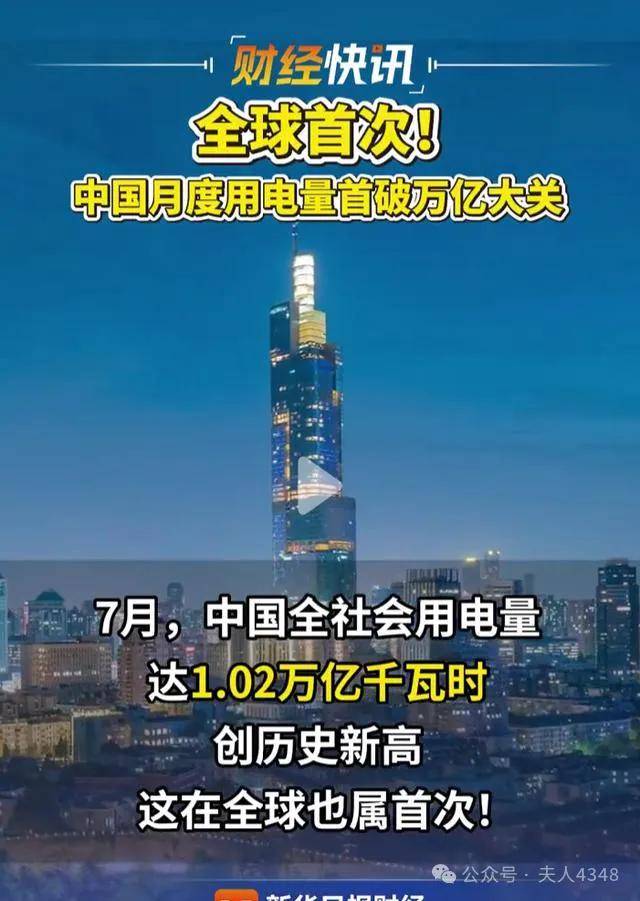
Group 1: Energy Consumption Milestone - In July, China's total electricity consumption exceeded 1 trillion kilowatt-hours for the first time in a month, equivalent to the annual electricity consumption of the ten ASEAN countries combined, and surpassing the total of Germany and France [1] - This figure represents a doubling compared to ten years ago, marking a historic milestone in energy consumption [1] Group 2: Historical Context of Energy Sources - The evolution of energy sources has been pivotal in shaping civilizations, with coal playing a crucial role in the Industrial Revolution and the rise of the British Empire [3][4][6] - Coal's energy density far exceeds that of wood, with one million tons of coal releasing heat equivalent to the combustion of six million acres of forest [7] - The transition from coal to oil marked a significant shift in energy dynamics, with the U.S. emerging as a leader in oil production after the first modern oil well was drilled in Pennsylvania in 1859 [9][12] Group 3: China's Energy Strategy - China, as the world's largest industrial nation, faces a unique energy challenge with abundant coal reserves but heavy reliance on imported oil and gas [13] - The country is pursuing a significant energy revolution, transitioning from fossil fuel dependence to renewable energy sources, particularly electricity [14] - China's strategy includes maximizing coal's clean and efficient use while aggressively expanding renewable energy capacity in wind and solar [14] Group 4: Implications for Industry and Technology - The recent surge in electricity consumption supports high-end manufacturing and a fully digitalized smart society, indicating a profound industrial transformation [14][15] - The electric vehicle industry has seen a 25.7% increase in electricity consumption, while solar manufacturing has surged by 30%, highlighting the energy-intensive nature of these sectors [15][16] - The rise of AI and data centers, which require substantial energy, underscores the importance of electricity as a strategic resource for future competitiveness [17][18] Group 5: Future Outlook - China's annual electricity consumption has surpassed 10 trillion kilowatt-hours, accounting for one-third of global consumption, while the U.S. stands at approximately 4 trillion [19] - The ongoing construction of the world's largest hydropower station and plans for over a hundred new nuclear power plants aim to establish China as a leading energy power [19][20] - Electricity is evolving from a mere commodity to a core strategic resource that influences national strength and global capital flows, signaling the onset of a new industrial revolution centered around China [20]

和众汇富研究手记:天合光能拓展西班牙市场
Cai Fu Zai Xian· 2026-02-25 03:14
在全球能源转型持续深化的背景下,国内光伏龙头企业再度传来海外订单进展。天合光能近日宣布,旗下天合跟踪已与 西班牙一家EPC企业达成合作协议,将为其位于西班牙的两大光伏电站项目提供合计360MW智能跟踪系统解决方案。 本次合作计划交付约11000套"开拓者1P"单排跟踪系统,项目建成后将有效提升电站发电效率与运行稳定性,也为公司 在欧洲成熟市场的进一步布局注入新动能。 外高端市场稳定获取订单的企业,往往具备更完善的产品矩阵与风险管控体系。天合光能在组件、储能及跟踪系统等多 领域形成协同布局,有助于分散单一产品价格波动带来的影响,提高整体盈利韧性。 此外,西班牙项目的实施还将进一步提升公司在欧洲市场的品牌影响力。当前全球光伏市场竞争格局加速重构,头部企 业通过本地化生产、技术合作与工程服务网络建设,不断巩固区域市场地位。和众汇富认为,本次合作不仅是一次设备 供货行为,更是公司深化欧洲战略布局的重要节点。随着项目逐步进入交付与并网阶段,其示范效应或将带动更多潜在 合作机会。 总体来看,天合光能通过此次360MW智能跟踪系统合作,展示了其在高端海外市场的产品实力与项目执行能力。在全 球能源结构加速转型、可再生能源装机 ...

能源转型新技术观察(6):太空光伏,是否会成为下一个星辰大海?
HTSC· 2026-02-25 02:50
Investment Rating - The report does not explicitly provide an investment rating for the industry Core Insights - The satellite launch industry is entering an accelerated phase, with significant growth expected in satellite deployment plans, including over 200,000 satellites submitted by China and 1 million by SpaceX, indicating a potential increase in the global satellite market from tens of MW to hundreds of MW and GW levels [15][21][22] - The space photovoltaic market is currently valued at 30 MW, representing only 2% of the terrestrial photovoltaic market, but could expand significantly under various scenarios, potentially reaching 100 GW and generating up to 9 times the value of the terrestrial market [3][18] - The competition for orbital resources is intensifying, with low Earth orbit (LEO) communication satellites becoming the primary focus, as they offer lower latency and broader applications compared to traditional satellites [16][35] Summary by Sections Section 1: Industry Growth and Satellite Launches - The global satellite launch volume is expected to reach a historical high in 2025, with a projected increase of 72.5% in new satellites launched, totaling approximately 4,330 satellites [22][21] - China's satellite deployment plans are ambitious, with a significant increase in the number of satellites expected to be launched by 2030, potentially exceeding 10,000 annually [21][27] Section 2: Space Photovoltaics Market Potential - The current space photovoltaic market is small, but three scenarios could lead to substantial growth: 1. A dense launch of communication satellites could push the market to 40% of the terrestrial photovoltaic market 2. Initial networking of computing constellations could create a demand for 10 GW of space photovoltaics, surpassing terrestrial values 3. Dominance of computing satellites could lead to a demand of 100 GW, increasing market value significantly [3][18] Section 3: Technological Developments and Supply Chain Opportunities - The report highlights the need for technological advancements in space photovoltaic systems, particularly in materials and efficiency, as traditional technologies face limitations in space environments [8][17] - The supply chain for space photovoltaics is expected to see increased demand for packaging materials, which are significantly more valuable in space applications compared to terrestrial uses [19][18] - The shift towards flexible solar wings is anticipated to replace rigid designs, creating new opportunities for materials such as UTG glass and CPI films [19][18]
科创新能源ETF(588830)涨超1.1%,北美光伏储能需求激增,成分股普涨带动指数上扬
Xin Lang Cai Jing· 2026-02-25 02:24
Group 1 - North American power supply tightness is driving Tesla and SolarCity to accelerate their deployment of photovoltaic and energy storage solutions, with Tesla planning to increase solar panel production capacity to 1GW, and a projected 30% growth in distributed photovoltaic deployment in 2023, leading to a North American installed photovoltaic capacity of 40GW by 2025 [1] - Analysis of the OBBB Act's energy storage details indicates that projects starting before August 2025 will not be assessed for non-PFE ratios, while MACR requirements for energy storage stations/systems will gradually increase to 55%-85% after 2026, suggesting that Chinese energy storage companies may need to expand their supply chains to include non-PFE battery suppliers [1] - As of February 25, 2026, the Shanghai Stock Exchange Sci-Tech Innovation Board New Energy Index (000692) rose by 1.24%, with constituent stocks such as Gaoce Co., Ltd. up 11.01%, Wenkang New Energy up 9.67%, and Jiayuan Technology up 5.23%, indicating strong market performance [1] Group 2 - Dongwu Securities highlights that photovoltaic installation growth in the Middle East will remain robust, with MESIA forecasting new installations in the region to increase from 5GW in 2024 to 35GW by 2030, prompting domestic Chinese photovoltaic leaders like JinkoSolar and TCL Zhonghuan to accelerate local production [2] - HJT technology is noted to have a cost advantage in the U.S. due to its simpler production process compared to TOPCon, resulting in lower overall costs suitable for the U.S. production environment; Tesla plans to deploy approximately 100GW of ground-mounted solar by 2028 to support AI computing power expansion and to promote integrated production from silicon wafers to modules to mitigate high tariff risks [2] - The Sci-Tech Innovation New Energy ETF closely tracks the Shanghai Stock Exchange Sci-Tech Innovation Board New Energy Index, which selects 50 large-cap stocks in photovoltaic, wind power, and new energy vehicles to reflect the overall performance of representative new energy companies in the Sci-Tech Innovation Board market [2]
工业硅:处于相对低估值区间多晶硅:情绪或提振盘面
Guo Tai Jun An Qi Huo· 2026-02-25 01:51
Report Summary 1. Report Industry Investment Rating - No information about the industry investment rating is provided in the report. 2. Core Viewpoints - The sentiment may boost the polycrystalline silicon market, but the trend strength of both industrial silicon and polycrystalline silicon is currently neutral, with a value of 0 [3]. 3. Summary by Directory 3.1 Fundamental Tracking - **Industrial Silicon and Polycrystalline Silicon Futures Market** - Si2605: The closing price is 8,410 yuan/ton, with a change of -40 yuan compared to T - 5 and -320 yuan compared to T - 22. The trading volume is 134,782 lots, showing a decrease of 65,318 lots compared to T - 5 and 101,060 lots compared to T - 22. The open interest is 293,851 lots, an increase of 7,958 lots compared to T - 1 [1]. - PS2605: The closing price is 47,000 yuan/ton, down 2,370 yuan compared to T - 5. The trading volume is 8,503 lots, an increase of 3,797 lots compared to T - 5. The open interest is 37,729 lots, with an increase of 885 lots compared to T - 1 [1]. - **Basis and Price** - Industrial silicon: The spot premium (against East China Si5530) is +890 yuan/ton, +440 yuan/ton (against East China Si4210), and +290 yuan/ton (against Xinjiang 99 silicon). The price of Xinjiang 99 silicon is 8,700 yuan/ton, and Yunnan Si4210 is 10,000 yuan/ton [1]. - Polycrystalline silicon: The spot premium (against N - type re - investment) is +3945 yuan/ton. The price of polycrystalline silicon - N - type re - investment material is 53,000 yuan/ton, down 650 yuan compared to T - 5 and 1750 yuan compared to T - 22 [1]. - **Profit** - Silicon plant profit: For Xinjiang new standard 553, it is - 2736.5 yuan/ton, and for Yunnan new standard 553, it is - 5616 yuan/ton [1]. - Polycrystalline silicon enterprise profit: 8.9 yuan/kg, an increase of 0.4 yuan compared to T - 1 [1]. - **Inventory** - Industrial silicon: The social inventory (including warehouse receipt inventory) is 55.7 million tons, a decrease of 0.5 million tons compared to T - 5. The enterprise inventory (sample enterprises) is 20.1 million tons, a decrease of 0.52 million tons compared to T - 5. The industry inventory (social inventory + enterprise inventory) is 75.8 million tons, a decrease of 1.02 million tons compared to T - 5 [1]. - Polycrystalline silicon: The manufacturer inventory is 34.9 million tons, an increase of 0.8 million tons compared to T - 5 [1]. - **Raw Material Cost** - Silicon ore: The price in Xinjiang is 320 yuan/ton, and in Yunnan is 230 yuan/ton [1]. - Washed coking coal: The price in Xinjiang is 1475 yuan/ton, and in Ningxia is 1200 yuan/ton [1]. - Petroleum coke: The price of Maoming coke is 1400 yuan/ton, and Yangzi coke is 1740 yuan/ton [1]. - Electrode: The price of graphite electrode is 12450 yuan/ton, and carbon electrode is 7200 yuan/ton [1]. - **Polycrystalline Silicon (Photovoltaic) and Related Products** - Price: The price of silicon wafers (N - type - 210mm) is 1.43 yuan/piece, down 0.05 yuan compared to T - 5. The price of battery cells (TOPCon - 210mm) is 0.435 yuan/watt, down 0.01 yuan compared to T - 5. The price of components (N - type - 210mm, centralized) is 0.738 yuan/watt, unchanged compared to T - 5. The price of photovoltaic glass (3.2mm) is 17.5 yuan/cubic meter, unchanged compared to T - 5. The price of photovoltaic - grade EVA is 9000 yuan/ton, unchanged compared to T - 5 [1]. - Profit: The profit of DMC enterprises is 1954 yuan/ton, a decrease of 7 yuan compared to T - 5. The profit of recycled aluminum enterprises is 490 yuan/ton, an increase of 80 yuan compared to T - 5 [1]. 3.2 Macro and Industry News - On February 9, the IEC international standard "Measurement Specification for R & D Perovskite Photovoltaic Cells" (IEC/TS 63202 - 9 ED1) led by China Huaneng Group Co., Ltd. was successfully established. This is the first international standard led by China in the perovskite photovoltaic field, which will help consolidate China's leading position in the standard testing of perovskite photovoltaic cells and promote the technological innovation and high - quality development of the perovskite photovoltaic cell industry [3].
油气概念股全线爆发 行业板块多数收涨 复工首日A股迎开门红
Jing Ji Guan Cha Bao· 2026-02-25 01:49
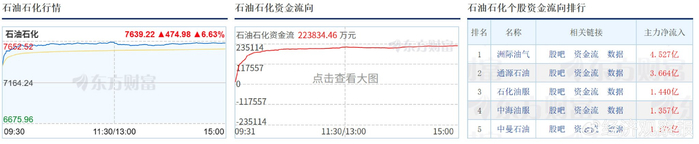
经观能源 2月24日,A股三大股指高开高走、放量上行,市场交投活跃度提升,石油化工、有色金属、贵黄金多 数板块表现强势,多只个股实现涨停或大幅上涨,展现出较强的市场活力。 贵金属板块全线暴涨,成为当日市场一大亮点。晓程科技领涨板块,涨幅高达15.19%;四川黄金涨 停,涨幅9.99%;中国黄金、西部黄金、招金黄金、赤峰黄金、中金黄金涨幅均超5%,分别为8.71%、 6.37%、5.88%、5.44%、5.39%;紫金矿业、湖南黄金、山东黄金也均有不错表现,涨幅分别达4.08%、 4.03%、3.61%,板块内个股全线飘红,无一下跌。 储能板块震荡上行,整体呈现涨多跌少格局,多只个股实现涨停或大幅上涨。新锦动力以20.07%的涨 幅实现20cm领涨;明阳电气、瑞可达、铜冠铜箔涨幅均超14%,其中明阳电气上涨17.48%、瑞可达上 涨16.63%、铜冠铜箔上涨14.49%;安靠智电、中油工程、通鼎互联、白云电器、风华高科等个股涨幅 超10%,豫能控股、协鑫集成、嘉泽新能涨幅接近10%,潍柴动力上涨8.62%,板块整体涨幅中等,龙 头个股表现突出。 石油化工板块表现突出,全线爆发领跑市场,板块内多只个股强势涨停。其 ...
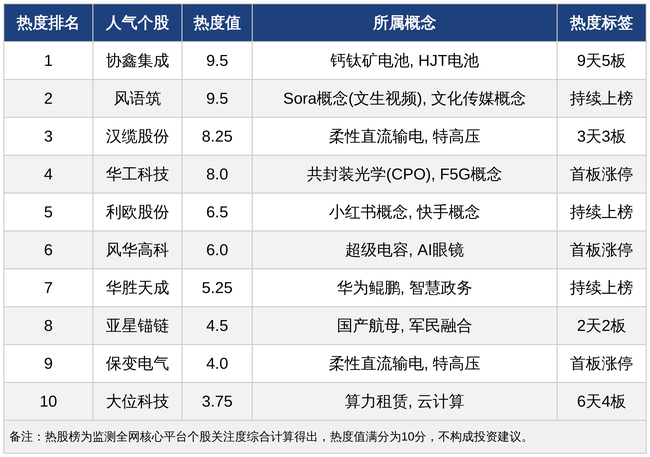
今日十大热股:协鑫集成9天5板领衔,风语筑、汉缆股份持续爆炒
Jin Rong Jie· 2026-02-25 01:48
Market Overview - The Shanghai Composite Index rose by 0.87% to 4117.41 points, while the Shenzhen Component Index increased by 1.36% and the ChiNext Index by 0.99%. Only the Sci-Tech Innovation 50 Index saw a decline of 0.34% [1] - The total trading volume in the Shanghai and Shenzhen markets reached 2.20 trillion yuan, an increase of approximately 219.84 billion yuan compared to the previous day. A total of 3764 stocks rose, while 1344 stocks fell [1] - Key sectors that performed well included mining, electronic textiles, and crude oil, while the film and entertainment and AI animation sectors lagged behind [1] Fund Flow Analysis - Major net inflows were observed in the electronic and non-ferrous metal sectors, while significant net outflows were noted in the computer and media sectors, with an overall net outflow of 3.178 billion yuan in the main market funds [1] Popular Stocks - The top ten popular stocks included Xiexin Integrated, Fengyuzhu, Hancable, Huagong Technology, Lio Co., Fenghua High-Tech, Huasheng Tiancheng, Yaxing Anchor Chain, Baobian Electric, and Dawi Technology [1] Company Highlights - **Xiexin Integrated**: Gained attention due to multiple catalysts, including a focus on perovskite battery technology with a certification efficiency of 33.31% and a strategic development in integrated solar storage [3] - **Fengyuzhu**: Notable for its strategic layout in AI technology and cultural technology, collaborating with ByteDance on a youth art support program, enhancing its appeal in the digital exhibition business [3] - **Hancable**: Benefited from macro policies and industry demand, with a focus on high-voltage direct current and offshore wind power transmission, and a leading technology in flexible DC submarine cables [3] - **Huagong Technology**: Driven by the explosion in AI computing demand, with a full order book for its optical module business and the launch of a 3.2T CPO optical engine product [4] - **Lio Co.**: Attracted attention for its strategic alignment with market trends in AI marketing and liquid cooling servers, achieving a turnaround in profitability [5] - **Fenghua High-Tech**: Gained traction due to tightening supply-demand dynamics in the MLCC industry, with expectations of price increases and strong demand from AI computing and new energy vehicles [5] - **Huasheng Tiancheng**: Gained popularity due to its involvement in Huawei Kunpeng and smart governance concepts, with significant profit growth signals in the first three quarters [5] - **Yaxing Anchor Chain**: Recognized for its leading position in the global anchor chain industry, with increasing demand driven by deep-sea projects and floating wind power development [5]


2.25犀牛财经早报:存储芯片涨价或将贯穿全年
Xi Niu Cai Jing· 2026-02-25 01:44
Group 1 - The total issuance scale of new funds in China has exceeded 209.4 billion yuan, with 227 new funds established as of February 24, 2026 [1] - 65 funds have raised over 1 billion yuan, with 15 funds exceeding 3 billion yuan, indicating strong market interest [1] - Insurance institutions are optimistic about the A-share market and plan to slightly increase their allocation to A-shares in 2026 [1] Group 2 - Over 93.2% of insurance asset management products have achieved positive returns this year, with nearly 20 products yielding over 10% [1] - The focus for insurance asset management institutions is expected to shift towards technology innovation and high-quality listed companies in key sectors [1] Group 3 - The private credit fund industry is facing warnings of potential defaults, with UBS predicting a default rate could reach 15% [2] - Concerns have been raised about the stability of private credit funds, particularly following redemption restrictions by Blue Owl Capital [2] Group 4 - The banking sector has seen a cold start to the year, with institutions expressing concerns over credit quality and lending trends [2] - Recent financial data indicates a rare year-on-year decline in credit issuance, raising questions about the banking sector's performance [2] Group 5 - The cancellation of export tax rebates for the photovoltaic industry is set to take effect on April 1, 2026, which may accelerate industry consolidation [3] - Companies are increasing production to maximize exports before the policy change, but there are concerns about demand in the second quarter [3] Group 6 - The global storage chip market is expected to see price increases starting in Q3 2025, driven by advancements in AI and computing power [4] - Chinese storage companies are making significant progress, positioning themselves as key players in the global market [4] Group 7 - HP reported a first-quarter revenue of $14.4 billion, a 6.9% increase year-on-year, with personal systems business revenue growing by 11% [6] - The company expects adjusted earnings per share for the fiscal year to be between $2.90 and $3.20 [6] Group 8 - Keep anticipates a narrowed loss of approximately 72 million yuan for the fiscal year ending December 31, 2025, compared to a larger loss in the previous year [6] - The company also expects to report an adjusted profit of around 25 million yuan for the same period [6] Group 9 - Huayi Technology has submitted an application for H-share issuance and listing on the Hong Kong Stock Exchange [7] - The application is subject to approval from regulatory bodies, indicating potential future growth opportunities [8] Group 10 - Kaipu Cloud has terminated its major asset restructuring plan to acquire a 70% stake in Nanning Taike Semiconductor due to market changes [9] - The company has committed to not planning any major asset restructuring for at least one month following the announcement [9] Group 11 - Hualian Holdings plans to acquire 100% of Argentum Lithium S.A. for approximately $175 million, pending shareholder approval [10] - The transaction is not classified as a related party or major asset restructuring, but it carries uncertainties regarding implementation [10] Group 12 - Supor reported a slight increase in revenue for 2025, but a 6.58% decline in net profit, attributed to decreased export orders and rising sales expenses [11] - The company is focusing on cost reduction and efficiency improvements to enhance profitability [11] Group 13 - Aidi Pharmaceutical reported a revenue increase of 72.49% for 2025, but still incurred a net loss of approximately 19.73 million yuan [12] - The increase in revenue is linked to higher sales of innovative HIV drugs and the consolidation of Nanda Pharmaceutical's operations [12] Group 14 - Weidong Nano reported a revenue decline of 2.52% for 2025, with a net profit decrease of 6.12%, influenced by reduced acceptance of photovoltaic equipment [13] - The company continues to invest heavily in R&D to maintain its competitive edge in new photovoltaic technologies [13] Group 15 - U.S. stock markets saw collective gains, with the Nasdaq rising by 1.04%, driven by rebounds in software and AI-related stocks [14] - The dollar index rebounded, while gold and silver prices experienced declines after recent highs [14]
光伏概念盘初走强,云南锗业、泰嘉股份双双涨停
Xin Lang Cai Jing· 2026-02-25 01:33
Group 1 - The photovoltaic sector showed initial strength, with Yunnan Zhenye and Taijia Co., Ltd. both hitting the daily limit up [1] - Wind and solar companies such as Fengguang Co., Ltd. rose over 18%, indicating positive market sentiment [1] - Other companies like Kaide Quartz, Dingjide, Dongyue Silicon Materials, and Xinlei Co., Ltd. also experienced gains, reflecting a broader trend in the industry [1]




研判2026!全球及中国光伏背板行业政策、产业链、发展现状、重点企业及未来展望:光伏背板市场需求萎缩,玻璃背板成为行业主流[图]
Chan Ye Xin Xi Wang· 2026-02-25 01:26
Core Viewpoint - The Chinese photovoltaic backsheet industry exhibits a fluctuating market scale, with growth driven by policy support and installation expansion from 2015 to 2017, followed by a downturn due to regulatory adjustments and price declines in 2018-2019. The market rebounded from 2020 onwards, reaching 8.5 billion yuan in 2022, but is expected to decline in 2023-2024 due to increased penetration of bifacial modules and intensified price competition [1][14]. Industry Overview - Photovoltaic backsheets are essential encapsulation materials located at the back of photovoltaic modules, providing protection against environmental factors and ensuring insulation [2][5]. - The structure of photovoltaic backsheets typically consists of five layers, with the outer layer made of PVDF for environmental resistance, a middle layer of PET for insulation, and inner layers of PVDF and EVA for adhesion [2][4]. Market Dynamics - The market for photovoltaic backsheets is influenced by the rapid penetration of bifacial modules, increased competition in traditional backsheet pricing, and adjustments in the global photovoltaic supply chain [1][14]. - The market scale reached 8.5 billion yuan in 2022, but is projected to decline in 2023-2024 due to various factors [1][14]. Industry Policies - The photovoltaic industry is supported by national policies aimed at promoting renewable energy, which has led to significant growth in both scale and technology within the sector [5][13]. - Policies such as the "14th Five-Year Plan for Renewable Energy Development" aim for renewable energy consumption to reach 18% of total energy consumption by 2025 [13]. Industry Chain - The photovoltaic backsheet industry has a complex supply chain, with upstream materials including PVDF, PVF, PET, and glass. Domestic materials have increasingly met performance and quality standards, reducing reliance on foreign suppliers [5][7]. - The midstream involves the manufacturing of backsheets, while the downstream is focused on application within the photovoltaic industry [5][6]. Market Share of Materials - The primary materials used in photovoltaic backsheets include PVDF (53%), PVF (15%), glass (14%), PET (10%), and others, with PVDF being the dominant material due to its superior properties [7][8]. Competitive Landscape - The market is characterized by a high concentration of leading domestic companies such as Zhonglai Co., Foster, and Saiwu Technology, with significant production bases primarily located in Jiangsu and Zhejiang provinces [15][16]. - In 2024, the estimated shipment volumes for major companies are projected to be 135 million square meters for Zhonglai, 100 million for Foster, and 89 million for Saiwu [15]. Development Trends - The industry is expected to see advancements in flexible photovoltaic backsheet technology, ultra-thin and lightweight materials, and the integration of smart functionalities into backsheets [17][18][19]. - These innovations aim to enhance adaptability, reduce costs, and improve the overall efficiency and reliability of photovoltaic systems [17][18][19].