
集成电路

Search documents
美佳音控股复牌高开166% 拟获极海中国折让约18.7%提全购要约
Zhi Tong Cai Jing· 2026-01-26 01:37
Core Viewpoint - Meijiayin Holdings (06939) resumed trading with a significant increase of 166.67%, reaching HKD 2 per share, with a trading volume of HKD 1.7 million [1] Group 1: Shareholder Transactions - Three shareholders sold a total of 40.67% of their shares to an independent third party, Geehy International, involving 211 million shares for a total consideration of HKD 105.5 million, equating to a price of HKD 0.5 per share [1] - The company issued 103 million new shares to the offeror at a price of HKD 0.61 per share, raising a net amount of HKD 61.28 million for research and development of chip products and solutions, marketing, and general working capital [1] Group 2: Ownership and Mandatory Offer - Following the completion of the transactions, the offeror will hold 50.56% of the company's equity, necessitating a mandatory general offer at a cash price of HKD 0.61 per share, which represents an 18.67% discount compared to the last closing price before the suspension [1] - The offeror is an indirect wholly-owned subsidiary of Jihai China, which is directly owned 81.084% by Nasda (002180) and 7.895% by the National Integrated Circuit Industry Investment Fund Phase II, with 21 other minority shareholders each holding less than 5% [1]
港股异动 | 美佳音控股(06939)复牌高开166% 拟获极海中国折让约18.7%提全购要约
智通财经网· 2026-01-26 01:31
Group 1 - The core point of the article is that Meijiayin Holdings (06939) resumed trading with a significant increase of 166.67%, reaching HKD 2 per share, with a trading volume of HKD 1.7 million [1] - Three shareholders of Meijiayin Holdings sold a total of 40.67% of their shares to an independent third party, Geehy International, involving 211 million shares for a total consideration of HKD 105.5 million, equating to a price of HKD 0.5 per share [1] - The company issued 103 million new shares to the offeror at a price of HKD 0.61 per share, raising a net amount of HKD 61.28 million, which will be used for research and development of chip products and solutions, marketing, and general working capital [1] Group 2 - After the completion of the transaction, the offeror will hold 50.56% of the company's equity and is required to make a mandatory general offer at a cash price of HKD 0.61 per share, which represents an 18.67% discount compared to the last trading price before suspension [1] - The offeror is a wholly-owned subsidiary of Jihai China, which is directly owned 81.084% by Nasda and 7.895% by the National Integrated Circuit Industry Investment Fund Phase II, with 21 other minority shareholders each holding less than 5% of Jihai China [1]
5万亿之城如何挑大梁、做尖兵?
Guo Ji Jin Rong Bao· 2026-01-26 01:29
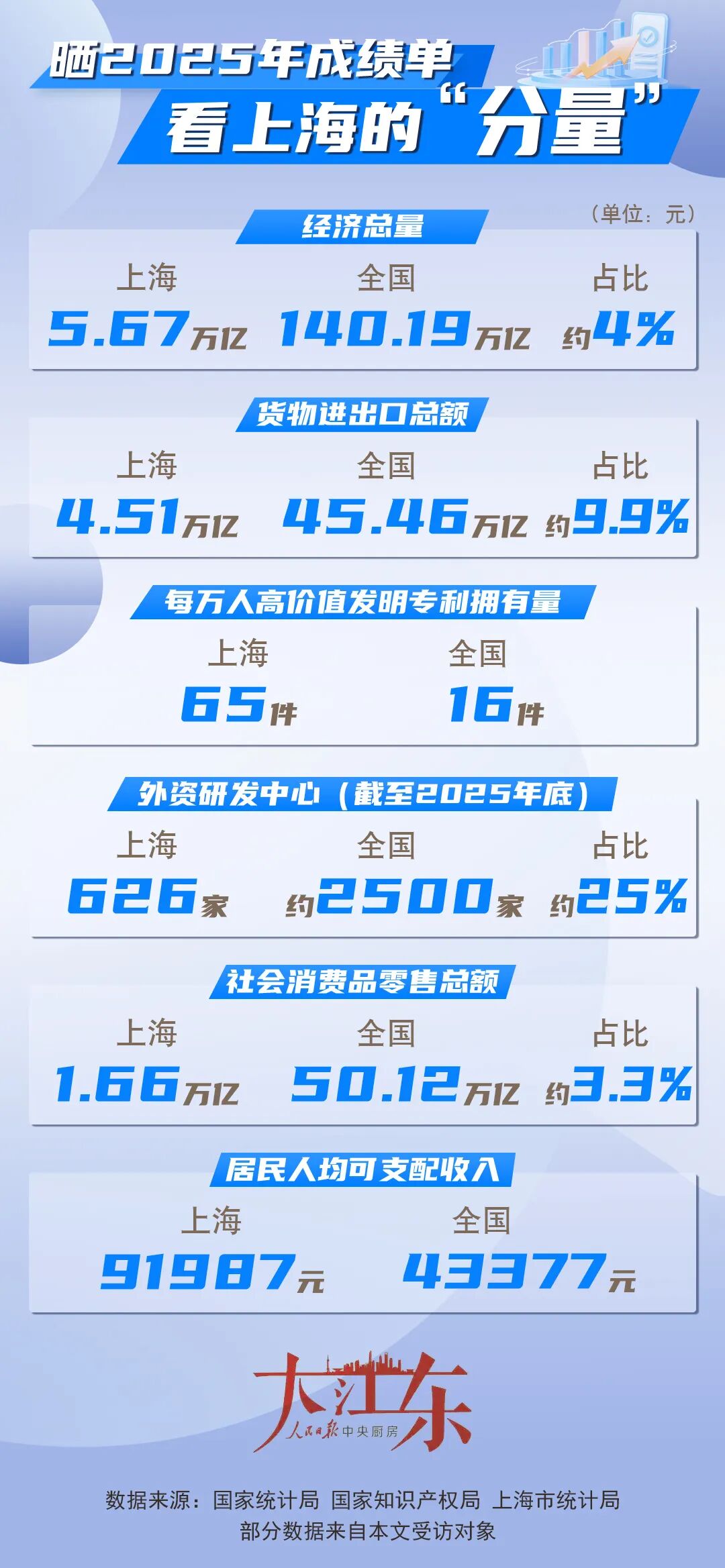
你追我赶,奋勇争先。中国经济正在开启"十五五"新征程。 山东,全省GDP过10万亿元。这个北方经济大省,成为继广东、江苏之后,第三个10万亿元的省份; 北京,在上海之后,也闯进了"5万亿元城市俱乐部"; 上海,从2021年GDP总量站上4万亿元,到成为全国首个5万亿之城,再到2025年全市生产总值增长5.4%左右,高于全国平均增速0.4个百分点…… 一图看上海的"分量" "上海的'GDP贡献',实质是为中国式现代化提供了系统性解决方案的'样本'" 大江东:从"十四五"期间表现来看,上海哪些经济指标反映出"经济大省挑大梁"的作用?为全国贡献了什么?我们常把"苏浙鲁粤"放在一起比较,上海作 为直辖市,在经济贡献和高质量发展方面,与其他几个省份、城市有何不同? 李湛:在面临经济下行压力增加之时,上海对全国的经济增长起到了很好的支撑作用。这5万亿元的"含新量"和"含金量"都很高。人工智能、集成电路、 生物医药三大先导产业工业总产值同比增长9.6%;工业战略性新兴产业增长6.5%,其中新能源产业增长12.9%。第三产业占比已接近80%,增速达6%。这 些结构性的优化,说明上海的发展动力已更多地转向创新驱动。 上海挑大梁 ...

新华社:透视“十四五”收官之年工业和信息化发展成效
Xin Hua She· 2026-01-26 01:14
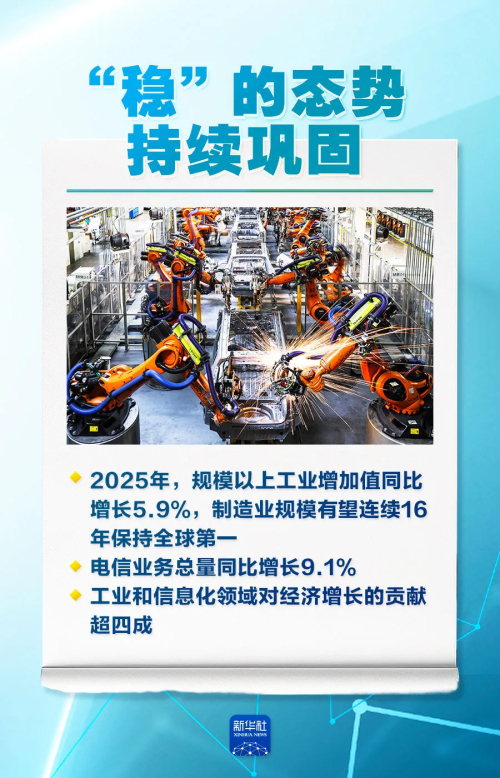
Core Insights - The industrial economy in China is showing steady growth, with a year-on-year increase of 5.9% in industrial added value for large-scale enterprises, and the manufacturing sector maintaining its position as the world's largest for 16 consecutive years [2][8] - The contribution of the industrial and information technology sectors to economic growth exceeds 40%, indicating their critical role in the national economy [2][7] Group 1: Industrial Growth and Achievements - The added value of equipment manufacturing and high-tech manufacturing increased by 9.2% and 9.4% year-on-year, respectively [9] - Over 35,000 basic-level, 8,200 advanced-level, 500 excellent-level, and 15 leading-level smart factories have been established [9] - More than 8,000 national green factories have been cultivated, contributing to energy and water consumption reduction in large-scale industrial units [9] Group 2: Innovation and New Technologies - Significant advancements in technology include over 300 key technology reserves from the first phase of 6G trials, and a year-on-year increase of 26.7% and 23.9% in the added value of integrated circuits and electronic materials, respectively [10] - The production of industrial robots increased by 28%, and new energy vehicle sales reached 16.49 million units, marking a year-on-year growth of 28.2% [10] - The application of artificial intelligence in manufacturing has expanded significantly, with the scale of intelligent computing power reaching 1590 EFLOPS [4] Group 3: Support for Small and Medium Enterprises - A total of 17,600 specialized and innovative "little giant" enterprises and over 140,000 specialized and innovative small and medium enterprises have been cultivated [3][13] - The added value of specialized and innovative "little giant" enterprises in large-scale industries is expected to grow by 6.9% year-on-year [3] Group 4: Future Directions and Policies - The focus for the upcoming year includes stabilizing growth, enhancing innovation, promoting integration, optimizing governance, and preventing risks, with a strong push for new industrialization [6] - The industrial and information technology sectors will continue to support the transformation and upgrading of traditional industries through initiatives like "5G + industrial internet" [5]
加速建设“世界光谷” 东湖高新区GDP连续7年领跑全市
Chang Jiang Ri Bao· 2026-01-26 00:43
Group 1 - The core viewpoint of the news highlights the significant economic growth and industrial development in the Optics Valley region, with a projected GDP of 336 billion yuan by 2025, maintaining a leading position in the city for seven consecutive years [1] - The industrial added value has seen a year-on-year growth of 13.1%, sustaining double-digit growth for 24 months, indicating robust industrial investment and performance [1] - Tax revenue has increased by 18.2% year-on-year, with over 70% of this growth attributed to high-tech industries, showcasing the region's strong contribution to the economy [1] Group 2 - The Optics Valley's electronic information industry has surpassed 650 billion yuan, solidifying its leading advantage, while the integrated circuit industry has also crossed the 100 billion yuan mark [1] - The region has established a strategic technology force with a matrix of national laboratories and innovation platforms, enhancing its innovation capabilities significantly [2] - The total number of enterprises in the area exceeds 167,000, with 5,821 high-tech enterprises, indicating a robust growth in the business ecosystem [2] Group 3 - The integration of industry and city development is accelerating, with significant infrastructure improvements such as 84 kilometers of rail transit and over 1,000 kilometers of municipal roads [2] - The population in the area has grown by 30%, with service population surpassing 2 million, reflecting the region's attractiveness and livability [2] - The future goal is to establish "World Optics Valley" with a comprehensive strength ranking among the top five national high-tech zones within five years, aiming for significant progress by 2035 [2]

北京:完善民营小微企业融资支持协调机制
Zhong Guo Zheng Quan Bao· 2026-01-25 21:05
Economic Growth Targets - The GDP growth target for Beijing in 2026 is set at around 5% [1][2] - The projected GDP for 2025 is 5.2 trillion yuan, with a year-on-year growth of 5.4%, surpassing the national average by 0.4 percentage points [1] Investment and Project Development - Beijing aims to actively expand effective investment, promoting major projects with a total investment of no less than 200 billion yuan [1][3] - The report emphasizes optimizing investment structure, increasing investments in livelihood improvement and consumption upgrade [3] Key Economic Indicators - The expected growth for general public budget revenue is around 4% [2] - The urban unemployment rate is targeted to be controlled within 5% [2] - The average annual concentration of fine particulate matter is aimed to be around 29 micrograms per cubic meter [2] Focus on High-Tech Industries - The report highlights the implementation of the "Artificial Intelligence +" initiative and the establishment of a national AI application pilot base [3] - Future industry pilot zones will be developed to foster new growth points in 6G, quantum technology, and biomanufacturing [3] Financial Sector Development - Beijing will enhance its modern service industry, leveraging its role as a national financial management center [4] - Support will be provided for the Beijing Stock Exchange to strengthen financing services for small and medium-sized enterprises [4]
北京明确2026年主要经济工作:多举措扩内需 发展高精尖产业
Shang Hai Zheng Quan Bao· 2026-01-25 18:54
Economic Growth and Development Plans - Beijing's GDP is expected to grow by around 5% in 2026, focusing on expanding domestic demand and accelerating the development of new productive forces [2] - The city aims to significantly boost high-tech industries and fully implement the "Artificial Intelligence +" initiative [2][5] Investment and Consumption Strategies - Beijing plans to promote effective investment by optimizing the implementation of key projects, with a total investment of no less than 200 billion yuan [4] - The government will enhance consumer capacity by formulating policies to increase urban and rural residents' income and improving the quality of traditional commercial areas [3] High-Tech Industry Development - The integrated circuit industry in Beijing has seen over 20% growth, with nearly 700,000 new energy vehicles produced annually and 34 innovative drugs approved for market [5] - The city will continue to develop high-tech industries, including expanding production in key integrated circuit projects and constructing an international pharmaceutical innovation park [5][6] Service Sector Growth - The modern service industry, including software information, technology services, and business services, contributed over 50% to economic growth in 2025 [4] - Beijing will support service consumption policies in education, health, and elder care, while encouraging innovation in service industries [3]

大江东|开局看上海②5万亿之城如何挑大梁、做尖兵?
Xin Lang Cai Jing· 2026-01-25 16:11
Core Insights - China's economy is entering a new phase with significant contributions from major cities and provinces, particularly Shanghai, which has achieved a GDP of 5 trillion yuan, marking its status as a leading economic hub [1][6]. Economic Performance - Shandong has become the third province in China to surpass a GDP of 10 trillion yuan, following Guangdong and Jiangsu [1]. - Beijing has joined the "5 trillion yuan city club," following Shanghai [1]. - Shanghai's GDP growth is projected at approximately 5.4% for 2025, exceeding the national average growth rate by 0.4 percentage points [1]. Industrial Contributions - Shanghai's three leading industries—artificial intelligence, integrated circuits, and biomedicine—saw an industrial output value increase of 9.6% year-on-year [6]. - The third sector's contribution to Shanghai's GDP is nearing 80%, with a growth rate of 6% [6]. - Shanghai's industrial strategic emerging industries grew by 6.5%, with the new energy sector growing by 12.9% [6]. Strategic Role - Shanghai serves as a critical hub for international resources, with foreign enterprises contributing about 25% of the city's GDP and one-third of its tax revenue [6]. - The city is a focal point for national strategies, including the Pudong New Area and the Lingang New Area, emphasizing its role in national economic leadership [6]. Research and Development - Shanghai's R&D expenditure as a percentage of GDP is around 4.5%, with significant contributions to high-quality development [7]. - The city has a strong output in scientific publications, with 30.6% of papers in top international journals published by Shanghai scientists [10]. Innovation and Transformation - Shanghai's approach to innovation is characterized by a seamless connection between R&D, pilot testing, and manufacturing, distinguishing it from other regions [11]. - The city has established a comprehensive system for cultivating smart factories, leading to significant digital transformation among small and medium enterprises [14]. Open Economy - Shanghai has been proactive in implementing institutional reforms, such as the registration system for the Sci-Tech Innovation Board, which has facilitated the listing of high-tech startups [15]. - The city has also pioneered cross-border service trade and knowledge protection initiatives, aligning with international standards [16][18]. Challenges and Future Directions - Shanghai faces challenges in balancing security and openness amid global uncertainties, including geopolitical tensions and economic decoupling [19]. - There is a need for enhanced collaboration between Shanghai and the broader Yangtze River Delta region to overcome administrative barriers and improve the integration of innovation and industrial chains [20].

北京“十五五”目标设置:GDP年均增速4.5%-5%
Xin Lang Cai Jing· 2026-01-25 11:01
中新网北京1月25日电 (记者 杜燕 徐婧)"十四五"时期,北京经济增长保持了稳中向好的发展态势,经济 总量跨越了两个万亿元台阶,在"十四五"收官的2025年突破5万亿元,比2024年增长5.4%,实现"十四 五"圆满收官。"十五五"时期,北京经济增长目标设置为4.5%-5%,努力争取更好结果。 北京市第十六届人民代表大会第四次会议25日开幕。当天,划定北京今后五年发展目标的《北京市国民 经济和社会发展第十五个五年规划纲要(草案)》(以下简称《纲要草案》)提请大会审查。 《纲要草案》从创新、协调、绿色、开放、共享、安全6个维度设置了29项主要指标,包括:地区生产 总值年均增速4.5%-5%,努力争取更好结果,全员劳动生产率达58万元/人左右,全社会研发投入占比 6%以上,城市副中心和平原新城地区生产总值年均增长5%以上,服务贸易年均增速5%左右,城镇调查 失业率控制在5%以内,等等。 "十四五"时期,北京经济总量跨越了两个万亿元台阶,第一个是在"十四五"开局的2021年,北京GDP突 破4万亿元,第二个是在"十四五"收官的2025年,北京GDP突破5万亿元,比2024年增长5.4%,实现"十 四五"圆满收官。 ...
逐步切换向绩优方向
HTSC· 2026-01-25 11:01
Core Insights - The A-share market is experiencing a rotation towards high-performing sectors, with small-cap stocks leading the gains amid mixed funding sentiment. The focus is on the flexibility of capital and the direction of future rotations, particularly towards sectors with performance validation [1][2] - Despite a net outflow of over 500 billion from broad-based ETFs since mid-January, there remains a strong underlying demand for capital, supported by insurance funds and the need for profit-taking among investors [2][3] - Historical data indicates that sectors with sustainable recovery capabilities tend to yield excess returns during earnings forecast disclosure periods, with current focus on price-increasing chains, high-end manufacturing, and AI-related sectors [3][4] Market Dynamics - The net outflow from major ETFs, particularly those linked to the CSI 300, has been significant, with share reductions of 29% for the CSI 300 ETF, 16% for the CSI 500 ETF, and 45% for the CSI 1000 ETF. However, the market's trading volume remains high, indicating a strong trading sentiment [2][3] - The performance of sectors such as non-ferrous metals, automobiles, electronics, and transportation is expected to improve, with a focus on price recovery chains and high-end manufacturing as key areas for investment [4][5] Investment Strategy - Investors are advised to continue positioning for the spring market, focusing on sectors with high performance potential and signs of recovery, such as batteries and certain chemical products. Additionally, attention should be given to sectors benefiting from price increases, including non-ferrous metals and storage chips [5][4] - The report suggests a gradual shift towards sectors with performance recovery, particularly those with improving earnings forecasts, as the earnings disclosure period approaches [3][4]