
天然气

Search documents
天然气概念股走强,蓝焰控股、石化油服涨停
Mei Ri Jing Ji Xin Wen· 2026-01-22 02:10
Group 1 - Natural gas concept stocks have shown strong performance, with companies like Blue Flame Holdings and Sinopec Oilfield Services hitting the daily limit up [1] - Other companies such as Potential Energy, Zhongtai Co., Victory Shares, and New Natural Gas also experienced significant gains [1]



西北地区首座储气库群本轮采气量超6亿立方米
Ren Min Ri Bao· 2026-01-22 01:55
为确保关键时刻"采得出、供得上",工作人员对安全仪表系统、自控系统进行全面维护测试,排查重点 设备设施隐患,反复推演采气工艺流程,组织多轮应急演练,确保极寒天气下设备平稳运行、流程安全 顺畅。 截至1月20日,我国西北地区首座储气库群——中国石油吐哈油田温吉桑储气库群本轮采气量累计突破6 亿立方米,达6.33亿立方米,为西气东输沿线多地民生供暖、工业生产提供了稳定能源保障。 连日来,我国部分地区遭遇持续低温天气,取暖需求攀升,天然气冬季保供进入关键期。自2025年11月 14日开启第三周期采气以来,温吉桑储气库群采气量稳步攀升,日采气量从初期的480万立方米逐步提 高到620万立方米,创日采气量历史新高。 责任编辑:江蓬新 下一步,吐哈油田储气库公司将持续跟踪气温变化和下游用气需求,动态调整采气方案,强化安全生产 管控,做好冬季保供工作。(尚嵘峥) ...
天然气概念走强 蓝焰控股、石化油服涨停
Xin Lang Cai Jing· 2026-01-22 01:54
Group 1 - The natural gas sector is experiencing a strong performance, with companies such as Blue Flame Holdings and Sinopec Oilfield Services hitting the daily limit up [1] - Potential Energy Holdings, Zhongtai Co., Victory Shares, and New Natural Gas are among the companies showing significant gains [1]
金融界财经早餐:央行发声!加快建设人民币跨境支付体系;五部门新设41个口岸进境免税店;“顶流”基金经理调仓曝光;摩尔线程、永辉超市等发布业绩预告(1月22日)
Jin Rong Jie· 2026-01-22 01:10
Company Highlights - Tianfu Communication expects a net profit attributable to shareholders of 1.881 billion to 2.150 billion yuan, representing a year-on-year growth of 40% to 60%, driven by the acceleration of the artificial intelligence industry and global data center construction [10] - Jin'an Guoji anticipates a net profit of 280 million to 360 million yuan for 2025, a significant increase of 655.53% to 871.4% year-on-year, due to improved market conditions for copper-clad laminates and optimized product structure [10] - Juhua Co. forecasts a net profit of 3.54 billion to 3.94 billion yuan for 2025, reflecting an 80% to 101% increase compared to the previous year [10] - Demingli expects a net profit of 650 million to 800 million yuan for 2025, marking an increase of 85.42% to 128.21% year-on-year [10] - Moore Threads anticipates revenue of 1.45 billion to 1.52 billion yuan for 2025, with a growth rate of 230.70% to 246.67% year-on-year, but expects a net loss of 950 million to 1.06 billion yuan, narrowing the loss by 34.50% to 41.30% [11] - Yonghui Supermarket predicts a net loss of 2.14 billion yuan for 2025, compared to a loss of 1.47 billion yuan in the previous year [11] - Tengjing Technology announced a procurement order from a client worth 12.8 million USD (approximately 89.15 million yuan) for a two-dimensional collimator array [11] - Tianhua New Energy is planning to issue shares overseas (H-shares) to accelerate its international strategy [11] - Zhaomi Technology has become a strategic partner for the 2026 Spring Festival Gala of China Central Television [11] - Ubisoft announced significant organizational and operational adjustments, terminating the development of six games and extending the development cycle of seven games, with expected net bookings of approximately 1.5 billion euros for the 2025-26 fiscal year, a reduction of about 330 million euros in gross profit compared to previous guidance [11] - SpaceX is actively pursuing an IPO plan, aiming to complete it by July this year [11] - Nvidia's CEO Jensen Huang plans to visit China to restart the domestic AI chip market, emphasizing the need for substantial infrastructure investment for AI [11] - Apple is accelerating its AI initiatives, developing an AI wearable device called "Pin" and planning significant updates to Siri, transforming it into the company's first AI chatbot [13] Industry Trends - The commercial aerospace sector is experiencing significant growth, with breakthroughs in reusable rocket technology and accelerated development of large satellite constellations, driving new directions like space photovoltaics to become a growth blue ocean [7] - European natural gas prices have surpassed 40 euros per megawatt-hour for the first time since June last year, driven by supply concerns due to unusually cold weather [7] - The autonomous driving sector in Guangdong has introduced policies to promote the application of autonomous driving models and expand testing areas for high-level autonomous driving [7] - The brain-computer interface industry is in a high-growth phase driven by policy support and technological breakthroughs, with Neuralink's production expectations and new ultrasound brain-computer interface technologies marking a shift towards commercialization [7] - The development of 6G technology in China has reached the first phase of technical testing, with over 300 key technology reserves, and the second phase of testing has recently commenced [8]


天然气:价格26年趋于平稳,27年大幅上升
Wu Kuang Qi Huo· 2026-01-22 01:03
Report Summary 1. Industry Investment Rating - No information provided 2. Core Viewpoints - The US natural gas price is expected to be relatively stable in 2026 and then rise in 2027 as market conditions tighten The Henry Hub natural gas spot price is projected to average slightly below $3.50 per million British thermal units this year, a 2% decrease from 2025, and then surge to an annual average of over $4.60 per million British thermal units in 2027 The increase in 2027 is due to demand growth outpacing supply growth [2] 3. Key Points by Section Price Forecast - EIA has lowered the Henry Hub price forecast for Q1 2026 from an average of $4.35 per million British thermal units last month to $3.38 per million British thermal units The prediction assumes milder - than - normal January temperatures, which may limit natural gas consumption during the peak space - heating season On January 9, the Henry Hub spot price was below $3 per million British thermal units, compared to around $5 per million British thermal units a month ago [3] Demand and Production - US dry natural gas production is expected to grow continuously throughout the forecast period It is projected to increase by 1% this year to nearly 109 billion cubic feet per day, led by the Permian region In 2027, production will grow another 1%, with the growth center shifting to the Haynesville region [6] - Total US natural gas demand, including exports, will grow by 2% in 2027, exceeding total supply (production plus imports) The total demand is forecast to reach 119 billion cubic feet per day in 2027, more than 1 billion cubic feet per day higher than the total supply, which will tighten the market balance and support higher prices at the end of the forecast period [6] - The growth in total demand is mainly driven by the expansion of liquefied natural gas (LNG) exports and the growth of electricity - sector consumption LNG exports grew by 26% in 2025 and will continue to grow through 2027, with an expected growth of 9% in 2026 and 11% in 2027 This growth is due to the operation of three new LNG export facilities [7] - The consumption of natural gas for power generation is also growing steadily, while the combined natural gas consumption of the industrial, residential, and commercial sectors decreased by 3% in 2026 and remained relatively stable in 2027 Industrial consumption decreased in 2026 and 2027 due to climate assumptions closer to the long - term average and lower industrial activity levels [8]
美国天然气两天暴涨近60%
Di Yi Cai Jing Zi Xun· 2026-01-22 00:58
Core Viewpoint - The article discusses the significant impact of an expanding polar vortex leading to extreme cold weather across the Northern Hemisphere, resulting in a surge in heating demand and a dramatic increase in U.S. natural gas prices, which have seen record weekly gains [2][3][4]. Group 1: Natural Gas Market Dynamics - U.S. natural gas futures rose over 29% to $5.07 per million British thermal units, marking a 59% increase over two trading days, the largest weekly gain on record in 35 years [2]. - The extreme cold is expected to significantly boost heating demand for both residential and commercial sectors, with electricity generation demand also rising, leading to a 26% spike in natural gas prices on a single day [2]. - The polar air mass is affecting over 200 million Americans, with temperatures in some regions, like Minnesota, feeling as low as -30°F (approximately -35°C) [2]. Group 2: Production and Supply Risks - The forecast of significantly lower temperatures poses a risk of production cuts in natural gas due to equipment freeze-ups, particularly in Texas, where oil fields may halt operations [3]. - Natural gas production in the Appalachian and Permian basins has been rising, but the cold weather could lead to a reduction of up to 10 billion cubic feet per day due to freeze-offs [3]. - Energy consultancy Energy Aspects has raised its winter production cut forecast to 80 billion cubic feet, with most reductions expected during the upcoming winter storm period [4]. Group 3: European Market Implications - European natural gas prices have also surged, with the Netherlands and the UK seeing their largest weekly increases in over two years, driven by strong heating demand and geopolitical risks [4][5]. - As of Tuesday, EU natural gas storage levels were at approximately 49.9%, significantly lower than the previous year's 61% and nearly 140 billion cubic meters below the five-year average [5]. - The competition for liquefied natural gas (LNG) shipments is intensifying globally, particularly as some Asian regions experience cold weather, further straining supply concerns [5].

今日国际国内财经新闻精华摘要|2026年1月22日
Xin Lang Cai Jing· 2026-01-22 00:55
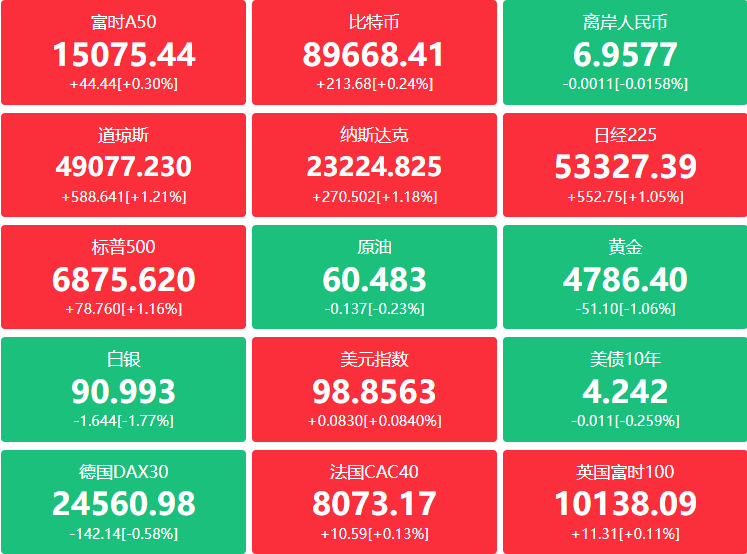
International News - US natural gas futures prices saw a significant increase, with intraday gains reaching up to 30%, currently reported at $5.083 per million British thermal units, after previously recording increases of 29%, 28%, and 27% [1][7] - Precious metals market showed a downward trend, with spot gold prices dropping below $4820, $4810, $4800, and $4790 per ounce, with daily declines of 0.25%, 0.44%, 0.64%, and 0.86% respectively [1][7] - Spot silver also faced pressure, falling below $93, $92, and $91 per ounce, with daily declines of 1.68%, 2.93%, and 3.74% respectively [1][7] - US stock market performed strongly, with all three major indices closing up over 1%, the Dow Jones up 1.21%, Nasdaq up 1.18%, and S&P 500 up 1.16% [1][7] Individual Stocks - Intel shares rose over 11%, reaching a four-year high; AMD increased by 8.3%, SanDisk by over 10%, Western Digital by over 8%, and Micron Technology by over 6% [2][8] - The Nasdaq Golden Dragon China Index rose by 2.22%, with notable gains from individual stocks such as New Oxygen up 14.93%, Baidu up 8.20%, and Century Internet up 7.17% [2][8] - OpenAI's CEO Sam Altman is meeting with top investors in the Middle East to pursue a new round of financing of at least $50 billion, with a post-funding valuation expected between $750 billion and $830 billion [2][8] - Apple plans a major overhaul of Siri, transforming it into a built-in chatbot with new features expected to launch later this year [2][8] Company Dynamics - French dairy company Lactalis announced a recall of multiple batches of infant formula in 18 countries, including China, due to potential contamination with Bacillus cereus toxin [3][9] - Ubisoft canceled the development of six games, including the remake of "Prince of Persia: The Sands of Time" and four unannounced titles [3][10] - The American Petroleum Institute (API) reported an increase of 3 million barrels in US API crude oil inventories last week, compared to a previous increase of 5.278 million barrels [3][10] - President Trump expressed hope for the retention of Kevin Hassett in his current position, with the shortlist for the Federal Reserve chair narrowing to two or three candidates [3][10]



寒潮保供 多家能源企业日供气量创新高
Yang Shi Xin Wen· 2026-01-22 00:45
储气库是天然气保供的"地下粮仓",在需求高峰时期发挥着关键调峰作用。面对天然气需求量的大幅攀 升,全国多地储气库开启"高峰采气"模式,调峰保供作用得到充分释放。 我国西北地区首座储气库群——温吉桑储气库群日采气量突破620万立方米,较采气初期提升了29%。 截至目前,本轮采气累计量已突破6亿立方米,为西气东输沿线地区民生供暖与工业生产提供稳定气源 支撑。与此同时,中国石化金坛、文96等12座储气库同步发力,顶峰采气量超4000万立方米,有效缓解 重点区域高峰用能压力。 国家管网集团充分发挥"全国一张网"的资源配置优势,17座联网储气库同步采气,日采气入网量近2亿 立方米,构建起多源互补、稳定可靠的保供体系。 (文章来源:央视新闻) 在新疆天山南麓,大范围降雪后最低气温降至-20℃左右。作为我国最大超深油气田和西气东输主力气 源地的塔里木油田,加大增储上产力度,日供天然气量超过9200万立方米。 面对极端天气,多家能源企业动态调整供气计划,日供气量创下新高。其中,我国最大油田长庆油田日 均产气量稳定在1.71亿立方米;位于四川盆地的西南石油局,日产水平提升至3040万立方米以上,创历 史新高。中国石化单日最大供 ...

国际油价收涨超0.4%,纽约天然气两天狂飙57%
Ge Long Hui A P P· 2026-01-21 23:57
Group 1 - WTI March crude oil futures closed up by $0.26, an increase of 0.43%, settling at $60.62 per barrel [1] - Brent March crude oil futures rose by $0.32, with a gain of over 0.49%, closing at $65.24 per barrel [1] - NYMEX February natural gas futures surged by over 24.77%, priced at $4.8750 per million British thermal units, with a cumulative increase of over 57.10% over the last two trading days [1] Group 2 - NYMEX February gasoline futures settled at $1.8574 per gallon [1] - NYMEX February heating oil futures closed at $2.4305 per gallon [1]
走出关税阴霾!2026年美股能源股“逆袭”封神,地缘政治风险引爆板块狂欢
Jin Rong Jie· 2026-01-21 23:56
Core Viewpoint - The energy sector in the U.S. stock market has reached historical highs due to rising geopolitical uncertainties, leading investors to bet on higher oil prices [1] Group 1: Energy Sector Performance - The S&P 500 Energy Index rose by 2.4% to 750.17 points, making it the best-performing sector within the S&P 500 [1] - Since April of last year, oil and gas stocks have steadily increased, recovering from the tariff impacts initiated by Trump [1] - The energy sector's strong performance marks a reversal from 2025, where the index only increased by 5%, lagging behind the S&P 500's 16% gain [2] Group 2: Geopolitical Influences - Geopolitical pressures related to Venezuela, Ukraine, and Greenland are maintaining a moderate risk premium for oil prices, with WTI crude oil at $60 per barrel being a critical threshold [1] - Following U.S. intervention in Venezuela, the energy sector benchmark index returned to pre-tariff levels [2] - Citigroup has raised its short-term forecast for Brent crude oil to $70 per barrel due to expanding geopolitical risk premiums [2] Group 3: Market Dynamics - The anticipated Arctic cold wave is expected to boost domestic natural gas market sentiment, benefiting companies like EQT Energy, Expand Energy, and Coterra Energy [1] - The International Energy Agency (IEA) has raised its oil demand forecast for 2026, providing additional support for oil prices [2] - Despite robust cash returns from upstream oil companies, they face risks from potentially unsustainable geopolitical risk premiums [2]