
消费金融

Search documents
与深圳特区同频共振 招联以科技创新重塑行业生态
2 1 Shi Ji Jing Ji Bao Dao· 2025-08-25 16:12
Core Viewpoint - Shenzhen's financial industry plays a crucial role in the city's high-quality development and serves as a strategic pillar for the national financial reform, marking the 45th anniversary of the Shenzhen Special Economic Zone and the 5th anniversary of comprehensive reform pilot implementation [1] Group 1: Company Overview - Zhaolian Consumer Finance Co., Ltd. is the first consumer finance company in the Guangdong-Hong Kong-Macao Greater Bay Area, leveraging Shenzhen's favorable business environment and innovation atmosphere to explore digital economy opportunities [3] - The company was established in 2015 through a collaboration between China Unicom and China Merchants Bank, breaking the boundaries between financial institutions and the real economy [4] Group 2: Technological Innovation - Zhaolian has pioneered a fully online consumer finance model, achieving full-process automation and marking the beginning of the industry's digital transformation [4] - The company has developed core capabilities in IT-driven product innovation, internet risk control, digital operations, and intelligent services, transitioning from "digital" to "intelligent" [6] Group 3: Service Innovations - Zhaolian has introduced a "3H" service model to enhance customer experience, which includes tools for price negotiation, credit limit discussions, and repayment plans [5] - The company has implemented a self-service system that combines traditional risk control strategies with multi-dimensional self-verified credit, significantly improving accessibility and convenience in inclusive finance [5] Group 4: Research and Development - Zhaolian invests nearly 5% of its revenue in R&D, with over 60% of its workforce dedicated to research, collaborating with universities and research institutions to drive technological breakthroughs [6] - The company has established a postdoctoral innovation practice base and joint laboratories with institutions like the Chinese Academy of Sciences and universities, focusing on AI and big data [6] Group 5: Industry Leadership - Zhaolian has achieved rapid growth and is recognized as a leader in the consumer finance sector, serving as the chair unit for the second and third sessions of the Consumer Finance Professional Committee of the China Banking Association [7] - The company has developed a dual-driven innovation model, empowering the ecosystem through cross-industry collaboration and promoting transformation in peer financial institutions [10] Group 6: Consumer Protection - Zhaolian has established a comprehensive consumer protection system, utilizing advanced technologies to enhance service quality and customer satisfaction, achieving a 99.04% first response rate to complaints within 48 hours [11] - The company has created an intelligent consumer protection model that proactively addresses customer complaints and enhances service efficiency [11] Group 7: Future Directions - Zhaolian aims to contribute to national strategies by exploring new paths for the integration of finance and technology, aligning with the goal of building a strong technological nation [12]


维信金科(02003)发布中期业绩 净利润2.16亿元 同比增长79.5% 客户投诉率降低至历史新低
Zhi Tong Cai Jing· 2025-08-25 15:07
Core Viewpoint - The company reported significant growth in revenue and net profit for the first half of 2025, indicating a strong performance despite ongoing economic challenges [1] Financial Performance - Total revenue reached RMB 2.5 billion, representing a year-on-year increase of 43.8% [1] - Net profit was RMB 216 million, showing a year-on-year growth of 79.5% [1] - Earnings per share stood at RMB 0.44, with an interim dividend of 5 Hong Kong cents [1] Operational Strategy - The company achieved a loan volume of RMB 38 billion in mainland China during the first half of 2025 [1] - In response to the economic situation, the company enhanced risk management and adjusted operational strategies to mitigate credit risks and reduce asset impairment [1] - A systematic upgrade of the risk control framework was implemented, focusing on optimizing the customer portfolio towards higher-quality borrowers [1] Strategic Initiatives - The company launched several strategic measures to enhance business resilience, including deepening partnerships with leading platforms to target quality borrowers [1] - New data sources were piloted for high-quality borrowers, strategically increasing their approval rates to build a robust sample library of quality borrowers [1] - Significant resources were allocated to reduce customer complaint rates to a historical low, laying a solid foundation for sustainable operations [1] Future Outlook - Although early risk indicators have shown a mild increase due to strategic investments, the company's ability to identify and operate with quality customers is expected to improve over time [1] - This positions the company for continued optimization of asset quality and establishes a solid long-term foundation for growth [1]
国常会强调综合施策释放内需潜力,央行加量续作MLF,债市继续承压
Dong Fang Jin Cheng· 2025-08-25 13:42
Group 1: Report Summary - The State Council Executive Meeting on August 22 emphasized comprehensive measures to release domestic demand potential, and the central bank increased the volume of MLF renewals, with a net injection of 300 billion yuan in August. The bond market continued to face pressure, but short - term bonds showed signs of recovery. The convertible bond market followed the stock market's upward trend [1]. Group 2: Bond Market News Domestic News - The State Council Executive Meeting on August 22 aimed to better promote domestic demand through large - scale equipment renewal and consumer goods trade - in policies, and emphasized cracking down on subsidy fraud [3]. - The China Securities Regulatory Commission released the "Regulations on the Classification Evaluation of Securities Companies" on August 22, aiming to promote the function of securities companies and strengthen investor protection [4]. - The central bank announced on August 22 that it would conduct 600 billion yuan of MLF operations on August 25, with a net injection of 300 billion yuan in August, marking six consecutive months of increased volume renewals [4]. - The central bank and the State Administration of Foreign Exchange solicited opinions on the "Regulations on the Administration of the Inter - bank Foreign Exchange Market (Draft for Comment)" on August 22, allowing the provision of inter - bank foreign exchange market data services on a commercial basis [5]. - Personal consumer loan subsidy policies will be launched on September 1, which is expected to boost the consumer finance industry [6]. International News - On August 22, Fed Chairman Powell suggested at the Jackson Hole central bank symposium that the rising downside risks to employment may require interest rate cuts [7]. Commodities - On August 22, WTI October crude futures rose 0.22% to $63.66 per barrel, and Brent October crude futures rose 0.09% to $67.73 per barrel. COMEX gold futures rose 1.05% to $3417.00 per ounce, while NYMEX natural gas prices fell 4.10% to $2.692 per ounce [8]. Group 3: Capital Market Conditions Open - Market Operations - On August 22, the central bank conducted 361.2 billion yuan of 7 - day reverse repurchase operations, with a net injection of 123.2 billion yuan after deducting the maturity amount [9]. Capital Interest Rates - On August 22, with continuous net injections from the central bank, the capital market returned to a loose state, and major repurchase interest rates declined. For example, DR001 dropped 5.17bp to 1.412%, and DR007 dropped 4.71bp to 1.467% [10]. Group 4: Bond Market Dynamics Interest - Rate Bonds - On August 22, the strong stock market and weak primary bond issuance pressured the bond market, but the announcement of 600 billion yuan of MLF operations at the end of the session led to a recovery in short - term bonds. By 20:00, the yield of the 10 - year treasury bond active bond 250011 rose 2.40bp to 1.7850%, and the yield of the 10 - year CDB bond active bond 250210 rose 2.30bp to 1.8760% [13]. - Bond issuance information includes details such as the issuance scale, winning bid yield, and multiple of special funds for various bonds [15]. Credit Bonds - On August 22, most industrial bonds' trading prices were relatively stable, with 2 bonds having a trading price deviation of over 10%. "H9 Longkong 01" fell over 23%, and "15 Zhongchengjian MTN001" rose over 55900% [16]. - Multiple companies announced credit - related events, including bond payment issues, financial losses, regulatory penalties, and account freezes [19]. Convertible Bonds - On August 22, the A - share market rose, with the Shanghai Composite Index, Shenzhen Component Index, and ChiNext Index rising 1.45%, 2.07%, and 3.36% respectively. The convertible bond market also rose, with the CSI Convertible Bond, Shanghai Convertible Bond, and Shenzhen Convertible Bond indexes rising 0.95%, 1.05%, and 0.81% respectively [20]. - Some convertible bonds announced events such as proposed downward revisions of conversion prices, non - downward revisions, and early redemptions [25]. Overseas Bond Markets - On August 22, yields of US Treasury bonds across various maturities generally declined. The 2 - year yield dropped 11bp to 3.68%, and the 10 - year yield dropped 7bp to 4.26%. The 2/10 - year yield spread widened by 4bp to 58bp, and the 5/30 - year yield spread widened by 6bp to 112bp [26][27]. - On August 22, yields of 10 - year government bonds in major European economies generally declined. For example, the German 10 - year yield dropped 3bp to 2.72% [29]. - The daily price changes of Chinese - funded US - dollar bonds as of the close on August 22 showed varying degrees of increase and decrease for different bonds [31].
行业迎来政策利好 蚂蚁消金上半年实现净利润14.6亿元
Bei Jing Shang Bao· 2025-08-25 12:22
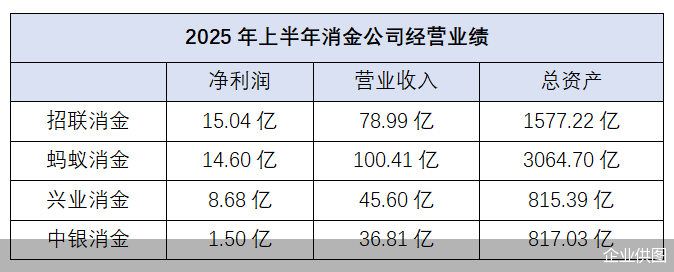
Core Viewpoint - Ant Consumer Finance reported strong growth in H1 2025, with revenue of 10.041 billion and net profit of 1.460 billion, reflecting year-on-year increases of 67.77% and 57.84% respectively, amidst favorable policies for the consumer finance industry [1] Group 1: Company Performance - Ant Consumer Finance achieved a total asset of 306.47 billion by the end of June 2025 [1] - Other consumer finance companies also reported their H1 2025 performance, with Zhaolian Consumer Finance net profit at 1.504 billion, down 13.34% year-on-year, and Xinyey Consumer Finance showing a significant increase in net profit by 213.43% to 0.868 billion [2] - Zhongyin Consumer Finance improved its performance from a loss of 0.306 billion in the same period last year to a net profit of 0.150 billion in H1 2025 [2] Group 2: Industry Context - The consumer finance industry is experiencing favorable policy support, with regulatory bodies providing assistance in expanding financing channels and transferring non-performing assets [1] - A new fiscal subsidy policy for personal consumer loans has been introduced, which includes Ant Consumer Finance and other leading companies, potentially enhancing their business growth momentum [1]
中银消金一董事任职资格获批
Bei Jing Shang Bao· 2025-08-25 11:15
北京商报讯(记者 岳品瑜 董晗萱)8月25日,据国家金融监督管理总局官网行政许可信息,国家金融监 督管理总局上海监管局核准翟依琳中银消费金融有限公司董事的任职资格。 ...
消费贷“国补”倒计时!机构何以借势拓增量?
券商中国· 2025-08-25 04:00
Core Viewpoint - The new personal consumption loan interest subsidy policy, effective from September 1, aims to provide targeted support for the portion of loans actually used for consumption, differing from previous practices of subsidizing the entire loan amount [1][2]. Group 1: Policy Implementation and Impact - The first batch of loan processing institutions includes 18 national commercial banks and 5 other personal consumption loan providers, selected for their ability to accurately identify the consumption portion of loans [2]. - The policy requires financial institutions to enhance their information systems to ensure that subsidy funds are used for actual consumption, which presents new technical challenges and opportunities for product innovation in the consumer finance sector [1][2][3]. - The policy is expected to significantly impact the market, prompting financial institutions to expand their business by collaborating directly with merchants to better control the flow of funds [1][4]. Group 2: Challenges and Opportunities in Consumer Finance - The implementation of the subsidy policy is anticipated to benefit leading institutions in the consumer finance sector, allowing them to scale their operations [4]. - However, challenges remain in monitoring the flow of funds for cash loan products, which complicates the identification of the consumption portion [4]. - The focus will likely shift towards "scene loans," which are tied to specific consumption scenarios, ensuring that loan funds are directly used for consumption [4][6]. Group 3: Market Trends and Strategic Directions - Consumer finance companies are increasingly encouraged to explore various consumption scenarios, with a focus on high-frequency consumption areas such as electronics, home appliances, and travel [6]. - The subsidy policy is expected to lower loan interest rates, thereby expanding the cost space for consumer finance companies to seek partnerships with merchants [6][7]. - Collaboration with major channels and large-scale consumption scenarios will become a priority for consumer finance companies, as they aim to leverage their flexibility in developing diverse and refined consumption scene partnerships [7].

国泰海通:业绩增长与增量资金入市共振 继续看好非银板块
智通财经网· 2025-08-25 01:49
Group 1 - The core viewpoint is that the non-bank sector is expected to see significant investment opportunities due to high growth in performance and increased capital inflow from residents [1] - The insurance sector is projected to continue its growth in the first half of 2025, driven by a decrease in preset interest rates and improved value rates due to the integration of reporting [1] - Consumer finance companies have shown high growth in performance in the first half of the year, supported by a rapid decline in funding costs, indicating strong investment opportunities in this sector [1] Group 2 - The average daily trading volume of stock funds reached 28,700 billion yuan this week, up from 23,842 billion yuan previously, with a year-on-year increase of 81.96% [2] - As of August 22, 2025, the underwriting scale for IPOs and private placements reached 7,386.12 billion yuan, while corporate bonds and convertible bonds financing scales were 145.91 billion yuan and 338.27 billion yuan respectively [2] - The balance of margin financing and securities lending reached 21,468 billion yuan as of August 21, 2025, with a financing balance of 21,320 billion yuan [2] Group 3 - The insurance industry reported a total premium income of 37,350 billion yuan for the first half of 2025, reflecting a year-on-year growth of 5.3% [3] - The total assets of the insurance industry reached 39.22 trillion yuan, with a growth rate of 9.23% compared to the beginning of the year [3] - The net assets of the insurance industry increased to 3.75 trillion yuan, showing a growth rate of 12.91% since the beginning of the year [3]

城与人的双向奔赴:以普惠金融之力,圆新市民城市安居梦
Nan Fang Du Shi Bao· 2025-08-25 01:45
Core Viewpoint - The article highlights the emergence of a new urban citizen group in China, referred to as "new citizens," who face significant challenges in accessing financial services due to their unique needs and lack of traditional credit history. The focus is on how companies like Mashang Consumer are innovating to meet these needs through technology and tailored financial products [2][3][4]. Group 1: New Citizen Demographics and Needs - The new citizen group has surpassed 300 million, accounting for over 20% of the national population, and includes various individuals such as migrant workers and recent graduates [2][3]. - This group is characterized by their "small, frequent, and urgent" financial needs, which are often unmet by traditional financial institutions due to high barriers to entry [5][6]. Group 2: Policy Support and Challenges - The Chinese government has implemented policies to enhance financial services for new citizens, aiming to improve their accessibility and overall well-being [4][5]. - Despite these policies, many new citizens still face real-world challenges, such as unstable employment and high rental costs, which complicate their financial situations [5][6]. Group 3: Innovative Financial Solutions - Mashang Consumer has integrated technology to break down barriers in financial services, focusing on flexible product offerings that cater to the specific needs of new citizens [6][7]. - The company has developed various loan products, such as "Consumption Upgrade Loan" and "Green Consumption Loan," to address the diverse financial needs of this demographic [6][7]. Group 4: Technology and Service Integration - Mashang Consumer employs a dual approach of "scene embedding and industry collaboration" to enhance service delivery, partnering with numerous online platforms and offline merchants to make financial services more accessible [7][8]. - The use of advanced technologies like AI and big data has enabled Mashang Consumer to create a digital risk control model, allowing for precise targeting of financial services to low-income and credit-invisible groups [9][10]. Group 5: Employment Support Initiatives - Recognizing the importance of stable employment for new citizens, Mashang Consumer has launched a free employment platform, "Yili Job," which has served millions and helped many find job opportunities [10][11]. - This initiative reflects the company's commitment to not only providing financial services but also supporting the overall integration of new citizens into urban life [11].
消费贷“国补”开闸倒计时 机构借势拓增量
证券时报· 2025-08-25 00:35
Core Viewpoint - The introduction of the personal consumption loan interest subsidy policy marks a significant shift in the government's approach to supporting consumer spending, focusing on the portion of loans actually used for consumption rather than the entire loan amount [1][3]. Group 1: Policy Implementation - The personal consumption loan interest subsidy policy will officially commence on September 1, with the first batch of loan processing institutions including 18 national commercial banks and 5 other personal consumption loan providers [3]. - The policy requires financial institutions to enhance their information systems to accurately identify the portion of loans used for consumption, ensuring that subsidy funds are effectively directed towards consumer spending [3][4]. - The policy's implementation is expected to drive financial institutions to innovate their consumption loan products and expand into various consumption scenarios through direct partnerships with merchants [1][6]. Group 2: Industry Impact - The subsidy policy is anticipated to have a substantial impact on the consumption finance industry, particularly benefiting the top four consumer finance companies by enabling them to significantly expand their business [6]. - However, challenges remain in monitoring the flow of funds for cash loan products, which complicates the identification of the portion used for consumption [6][8]. - The focus on scenario-based loans, which are tied to specific consumption contexts, is seen as a necessary approach to ensure compliance with the subsidy policy [6][8]. Group 3: Market Dynamics - The consumption finance sector is increasingly encouraged to develop scenario loans, with recent data indicating a focus on low-frequency consumption scenarios such as electronics, home appliances, and home renovations [8]. - The subsidy policy is expected to lower loan interest rates, thereby expanding the cost space for consumer finance companies to seek partnerships with merchants [8][9]. - Collaboration with major institutions and large-scale consumption scenarios is likely to become a priority for consumer finance companies, as it allows for rapid business growth [9].

加强公司治理 中银消费金融大股东战略增持获监管批复
Zhong Guo Jing Ying Bao· 2025-08-24 05:24
Core Viewpoint - The recent equity change in China Bank Consumer Finance Co., Ltd. (中银消金) reflects a strategic move to enhance governance and support sustainable development in the context of increasing consumer financial capabilities and expanding financial supply in the consumer sector [1][2]. Group 1: Equity Change and Ownership Structure - China Bank's direct shareholding in 中银消金 has increased to 47.98% following the acquisition of shares from Shenzhen Bode Innovation Investment Co., Ltd. and Beijing Sequoia Shengyuan Management Consulting Co., Ltd. [2] - After the equity change, China Bank's total shareholding, including indirect holdings through 中银信用卡 (International) Co., Ltd., will reach 61.21% [2]. - The concentration of shareholding is expected to enhance internal control and risk management, reducing the influence of multiple stakeholders and promoting unified governance [3]. Group 2: Online Transformation and Business Strategy - 中银消金 has been transitioning towards online operations, with the proportion of online loans increasing from 84.40% in 2022 to a projected 93.72% in 2024 [2]. - The company has reduced its offline mortgage loan business to less than 40% of its total loan balance by the end of 2023, indicating a significant shift in its business model [2]. - The "好客贷" product, developed in collaboration with China Bank, is a key online credit consumption loan product with a maximum loan limit of 200,000 yuan [2]. Group 3: Industry Trends and Implications - The trend towards concentrated shareholding is seen as a means to enhance risk resilience and operational efficiency in the consumer finance sector [4]. - Major shareholders with financial or industrial backgrounds can better integrate capital, technology, and resources, focusing on core business areas and improving service capabilities [4][5]. - The shift towards concentrated ownership is viewed as a necessary response to regulatory policies and a strategy for optimizing corporate governance and enhancing risk management capabilities [5].
