
石油与天然气

Search documents
黄金:突破新高,白银:冲顶前高
Guo Tai Jun An Qi Huo· 2025-09-04 02:23
1. Report Industry Investment Ratings No industry investment ratings are provided in the report. 2. Core Views of the Report - The report provides trend outlooks for various commodities, including precious metals, base metals, energy, chemicals, and agricultural products. For example, gold is expected to break new highs, while silver is likely to reach previous highs. Copper prices are expected to remain firm due to a weaker US dollar, and zinc is expected to trade within a range [2][7][14]. - The market is influenced by multiple factors such as macro - economic data, central bank policies, and geopolitical events. For instance, weak US JOLTS job openings data has strengthened the market's expectation of a September interest rate cut [7][14][17]. 3. Summary by Commodity Precious Metals - **Gold**: Expected to break new highs. The trend strength is 2, indicating a strong bullish view. Yesterday, the closing price of Shanghai Gold 2510 was 814.88, with a daily increase of 1.31%, and the night - session closing price was 821.68, with a night - session increase of 1.40% [2][7][10]. - **Silver**: Expected to reach previous highs. The trend strength is 2, also indicating a strong bullish view. The closing price of Shanghai Silver 2510 was 9820, with a daily decrease of 0.04%, and the night - session closing price was 9918.00, with a night - session increase of 1.34% [2][7][10]. Base Metals - **Copper**: With the US dollar under pressure, copper prices are firm. The trend strength is 1, suggesting a moderately bullish view. The closing price of the Shanghai Copper main contract was 80,110, with a daily increase of 0.56%, and the night - session closing price was 80260, with a night - session increase of 0.19% [2][13][15]. - **Zinc**: Expected to trade within a range. The trend strength is 0, indicating a neutral view. The closing price of the Shanghai Zinc main contract was 22285, with a daily decrease of 0.18% [2][16][18]. - **Lead**: With continuous inventory reduction, lead prices are supported. The trend strength is 0, a neutral view. The closing price of the Shanghai Lead main contract was 16865, with a daily increase of 0.09% [2][19]. - **Tin**: Expected to trade within a range. The trend strength is 1, a moderately bullish view. The closing price of the Shanghai Tin main contract was 273,120, with a daily decrease of 0.31% [2][22][27]. - **Aluminum**: Expected to trade within a range. The trend strength is 0, a neutral view. The closing price of the Shanghai Aluminum main contract was 20710, with a decrease of 10 compared to the previous day [2][28][29]. - **Alumina**: The price center is moving down. The trend strength is - 1, indicating a bearish view. The closing price of the Shanghai Alumina main contract was 2992, with a decrease of 30 compared to the previous day [2][28][29]. - **Nickel and Stainless Steel**: Nickel is expected to have narrow - range fluctuations based on fundamentals and be affected by news - driven sentiment. Stainless steel prices are expected to have narrow - range fluctuations. The trend strength of both is 0, a neutral view. The closing price of the Shanghai Nickel main contract was 121,790, and the closing price of the Stainless Steel main contract was 12,915 [2][31][36]. Energy and Chemicals - **Carbonate Lithium**: Spot trading has improved, but the continuous increase in warehouse receipts suppresses the futures market. The trend strength is 0, a neutral view. The closing price of the 2509 contract was 72,080, with a decrease of 1,200 compared to the previous day [2][37][41]. - **Industrial Silicon**: With warehouse receipt accumulation, the strategy is to short at high prices. The trend strength is 0, a neutral view. The closing price of Si2511 was 8,490, with an increase of 20 compared to the previous day [2][42][45]. - **Polysilicon**: Attention should be paid to market news. The trend strength is 1, a moderately bullish view. The closing price of PS2511 was 52,160, with an increase of 285 compared to the previous day [2][43][45]. - **Iron Ore**: Due to repeated macro - expectations, it is expected to have wide - range fluctuations. The trend strength is 0, a neutral view. The closing price of the futures was 777.0, with an increase of 5.5 and a daily increase of 0.71% [2][46]. - **Rebar and Hot - Rolled Coil**: Both are expected to have wide - range fluctuations. The trend strength of both is 0, a neutral view. The closing price of RB2510 was 3,034, with a decrease of 10 and a decrease of 0.33%; the closing price of HC2510 was 3,310, with a decrease of 6 and a decrease of 0.18% [2][48][49]. - **Silicon Ferrosilicon and Manganese Silico - Manganese**: Both are expected to have wide - range fluctuations. The trend strength of both is 0, a neutral view. The closing price of Silicon Ferrosilicon 2511 was 5520, with a decrease of 8; the closing price of Manganese Silico - Manganese 2511 was 5720, with a decrease of 10 [2][53][55]. - **Coke and Coking Coal**: Both are expected to have wide - range fluctuations. The trend strength of both is 0, a neutral view. The closing price of JM2601 was 1106, with a decrease of 6.5 and a decrease of 0.6%; the closing price of J2601 was 1594, with a decrease of 2.5 and a decrease of 0.2% [2][56]. - **Log**: Expected to fluctuate repeatedly. The trend strength is 0, a neutral view. The closing price of the 2509 contract was 775.5, with a daily decrease of 2.8% [2][58][61]. - **Para - Xylene**: The cost has collapsed, and the unilateral trend has weakened. The trend strength is not provided. The closing price of the PX main contract was 6810, with a decrease of 24 and a decrease of 0.35% [2][62]. - **PTA**: The strategy is to take a long position in the spread between different months. The trend strength is not provided. The closing price of the PTA main contract was 4732, with a decrease of 24 and a decrease of 0.50% [2][62]. - **MEG**: The unilateral trend is weak. The trend strength is not provided. The closing price of the MEG main contract was 4331, with a decrease of 8 and a decrease of 0.18% [2][62]. Agricultural Products - **Palm Oil**: Lacks continuous driving forces and is waiting for a correction. The trend strength is not provided [2][61]. - **Soybean Oil**: Expected to have an oscillatory adjustment. The trend strength is not provided [2][61]. - **Soybean Meal**: Due to trade friction concerns, US soybeans are weak, while domestic soybean meal is slightly stronger. The trend strength is not provided [2][63]. - **Corn**: Expected to trade within a range. The trend strength is not provided [2][65]. - **Sugar**: Attention should be paid to the production and cost in Guangxi. The trend strength is not provided [2][66]. - **Cotton**: Attention should be paid to the new crop listing situation. The trend strength is not provided [2][67]. - **Egg**: The near - term trading sentiment is strong. The trend strength is not provided [2][69]. - **Live Pig**: The spot market is weak, while the long - term expectation is strong. The trend strength is not provided [2][70]. - **Peanut**: Attention should be paid to the new peanut listing. The trend strength is not provided [2][71].
国际油价收跌超2%
Sou Hu Cai Jing· 2025-09-03 19:31
Core Insights - WTI October crude oil futures closed down by $1.62, a decline of nearly 2.47%, settling at $63.97 per barrel [1] - Brent November crude oil futures fell by $1.54, approximately a 2.23% decrease, closing at $67.60 per barrel [1] - Abu Dhabi Murban crude oil futures dropped by 2.72%, priced at $70.01 per barrel as of 02:00 Beijing time [1] Natural Gas and Other Commodities - NYMEX October natural gas futures increased by about 1.83%, closing at $3.0640 per million British thermal units [1] - NYMEX October gasoline futures settled at $2.0120 per gallon [1] - NYMEX October heating oil futures closed at $2.3609 per gallon [1] European Market Movements - At the end of the European trading session on September 3, ICE UK natural gas futures rose by 1.42% [1] - TTF benchmark Dutch natural gas futures increased by 1.07% [1] - ICE EU carbon emission trading allowances (futures prices) rose by 1.13% [1]
Suncor Energy (SU) Q2 Earnings: How Key Metrics Compare to Wall Street Estimates
ZACKS· 2025-09-03 15:31
Core Insights - Suncor Energy reported a revenue of $8.6 billion for the quarter ended June 2025, reflecting a year-over-year decline of 9.8% and an EPS of $0.51, down from $0.93 in the same quarter last year, but exceeded the Zacks Consensus Estimate for revenue by 11.28% and for EPS by 2% [1] Financial Performance - Revenue: $8.6 billion, down 9.8% year-over-year [1] - EPS: $0.51, compared to $0.93 in the previous year [1] - Revenue surprise: +11.28% over the Zacks Consensus Estimate of $7.72 billion [1] - EPS surprise: +2% over the consensus estimate of $0.50 [1] Key Metrics - Total upstream production per day: 808.10 Kbbls, exceeding the average estimate of 791.40 Kbbls [4] - Total refined product sales per day: 600.5 million barrels, surpassing the estimate of 493.77 million barrels [4] - Sales volumes per day - Total Oil Sands operations: 747.8 million barrels, above the estimate of 730.66 million barrels [4] - Crude oil processed per day - Eastern North America: 231.1 million barrels, compared to the estimate of 202.02 million barrels [4] - Crude oil processed per day - Western North America: 211.2 million barrels, exceeding the estimate of 195.2 million barrels [4] - Total crude oil processed per day: 442.3 million barrels, above the estimate of 397.22 million barrels [4] - Production volumes per day - Oil Sands operations - non-upgraded bitumen: 310.2 million barrels, exceeding the estimate of 265.67 million barrels [4] - Production volumes per day - Oil Sands Operations - Upgraded (SCO and Diesel): 438.2 million barrels, below the estimate of 464.99 million barrels [4] - Sales volumes per day - Oil Sands operations - Upgraded (SCO and Diesel): 440.2 million barrels, compared to the estimate of 464.99 million barrels [4] - Sales volumes per day - Oil Sands operations - non-upgraded bitumen: 307.6 million barrels, above the estimate of 265.67 million barrels [4] - Production volumes per day - Total Fort Hills bitumen production: 162.9 million barrels, exceeding the estimate of 157.14 million barrels [4] - Production volumes per day - Total Syncrude production: 196.5 million barrels, below the estimate of 212.74 million barrels [4] Stock Performance - Suncor Energy shares returned +5.3% over the past month, outperforming the Zacks S&P 500 composite's +3% change [3] - The stock currently holds a Zacks Rank 3 (Hold), indicating expected performance in line with the broader market [3]



原油供需研究框架
2025-09-03 14:46
Summary of Key Points from Conference Call Records Industry Overview - The records primarily discuss the **global oil industry**, focusing on the dynamics of **OPEC+**, **U.S. shale oil**, and **refining capacity** [1][2][3][4][5][6][7][8][9][10][11][12][13][14][15][16][17][18][19]. Core Insights and Arguments - **OPEC+ Production and Compliance**: OPEC+ has increased its voluntary production cuts, with compliance rates improving. However, actual production has often fallen below target levels in recent years [3][5]. - **Impact of Price Wars**: Saudi Arabia has engaged in two significant price wars, the first due to the U.S. shale boom and the second following a breakdown in agreements with Russia. Both resulted in financial strain for Saudi Arabia without achieving substantial market share gains [6][7]. - **U.S. Shale Revolution**: The U.S. has transitioned from a net importer to an exporter of oil due to the shale revolution, leading to global oversupply and price declines. U.S. shale companies' capital expenditures (CAPEX) are closely tied to oil prices, with a notable increase in domestic CAPEX share [7][10]. - **Resource Pressure on U.S. Shale Companies**: The lifespan of reserves for U.S. shale companies has decreased, prompting potential strategies such as reducing output or increasing CAPEX to address resource pressures [11]. - **Global Refining Trends**: There is a shift in global refining product consumption towards lighter components, with the Asia-Pacific region becoming the primary consumer, accounting for nearly 40% of global oil consumption [1][4][14]. - **Refinery Capacity and Utilization**: Global refining capacity is currently in excess, with a decline in utilization rates. China's rapid expansion in refining capacity is also facing oversupply issues [2][18]. Additional Important Insights - **OPEC+ Internal Dynamics**: Russia's strategy within OPEC+ has involved circumventing production cuts by adjusting baseline production levels, leading to internal conflicts within the organization [8]. - **Future Supply and Demand Outlook**: Projections indicate that by 2025-2026, supply from U.S. shale, Canadian pipelines, and new projects in Brazil and Kazakhstan will exceed demand growth, putting downward pressure on oil prices [2][19]. - **Capital Expenditure Trends**: Despite a recent uptick in CAPEX among U.S. shale companies, overall levels remain lower than during the peak of the shale revolution, indicating a cautious approach to investment [10][12]. - **Consumer Behavior Changes**: In the U.S., gasoline and diesel remain dominant, while in China, the consumption of lighter components like liquefied petroleum gas is increasing, reflecting a shift in energy consumption patterns [17]. This summary encapsulates the critical points discussed in the conference call records, providing a comprehensive overview of the current state and future outlook of the global oil industry.
地缘扰动叠加现货偏紧,支撑原油区间内高位震荡
Tong Hui Qi Huo· 2025-09-03 14:25
Report Investment Rating - No investment rating for the industry is provided in the report. Core Viewpoints - The current crude oil market presents a game pattern of strong reality and weak expectation. Geopolitical disturbances on the supply - side provide short - term strong support, and the destocking rhythm of refined oil in China strengthens demand resilience. However, the OPEC+ meeting maintaining production policies may weaken medium - and long - term supply constraints, and the risk of Saudi Arabia releasing idle production capacity and potential impacts of India's consumption policy adjustment form upward pressure. In the short term, the SC - WTI premium may remain high. If geopolitical risks do not escalate beyond expectations, oil prices may show a high - level oscillation pattern within a range [3]. Summary by Directory 1. Daily Market Summary a. Crude Oil Futures Market Data Analysis - **Prices and Spreads**: On September 2, 2025, the price of the Shanghai Crude Oil (SC) main contract rose from 483.5 yuan/barrel to 490.4 yuan/barrel, a 1.43% increase. WTI and Brent prices remained unchanged at 64.61 and 68.16 dollars/barrel respectively. The SC - Brent spread rose from - 0.38 dollars/barrel to +0.45 dollars/barrel, a 218% increase, indicating that domestic crude oil strengthened relative to Brent. The SC - WTI spread expanded from 3.17 to 4.0 dollars/barrel, and the SC premium over WTI increased significantly. The near - far month spread (SC continuous 1 - continuous 3) rose from - 0.1 to +0.2 yuan/barrel, reflecting the tight supply expectation in the spot market [1]. - **Positions and Transactions**: Although the warehouse receipts of Chinese crude oil, fuel oil, asphalt and other varieties remained unchanged on September 2, the warehouse receipts of petroleum asphalt plants decreased by 1000 tons, implying the pick - up demand of physical enterprises [1]. b. Industrial Chain Supply - Demand and Inventory Changes Analysis - **Supply Side**: The attack on Russian refineries continued to ferment, and the CDU maintenance volume in Russia reached 6.4 million tons in August, leading to a contraction in high - sulfur fuel oil supply. The attack on a refinery in a European country disrupted regional refined oil supply and strengthened the geopolitical premium. The sanctions on Yangshan Warehouse reduced the circulation inventory of crude oil in the Chinese market. However, it is necessary to be vigilant that the OPEC+ meeting over the weekend may maintain the production policy unchanged, and the potential risk of Saudi Arabia increasing production still needs attention [2]. - **Demand Side**: The commercial inventory of refined oil in China was fully destocked. The diesel inventory decreased by 2.54% month - on - month to 102.52 million barrels, reaching a three - month low, indicating strong industrial oil demand. The supply of low - sulfur fuel oil in major bunkering ports remained tight. The expectation of a decrease in arbitrage cargoes in Singapore in the second half of September strengthened the structural demand for the switch from high - sulfur to low - sulfur in the Asia - Pacific region. India's plan to cut gasoline vehicle consumption tax may stimulate traditional energy demand, but the competition from electric vehicles may compress long - term demand growth [2]. - **Inventory Side**: China's weekly crude oil inventory decreased by 0.21% to 209.84 million barrels, declining for the fourth consecutive week. Although the data of the US strategic crude oil reserve was not updated, combined with the recent actions of the EIA, the replenishment demand still provided support for WTI. Notably, the positive SC - Brent spread indicated that the inventory pressure in the Chinese region had eased compared with Europe [2]. 2. Industrial Chain Price Monitoring a. Crude Oil - **Futures Prices**: On September 2, 2025, the SC price was 490.40 yuan/barrel, up 1.43% from the previous day; WTI was 65.62 dollars/barrel, up 1.56%; Brent was 69.07 dollars/barrel, up 1.34%; the OPEC basket price remained unchanged at 70.98 dollars/barrel [5]. - **Spot Prices**: Various crude oil spot prices showed different degrees of increase, such as Oman rising 1.27% to 71.90 dollars/barrel, and Victory rising 1.82% to 66.60 dollars/barrel [5]. - **Spreads**: The SC - Brent spread rose from - 0.38 to 0.45 dollars/barrel, a 218.42% increase; the SC - WTI spread expanded from 3.17 to 4.00 dollars/barrel, a 26.18% increase [5]. - **Other Assets**: The US dollar index rose 0.63% to 98.32; the S&P 500 index fell 0.69% to 6,415.54 points; the DAX index fell 2.29% to 23,487.33 points; the RMB exchange rate rose 0.20% to 7.15 [5]. - **Inventory and Production**: The US commercial crude oil inventory decreased by 0.57% to 41,829,200 barrels; the Cushing inventory decreased by 3.57% to 2,263,200 barrels; the US strategic reserve inventory increased by 0.19% to 40,420,100 barrels; the API inventory decreased by 0.22% to 44,982,200 barrels. The US refinery weekly operating rate decreased by 2.07% to 94.60%, and the crude oil processing volume decreased by 1.91% to 1,688,000 barrels per day [5]. b. Fuel Oil - **Futures Prices**: The FU price was 2,847.00 yuan/ton, up 0.53% from the previous day; the LU price was 3,559.00 yuan/ton, up 2.45% [6]. - **Spot Prices**: Most fuel oil spot prices increased, such as NYMEX fuel oil IF0380 in Singapore rising 2.66% to 237.16 cents/gallon [6]. - **Paper Prices**: Some paper prices remained unchanged, while some data were not updated [6]. - **Spreads**: The China high - low sulfur spread increased by 10.90% to 712.00 yuan/ton; the LU - Singapore FOB (0.5%S) spread increased by 4.22% to - 1,929.00 yuan/ton [6]. - **Inventory**: The Singapore fuel oil inventory increased by 7.33% to 24.724 million barrels [6]. 3. Industry Dynamics and Interpretations a. Supply - The sanctions on Yangshan Warehouse led to a tightening of supply. The willingness of short - sellers to deliver at Yangshan Warehouse decreased, and they closed their positions and left the market, resulting in the fuel oil price no longer being anchored to Yangshan Warehouse and the price center moving up. The attack on Russian refineries continued to disrupt the high - sulfur supply, and the supply of low - sulfur fuel oil in major bunkering ports was tight [7][8]. b. Demand - India's Tata Motors proposed to cut the consumption tax on some gasoline vehicles, which would make their prices lower than those of electric vehicles, potentially stimulating traditional energy demand [9]. c. Inventory - On September 2, the warehouse receipts of medium - sulfur crude oil futures, low - sulfur fuel oil futures, fuel oil futures, and petroleum asphalt futures warehouses remained unchanged, while the petroleum asphalt factory warehouse receipts decreased by 1000 tons. China's crude oil and refined oil inventories continued to decline [10]. d. Market Information - Brazil officially applied to join the International Energy Agency (IEA). The crude oil market closed early due to holidays, and trading was light, but the price showed an oscillating upward trend. The market was dominated by positive factors, but the concern about Saudi Arabia increasing production over the weekend limited the upside of oil prices. The spot gold price broke through the $3500 mark in the Asian session, and the market expected the OPEC+ to maintain production at the meeting over the weekend [11]. 4. Industrial Chain Data Charts - The report provides multiple data charts, including the prices and spreads of WTI and Brent first - line contracts, the SC - WTI spread statistics, the US weekly crude oil production, the number of oil rigs in the US and Canada, etc., with data sources from WIND, EIA, etc. [12][14][18]
中国石油9月2日获融资买入3.25亿元,融资余额24.43亿元
Xin Lang Cai Jing· 2025-09-03 04:21
Core Viewpoint - China National Petroleum Corporation (CNPC) has shown significant trading activity with a notable increase in stock price and financing activities, indicating strong market interest and potential investment opportunities [1][2]. Financing Activities - On September 2, CNPC's stock price increased by 4.25%, with a trading volume of 3.42 billion yuan. The financing buy-in amounted to 325 million yuan, while financing repayment was 220 million yuan, resulting in a net financing buy of 105 million yuan [1]. - As of September 2, the total financing and securities lending balance for CNPC reached 2.467 billion yuan, with the financing balance of 2.443 billion yuan accounting for 0.17% of the circulating market value, which is above the 50th percentile level over the past year [1]. Securities Lending - On the same day, CNPC repaid 38,600 shares in securities lending and sold 870,300 shares, generating a selling amount of approximately 7.90 million yuan based on the closing price. The remaining securities lending volume was 2.681 million shares, with a balance of 24.34 million yuan, exceeding the 90th percentile level over the past year [1]. Company Overview - CNPC, established on November 5, 1999, and listed on November 5, 2007, is primarily engaged in the exploration, development, production, transportation, and sales of crude oil and natural gas, as well as renewable energy [2]. - The company's revenue composition includes refining products (73.89%), crude oil (45.28%), natural gas (39.06%), chemical products (10.48%), and other segments [2]. Financial Performance - For the first half of 2025, CNPC reported a revenue of 1.450 trillion yuan, a year-on-year decrease of 6.68%, and a net profit attributable to shareholders of 83.993 billion yuan, down 5.21% year-on-year [2]. Dividend Distribution - Since its A-share listing, CNPC has distributed a total of 835.015 billion yuan in dividends, with 243.890 billion yuan distributed over the past three years [3]. Institutional Holdings - As of June 30, 2025, CNPC's top ten circulating shareholders include Hong Kong Central Clearing Limited, which holds 856 million shares, an increase of 358,300 shares from the previous period [3]. - Other notable shareholders include Huaxia SSE 50 ETF and Huatai-PB CSI 300 ETF, with significant increases in their holdings [3].

中国海油9月2日获融资买入2.41亿元,融资余额18.29亿元
Xin Lang Cai Jing· 2025-09-03 01:30
Group 1: Company Overview - China National Offshore Oil Corporation (CNOOC) is primarily engaged in the exploration, production, and sales of crude oil and natural gas, with operations in China, Canada, the USA, the UK, Nigeria, and Brazil [2] - The company's revenue composition includes 84.57% from oil and gas sales, 13.11% from trading, and 2.32% from other businesses [2] - As of June 30, 2025, CNOOC had 232,800 shareholders, a decrease of 0.25% from the previous period, with an average of 12,936 circulating shares per shareholder, an increase of 5.50% [2] Group 2: Financial Performance - For the first half of 2025, CNOOC reported operating revenue of 207.61 billion yuan, a year-on-year decrease of 8.45%, and a net profit attributable to shareholders of 69.53 billion yuan, down 12.79% year-on-year [2] - CNOOC has distributed a total of 224.33 billion yuan in dividends since its A-share listing, with 176.36 billion yuan distributed over the past three years [3] Group 3: Market Activity - On September 2, CNOOC's stock rose by 1.70%, with a trading volume of 2.641 billion yuan [1] - The financing buy-in amount for CNOOC on the same day was 241 million yuan, with a net financing buy of 13.48 million yuan, while the total financing balance reached 1.844 billion yuan [1] - CNOOC's margin trading balance accounted for 2.32% of its market capitalization, indicating a high level of financing activity [1]

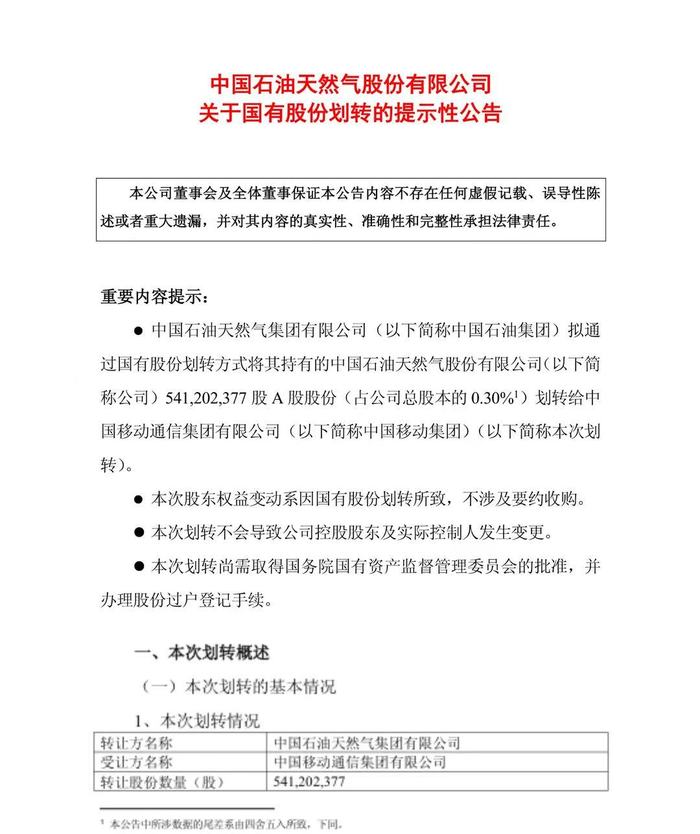
中国石油:控股股东拟将5.41亿A股股份无偿划转给中国移动集团
Xin Lang Cai Jing· 2025-09-03 00:48
Core Viewpoint - China National Petroleum Corporation (CNPC) is transferring approximately 541 million A-shares (0.30% of total share capital) to China Mobile Group to deepen strategic cooperation and optimize shareholding structure [1][4][5]. Group 1: Share Transfer Details - The transferring party is CNPC, while the receiving party is China Mobile Group [4]. - Before the transfer, CNPC held 150,923,565,570 A-shares (82.46% of total share capital) and 291,518,000 H-shares (0.16% of total share capital) through its wholly-owned subsidiary [4]. - After the transfer, CNPC will hold 150,382,363,193 A-shares (82.17% of total share capital) and maintain its H-shares [5]. - China Mobile Group will hold 541,202,377 A-shares (0.30% of total share capital) and 178,794,300 shares (0.10% of total share capital) through its subsidiary [5]. Group 2: Strategic Intent and Financial Impact - The transfer aims to deepen strategic cooperation and achieve complementary advantages without significantly impacting normal operations [6]. - The transfer price is set at zero, and it does not involve a tender offer or change in control of the company [6]. Group 3: Financial Performance - For the first half of 2025, the company reported a revenue of 1.45 trillion RMB, a decrease of 6.7% year-on-year [8]. - Oil and gas, along with new energy businesses, generated a revenue of 422.67 billion RMB, down 6.3% year-on-year [8]. - The net profit attributable to shareholders was 84.01 billion RMB, a decline of 5.4% year-on-year, while net cash flow from operating activities increased by 4% to 227.06 billion RMB [8]. - The board has proposed an interim dividend of 0.22 RMB per share, totaling 40.26 billion RMB, maintaining a historically high level [8].

国投期货:综合晨报-20250902
Guo Tou Qi Huo· 2025-09-02 07:54
Group 1: Energy and Metals Crude Oil - Brent crude's November contract rose 1.04% overnight. Mid - term supply - demand is loose, but short - term net long positions of funds are low, making oil prices sensitive to geopolitical positives. Consider shorting SC's November contract on rallies and use out - of - the - money call options for protection [1] Precious Metals - Rising Fed rate - cut expectations and concerns about Fed independence boost precious metals. International gold prices may hit new highs. Hold long positions and focus on US non - farm payrolls data on Friday [2] Copper - Overnight, copper prices oscillated and closed lower. The probability of short - term copper prices breaking through the 80,000 - yuan mark and expanding the upward trend is increasing. Hold short - term long positions based on the MA5 moving average and pay attention to the rise in the premium of the 2510 contract's call option with a strike price of 82,000 yuan [3] Aluminum - Overnight, Shanghai aluminum oscillated. Downstream开工率 has been rising seasonally for four weeks, and inventory is likely to be low this year. However, the inventory of aluminum ingots and bars increased slightly at the beginning of the week. The short - term trend is oscillatory, with resistance at the 21,000 - yuan area [4] Cast Aluminum Alloy - Cast aluminum alloy follows Shanghai aluminum. The spot - to - Shanghai aluminum cross - variety spread may narrow further due to tight scrap aluminum supply and expected tax policy adjustments [5] Alumina - Alumina's operating capacity is at a historical high, with rising inventory and warehouse receipts. Supply surplus is emerging, and the northwest tender price has dropped significantly. It is in a weak trend but may not fall deeply after breaking through the cost of high - cost production capacity. Pay attention to the support at the June low of 2830 yuan to the 3000 - yuan mark [6] Zinc - SMM's zinc social inventory rose to 146,300 tons, pressuring zinc prices. In September, smelter maintenance will increase, and zinc output is expected to decrease. LME zinc inventory is low, and there is strong support at the 22,000 - yuan mark. It is expected to oscillate in the "Golden September and Silver October" season. Consider shorting on rebounds in the medium - term at the 23,000 - 23,500 - yuan range [7] Nickel and Stainless Steel - Shanghai nickel rebounded sharply. Concerns about political unrest in Indonesia may push up the price of the nickel industry chain. Short - term trading should be oscillatory, suspending the short - selling strategy [9] Tin - After strong two - way fluctuations, tin prices closed with a positive line overnight. LME Singapore warehouse inventory increased. There is a shortage of concentrate in the domestic tin market. Hold short - term long positions based on the 271,000 - yuan level and avoid chasing the rise [10] Lithium Carbonate - Lithium carbonate futures oscillated weakly. Total market inventory decreased slightly to 141,000 tons. The market is focused on the 930 - term expectation. Adopt a bullish strategy with risk control [11] Industrial Silicon - Industrial silicon futures rose slightly, driven by polysilicon sentiment. In September, supply surplus is expected to intensify. Temporarily observe the support at 8300 yuan/ton. If it breaks, consider short - selling lightly [12] Polysilicon - Polysilicon futures rose significantly due to a leading company's "industry restructuring plan" and the "self - discipline production limit" in September. The policy's short - term implementation needs verification. Pay attention to the resistance at 53,000 yuan/ton and control positions [13] Group 2: Steel and Iron Ore Rebar and Hot - Rolled Coil - Night - session steel prices continued to decline slightly. Rebar's apparent demand improved, but inventory accumulated. Hot - rolled coil's demand and output declined, and inventory also increased. The market is under short - term pressure, and pay attention to the improvement in building material demand [14] Iron Ore - Iron ore's overnight futures oscillated. Global shipments reached a new high this year, and domestic arrivals rebounded. Iron - water production may decline significantly this week. It is expected to oscillate at a high level [15] Coke - Coke prices rebounded at the end of the session. The first round of price cuts was partially implemented. Inventory decreased slightly, and the market is affected by the "anti - involution" policy. Prices are under short - term pressure [16] Coking Coal - Coking coal prices mainly declined during the session and rebounded at the end. Total inventory decreased, and production - end inventory increased. It is affected by the "anti - involution" policy, and prices are under short - term pressure [17] Silicomanganese - Silicomanganese prices oscillated downwards and rebounded at the end. Demand is good, and manganese ore prices have limited downside. Observe the support at the previous low [18] Ferrosilicon - Ferrosilicon prices oscillated downwards and rebounded at the end. Demand is okay, and supply has increased significantly, with inventory slightly decreasing [19] Group 3: Shipping and Energy - Related Products Container Freight Index (European Line) - Spot market freight rates are in a downward channel. The impact of geopolitical events on the market is short - term. The market is under pressure. Pay attention to airlines' empty - sailing plans for the National Day Golden Week. If the scale is smaller than last year, the market may decline further [20] Fuel Oil and Low - Sulfur Fuel Oil - As of the end of July, Singapore and China's bunker fuel sales decreased year - on - year, and domestic refinery production enthusiasm was low. LU is under pressure, while FU is relatively stronger due to geopolitical premiums [21] Asphalt - Factory and social inventories of asphalt continued to decline. Asphalt futures rose against the trend. It is expected to oscillate strongly in the short - term. Consider a spread strategy of going long on the crack spread between BU and SC10 [22] Liquefied Petroleum Gas - September's CP was stable. After the gas off - season, it showed some resilience. Import costs and domestic demand rebounded, supporting the spot price. The short - term futures market is stronger in the near - term and weaker in the far - term [23] Group 4: Chemical Products Urea - Urea's daily output decreased slightly but remained high year - on - year. Some compound fertilizer enterprises limited production, and agricultural fertilizer preparation was slow. Inventory at production enterprises increased. During India's tender period, the market sentiment may change [24] Methanol - Methanol's autumn maintenance is ending, and domestic supply is increasing, with production enterprises accumulating inventory. However, downstream demand is expected to improve due to better economics and pre - holiday stocking, so the market outlook is positive [25] Pure Benzene - Pure benzene prices continued to be weak, breaking through 6000 yuan/ton at night. Supply increased, demand was weak, and the port inventory increased slightly. There is an expectation of supply - demand improvement in the third quarter, but pay attention to the downstream rhythm [26] Styrene - Styrene's trend is weak. Crude oil may fluctuate widely, and pure benzene may be weak, providing no support. Demand is weak, supply is high, and inventory has increased significantly, resulting in a weak fundamental situation [27] Polypropylene, Plastic, and Propylene - Propylene production enterprises have controllable inventory pressure, but downstream acceptance of price increases is limited. Ethylene's downstream demand is mixed, and polypropylene's supply pressure is increasing, with weak downstream orders [28] PVC and Caustic Soda - PVC is weak due to high supply and low demand. Caustic soda is relatively strong, but the profit is good, so future supply may increase. PVC is expected to oscillate weakly, and caustic soda may oscillate widely [29] PX and PTA - Night - session PX drove PTA to rise first and then fall, oscillating. Terminal demand is improving, but the actual supply - demand improvement is limited. Pay attention to device dynamics, oil prices, and polyester's production increase [30] Ethylene Glycol - Ethylene glycol's night - session price dropped to the 4400 - yuan mark. Domestic production increased, and port inventory rose slightly. It is expected to oscillate within a range. Pay attention to policies and the peak - season demand [31] Short - Fiber and Bottle Chip - Short - fiber's supply - demand is stable, and its price follows the cost. New capacity this year is limited, and the peak - season demand may boost the market. Bottle - chip has long - term over - capacity issues. Pay attention to petrochemical policies [32] Group 5: Agricultural Products Soybean and Soybean Meal - Last night, soybean meal futures increased in position and oscillated upwards. Globally, the "crushing for oil" pattern is emerging. Domestically, import costs limit the decline of soybean meal. Supply is sufficient in the fourth quarter but may be short in the first quarter of next year. The market may oscillate in the short - term and is cautiously bullish in the long - term [36] Soybean Oil and Palm Oil - Overnight, soybean oil and palm oil rebounded. Short - term price declines released negative factors, and concerns about supply in Indonesia exist. Domestic soybean supply is loose in the near - term and uncertain in the far - term. Palm oil may enter a production - reduction cycle in the fourth quarter. Consider buying on dips in the long - term [37] Rapeseed and Rapeseed Oil - The Canadian rapeseed futures market was closed. Global rapeseed supply will be seasonally loose. China's rapeseed supply - demand is expected to be in a tight - balance state. Rapeseed futures may stabilize in the short - term [38] Soybean No. 1 - After recent price declines, the price of domestic soybean futures rebounded as short - sellers reduced positions. Policy - driven auctions increased supply. New soybeans are expected to have a good harvest. Pay attention to the new - season opening price [39] Corn - Dalian corn futures rose last night. New - season corn may have a good harvest. Short - term, the market may oscillate stably. After the new - grain purchase enthusiasm fades, it may decline at the bottom [40] Live Pigs - Live - pig futures opened high and closed low on Monday. The pig - grain ratio is below 6:1. Supply is expected to increase in September, but demand may also rise during holidays. The price is under downward pressure. Pay attention to policies and supply release [41] Eggs - Egg futures increased in position on Monday. Spot prices did not rise strongly in the autumn semester. Old - hen culling increased, and chick replenishment was low in August. Consider long positions in far - month contracts next year and pay attention to short - sellers' exit in near - month contracts [42] Cotton - US cotton oscillated weakly last week. US cotton signing data improved. China - US negotiations are ongoing. Brazilian cotton's harvest is slow but the yield is expected to be good. Zhengzhou cotton is expected to oscillate, with strong support below. Buy on dips [43] Sugar - Overnight, US sugar oscillated. Brazilian sugar production may remain high. In China, domestic sugar sales are fast, and inventory pressure is low. The 25/26 sugar - cane production in Guangxi is uncertain. Sugar prices are expected to oscillate [44] Apples - Apple futures oscillated at a high level. Early - maturing apples have high prices, but the supply in the 25/26 season may not change much. The price may rise in the short - term but lacks long - term bullish factors. Temporarily observe [45] Wood - Wood futures oscillated. Foreign prices rose, but domestic prices increased slightly. Imports may remain low, and inventory pressure is small. The supply - demand situation improved, but peak - season demand has not started. Temporarily observe [46] Pulp - Pulp futures rose slightly yesterday. Port inventory declined slightly, but it is still high year - on - year. Supply is relatively loose, and demand is average. Temporarily observe or trade within a range [47] Group 6: Financial Products Stock Index - The stock market oscillated strongly yesterday, with the ChiNext Index performing well. Futures contracts of stock indices rose. Shanghai's mortgage policy was adjusted. The market has an optimistic expectation of factors such as Fed rate cuts. Increase allocation to the technology - growth sector and also pay attention to consumption and cyclical sectors [48] Treasury Bonds - Treasury bond futures rose across the board. The "stock - bond seesaw" effect is weakening. In September, domestic monetary policy may be loosened. The yield curve is expected to steepen [49]
中国石油9月1日获融资买入1.26亿元,融资余额23.38亿元
Xin Lang Cai Jing· 2025-09-02 04:31
Group 1 - China Petroleum's stock price decreased by 0.11% on September 1, with a trading volume of 1.142 billion yuan [1] - The financing buy-in amount for China Petroleum on the same day was 126 million yuan, while the financing repayment was 85.0735 million yuan, resulting in a net financing buy-in of 41.0405 million yuan [1] - As of September 1, the total financing and securities lending balance for China Petroleum was 2.354 billion yuan, with the financing balance at 2.338 billion yuan, accounting for 0.17% of the circulating market value, which is below the 40th percentile level over the past year [1] Group 2 - China Petroleum's main business includes exploration, development, production, transportation, and sales of crude oil and natural gas, as well as refining and sales of oil products and chemicals [2] - The revenue composition of China Petroleum shows that refining products account for 73.89%, crude oil for 45.28%, natural gas for 39.06%, chemical products for 10.48%, and other income sources [2] - For the first half of 2025, China Petroleum reported operating revenue of 1.450 trillion yuan, a year-on-year decrease of 6.68%, and a net profit attributable to shareholders of 83.993 billion yuan, down 5.21% year-on-year [2] Group 3 - Since its A-share listing, China Petroleum has distributed a total of 835.015 billion yuan in dividends, with 243.89 billion yuan distributed in the last three years [3] - As of June 30, 2025, the top ten circulating shareholders of China Petroleum include Hong Kong Central Clearing Limited and several ETFs, with notable increases in holdings [3] - The number of shareholders decreased by 8.82% to 482,400, while the average circulating shares per person increased by 9.77% to 339,297 shares [2]