
保险资管

Search documents
友邦保险资管成上海首批获批开业外资独资保险资管公司
Jin Rong Jie· 2025-12-31 10:58
Core Viewpoint - AIA Life Insurance Company has announced the establishment of AIA Asset Management Company, which has received approval from the Shanghai Regulatory Bureau of the National Financial Regulatory Administration, marking it as one of the first foreign-owned insurance asset management companies to operate in Shanghai [1][2]. Group 1: Company Overview - AIA Asset Management aims to implement a diversified, segmented, and specialized development strategy to enhance long-term investment capabilities and better match long-term liabilities [1]. - The company will focus on "long-term value investment" strategies, emphasizing stability of returns, term adaptability, and diversified layouts to improve fund utilization efficiency [1][2]. Group 2: Industry Context - The establishment of AIA Asset Management reflects the high-level opening up of the industry and enriches the diversity of asset management institutions in Shanghai, contributing to the city's development as an international financial center [1]. - The growing scale of domestic insurance funds and the accelerating aging population are driving the demand for pension investments, presenting rapid development opportunities for the insurance asset management industry [2]. Group 3: Strategic Goals - AIA Asset Management will leverage AIA Group's global investment perspective and governance framework, along with AIA Life's extensive experience in the Chinese market, to better seize investment opportunities [2]. - The company aims to enhance its core competitiveness and deepen its local presence, demonstrating confidence in the long-term positive outlook of the Chinese economy [2].
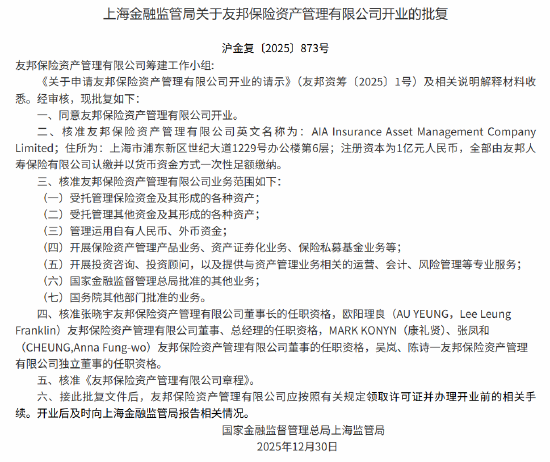
友邦保险资管获批开业 多位高管任职资格获批
Xin Lang Cai Jing· 2025-12-31 09:03
Core Viewpoint - The Shanghai Financial Regulatory Bureau has approved the establishment of AIA Insurance Asset Management Company Limited, allowing it to commence operations with a registered capital of 100 million RMB, fully subscribed by AIA Life Insurance Company Limited [1][3][6]. Group 1: Company Establishment - AIA Insurance Asset Management Company Limited is located at 1229 Century Avenue, Pudong New District, Shanghai [1][3]. - The registered capital of the company is 100 million RMB, which has been fully paid in cash by AIA Life Insurance Company Limited [1][3][6]. Group 2: Management Approval - Zhang Xiaoyu has been approved as the Chairman of AIA Insurance Asset Management Company Limited [1][3][7]. - Ouyang Liliang (AU YEUNG, Lee Leung Franklin) has been approved as the Director and General Manager [1][3][7]. - Other board members approved include Mark Konyn and Zhang Fenghe (CHEUNG, Anna Fung-wo), along with independent directors Wu Lan and Chen Shiyi [1][3][7]. Group 3: Business Scope - The approved business scope includes managing insurance funds and various assets, managing other funds, and operating self-owned RMB and foreign currency funds [6]. - The company will also engage in insurance asset management products, asset securitization, and private equity fund businesses [6]. - Additional services include investment consulting, risk management, and other professional services related to asset management [6].

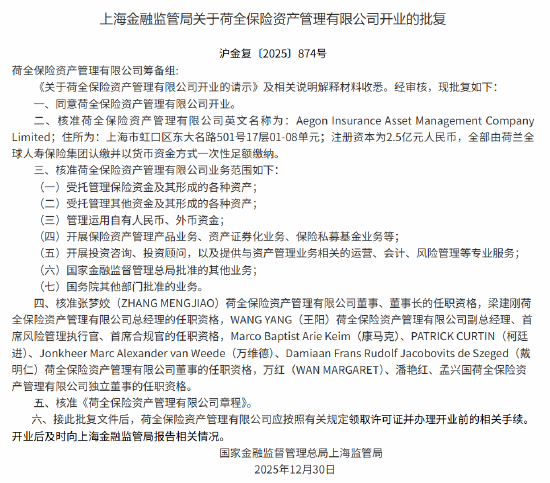
荷全保险资管获批开业 多位高管任职资格获批
Xin Lang Cai Jing· 2025-12-31 09:03
12月31日金融一线消息,上海金融监管局发布批复,同意荷全保险资产管理有限公司开业,核准荷全保 险资产管理有限公司英文名称为:Aegon Insurance Asset Management Company Limited;住所为:上海 市虹口区东大名路501号17层01-08单元;注册资本为2.5亿元人民币,全部由荷兰全球人寿保险集团认 缴并以货币资金方式一次性足额缴纳。 同时,核准张梦姣(ZHANG MENGJIAO)荷全保险资产管理有限公司董事、董事长的任职资格,梁建 刚荷全保险资产管理有限公司总经理的任职资格,WANG YANG(王阳)荷全保险资产管理有限公司 副总经理、首席风险管理执行官、首席合规官的任职资格,Marco Baptist Arie Keim(康马克)、 PATRICK CURTIN(柯廷进)、Jonkheer Marc Alexander van Weede(万维德)、Damiaan Frans Rudolf Jacobovits de Szeged(戴明仁)荷全保险资产管理有限公司董事的任职资格,万红(WAN MARGARET)、潘艳红、孟兴国荷全保险资产管理有限公司独立董事的任职 ...
银行保险资管业协会发布《保险资产管理行业数据分类分级指南》
Ge Long Hui· 2025-12-31 03:44
Core Viewpoint - The China Banking and Insurance Asset Management Association has released a guideline for data classification and grading in the insurance asset management industry, effective from January 1, 2026, aimed at enhancing data security management standards [1] Group 1: Guideline Overview - The guideline, titled "Data Classification and Grading Guidelines for the Insurance Asset Management Industry" (T/BIAMAC 001—2025), outlines principles, methods, specific rules, implementation steps, and application scenarios for data classification and grading [1] - It is designed for insurance asset management institutions to manage data generated and used in their business and operational processes [1] Group 2: Objectives and Implementation - The guideline aims to provide a scientific, practical, and operable method for data classification and grading, establishing a unified data directory for the industry [1] - The implementation of this guideline is expected to enhance the standardization level of data security management within the insurance asset management sector [1]
中国人保资产法定代表人变更 黄明接任
Xin Lang Cai Jing· 2025-12-31 03:42
Core Viewpoint - China People's Insurance Asset Management Co., Ltd. (referred to as "P&C Asset") has officially changed its legal representative to Mr. Huang Ming, marking a significant governance structure adjustment within the company [1][2]. Company Summary - The change in legal representative has been approved by the Shanghai Municipal Market Supervision Administration and completed the necessary business registration procedures, indicating a formal governance structure adjustment for P&C Asset [2]. - P&C Asset is a core asset management platform under China People's Insurance Group, and this management change has attracted considerable market attention [2]. Leadership Profile - Mr. Huang Ming, the new legal representative, has an extensive background in the asset management industry, holding a Ph.D. in economics and a senior economist title. His career spans various sectors, including securities, insurance asset management, and pension management [3]. - His previous roles include leadership positions at Guangdong Securities Co., Ltd., P&C Asset, and Taiping Financial Group, which have equipped him with expertise in asset management, risk control, and investment research [3]. Industry Impact - Industry insiders suggest that changes in the legal representative of insurance companies and asset management firms often signal potential strategic adjustments. The market will closely monitor how this management change at P&C Asset may influence its investment strategies and business layout [4]. - Established in 2003, P&C Asset is one of the first insurance asset management companies approved by the State Council and the China Insurance Regulatory Commission, with a registered capital of 1 billion RMB, primarily engaged in managing investments for insurance funds, social security funds, and enterprise annuities [4].

太保资产副总经理易平:以客户价值为锚驱动投研体系和投资策略持续精进与敏捷迭代
Shang Hai Zheng Quan Bao· 2025-12-30 19:26
Core Viewpoint - Taiping Asset has been recognized for its robust investment management system, winning two awards at the "2025 Shanghai Securities Eagle · Golden Wealth" list, which reflects its ability to navigate complex market conditions and deliver solid performance [3]. Investment Philosophy - The company adheres to four core investment philosophies: value investment, long-term investment, prudent investment, and responsible investment, which are fundamental to achieving stable long-term performance [4]. - Long-term performance is derived from five key aspects: strict adherence to asset-liability matching principles, deepening cross-cycle asset allocation, building a professional research and investment team, establishing an efficient investment management system, and enhancing comprehensive risk management [4]. Risk Management - A comprehensive risk management framework has been established, covering pre-investment identification and assessment, in-process monitoring and control, and post-evaluation and disposal, which supports investment decision-making [5]. Asset Allocation Strategy - In a low interest rate environment, the focus is on diversifying asset allocation to secure long-term, stable returns, emphasizing the importance of enhancing portfolio certainty and resilience [6]. - The company is increasing its allocation to long-term value equity assets and high-dividend stocks, while also expanding the breadth and depth of fixed-income investments, including QDII bond funds, REITs, ABS, convertible bonds, and ESG-related strategies [7]. Long-term Strategic Insights - The company sees significant expansion potential in strategic asset allocation, particularly in light of rising global macro uncertainties, with a renewed focus on gold and other precious metals as long-term strategic assets [7]. - There is an ongoing development of asset securitization products, and the company aims to enhance its participation in the capital market through long-term equity investments [7]. Dividend Value Strategy - Taiping Asset emphasizes a "dividend value" strategy, which focuses on intrinsic value assessment rather than merely chasing high dividends, using free cash flow models to evaluate sustainable business models and stable profitability [8]. - The company targets high-quality enterprises with sound governance, clear competitive advantages, stable profit models, and ample cash flow for investment [8].

新规强化全周期披露责任,吹散银行理财“信息迷雾”
Di Yi Cai Jing Zi Xun· 2025-12-29 12:48
Core Viewpoint - The recent issuance of the "Measures for the Management of Information Disclosure of Asset Management Products by Banking and Insurance Institutions" aims to address long-standing issues in the wealth management sector, such as distorted yield displays and non-transparent valuation methods, by standardizing information disclosure practices [1][2][6]. Group 1: Regulatory Framework - The new regulations establish a unified standard for information disclosure across three types of asset management products: asset management trusts, bank wealth management products, and insurance asset management products [2][6]. - The regulations emphasize the importance of protecting investors' rights to information and choice, which is a fundamental obligation of asset management institutions [2][6]. - The measures require clear disclosure of performance benchmarks, including the rationale for their selection and calculation methods, while explicitly stating that performance benchmarks are not expected yields [2][3]. Group 2: Disclosure Requirements - The regulations enhance periodic disclosure requirements, mandating accurate reporting of product net values, performance, and investment asset conditions, while introducing a mechanism for transparent disclosure of underlying asset structures [3][4]. - Specific rules for cash management products prohibit the display of annualized returns for products that have been established for less than seven days, aiming to curb misleading marketing practices [3][4]. - The regulations also require that all parties involved in the asset management process, including product managers and sales institutions, share responsibility for ensuring the accuracy and completeness of disclosed information [4][6]. Group 3: Industry Impact - The new rules are expected to elevate the quality of information disclosure, potentially becoming a key competitive differentiator for asset management institutions [4][6]. - The introduction of a "dual-channel" disclosure principle aims to simplify investor access to information, thereby enhancing transparency and consistency across different disclosure platforms [4][6]. - The regulations are anticipated to drive asset management companies towards greater professionalism and specialization by mandating the disclosure of investment strategies, portfolio structures, and performance benchmarks [5][6]. Group 4: Future Outlook - The regulations will take effect on September 1, 2026, allowing an eight-month transition period for banking and insurance institutions to adapt [6]. - The increased compliance requirements may raise operational costs for asset management firms, necessitating a comprehensive review and upgrade of their disclosure systems and product documentation [6][7]. - Long-term, the standardization of information disclosure is expected to reshape the competitive landscape of the asset management industry, with a focus on transparency and professional management becoming essential for maintaining a competitive edge [6][7].
保险资管行业数据分类分级指南发布 2026年1月1日起实施
Xin Lang Cai Jing· 2025-12-29 09:44
Core Viewpoint - The China Banking and Insurance Asset Management Association has released the "Guidelines for Data Classification and Grading in the Insurance Asset Management Industry" (T/BIAMAC 001-2025), which aims to standardize data management practices within the industry [1] Group 1 - The guidelines include principles, methods, specific rules, implementation steps, and application scenarios for data classification and grading [1] - The guidelines are applicable to insurance asset management institutions for managing data generated and used in their business and operational processes [1] - As a group standard, the guidelines will be implemented starting January 1, 2026, to enhance the standardization of data security management [1] Group 2 - The objective of the guidelines is to provide a scientific, practical, and operable method for data classification and grading [1] - The guidelines aim to construct a unified data directory for the industry [1] - The implementation of these guidelines is expected to improve the overall data security management standards within the insurance asset management sector [1]
追光与避险:六位资管大咖纵论财富守护之道
Zheng Quan Ri Bao· 2025-12-28 16:14
Core Insights - The forum discussed the theme "Wealth Protection Strategies for Asset Management Institutions" with industry experts sharing insights on investment opportunities and risk management in the current financial landscape [1] Group 1: Investment Opportunities - The equity market has shown significant recovery this year, prompting market participants to evaluate future investment opportunities [2] - "Certainty" is a key focus for institutional investors like insurance and banks, with an emphasis on prioritizing winning probabilities before seeking higher returns [2] - The growth sector may become a "deciding factor" for profitability in the equity market next year, supported by economic recovery and corporate profit restoration [2] - Market opportunities in 2026 are expected to arise more from structural insights rather than directional predictions, with a focus on "new productive forces" and multi-asset portfolio stability [2] - Investment opportunities are identified in AI-related technology, overseas industries, turnaround sectors, and dividend assets [2][3] Group 2: Asset Management Challenges - The asset management industry faces challenges, including the need for public funds to embrace active management despite the rise of index investing [4] - There is a persistent issue of aligning investor expectations with actual returns, which complicates wealth management [4] - The industry must address the cyclical nature of investor behavior, which often leads to a focus on short-term performance rather than long-term stability [4] - The insurance asset management sector must balance safety, liquidity, and profitability, with a proposed separation of assessments for different insurance products and investment strategies [5] Group 3: Risk Factors - Key risk points in the industry include low-interest rate environments leading to spread risks, cross-regional and cross-sector investment risks, and complexities in alternative asset management compliance [5]
资管信披迎新规 保障投资者知情权选择权
Zheng Quan Ri Bao· 2025-12-28 16:06
Core Viewpoint - The National Financial Regulatory Administration has issued the "Management Measures for Information Disclosure of Asset Management Products" to standardize information disclosure for trust products, wealth management products, and insurance asset management products, enhancing investor rights protection and reducing information asymmetry in the investment market [1][2]. Group 1: Regulatory Framework - The new measures aim to unify the information disclosure standards across asset management trust products, wealth management products, and insurance asset management products, addressing inconsistencies in current regulations [2][3]. - The measures consist of six chapters and thirty-five articles, covering the entire lifecycle of asset management products, including fundraising, ongoing management, and termination [2][3]. - Key requirements include clear product descriptions, performance benchmarks, and regular reporting on net asset values and investment performance to ensure transparency and accountability [2][3]. Group 2: Impact on the Industry - The introduction of stricter disclosure requirements may increase compliance costs for asset management institutions, particularly smaller firms, but it also allows for differentiated competition within a unified framework [4]. - Enhanced transparency is expected to lower information asymmetry in investment decisions, thereby boosting market confidence and directing funds towards well-managed institutions [4]. - The insurance asset management sector has become a significant player in the asset management industry, with insurance funds accounting for 21% of the total asset management scale, which reached 174.50 trillion yuan by mid-2025 [5]. Group 3: Future Directions - Insurance asset management institutions are encouraged to focus on serving the insurance sector while considering the expansion of third-party services [6]. - There is a need for these institutions to deepen their engagement in long-term fund management, particularly in pension funds, while enhancing their market competitiveness through technology and transparent product offerings [7].