
咖啡种植

Search documents
“全球咖啡即将耗尽”!巴西局势恶化,阿拉比卡咖啡期货价格创历史新高
Hua Er Jie Jian Wen· 2025-10-24 13:16
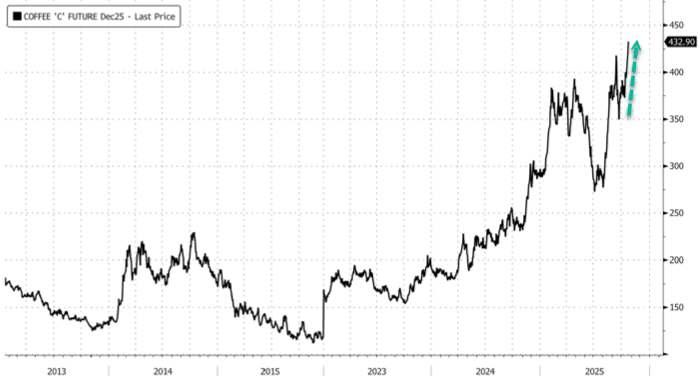
Core Viewpoint - A severe supply crisis in the coffee market is emerging due to adverse weather conditions in Brazil, the world's largest coffee producer, pushing Arabica coffee futures prices to historic highs and raising concerns about a potential long-term shortage in global coffee supply [1][3]. Group 1: Price Surge and Market Impact - Arabica coffee futures prices surged nearly 4% to $4.36 per pound, setting a new record high, surpassing the previous record of $4.2995 per pound established in February [1][3]. - The current price increase is driven by renewed fears that Brazil's adverse weather could significantly impact its coffee exports, particularly affecting high-end varieties used by major brands like Starbucks and Dunkin' [3][4]. Group 2: Supply Crisis in Brazil - Brazil's supply issues are worsening, with reports of severe drought and extreme heat damaging coffee trees and affecting the flowering and fruiting process [4]. - The initial hopes for recovery from the first flowering of the 2026 coffee crop have been dashed due to ongoing adverse weather, leading to a significant reduction in Brazil's coffee exports, which have dropped by approximately 8 to 9 million bags compared to the same period last year [4][5]. Group 3: Global Inventory and Demand - Major importing countries are facing tight coffee inventories, with stocks at key ports sufficient for only 3 to 4 weeks, primarily in Europe, while the U.S. market is experiencing physical supply shortages [5]. - The current situation is described as an "unprecedented supply gap," the likes of which have not been seen in over 315 years of commercial coffee exports [5]. Group 4: Future Price Outlook - Market fundamentals suggest that coffee prices may continue to rise, especially as the Northern Hemisphere enters the critical winter consumption season, intensifying demand for physical coffee beans [6]. - It is anticipated that even if futures prices experience temporary corrections, actual coffee trading prices could be pushed up to the range of $5 to $6 per pound due to extreme supply scarcity [6].

实现高质量发展,“风”从何处起?
Ren Min Ri Bao· 2025-10-18 23:31
Core Insights - The articles highlight the opportunities and advancements in Yunnan's development, particularly in wind energy and tourism, leveraging natural resources and community involvement [1][2][3][4][5][6] Group 1: Wind Energy Development - Yunnan's high altitude and strong winds enable the establishment of wind farms, providing green electricity to 1.08 million households [1] - The planning of wind power bases in Qiubei County includes the construction of 320 kilometers of industrial roads and 17 kilometers of rural roads to facilitate agricultural product distribution [2] - The integration of wind energy projects with ecological restoration demonstrates a commitment to sustainable development [3] Group 2: Tourism and Economic Growth - The establishment of a flower demonstration park in Kunming has created 135 jobs and increased income by 5.4 million yuan annually through community involvement [2] - The Pu'er region is developing a "tea and coffee" tourism destination, showcasing local agricultural products and enhancing economic opportunities [2] - The transformation of traditional homes in scenic areas into modern accommodations has led to individual incomes exceeding 2 million yuan per year [2] Group 3: Ecological and Community Initiatives - Yunnan emphasizes ecological protection alongside development, with initiatives to restore the ecological environment around Dianchi Lake [4] - The promotion of cultural festivals among different ethnic groups fosters a sense of community and shared prosperity [4] - The opening of the China-Laos Railway has expanded trade, covering 19 countries and facilitating the transport of over 3,300 types of goods [4] Group 4: Strategic Vision for Development - The articles advocate for a strategic approach to development that prioritizes ecological sustainability and community welfare [5][6] - The focus on creating a shared future and mutual benefits aligns with global initiatives, enhancing Yunnan's role in international cooperation [6] - The narrative emphasizes the importance of aligning development goals with the needs and aspirations of local communities [6]
茶咖日报|3项指标全国占比均超97%,“云南咖啡”成为中国咖啡代名词
Guan Cha Zhe Wang· 2025-10-17 10:43
Group 1: Yunnan Coffee Industry - Yunnan coffee has become synonymous with Chinese coffee, with a planting area of 1.1931 million acres, accounting for 97.85% of the national total [1] - The total production of Yunnan coffee is 150,200 tons, representing 98.65% of the national output, with an agricultural output value of 4.872 billion yuan, which is 98.61% of the national figure [1] - In 2024, Yunnan's coffee planting area is expected to grow by 4% year-on-year, and production is projected to increase by 3% [1] - The average price of coffee beans in Yunnan is 41.02 yuan/kg, up 10.3% year-on-year, and the average price of specialty coffee is 67.37 yuan/kg [1] - The proportion of specialty coffee has increased from less than 8% in 2021 to 31.6% [1][2] Group 2: Nestlé Group Financial Performance - Nestlé reported total sales of 65.9 billion Swiss francs for the first nine months of 2025, a decrease of 1.9% year-on-year [3] - The organic growth rate for the same period was 3.3%, with all regions and global direct operations achieving positive growth [3] - The organic growth rate in the third quarter was 4.3%, an improvement from 2.9% in the first half of the year, driven by pricing in the coffee and candy segments [3][4] Group 3: Coffee Machine National Standards - The national standard for home and similar use coffee machines (GB/T 46503—2025) will be implemented starting May 1, 2026, aimed at improving product quality and consumer experience [8] - The standard specifies performance requirements, including extraction pressure, water tank volume deviation, and steam frothing moisture content [8][9] - User experience and environmental indicators are also addressed, including noise control and energy consumption management [9] Group 4: Bawang Tea Ji Expansion - Bawang Tea Ji has opened its highest store globally in Thailand, located on the 74th floor of King Power Mahanakhon, a landmark building [5][6] - The brand is accelerating its development in Thailand, with plans to open five new stores this month, bringing the total to 13 [6] - Bawang Tea Ji has entered multiple markets in the Asia-Pacific region, including Malaysia, Singapore, and the United States [6] Group 5: Lu Yu Tea Industry Model - Anhui Agricultural University has released the Lu Yu Tea Industry Model, an AI tool designed to assist in tea research and industry applications [10] - The model contains over 40,000 tea-related documents and can identify pests and diseases from leaf images with over 90% accuracy [10]
“风”从何起归何处(评论员观察)
Ren Min Ri Bao· 2025-10-16 22:04
Core Insights - The article emphasizes the importance of leveraging unique advantages for development, focusing on innovation and proactive measures to create conditions for growth [1][2]. Group 1: Development Strategies - Yunnan province is utilizing its natural resources, such as wind power, to provide green energy to over 1.08 million households through 310 wind turbines [1]. - The region is enhancing agricultural infrastructure by constructing 320 kilometers of industrial roads and 17 kilometers of rural roads to facilitate product circulation [2]. - The integration of tourism and local culture is evident in the transformation of traditional homes into guesthouses, generating annual incomes exceeding 2 million yuan for some households [2]. Group 2: Environmental and Ecological Initiatives - The establishment of wind farms has led to ecological restoration, showcasing a harmonious coexistence of agriculture and renewable energy [3]. - The implementation of a high-precision CO2 monitoring system supports carbon trading, reflecting a commitment to green development [3]. - Comprehensive environmental governance around Dianchi Lake has resulted in improved water quality and biodiversity, enhancing the quality of life for residents [4]. Group 3: Community and Cultural Integration - The promotion of cultural events among different ethnic groups fosters a sense of community and shared identity, contributing to social cohesion [4]. - The opening of the China-Laos railway has expanded trade opportunities, covering 19 countries and facilitating the exchange of over 3,300 types of goods [4]. Group 4: Vision for Sustainable Development - The article advocates for a holistic approach to ecological protection and community development, emphasizing the need for a shared prosperity model among diverse ethnic groups [6]. - The focus on ecological benefits as a fundamental aspect of public welfare highlights the importance of sustainable practices in enhancing living standards [6]. - The narrative underscores the significance of aligning development strategies with the interests of the people and global cooperation for mutual benefits [7].
哥伦比亚咖啡产量创33年来新高
Shang Wu Bu Wang Zhan· 2025-10-12 03:37
Core Insights - The Colombian Coffee Federation reports that the coffee production for the 2024-2025 coffee year is projected to reach 14.8 million bags, the highest level since 1992, representing a 17% increase compared to the previous year [1] Production and Export - The increase in production is attributed to healthy coffee plantations, professional technical support, and favorable climatic conditions [1] - Coffee exports are expected to reach 13.3 million bags, a 12% year-on-year increase, generating revenue of $4.754 billion [1] Domestic Consumption and Imports - Domestic coffee consumption reached 2.2 million bags, reflecting a 3% year-on-year growth [1] - Coffee imports surged to 893,000 bags, a significant increase of 166% year-on-year, indicating robust demand on both domestic and international fronts [1] Market Pricing - As of October 7, the international coffee price stands at $3.75 per pound [1]
“君研咖啡”系列报告之二:咖啡:结构性矛盾凸显
Guo Tai Jun An Qi Huo· 2025-10-10 10:11
1. Report Industry Investment Rating - No relevant content found 2. Core Viewpoints of the Report - Since the fourth quarter of 2023, against the backdrop of the global agricultural product prices oscillating downwards to near production costs, the ICE US coffee price has risen significantly against the trend and reached a record high, and the price difference between Arabica and Robusta coffee has also hit a new high [2][7]. - The structural contradiction in the global Arabica coffee market continues to be prominent. Although the price has reached a record high, the Arabica coffee production is still lower than the historical peak, and the proportion of Arabica coffee production is decreasing year by year. Meanwhile, the demand for Arabica coffee is strong due to the rapid growth of freshly - ground coffee consumption [2][24]. - The Brazilian产区 is the core anchor point for trading global Arabica coffee. Although most major producing countries have increased their Arabica coffee production under high - price incentives, the large reduction in Brazil's output offsets the increase in other regions, resulting in the global Arabica coffee production still being lower than the 20/21 level [3][34] 3. Summary According to Relevant Catalogs 3.1 Arabica Coffee Price Remains High - The price of Arabica coffee has always fluctuated greatly. From 1999 to 2025, there were significant increases and decreases in the ICE US coffee主力合约 price, with a maximum cumulative increase of 631.99% and a maximum cumulative decrease of 71.68% [6]. - Since the fourth quarter of 2023, the ICE US coffee price has risen significantly against the trend and reached a record high. On February 11, 2025, it hit a historical high of 429.95 cents/pound. After a short - term decline, it reached 424.00 cents/pound on September 16, 2025 [7]. - Since September 2024, the price ratio and difference between Arabica and Robusta coffee have been rising, and the difference reached nearly 200 cents/pound on September 15, 2025, a record high [8] 3.2 Global Arabica Coffee Production Has Not Fully Recovered 3.2.1 Arabica Coffee Has Higher Requirements for Planting Environment and Management Level - Arabica coffee has higher requirements for planting environment and management level. It is more sensitive to high temperatures, has weaker pest - resistance, needs higher - altitude planting and more refined management, but has lower yields per unit area compared to Robusta coffee [13]. - USDA predicts that the global Arabica coffee production in 25/26 will be 582 tons, accounting for 54.30% of the global coffee production [13] 3.2.2 Global Coffee Production Has Recovered - Global coffee production is highly concentrated and has increased for three consecutive years. USDA predicts that the global coffee production in 25/26 will be 10.72 million tons (a year - on - year increase of 260,000 tons). The top 5 producing countries account for 73.49% of the total production, and the top 10 account for 88.50%. The top 5 producing countries are Brazil, Vietnam, Colombia, Indonesia, and Ethiopia [14]. - The global coffee ending stocks - to - use ratio is still low. Although the production has increased for 3 consecutive years, the ending stocks - to - use ratio remains at a low level. USDA predicts that the global coffee production in 25/26 will be 10.72 million tons, consumption will be 10.16 million tons, and ending stocks will be 1.37 million tons [17] 3.2.3 The Proportion of Arabica Coffee Is Decreasing Year by Year - The global Arabica coffee production has not fully recovered, and its proportion in the total coffee production remains at a low level. USDA predicts that the global Arabica coffee production in 25/26 will be 5.82 million tons (a year - on - year decrease of 100,000 tons), while the Robusta coffee production will be 4.9 million tons (a year - on - year increase of 360,000 tons), and the proportion of Arabica coffee production will drop from 56.6% to 54.3% [21]. - Among the top 5 Arabica coffee producing countries, only Brazil produces both Arabica and Robusta. USDA predicts that in 25/26, the Arabica coffee production in Brazil will account for 63% of its total coffee production, and the other 4 major producing countries almost entirely produce Arabica. Among the top 5 Robusta coffee producing countries, the Robusta coffee production in Vietnam will account for 97% of its total production in 25/26 [29] 3.3 Brazilian产区 Is the Core Anchor Point for Trading Arabica Coffee - USDA predicts that the global Arabica coffee production in 25/26 will be 5.82 million tons, 310,000 tons less than in 20/21. Among the top 5 producing areas, Brazil's production will decrease by 530,000 tons, and Colombia's will decrease by 50,000 tons, while Ethiopia's will increase by 240,000 tons, Honduras's will decrease by 40,000 tons, and Peru's will increase by 60,000 tons [34]. - Driven by high prices, most major producing countries have increased their Arabica coffee production compared to 20/21. However, due to the large reduction in Brazil's output, the global Arabica coffee production is still lower than the 20/21 level. Therefore, the Brazilian产区 remains the core anchor point for trading global Arabica coffee in the future [34]
巴西对着美国说话挺直接,就问那 40% 的关税能不能撤了。
Sou Hu Cai Jing· 2025-10-07 01:23
Group 1 - The article discusses Brazilian President Lula's direct appeal to the U.S. regarding the 40% tariff imposed on Brazilian exports, emphasizing the need for a resolution to this issue [2][3] - The 40% tariff increase from 10% to 50% has severely impacted Brazilian exporters, particularly in the coffee and orange juice sectors, with coffee farmers reporting losses and orange juice producers unable to sell their products [2][3] - Brazilian aircraft manufacturer Embraer faces significant financial losses due to the tariffs, estimating a loss of 2 billion reais, and highlighting the negative impact on U.S. suppliers as well [3] Group 2 - Lula argues that the U.S. has benefited from a trade surplus with Brazil over the past 15 years, with a cumulative surplus of 410 billion USD, and that the rationale for the tariff is unfounded [3][4] - The tariffs are seen as a political maneuver rather than an economic necessity, with Lula asserting that the U.S. should not interfere in Brazil's judicial matters [4] - Brazil has initiated a complaint to the WTO against the U.S. for violating trade agreements and is exploring new markets to mitigate the impact of the tariffs [4][5] Group 3 - The Brazilian industry is experiencing significant declines in exports, with a reported 52 billion reais loss and a 22.3% drop in aircraft manufacturing exports [5] - The furniture industry is also suffering, with a substantial decrease in orders from the U.S., which accounts for 30% of its market [5] - Lula emphasizes the importance of mutual respect in trade relations, indicating a willingness to negotiate while maintaining Brazil's sovereignty [5]

打工人的续命水,快要喝不起了?
虎嗅APP· 2025-09-29 13:19
Core Viewpoint - The article discusses the impact of climate change on coffee production, highlighting the rising prices of coffee beans and the shift in farming practices in Yunnan, China, where farmers are increasingly growing coffee instead of traditional crops due to higher profitability [2][16]. Group 1: Coffee Price Dynamics - Coffee prices have surged, with the procurement price for fresh coffee fruit in Yunnan increasing from 3-5 yuan per pound to around 11 yuan, nearly tripling within a year [2]. - The price of raw coffee beans has also risen significantly, with some reports indicating prices reaching 80-100 yuan per kilogram, compared to 35-40 yuan in previous years [16]. Group 2: Climate Change Effects - Climate change is causing a reduction in the suitable growing areas for Arabica coffee, which is highly sensitive to temperature and rainfall changes [4][9]. - The production of Arabica coffee is expected to decline as climate conditions become less favorable, with predictions indicating that by 2050, suitable areas for coffee cultivation could decrease by about 50% [21][22]. Group 3: Coffee Production Challenges - The coffee cultivation process is lengthy, taking at least 5 years from seed to fruit-bearing, with optimal production occurring between 10-15 years [6]. - Factors such as excessive rainfall and drought are increasingly affecting coffee maturity and yield, leading to challenges in production [7][9]. Group 4: Pest and Disease Impact - Climate change is exacerbating pest issues, with the coffee borer beetle becoming more prevalent due to rising temperatures, leading to significant economic losses for coffee producers [9][11]. - The increased prevalence of pests and diseases is raising the cost of coffee production, further straining smallholder farmers who already operate on thin margins [19]. Group 5: Consumer Impact - Consumers may face higher prices for coffee as producers and companies pass on the increased costs associated with climate change and production challenges [19]. - Despite rising coffee bean prices, many consumers continue to purchase coffee at lower prices due to the relatively small proportion of coffee bean costs in the overall price of coffee products [16][18]. Group 6: Future of Coffee Production - The coffee industry is exploring the cultivation of more resilient coffee varieties that can withstand climate challenges, such as the Excelsa coffee variety, which is gaining attention for its drought and pest resistance [22][23]. - Companies are beginning to recognize the importance of sustainable practices to mitigate climate risks, with some, like Starbucks, committing to ethical sourcing and sustainable supply chains [24].

从“原料供应”→“品牌输出” 亮眼数据彰显我国咖啡产业迎来发展黄金期
Yang Shi Wang· 2025-09-26 09:54
Core Insights - Yunnan is the largest coffee-producing province in China, with significant growth in coffee exports in the first half of the year, targeting 34 countries and regions including the Netherlands, Germany, and Vietnam [1] - The price of Yunnan coffee beans has risen sharply, influenced by international coffee prices reaching a 50-year high, with prices increasing from 40 yuan/kg at the end of last year to around 66 yuan/kg in May this year [3] - The coffee industry in Yunnan is experiencing a boom, with a reported export value of over 770 million yuan in the first eight months of the year, making it the largest coffee exporter in China [7] Production and Market Dynamics - Yunnan's coffee production capacity is expanding due to increasing domestic consumption and overseas orders, with a daily production of about 2 tons of roasted beans in a processing facility [1][3] - The coffee planting area in Yunnan is projected to reach 1.267 million acres by the end of 2024, with an expected production of 146,000 tons and an agricultural output value of nearly 5 billion yuan, reflecting a 13% year-on-year growth [12] - The coffee industry is transitioning from raw material supply to brand output, with a focus on quality improvement and technological innovation [13] Export Trends and Opportunities - The demand for Yunnan coffee is increasing, with overseas orders driving industry upgrades and a shift towards exporting processed coffee products such as roasted beans and instant coffee [18] - The global coffee market is projected to grow significantly, with estimates of reaching 840.23 billion yuan in 2024 and 1,107.82 billion yuan by 2030, indicating a compound annual growth rate of 4.72% [16] - The coffee industry in Yunnan is enhancing its production processes to meet the evolving demands of international markets, including the introduction of modern production lines for cold brew coffee [14]
哥伦比亚咖啡协会警告关税差异或引发三角贸易
Shang Wu Bu Wang Zhan· 2025-09-24 17:10
Core Viewpoint - The Colombian Coffee Growers Federation warns that tariff disparities could lead to triangular trade, jeopardizing the quality and reputation of Colombian coffee [1] Group 1: Tariff Disparities - The United States imposes high tariffs on coffee from Indonesia, Vietnam, and Brazil, while Colombian coffee faces only a 10% tariff [1] - This tariff structure creates opportunities for Colombian coffee exports but is limited by insufficient inventory to meet increased demand [1] Group 2: Potential Trade Issues - The manager of the Colombian Coffee Growers Federation, Bahamon, cautions that the tariff differences may encourage coffee from other countries to be routed through Colombia to the U.S., leading to unmanageable triangular trade [1] - Bahamon urges the government to implement regulatory measures promptly to prevent market distortions [1]