
新型储能

Search documents
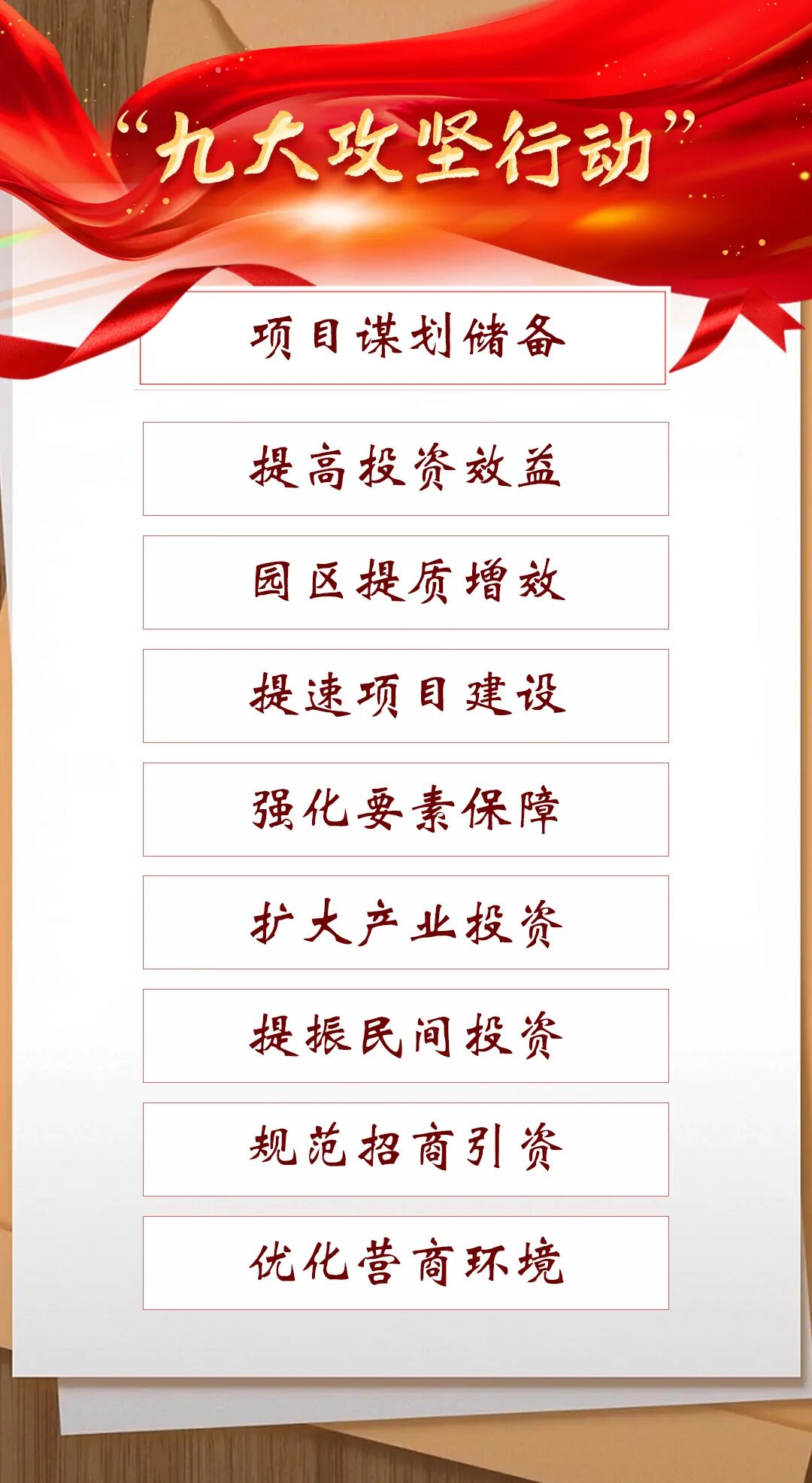
点读云南丨抓项目 拼项目
Xin Lang Cai Jing· 2026-01-11 10:02
Economic Development and Key Industries - Yunnan Province emphasizes high-quality development and project work to drive economic growth, focusing on nine major initiatives [1] - Since the 14th Five-Year Plan, Yunnan has held 16 consecutive quarterly meetings to promote major industrial projects, leading to significant investment and project completion [4] - The province achieved a 39.22% support rate for overall investment, with private enterprise projects completing 86.36% of their annual investment plans [6] Project Implementation and Investment - Yunnan has successfully completed 102.67% of the annual investment plan for 72 key projects and 104.08% for 832 infrastructure projects [6] - The provincial government is concentrating on project-driven growth to enhance the real economy and establish a modern industrial system with Yunnan characteristics [8] Social Welfare and Insurance Initiatives - Yunnan is implementing a long-term care insurance system to support individuals with disabilities, with varying fund payment ratios based on employment status [11][13] - The province has announced an increase in living and care subsidies for disabled individuals, effective January 1, 2026, raising monthly support for certain categories of disabilities [16] Industry-Specific Developments - The nut industry in Yun County is projected to exceed 820 million yuan in output by 2025, with significant growth in planting area and production [23] - A national-level biopharmaceutical pilot platform has been launched in Kunming to enhance the biopharmaceutical industry's capabilities [25] - The first water asset securitization project in Qujing has been successfully established, marking a significant financial innovation in the region [26] - The first complete cost insurance for coffee cultivation has been implemented in Pu'er, providing substantial risk coverage for local farmers [27]

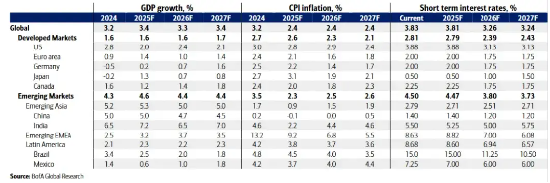
2026,预见|宏观篇:盈利为核,流动为翼——2026年全球温和复苏中的价值新主线
Xin Lang Cai Jing· 2026-01-07 08:16
Core Viewpoint - The global economy is expected to show moderate recovery in 2026, supported by ample liquidity and a gradual recovery in inventory and profit cycles, shifting the market narrative from valuation recovery to profit support [1][30]. Group 1: Overseas Macro - The global economy will continue to recover, with K-shaped economic characteristics persisting but narrowing. Major economies are projected to have varied GDP growth rates: the US at 2.4%, Eurozone at 1.0%, Japan at 0.8%, and emerging markets at 4.2% [2][30]. - Global inflation is on a downward trend, with expectations that the Federal Reserve may cut interest rates 2-3 times in 2026, leading to a decrease in short-term rates [31][30]. Group 2: Domestic Macro - Fiscal policies are expected to drive investment recovery in major economic provinces, with a focus on infrastructure, manufacturing recovery, and a narrowing decline in real estate sales and investment [8][35]. - The Producer Price Index (PPI) is anticipated to rise initially before stabilizing, while the Consumer Price Index (CPI) may see moderate increases. The profit cycle is gradually recovering, with improvements expected in various sectors [9][35]. Group 3: Liquidity Environment - A clear trend of global liquidity easing is established, with the Federal Reserve leading improvements in overseas liquidity. Domestic monetary policy is expected to align with fiscal measures, potentially leading to interest rate cuts [12][38]. - The supply of funds is likely to be dominated by institutional capital, with private equity funds potentially driving high-net-worth individuals back into equity allocations [14][38]. Group 4: Strategic Allocation Directions - The market is expected to shift from valuation recovery to profit-driven dynamics in 2026, with Chinese assets still having room for valuation recovery [41][42]. - Key sectors to focus on include technology and advanced manufacturing, traditional export chains, and industries with increasing overseas revenue proportions [42][45]. - Future industry themes may include smart manufacturing, next-generation communications, advanced materials, and future energy solutions [47].
宿迁打造长三角数智制造新基地
Xin Hua Ri Bao· 2026-01-07 05:19
Group 1 - The core viewpoint of the news is the launch of a three-year action plan for the construction of a smart manufacturing new base in the Yangtze River Delta, emphasizing the importance of digital intelligence in industrial upgrading and productivity development [1] - The city government of Suqian positions the development of smart manufacturing as a key strategic initiative during the 14th Five-Year Plan, focusing on data-driven approaches, manufacturing upgrades, and innovation empowerment [1] - Suqian aims to embrace the wave of digital integration with a sense of urgency, encouraging enterprises to prioritize digital transformation as a top management agenda and leverage various support policies for technological upgrades [1] Group 2 - In 2023, Suqian will focus on the "619" industrial system, targeting transformation, upgrading, and high-end development, with an emphasis on advanced industries such as intelligent robots, low-altitude manufacturing, and new energy storage [2] - The city plans to deepen existing advantageous industries like textiles and machinery into high-precision fields while fostering new growth areas in food, fresh-cut flowers, and the digital economy [2] - The implementation of a new round of "smart transformation and digital networking" actions will promote the construction of "smart factories—data sets—industrial models" [2]
启动数智新城建设三年行动计划宿迁打造长三角数智制造新基地
Xin Hua Ri Bao· 2026-01-07 01:32
Group 1 - The core viewpoint of the news is that Suqian City is initiating a three-year action plan to build a new smart manufacturing base in the Yangtze River Delta, focusing on the systematic layout of smart facilities and the development of smart industries [1] - Suqian's municipal government emphasizes the importance of smart manufacturing as a key driver for industrial upgrading and the development of new productive forces, positioning it as one of the five development orientations during the 14th Five-Year Plan period [1] - The city aims to embrace the wave of smart integration with a sense of urgency, encouraging enterprises to treat smart transformation as a top priority and to leverage various support policies for technological upgrades [1] Group 2 - In 2023, Suqian plans to focus on the "619" industrial system, targeting transformation, upgrading, and high-end development, with an emphasis on advanced industries such as embodied intelligent robots, low-altitude manufacturing, and new energy storage [2] - The city will continue to deepen existing advantageous industries like textiles and machinery into high-precision fields while fostering new growth areas in food, fresh-cut flowers, and the digital economy [2] - Suqian will implement a new round of "smart transformation and networking" actions, promoting the construction of "smart factories - data sets - industrial models" [2]
河南培育壮大六大绿色低碳产业
He Nan Ri Bao· 2026-01-05 00:44
Core Viewpoint - The Henan Provincial Government has issued policies to accelerate the green and low-carbon development of the manufacturing industry, focusing on six areas with 21 measures to enhance the green competitive advantage of manufacturing in Henan [1][2] Group 1: Green Low-Carbon Transition - The policies aim to promote the green and low-carbon transformation of traditional industries and expand the scale of green low-carbon industries [1] - By 2027, the scale of the new energy vehicle and energy-saving environmental protection equipment industries is expected to reach 300 billion yuan each, while the hydrogen energy, new energy storage, and new battery industries are projected to reach a scale of 100 billion yuan each [1] Group 2: Implementation of Green Transformation - A new round of green transformation will be implemented in 10 traditional industries, targeting the addition of approximately 2,000 A-level, B-level, and performance-leading enterprises by 2027 [2] - The manufacturing sector aims for clean and low-carbon energy to account for 25% of energy consumption by 2027 [2] Group 3: Technological Innovation and Standards - The policies emphasize the importance of technological innovation in green low-carbon development, with goals to complete the revision of 30 green low-carbon standards and promote 100 green low-carbon technologies by 2027 [2] - The establishment of 500 new green factories is also targeted [2] Group 4: Financial Support for Green Manufacturing - Financial tools such as green credit, green funds, and green insurance will be leveraged to support the green low-carbon development of the manufacturing sector [2]
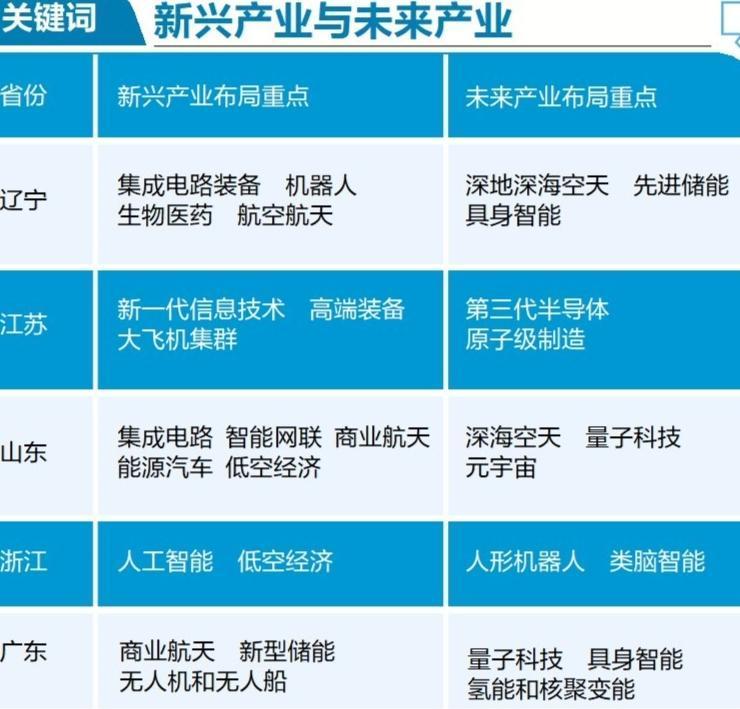
竞逐新赛道,都有啥新招?
Xin Lang Cai Jing· 2026-01-04 22:08
Group 1: Emerging and Future Industries - Various provinces are focusing on emerging and future industries, with specific emphasis on sectors like integrated circuits, robotics, and advanced energy storage [1][6] - Jiangsu aims to deepen integration into the Yangtze River Delta's aircraft manufacturing cluster and emphasizes atomic-level manufacturing [6] - Provinces like Shandong and Guangdong are prioritizing sectors such as quantum technology and hydrogen energy, indicating a trend towards high-tech and sustainable industries [1][7] Group 2: Digital Development - Provinces are actively developing digital infrastructure, with Liaoning focusing on data annotation industries and integrating AI into traditional industries [2][9] - Beijing aims to become a global benchmark city for digital economy, emphasizing core technologies like high-end chips and software [2][9] - Guangdong is enhancing its data trading platforms to foster industrial clusters, showcasing a strong market-driven approach [2][9] Group 3: Marine Economy - Coastal provinces are shifting their focus to marine economies, with Guangdong and Shandong aiming to create comprehensive marine industry ecosystems [8][19] - Liaoning and Jiangsu are leveraging their industrial bases to upgrade traditional marine industries towards high-end and green solutions [8][19] - The emphasis on marine economic development reflects a strategic pivot towards utilizing ocean resources for economic growth [8][19] Group 4: Consumption and Economic Growth - Guangdong is promoting the establishment of international consumption centers, aiming to enhance service industry standards and consumer environments [10][11] - Provinces like Beijing and Jiangsu are emphasizing high-energy consumption innovations, focusing on cultural and tourism integration to stimulate local economies [11][15] - The strategies aim to release local market potential and enhance consumer confidence through improved infrastructure and services [11][15] Group 5: Strategic Technology and Talent Development - Provinces are prioritizing the establishment of national laboratories and major scientific facilities to strengthen strategic technological capabilities [12][14] - There is a focus on integrating education, technology, and talent development to foster innovation and address regional needs [13][14] - Collaborative efforts across provinces aim to enhance the overall effectiveness and resilience of the national innovation system [12][14]
省政府办公厅最新发文:培育壮大六大绿色低碳产业
Xin Lang Cai Jing· 2026-01-04 00:25
Core Viewpoint - The Henan Provincial Government has issued a set of policies aimed at accelerating the green and low-carbon development of the manufacturing industry, focusing on six key areas and introducing 21 measures to enhance the green competitive advantage of manufacturing in Henan [1][2]. Group 1: Green and Low-Carbon Transition - The policies emphasize the importance of developing resource and environment-friendly industries as a critical point for green and low-carbon development in manufacturing [1]. - The goal is to cultivate industries such as new energy vehicles, energy-saving and environmental protection equipment, hydrogen energy, new energy storage, new batteries, and intelligent computing, aiming for significant growth in these sectors by 2027 [1]. Group 2: Industry Scale and Targets - By 2027, the scale of the new energy vehicle and energy-saving environmental protection equipment industries is expected to reach 300 billion yuan each, while hydrogen energy, new energy storage, and new battery industries are projected to reach a scale of 100 billion yuan each [1]. - The initiative aims to establish over 10 large-scale computing centers with a computing power reaching E-level [1]. Group 3: Traditional Industry Transformation - A new round of green transformation will be implemented for 10 traditional industries, with a target of adding around 2,000 A-level, B-level, and performance-leading enterprises by 2027 [2]. - The focus will also be on achieving low (or zero) VOCs content in raw materials for key industries dealing with volatile organic compounds (VOCs) [2]. Group 4: Energy Consumption and Capacity Governance - The policies aim for clean and low-carbon energy to account for 25% of energy consumption in the manufacturing sector by 2027 [2]. - The initiative includes plans for the exit of outdated and inefficient production capacities by 2027 [2]. Group 5: Technological Innovation and Standards - The policies highlight the need for technological innovation, with a target to complete the revision of 30 green and low-carbon standards and promote 100 green and low-carbon technologies by 2027 [2]. - The establishment of 500 new green factories is also part of the plan [2]. Group 6: New Business Models and Financial Support - The initiative aims to foster new business models and scenarios for green low-carbon development by integrating digitalization with green practices, modern services with green manufacturing, and green products with green consumption [2]. - Financial tools such as green credit, green funds, and green insurance will be leveraged to support the green low-carbon development of the manufacturing sector [2].
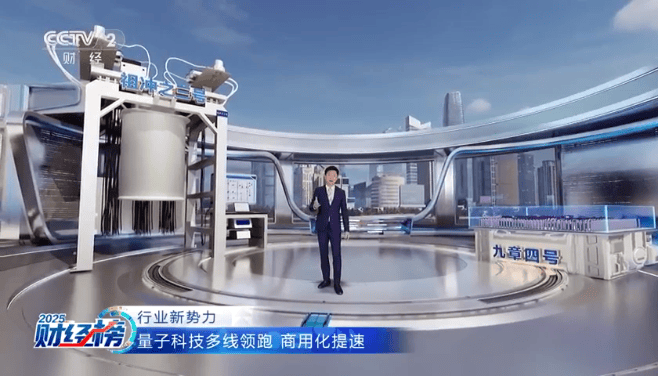
2025量子科技多线领跑 AI赋能千行百业
Sou Hu Cai Jing· 2025-12-31 16:23
Group 1: Quantum Technology - In 2025, China's quantum technology commercialization is accelerating, showcasing vast application prospects [3] - China's "Zuchongzhi 3" superconducting quantum computer is reportedly 10 trillion times faster than the world's fastest supercomputer for specific tasks, while "Jiuzhang 4" can solve problems in microseconds that would take supercomputers 10^42 years [3] - Over 30 countries have released quantum strategy plans with total investments exceeding $35 billion, and the number of related companies has surpassed 800, with financing exceeding $14.5 billion in the past decade [3] Group 2: Artificial Intelligence - AI has evolved from a reactive model to a proactive service model, enabling autonomous operations in factories and personalized services in daily life [5] - The AI industry in China is projected to exceed 1.2 trillion yuan by 2025 and is expected to surpass 1.8 trillion yuan by 2028, with over 15% of work decisions globally anticipated to be made by AI agents by 2028 [5] Group 3: Smart Glasses - Smart glasses are emerging as the next mainstream interactive terminal, with significant advancements in battery life, optical display, and integration with AI models [7] - In the first half of the year, over 2.4 million smart glasses with camera functions were shipped globally, with China capturing a 35.5% market share, leading the world [7] - The Chinese smart glasses market is expected to grow at a compound annual growth rate of 55.6% from 2024 to 2029, the highest globally [7] Group 4: New Energy Storage - New energy storage technologies are ensuring the stability and affordability of green electricity, acting as "super charging stations" for cities [9] - By the end of September, China's new energy storage capacity reached 103 million kilowatts, accounting for over 40% of the global total, making it the world leader [9] Group 5: Innovative Pharmaceuticals - China's innovative pharmaceuticals are advancing in research, application, and international expansion, with a focus on cancer and rare diseases [11] - The number of innovative drugs in development accounts for approximately 30% of the global total, with a record number of approvals and 50 innovative drugs included in the national medical insurance directory [11] - Total licensing agreements for innovative drugs have surpassed $100 billion, demonstrating China's capability in original technology and global recognition [11]
关于印发《广东省推动金融服务科技强省建设工作方案》的通知
Xin Lang Cai Jing· 2025-12-26 12:21
Core Viewpoint - The Guangdong Province's plan aims to establish a financial service system that supports the construction of a technology-driven economy, promoting a virtuous cycle of "technology-industry-finance" to enhance technological self-reliance and productivity by 2027 [1][12]. Overall Goals - The strategy focuses on enhancing financial services for the technology-driven economy, targeting key areas in the Guangdong-Hong Kong-Macao Greater Bay Area and strategic emerging industries, aiming to build a modern technology finance matrix by the end of 2027 [2][13]. - The plan aims for technology-related loans to rank among the highest in the nation, with growth rates exceeding the average loan growth, and to significantly increase the scale of intellectual property pledge financing [2][13]. Key Focus Areas Key Regions - The plan emphasizes the importance of the Greater Bay Area's strategic positioning, focusing on major platforms like Hengqin, Qianhai, Nansha, and He Tao to enhance financial services in these areas [4][14]. Key Industries - Financial services will be directed towards emerging industries such as integrated circuits, new energy vehicles, low-altitude economy, biomedicine, and artificial intelligence, among others [5][14]. Key Enterprises - The initiative will support the "Ten-Hundred-Thousand" plan, focusing on 50 leading technology enterprises, 100 chain enterprises, and 10,000 specialized and innovative enterprises to strengthen the industrial chain [6][15]. Major Tasks Implementing Technology Finance Foundation Projects - The plan encourages the establishment of a technology innovation investment fund system, utilizing various types of funds to support early-stage technology enterprises and enhance their valuation and reduce financing costs [7][16]. - A comprehensive technology credit system will be developed to accommodate different stages of enterprise growth, with a focus on flexible repayment options and innovative credit products [8][17]. Enhancing Bond Market Support - The plan aims to leverage the bond market to support technology innovation, encouraging the issuance of technology innovation bonds to finance projects in this sector [8][18]. Capital Market Development - The strategy will utilize various capital market tools to support technology enterprises at different growth stages, promoting a structured listing and financing system [8][18]. Cross-Border Financial Services - The plan will facilitate cross-border financing for technology enterprises, allowing them to access international capital markets and improve their financial flexibility [18]. Risk Mitigation and Insurance - A risk-sharing mechanism will be established to reduce financing costs for high-tech enterprises, including government subsidies for loans and the development of specialized insurance products [9][18]. Data and Financial Technology Integration - Financial institutions will be encouraged to utilize big data and AI to create credit products based on the multidimensional data of technology enterprises, enhancing financing accessibility [9][18]. Knowledge Property Financial Ecosystem - The initiative will support the development of a comprehensive financial ecosystem for intellectual property, promoting innovative financing methods and insurance products related to IP [9][18]. Talent Development - The plan emphasizes the creation of a talent system that integrates technology, industry, and finance to support the development of a technology-driven economy [10][18].
超研股份(301602.SZ):拟与专业投资机构共同投资设立基金
Ge Long Hui A P P· 2025-12-26 10:36
Core Viewpoint - Chao Yan Co., Ltd. (301602.SZ) announced the establishment of a new investment fund to optimize its industrial layout and leverage the expertise of professional investment institutions [1] Group 1: Fund Establishment - The company plans to jointly invest in the Guangdong Yuecai Zhongying Emerging Industry Equity Investment Fund Partnership (tentative name) with professional investment institutions [1] - The fund aims to raise a total of RMB 1 billion, with the company contributing RMB 50 million, representing a 5% stake [1] Group 2: Investment Direction - The investment focus will be on new energy storage, biomedicine, smart terminal industry chains, and related fields [1]