焦炭

Search documents
《黑色》日报-20260112
Guang Fa Qi Huo· 2026-01-12 05:08
Report Industry Investment Ratings - No industry investment ratings are provided in the reports. Core Views Steel Industry - The spot demand for steel is weak, and prices have fully priced in the weak demand. Before the holiday, focus on the impact of policies on the demand expectation of steel. In December, steel prices fluctuated with the rhythm of raw material prices and maintained a sideways trend. Steel production cuts are significant, with limited downward driving force, but the weak demand expectation for the May contract restricts the upside space for prices. The upside elasticity depends on changes in the raw material supply side. Overall, it is expected to fluctuate within a range in January. The reference range for the May contract of rebar is 3050 - 3250 yuan, and for hot-rolled coils, it is 3200 - 3350 yuan [1]. Iron Ore Industry - The fundamental pattern of iron ore is shifting towards a situation of both weak supply and demand. The price ceiling is constrained by high inventories, while the downside is supported by the expectation of steel mills' restocking. In the future, iron ore will gradually transition from a state of loose supply - demand to one of weak supply - demand. During the off - season, it is necessary to focus on macro - sentiment and policy expectations. It is expected that iron ore prices will fluctuate widely in the short term [4]. Coke and Coking Coal Industry - For coke, the supply adjustment lags behind coking coal, and coking profits are under pressure, but the start - up rate is rising. The demand side sees an increase in iron - making water production and a rebound in steel prices at low levels. In terms of inventory, ports and steel mills are accumulating inventory, while coking plants are reducing inventory, and the overall inventory is slightly increasing at a medium level. For coking coal, the supply side has a slight increase in daily production after the new year, and imports are recovering. The demand side has a stable increase in iron - making water production, and the restocking demand is warming up. The overall inventory is also slightly increasing at a medium level. In terms of strategies, it is recommended to go long on dips and pay attention to the strategy of going long on coking coal and short on coke [6]. Ferrosilicon and Ferromanganese Industry - For ferrosilicon, the supply - demand contradiction has been alleviated, and there is support on the demand side. In the short term, focus on macro, policy expectations, and cost - side changes. It is expected to fluctuate within the range of 5500 - 6200. For ferromanganese, it is in a state of self - supply surplus but overall balance of manganese elements. Manganese ore provides price support, and there is also support from off - season demand. Follow - up attention should be paid to the reduction in ferromanganese production and the restocking expectations of steel mills for raw materials during the year - end winter storage. It is expected to fluctuate widely, and the recommended strategy is to operate within the range of 5800 - 6300 [7]. Summary by Directory Steel Industry Steel Prices and Spreads - Rebar and hot - rolled coil spot and futures prices generally declined. For example, the spot price of rebar in East China dropped from 3320 yuan to 3290 yuan, and the May contract of rebar fell from 3187 yuan to 3144 yuan [1]. Cost and Profit - Steel billet and slab prices remained unchanged. The cost of Jiangsu electric - arc furnace rebar increased by 3 yuan, while the cost of Jiangsu converter rebar decreased by 17 yuan. The profit of East China hot - rolled coils decreased by 12 yuan, and the profit of North China rebar increased by 28 yuan [1]. Production - The daily average iron - making water production increased by 1.6 to 229.0, a 0.7% increase. The production of the five major steel products increased by 3.4 to 818.6, a 0.4% increase. Rebar production increased by 2.8 to 191.0, a 1.5% increase, with electric - arc furnace production increasing by 2.0 to 32.8, a 6.6% increase [1]. Inventory - The inventory of the five major steel products increased by 21.8 to 1253.9, a 1.8% increase. Rebar inventory increased by 16.1 to 438.1, a 3.8% increase, while hot - rolled coil inventory decreased by 2.8 to 368.1, a 0.8% decrease [1]. Transaction and Demand - The building materials trading volume increased by 0.5 to 8.9, a 6.6% increase. The apparent demand for the five major steel products decreased by 44. to 796.8, a 5.3% decrease. The apparent demand for rebar decreased by 25.5 to 175.0, a 12.7% decrease [1]. Iron Ore Industry Iron Ore - Related Prices and Spreads - The warehouse - receipt costs of various iron ore powders slightly increased, and the basis of the May contract for some powders changed slightly. The 5 - 9 spread increased by 0.5 to 21.5, a 2.4% increase, while the 1 - 5 spread decreased by 7.5 to 37.5, a 16.7% decrease [4]. Supply - The 45 - port arrival volume increased by 155.0 to 2756.4, a 6.0% increase, while the global shipping volume decreased by 463.4 to 3213.7, a 12.6% decrease. The national monthly import volume decreased by 76.9 to 11054.0, a 0.7% decrease [4]. Demand - The daily average iron - making water production of 247 steel mills increased by 2.1 to 229.5, a 0.9% increase. The 45 - port daily average ore - removal volume decreased by 1.9 to 323.3, a 0.6% decrease. The national monthly pig iron production decreased by 320.6 to 6234.3, a 4.9% decrease, and the national monthly crude steel production decreased by 212.6 to 6987.1, a 3.0% decrease [4]. Inventory Change - The 45 - port inventory increased by 304.4 to 16275.26, a 1.9% increase. The imported ore inventory of 247 steel mills increased by 43.0 to 8989.6, a 0.5% increase. The inventory available days of 64 steel mills decreased by 1.0 to 19.0, a 5.0% decrease [4]. Coke and Coking Coal Industry Coke - Related Prices and Spreads - The prices of Shanxi and Rizhao port quasi - first - grade wet - quenched coke remained unchanged. The May contract of coke decreased by 17 to 1748, a 1.0% decrease. The coking profit decreased by 11 to - 54 [6]. Coking Coal - Related Prices and Spreads - The price of Shanxi medium - sulfur main - coking coal remained unchanged, while the price of Mongolian No. 5 raw coal increased by 33 to 1213, a 2.8% increase. The May contract of coking coal increased by 6 to 1196, a 0.5% increase. The sample coal mine profit decreased by 26 to 484, a 5.14% decrease [6]. Supply - The daily average production of all - sample coking plants increased by 0.9 to 63.6, a 1.4% increase, and the daily average production of 247 steel mills increased by 0.1 to 46.9, a 0.1% increase. The raw coal production decreased by 2.7 to 853.4, a 0.3% decrease [6]. Demand - The iron - making water production of 247 steel mills increased by 2.1 to 229.5, a 0.9% increase [6]. Inventory Change - The total coke inventory increased by 0.2 to 915.7, a 0.0% increase. The coke inventory of all - sample coking plants decreased by 5.5 to 86.1, a 6.0% decrease, and the coke inventory of 247 steel mills increased by 1.7 to 645.7, a 0.3% increase. The coking coal inventory of all - sample coking plants increased by 19.2 to 1071.7, a 1.8% increase, and the coking coal inventory of 247 steel mills decreased by 4.5 to 797.7, a 0.64% decrease [6]. Ferrosilicon and Ferromanganese Industry Spot Prices and Spreads - The spot prices of ferrosilicon and ferromanganese generally declined. The closing price of the ferrosilicon main contract decreased by 36.0 to 5632.0, a 0.6% decrease, while the closing price of the ferromanganese main contract increased by 12.0 to 5904.0, a 0.24% increase [7]. Cost and Profit - The production costs of ferrosilicon in Inner Mongolia, Qinghai, and Ningxia remained unchanged, while the production cost of ferromanganese in Guangxi increased by 8.5 to 6236.3, a 0.1% increase. The production profit of ferrosilicon in Inner Mongolia decreased by 55.89 to - 139.7 [7]. Manganese Ore Supply - The manganese ore shipping volume increased by 32.2 to 117.4, a 37.8% increase, the arrival volume increased by 19.1 to 669, a 46.8% increase, and the ore - removal volume increased by 8.8 to 64.5, a 15.8% increase. The manganese ore port inventory decreased by 7.9 to 438.9, a 1.8% decrease [7]. Supply - The ferrosilicon production enterprise start - up rate increased by 0.1 to 29.6, a 0.34% increase, and the ferromanganese weekly production decreased by 0.3 to 19.1, a 1.4% decrease [7]. Demand - The daily average iron - making water production of 247 steel mills increased by 2.1 to 229.5, a 0.9% increase. The ferrosilicon demand (calculated by Steel Union) decreased by 0.1 to 18, a 1.9% decrease, and the ferromanganese demand (calculated by Steel Union) increased by 0.1 to 11.6, a 0.74% increase [7]. Inventory Change - The ferrosilicon inventory of 60 sample enterprises increased by 0.5 to 6.9, a 7.1% increase, and the inventory of 63 sample enterprises of ferromanganese decreased by 1.1 to 38.3, a 2.8% decrease [7].
焦炭板块1月9日涨0.02%,美锦能源领涨,主力资金净流出1.32亿元
Zheng Xing Xing Ye Ri Bao· 2026-01-09 09:00
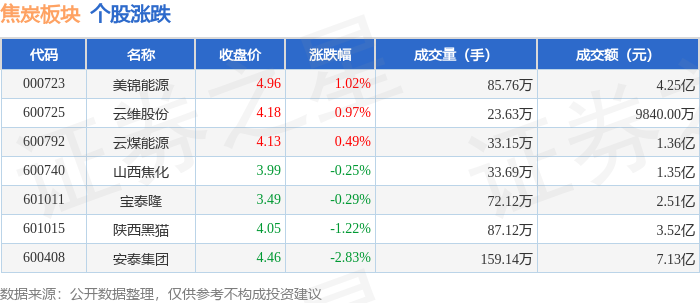
Group 1 - The coke sector experienced a slight increase of 0.02% on January 9, with Meijin Energy leading the gains [1] - The Shanghai Composite Index closed at 4120.43, up 0.92%, while the Shenzhen Component Index closed at 14120.15, up 1.15% [1] - The trading volume and turnover for key coke stocks were reported, with Meijin Energy closing at 4.96, up 1.02% [1] Group 2 - The net outflow of main funds in the coke sector was 132 million yuan, while retail investors saw a net inflow of 166 million yuan [1] - Individual stock fund flows showed significant variations, with Yunwei Co. experiencing a main fund net inflow of 5.1 million yuan, while Shanxi Coking experienced a net outflow of 3.8 million yuan [2] - The overall sentiment in the coke sector indicates mixed investor behavior, with retail investors showing a preference for certain stocks despite the outflows from main and speculative funds [2]


《黑色》日报-20260109
Guang Fa Qi Huo· 2026-01-09 02:37
1. Report Industry Investment Ratings No information about industry investment ratings is provided in the given reports. 2. Core Views Steel - Steel prices fluctuated within a range, with this week's data showing increased production, accumulated inventory, and a significant decline in apparent demand. The current demand is in a seasonal off - peak, while steel mill production has rebounded from a low level, resulting in increased supply and decreased demand, and inventory has stopped falling and started to rise. Before the Spring Festival, steel usually accumulates inventory seasonally. The decline in the apparent demand for hot - rolled coils is not significant, and attention should be paid to whether the inventory accumulation is lower than expected. The raw materials, coking coal and iron ore, support steel prices due to strong supply - side expectations. The fluctuation range of rebar is expected to be between 3000 - 3200, and that of hot - rolled coils between 3150 - 3350 [1]. Iron Ore - The iron ore market is expected to transition from a situation of loose supply and demand to a situation of weak supply and demand. The price is suppressed by high inventory on the upside and supported by the expectation of steel mill restocking on the downside, and it is expected to maintain high - level volatility. In the short term, it is necessary to pay attention to macro - sentiment, policy expectations, and the rhythm of steel mill restocking. In the long term, negotiation situations should be monitored. The short - term price is expected to fluctuate widely, and the recommended strategy is range - bound trading, with a reference range of 770 - 830 [4]. Coke and Coking Coal - For coke, the futures market saw a peak - to - fall trend, while the spot market is weakly stable. After the fourth round of price cuts, some coke enterprises are resisting further price cuts and implementing production restrictions to maintain prices. The supply is recovering, and the demand is increasing as steel mills resume production after the New Year. The overall inventory is slightly increasing in the middle position, and the supply - demand situation has improved. The recommended strategy is to go short on the spot at high prices on a light - position basis and consider an arbitrage strategy of going long on coke and short on coking coal. For coking coal, the futures market continued to rise, and the spot market also showed a mixed performance. The supply is gradually recovering, and the demand is increasing as steel mills reduce losses and increase production. The overall inventory is slightly increasing in the middle position. The recommended strategy is to go short on the spot at high prices on a light - position basis and consider an arbitrage strategy of going long on coking coal and short on coke [6]. Ferrosilicon and Silicomanganese - For ferrosilicon, the futures price dropped significantly, mainly affected by market sentiment. The supply is at a historically neutral - low level, with some potential for short - term increase. The demand from the steel - making industry has some support, and the non - steel demand, such as from the metal magnesium industry, is also strong. The cost is relatively stable, and the supply - demand contradiction has been alleviated. The price is expected to fluctuate within a range of 5500 - 6200. For silicomanganese, the futures price also decreased. The supply is relatively stable, and the demand from the steel - making industry is increasing. The manganese ore price provides support for the silicomanganese price. The supply - demand situation is in a state of slight oversupply but with overall balance in manganese elements. The price is expected to fluctuate widely, and the recommended strategy is range - bound trading, with a reference range of 5800 - 6300 [7]. 3. Summary by Relevant Catalogs Steel Steel Prices and Spreads - Rebar and hot - rolled coil prices showed different trends. For example, rebar in North China increased by 30 yuan/ton, while hot - rolled coils in East China decreased by 10 yuan/ton [1]. Cost and Profit - The cost of steel billets and slab remained unchanged, while the cost of Jiangsu's electric - arc furnace and converter rebar increased slightly. The profit of rebar in South China increased by 48, and the profit of hot - rolled coils in North China increased by 5 [1]. Production - The daily average pig iron output increased by 1.6 to 229.0, a 0.7% increase. The output of five major steel products increased by 3.4 to 818.6, a 0.4% increase. The rebar output increased by 2.8 to 191.0, a 1.5% increase [1]. Inventory - The inventory of five major steel products increased by 21.8 to 1253.9, a 1.8% increase. The rebar inventory increased by 16.1 to 438.1, a 3.8% increase, while the hot - rolled coil inventory decreased by 2.8 to 368.1, a 0.8% decrease [1]. Transaction and Demand - The building materials trading volume decreased by 4.2 to 8.4, a 33.1% decrease. The apparent demand for five major steel products decreased by 44.2 to 796.8, a 5.3% decrease. The apparent demand for rebar decreased by 25.5 to 175.0, a 12.7% decrease [1]. Iron Ore Iron Ore - Related Prices and Spreads - The warehouse - receipt costs of various iron ore powders decreased, and the basis of the 05 - contract for different iron ore powders increased. The 5 - 9 spread decreased by 2.5 to 21.0, a 10.6% decrease, while the 1 - 5 spread increased by 34.0 to 45.0, a 309.1% increase [4]. Supply - The global iron ore shipping volume decreased by 463.4 to 3213.7, a 12.6% decrease, and the national monthly import volume decreased by 76.9 to 11054.0, a 0.7% decrease [4]. Demand - The daily average pig iron output of 247 steel mills increased by 0.8 to 227.4, a 0.4% increase, and the daily average port clearance volume of 45 ports increased by 10.2 to 325.2, a 3.2% increase [4]. Inventory Changes - The inventory of 45 ports increased by 41.8 to 15970.89, a 0.3% increase, and the inventory of imported iron ore in 247 steel mills increased by 86.4 to 8946.5, a 1.0% increase [4]. Coke and Coking Coal Coke - Related Prices and Spreads - The price of Shanxi's quasi - first - grade wet - quenched coke (warehouse - receipt) remained unchanged, while the price of Rizhao Port's quasi - first - grade wet - quenched coke (warehouse - receipt) increased by 11, a 0.7% increase [6]. Coking Coal - Related Prices and Spreads - The price of Shanxi's medium - sulfur primary coking coal (warehouse - receipt) remained unchanged, while the price of Mongolian No. 5 raw coal (warehouse - receipt) increased by 33, a 2.8% increase [6]. Supply - The daily average output of all - sample coking plants increased by 0.9 to 63.6, a 1.4% increase, and the daily average output of 247 steel mills increased by 0.1 to 46.9, a 0.1% increase [6]. Demand - The pig iron output of 247 steel mills increased by 2.1 to 229.5, a 0.9% increase [6]. Inventory Changes - The total coke inventory remained basically unchanged, with the inventory of all - sample coking plants decreasing by 5.5 to 86.1, a 6.0% decrease, and the inventory of 247 steel mills increasing by 1.7 to 645.7, a 0.3% increase [6]. Ferrosilicon and Silicomanganese Spot Prices and Spreads - The price of ferrosilicon and silicomanganese decreased. For example, the ferrosilicon 72% FeSi in Inner Mongolia decreased from 5750.0 to 5350.0, and the silicomanganese FeMn65Si17 in Inner Mongolia increased from 5300.0 to 5650.0 [7]. Cost and Profit - The cost of some manganese ores increased slightly, and the production profit of ferrosilicon in Inner Mongolia decreased significantly [7]. Supply - The production of ferrosilicon decreased slightly, and the production of silicomanganese decreased by 0.3 to 19.1 [7]. Demand - The demand for ferrosilicon and silicomanganese from the steel - making industry increased slightly [7]. Inventory Changes - The inventory of ferrosilicon in 60 sample enterprises increased by 0.5 to 6.9, a 7.1% increase, and the inventory of silicomanganese in 63 sample enterprises decreased by 1.1 to 38.3, a 2.8% decrease [7].
2026年1月双焦基本面月报-20260108
Hong Ta Qi Huo· 2026-01-08 10:48
Report Industry Investment Rating - Not provided in the document Core Viewpoint - The coking coal and coke market currently has an oversupply situation. With the continuous low level of hot metal, there is limited room for price increases. It is more likely to operate stably with fluctuations before the Spring Festival [5] Summary by Relevant Catalogs Macro Interpretation - **Domestic Market**: In December, China's manufacturing PMI rose to 50.1%, and non - manufacturing PMI to 50.2%. The recovery was driven by policies, external demand, and seasonal factors. In the "15th Five - Year Plan" start - up year, with economic growth pressure, proactive fiscal policies are expected to be implemented early, and corporate profit recovery will be an important market driver [8] - **International Market**: Overseas economies show a pattern of total expansion and falling interest rates. Major economies have looser monetary policies. The Fed cut the federal funds rate in December. The US, EU, and Japan have increasing fiscal deficits. Although the US economy grew rapidly in Q3 2025, core inflation is falling, providing room for loose policies, but future interest rate paths are uncertain [8] Coal Supply - In 2025, from January to November, China's total raw coal production was 4.402 billion tons, with a year - on - year increase of 1.84%. As of January 5, 2026, the daily output of raw coal and clean coal of 523 sample mines decreased month - on - month. In December, coking coal production declined slightly. In January, coal production will be restricted by various factors, and Mongolian coal imports may fall [10] Coking Coal Import - From January to November 2025, China's total coking coal imports were 104.8917 million tons, a year - on - year decrease of 5.66%. Imports from Mongolia, Australia, Russia, and Canada all showed different trends. Weak demand and a cautious market sentiment restricted port coking coal prices [17] Coking Coal Inventory - As of January 5, 2026, the inventories of 523 clean coal sample mines, port coking coal, and independent coking enterprises increased slightly month - on - month, while the inventory of 247 integrated steel enterprises decreased slightly. In December, the coking coal inventory problem was significant, with upstream accumulation and slow downstream winter storage [26] Coke Supply - From January to November 2025, China's total coke production was 461 million tons, a year - on - year increase of 3.2%. As of January 5, 2026, the daily output of 230 independent coking enterprises decreased slightly, and that of 247 integrated steel plants increased slightly, but the capacity utilization rate decreased for both. In January, coke supply is expected to shrink further [34] Coke Import and Export - From January to November 2025, China's total coke and semi - coke exports were 693,650 tons, a year - on - year decrease of 10.62%. Exports have been at a low level, restricted by coking coal cost fluctuations. In November, exports to Europe increased due to European steelmakers' procurement adjustments [44] Coke Inventory - As of January 5, 2026, the total coke inventory increased slightly month - on - month. The inventories of independent coking enterprises, 247 steel enterprises, and ports all rose. The overall coke inventory is accumulating, and the supply surplus pressure is increasing [47] Iron Element Demand - On January 5, 2026, the profit per ton of blast furnace steel increased, but the daily hot metal output of 247 steel enterprises and the consumption of the five major steel products decreased, and the inventory of the five major steel products decreased slightly. In December, coke demand weakened, and in January, demand may be affected by factors such as the late Spring Festival, environmental protection, and maintenance [55] Iron Element Terminal Demand - From January to November 2025, fixed - asset investment decreased by 2.6% year - on - year. Infrastructure investment decreased by 1.1%, manufacturing investment increased by 1.9%, and real estate development investment decreased by 15.9%. Steel exports increased by 6.66% year - on - year, showing economic structural differentiation [63]
焦炭板块1月8日跌1.09%,云煤能源领跌,主力资金净流出2.56亿元
Zheng Xing Xing Ye Ri Bao· 2026-01-08 08:58
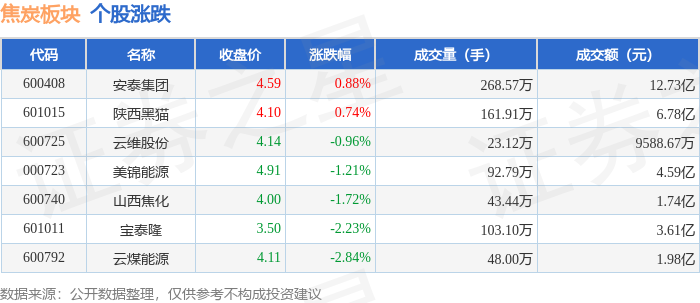
Core Viewpoint - The coking coal sector experienced a decline of 1.09% on January 8, with Yunmei Energy leading the losses, while the Shanghai Composite Index fell by 0.07% and the Shenzhen Component Index decreased by 0.51% [1] Group 1: Market Performance - The closing price of the Shanghai Composite Index was 4082.98, and the Shenzhen Component Index closed at 13959.48 [1] - The individual stock performance in the coking coal sector showed mixed results, with stocks like Antai Group and Shaanxi Black Cat experiencing slight gains, while others like Yunmei Energy and Meijin Energy faced notable declines [1] Group 2: Trading Volume and Capital Flow - The total net outflow of main funds in the coking coal sector was 256 million yuan, while retail investors saw a net inflow of 215 million yuan [1] - The trading volume for Antai Group was 2.6857 million shares, with a transaction value of 1.273 billion yuan, while Yunmei Energy had a trading volume of 480,000 shares and a transaction value of 19.87 million yuan [1] Group 3: Individual Stock Capital Flow - Major net outflows were observed in stocks such as Meijin Energy (-71.23 million yuan) and Shaanxi Black Cat (-49.01 million yuan), while retail investors showed positive net inflows in these stocks [2] - The net inflow of retail funds for Yunmei Energy was 7.02 million yuan, indicating some interest from retail investors despite the overall decline in the stock [2]

兴业证券:2025年各行业上涨由何贡献?
智通财经网· 2026-01-07 11:17
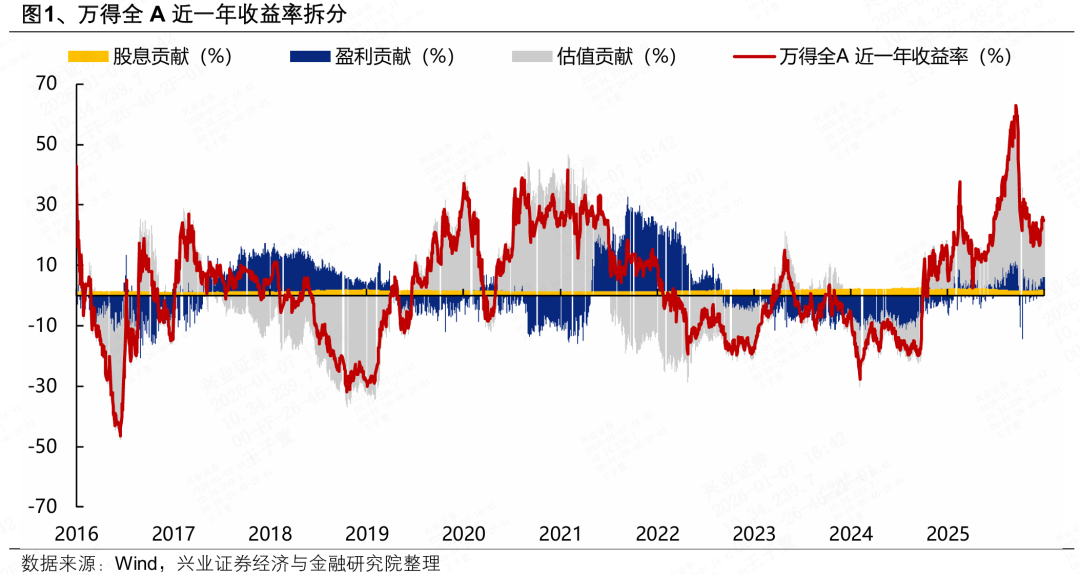
Group 1 - The core viewpoint of the report by Industrial Securities indicates that the overall A-share market is expected to rise by 27.65% in 2025, with profit contribution at 5.29%, valuation contribution at 20.44%, and dividend contribution at 1.91% [1][6][9] - In the primary industry analysis, profit is identified as the "watershed" determining the performance of various sectors in 2025, with leading sectors such as non-ferrous metals, AI hardware (communication, electronics), new energy, and machinery showing significant profit contributions [1][6][9] - Conversely, sectors like consumer goods, real estate, and dividends are expected to lag, primarily due to profit drag [1][6][9] Group 2 - In the secondary industry analysis, sectors with higher growth rates generally have positive profit contributions, while industries such as military (aerospace equipment, ground weapons, military electronics), steel raw materials, and decoration show negative profit contributions, mainly driven by valuation [9][12][14] - The report highlights that in the Hong Kong stock market, most leading sectors also exhibit positive profit contributions, particularly in non-ferrous metals, agriculture, pharmaceuticals, chemicals, and machinery, while lagging sectors like social services and construction are primarily affected by profit drag [12][14] - The secondary industries in the Hong Kong stock market show a similar trend, with leading sectors having positive profit contributions, while industries like motorcycles, traditional Chinese medicine, and glass fiber are negatively impacted by profit drag [14]

焦炭板块1月7日涨4.61%,陕西黑猫领涨,主力资金净流入5.59亿元
Zheng Xing Xing Ye Ri Bao· 2026-01-07 08:59
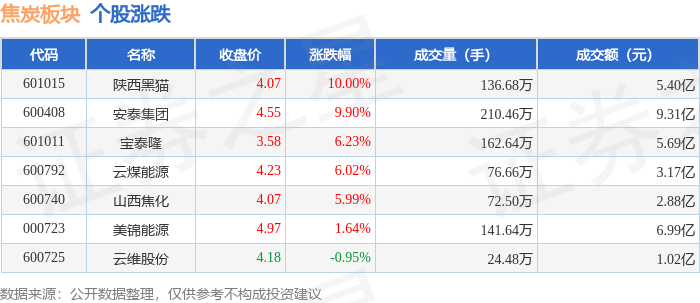
Group 1 - The coke sector experienced a significant increase of 4.61% on January 7, with Shaanxi Black Cat leading the gains [1] - The Shanghai Composite Index closed at 4085.77, up 0.05%, while the Shenzhen Component Index closed at 14030.56, up 0.06% [1] - Key stocks in the coke sector showed notable price increases, with Shaanxi Black Cat rising by 10.00% to a closing price of 4.07, and Antai Group increasing by 9.90% to 4.55 [1] Group 2 - The net inflow of main funds in the coke sector was 559 million yuan, while retail funds saw a net outflow of 360 million yuan [1] - Antai Group had the highest net inflow from main funds at 284 million yuan, accounting for 30.49% of its trading volume [2] - Shaanxi Black Cat also saw a significant net inflow of 125 million yuan, representing 23.07% of its trading volume [2]
美锦能源涨2.04%,成交额5.67亿元,主力资金净流入2233.42万元
Xin Lang Zheng Quan· 2026-01-07 06:24
Core Viewpoint - Meijin Energy's stock price has shown a modest increase in early January 2025, with a year-to-date rise of 6.17% and a recent trading volume indicating active market participation [1] Group 1: Stock Performance - As of January 7, 2025, Meijin Energy's stock price reached 4.99 CNY per share, with a trading volume of 5.67 billion CNY and a market capitalization of 21.973 billion CNY [1] - The stock has experienced a 4.61% increase over the last five trading days and a 1.42% increase over the last twenty days [1] - The company has seen a net inflow of 22.3342 million CNY from main funds, with significant buying activity from large orders [1] Group 2: Financial Performance - For the period from January to September 2025, Meijin Energy reported a revenue of 12.975 billion CNY, reflecting a year-on-year decrease of 9.71% [2] - The company recorded a net profit attributable to shareholders of -737 million CNY, a decline of 12.57% compared to the previous year [2] Group 3: Shareholder Information - As of September 30, 2025, the number of shareholders decreased to 234,000, while the average number of circulating shares per person increased by 6.29% to 18,791 shares [2] - The company has distributed a total of 1.976 billion CNY in dividends since its A-share listing, with no dividends paid in the last three years [3] - Major shareholders include Guotai Junan CSI Coal ETF, which increased its holdings by 73.9442 million shares, and Southern CSI 500 ETF, which reduced its holdings by 930,100 shares [3]
大越期货焦煤焦炭早报-20260107
Da Yue Qi Huo· 2026-01-07 02:28
2、基差:现货市场价1100,基差4;现货升水期货;中性 3、库存:钢厂库存801万吨,港口库存295万吨,独立焦企库存861万吨,总样本库存1957万吨,较上 周减少21万吨;偏多 交易咨询业务资格:证监许可【2012】1091号 焦煤焦炭早报(2026-1-7) 大越期货投资咨询部 胡毓秀 从业资格证号:F03105325 投资咨询证:Z0021337 联系方式:0575-85226759 重要提示:本报告非期货交易咨询业务项下服务,其中的观点和信息仅作参考之用,不构成对任何人的投资建议。 我司不会因为关注、收到或阅读本报告内容而视相关人员为客户;市场有风险,投资需谨慎。 每日观点 焦煤: 1、基本面:节后部分前期停产检修煤矿陆续复产,区域内供应小幅增量,煤矿产量较节前有所改善。 考虑到焦炭价格有继续降价预期,双焦市场情绪偏弱,煤矿线下报价均有不同程度下跌。且线上成交仍 不理想,竞拍底价多有下调,成交价格跌多涨少;偏空 6、预期:钢厂目前利润得到一定的回升,但整体利润仍较低,对高价煤种资源抵触情绪仍存,且对焦 炭还有第五轮提降的预期,因此下游企业采购依旧谨慎,目前多控制原料到货节奏,按需采购为主,预 计短 ...
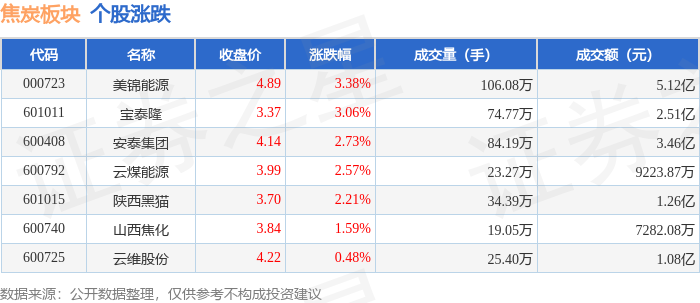
焦炭板块1月6日涨2.53%,美锦能源领涨,主力资金净流入6588.93万元
Zheng Xing Xing Ye Ri Bao· 2026-01-06 09:03
Core Viewpoint - The coke sector experienced a 2.53% increase on January 6, with Meijin Energy leading the gains, while the Shanghai Composite Index rose by 1.5% and the Shenzhen Component Index increased by 1.4% [1] Group 1: Market Performance - The closing price of Meijin Energy was 4.89, with a rise of 3.38% and a trading volume of 1.0608 million shares, amounting to a transaction value of 512 million yuan [1] - Baotailong closed at 3.37, up 3.06%, with a trading volume of 747,700 shares and a transaction value of 251 million yuan [1] - Antai Group's closing price was 4.14, increasing by 2.73%, with a trading volume of 841,900 shares and a transaction value of 346 million yuan [1] Group 2: Fund Flow Analysis - The coke sector saw a net inflow of 65.8893 million yuan from main funds, while retail funds experienced a net outflow of 27.0086 million yuan [1] - Antai Group had a main fund net inflow of 43.4414 million yuan, accounting for 12.56% of its total, while retail funds had a net outflow of 35.3499 million yuan, representing -10.22% [2] - Meijin Energy recorded a main fund net inflow of 30.8955 million yuan, which is 6.03% of its total, with retail funds showing a net outflow of 525.92 thousand yuan, or -1.03% [2]