计算机

Search documents
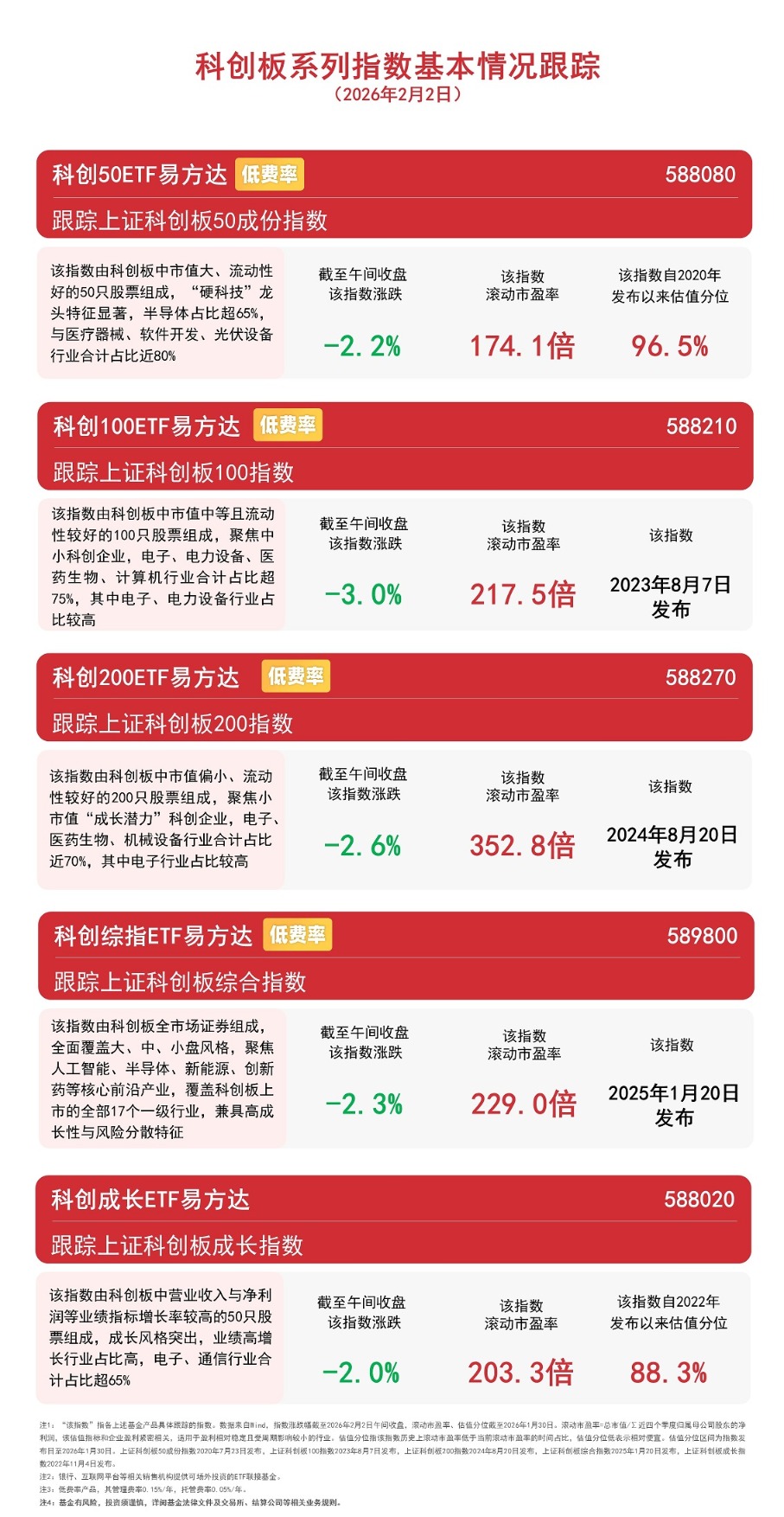
科创板系列指数震荡走弱,关注科创200ETF易方达(588270)、科创50ETF易方达(588080)等布局机会
Mei Ri Jing Ji Xin Wen· 2026-02-02 06:08
Core Viewpoint - The news discusses various ETFs tracking the STAR Market indices, highlighting their performance, composition, and fee structures, indicating a focus on technology and growth sectors in China. Group 1: ETF Performance and Composition - The STAR 50 ETF tracks the STAR Market 50 Index, consisting of 50 large-cap stocks with significant liquidity, primarily in the semiconductor sector, which accounts for over 65% of the index [2] - The STAR 100 ETF follows the STAR Market 100 Index, made up of 100 mid-cap stocks, with a focus on small and medium-sized tech companies, where electronics and power equipment sectors represent over 75% [2] - The STAR 200 ETF tracks the STAR Market 200 Index, comprising 200 small-cap stocks, with a high concentration in electronics, pharmaceuticals, and machinery, accounting for nearly 70% of the index [2] Group 2: Index Performance Metrics - The STAR 50 Index has a rolling P/E ratio of 174.1, with a performance change of -2.2% [2] - The STAR 100 Index has a rolling P/E ratio of 217.5, with a performance change of -3.0% as of August 7, 2023 [2] - The STAR 200 Index has a rolling P/E ratio of 352.8, with a performance change of -2.6% [2] Group 3: Growth Focus and Sector Representation - The STAR Growth ETF tracks the STAR Market Growth Index, consisting of 50 stocks with high growth rates in revenue and net profit, with over 65% in electronics and communications sectors [5] - The growth style is emphasized, indicating a focus on companies with strong performance metrics [5]

海通国际研究中国策略周报:春季行情蓄力更健康,春节大红包更靠结构
Sou Hu Cai Jing· 2026-02-02 05:10
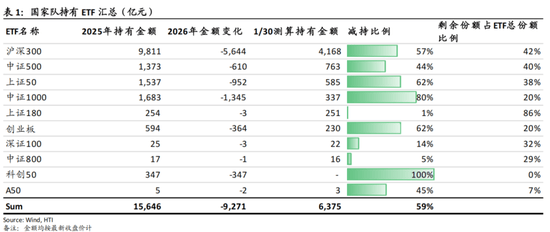
Market Overview - The current market is in a phase of upward trend with periodic fluctuations, emphasizing a balanced allocation between technology and value sectors, focusing on structural aspects rather than short-term index movements [1] - The market is expected to stabilize and rise before the Spring Festival, driven by fundamental and liquidity factors, with significant political and economic catalysts anticipated [1] Investment Strategy - Focus on sectors benefiting from the Spring Festival effect and macroeconomic catalysts in February, particularly in technology and value assets [1][3] - Maintain value assets as a core holding while increasing exposure to cyclical industry leaders showing improved sentiment [3] Sector Highlights - AI applications are gaining traction, with major tech companies competing for market share during the Spring Festival, including initiatives from Tencent, Baidu, and Alibaba [2] - High-performing technology manufacturing sectors include AI hardware, energy storage, and pharmaceuticals [2] - Future industries of interest include defense, domestic computing power, and controlled nuclear fusion [2] Liquidity and Market Data - The dollar index experienced significant fluctuations, impacting market expectations regarding the Federal Reserve's policies [5] - A notable outflow of approximately 370 billion yuan from broad-based ETFs, while sector-specific ETFs saw inflows, particularly in metals and semiconductors [5] - In the Hong Kong market, short-selling activity has returned to historical averages, with net inflows from southbound funds decreasing [6] ETF Holdings Summary - Significant reductions in holdings of major ETFs, with the CSI 300 seeing a decrease of 5,644 million yuan, leaving a remaining share of 42% [7] - Other ETFs also experienced notable reductions, indicating a shift in investment strategies among institutional investors [7]
短期调整不足为惧
GOLDEN SUN SECURITIES· 2026-02-02 03:42
- The report mentions the construction of the A-share prosperity index, which is based on the Nowcasting target of the year-on-year net profit attributable to the parent company of the Shanghai Composite Index. The index reflects the high-frequency prosperity trend of the A-share market[29][30] - The A-share sentiment index is constructed by dividing the market into four quadrants based on the direction of changes in volatility and trading volume. Among these, the quadrant with "volatility up - trading volume down" shows significant negative returns, while the others show significant positive returns. This index includes bottom-warning and top-warning signals[34][37][39] - The report evaluates the performance of style factors using the BARRA factor model, which includes ten categories: size (SIZE), beta (BETA), momentum (MOM), residual volatility (RESVOL), non-linear size (NLSIZE), valuation (BTOP), liquidity (LIQUIDITY), earnings yield (EARNINGS_YIELD), growth (GROWTH), and leverage (LVRG). Recent analysis shows that momentum factors have high excess returns, while beta factors exhibit significant negative excess returns[56][57][58]
2026年第2期:国元证券2026年2月金股组合及投资逻辑
Guoyuan Securities· 2026-02-02 03:12
Stock Recommendations - The recommended stocks for February 2026 include: - Daotong Technology (688208.SH) with an expected EPS growth of 28.14% and a PE ratio of 34.98[2] - Kaiying Network (002517.SZ) with an expected EPS growth of 27.56% and a PE ratio of 24.92[2] - Huitong Co., Ltd. (688219.SH) with an expected EPS growth of 33.31% and a PE ratio of 12.59[2] - Yinlun Co., Ltd. (002126.SZ) with an expected EPS growth of 36.66% and a PE ratio of 36.89[2] - Aikedi (600933.SH) with an expected EPS growth of 18.08% and a PE ratio of 19.18[2] - Hongyuan Electronics (603267.SH) with an expected EPS growth of 50.66% and a PE ratio of 54.53[2] Market Performance - The Guoyuan monthly stock portfolio achieved a weighted return of 9.60% in January 2026, outperforming the Shanghai Composite Index which rose by 3.76%[12] - The best-performing stocks in January included: - Kaige Precision Machinery with a return of 42.21%[12] - Tongling Nonferrous Metals with a return of 37.60%[12] Risk Factors - Potential risks include overseas policy risks across various industries and operational risks specific to individual companies[6]




廖市无双-风格切换成长轮休-该如何应对
2026-02-02 02:22
Summary of Conference Call Records Industry and Company Overview - The conference call discusses the current state of the market, focusing on various sectors including technology, resources, and financial services. The analysis highlights the performance of indices such as the CSI 500, CSI 1000, and the Shanghai Composite Index. Key Points and Arguments Market Conditions - The market is experiencing a weakening momentum, necessitating risk control and attention to the 20-day moving average and external factors affecting resource prices [1][3] - In January, the first three weeks saw strong performance from small-cap indices like CSI 500 and CSI 1000, but a cooling trend began in the third week, with large-cap indices like the Shanghai 50 and CSI 300 breaking below the 20-day moving average [2][4] Sector Performance - The non-ferrous metals sector is under pressure, with expectations of a prolonged adjustment phase, potentially lasting six months to a year. The previous year's surge of 97.5% in the non-ferrous index makes it unlikely to replicate such gains this year [5][6] - The technology growth sector is showing signs of weakness, with various industries including defense, electronics, and computing experiencing pullbacks [6][7] Investment Strategy - Investors are advised to maintain a balanced portfolio with a focus on sectors that are currently undervalued and have a high risk awareness. Caution is recommended for technology growth stocks due to potential short-term volatility [3][4] - Recommended sectors for investment include construction materials, electronics, and communication, which are considered to have a favorable risk-reward ratio [2][12] Market Trends and Predictions - The market is expected to enter a phase of strong oscillation leading up to the Spring Festival, with large-cap indices outperforming small-cap growth indices [8][11] - The brokerage sector is anticipated to enter a bullish cycle, with a potential for upward movement despite current low market sentiment [9][10] Risk Factors - The volatility in global resource prices, such as a 35% drop in silver prices, is impacting related assets and indices, particularly those with significant exposure to non-ferrous resources [4][5] - The potential for further declines in small-cap indices if they do not rebound quickly is a concern, indicating a need for careful monitoring of technical indicators [4][8] Future Outlook - The overall market is expected to remain in a state of fluctuation, with opportunities for growth anticipated towards the end of 2026. Investors are encouraged to adjust their portfolios accordingly and focus on sectors with solid fundamentals [11][18] Additional Important Content - The call emphasizes the importance of monitoring technical indicators such as the 20-day and 5-week moving averages to make timely adjustments to investment positions [4][11] - The discussion includes insights on the cyclical nature of certain sectors, particularly those related to commodities and technology, suggesting a strategic approach to investing in these areas [13][15]
【申万宏源策略 | 一周回顾展望】开启区间震荡行情
申万宏源研究· 2026-02-02 01:08
Core Viewpoint - The current market is experiencing a transition from a strong momentum phase to a high-level consolidation phase, with the "steady and far-reaching" policy supporting this shift. The market's internal strength is gradually declining, indicating a need for time to digest valuations and performance [2][6]. Short-term Market Positioning - The short-term market has reached historical high levels, with the A-share floating profit also retreating from these highs. The average holding period remains at historically low levels, indicating excessive trading behavior. The technology sectors that initially led the market have seen a reduction in attractiveness, while cyclical sectors are also experiencing a decline in internal stability [3][5]. Long-term Market Positioning - The opening red market is an extension of the structural market of 2025, with expectations of a mid-term fundamental upcycle. However, as valuations reach historical highs, the market faces increased resistance, necessitating a transition from upward to consolidation phases. This requires time for performance to catch up with valuations [5][21]. Market Characteristics at High Valuation Levels - Four key characteristics of the market at high valuation levels include: 1. Increased difficulty in raising valuations. 2. Stricter conditions for upward breakthroughs, requiring new performance drivers. 3. High sensitivity to liquidity shocks, which could trigger adjustments from upper to lower consolidation ranges. 4. The need for "perfect performance validation" to avoid downward adjustments [21][22]. Sector Performance Insights - Various sectors, including communication, electronics, defense, and basic chemicals, have reached historical high valuation levels. The overall PE valuation of A-shares is also at historical highs, indicating a need for performance to catch up with these valuations [5][23]. Policy Impact - The "steady and far-reaching" policy is expected to accelerate the market's transition to the next phase, characterized by style switching and profit expansion, followed by a period of consolidation. This policy is likely to influence the performance of heavyweight stocks that have been under pressure [24][22].
春季行情蓄力更健康,春节大红包更靠结构
Haitong Securities International· 2026-02-01 23:30
Investment Focus - The report emphasizes a balanced allocation between technology and value sectors, focusing on market structure rather than short-term index fluctuations [1][11] - Recent market movements show a stronger rebound in value sectors compared to high-tech, with increased expectations for policies supporting the real estate sector [1][12] - Rising commodity prices and stabilization in certain product prices are aiding valuation recovery in undervalued sectors like real estate and baijiu [1][12] Market Outlook - The report anticipates stabilization and upward movement in Chinese equities (A-shares and Hong Kong stocks) leading into the Lunar New Year, driven by domestic fundamentals and liquidity conditions [2][13] - A series of political and economic catalysts, including local and national meetings and the rollout of the 15th Five-Year Plan, are expected to enhance market sentiment [2][13] Investment Strategy - The report suggests positioning for the Lunar New Year "red packet" rally by focusing on industries benefiting from holiday effects and macroeconomic catalysts [2][14] - Key areas of focus include AI applications, high-quality tech manufacturing, and future industries such as defense and domestic chip production [2][14] Sector Analysis - Non-bank financials, particularly brokers and insurers, are expected to recover from previous outflows due to their strong fundamentals [3][19] - The holiday consumption chain, including sectors like gaming, food and beverage, and travel, is highlighted as a potential growth area [3][19] - Hong Kong dividend assets with earnings leverage, such as real estate and chemicals, are also noted for their potential upside following policy support [3][19] Liquidity Data - A-share ETF flows show a divergence, with broad-based ETFs experiencing significant outflows while sector-specific ETFs saw inflows, particularly in metals and chemicals [4][16] - In Hong Kong, short-selling activity has returned to historical averages, with notable inflows into energy and property sectors [5][17]


机构研究周报:风格转换成长“轮休”,黄金短空长多
Wind万得· 2026-02-01 22:37
Core Viewpoint - The article discusses the recent volatility in the gold and silver markets, the transition of the equity market from a "structural bull" to a "comprehensive bull," and the implications for various sectors, particularly technology and real estate [1][3][4]. Group 1: Precious Metals - On January 30, gold and silver experienced significant declines, with silver dropping 36% and gold falling over 12%, marking the largest daily declines in history [3]. - Short-term market dynamics indicate that the momentum for gold's correction is still accumulating, while the long-term fundamentals for gold remain solid, suggesting a continued bull market trend [3]. Group 2: Equity Market - According to Franklin Templeton, the domestic asset allocation for 2026 will be driven by three core logic points: a weak dollar benefiting RMB assets, low domestic interest rates leading to increased equity investments, and policy support impacting inflation [4]. - Zhejiang Securities notes that the technology growth sector has entered a phase of high-level consolidation after a strong three-week performance, while the resource sector is experiencing volatility amid global resource price fluctuations [6]. - CICC highlights that the willingness of residents to invest in the stock market remains weak, with the correlation between available funds and stock market performance being low [7]. Group 3: Industry Research - Huatai Securities indicates that the real estate sector is entering a "policy + small spring" window, with improved transaction volumes in core cities and relaxed financing conditions [10]. - China Europe Fund emphasizes a moderate bull market for A-shares in 2026, focusing on structural opportunities in overseas computing power and industrial metals [11]. - China Asset Management points out that the demand for electrical equipment exports is rising due to the urgent need for upgrades in North America's aging power grid [12].



1月私募调研路径曝光 计算机和机械设备受关注
Shang Hai Zheng Quan Bao· 2026-02-01 18:16
私募开年密集调研 机构2026年进攻方向,或可从其1月调研路径窥得端倪。据私募排排网统计,1月有近660家私募参与A 股调研活动,合计调研频次超1700次。分行业来看,计算机、机械设备、医药生物和电子等板块备受关 注。在一些业内人士看来,尽管2025年科技板块整体涨幅显著,但从产业趋势和企业盈利情况来看,现 在远未行至"泡沫阶段",尤其是半导体和AI应用值得重点挖掘。 私募排排网最新统计数据显示,2026年1月共有659家私募参与A股公司调研活动,覆盖了28个申万一级 行业中的332只标的,合计调研频次达1719次。 1月16日,丹羿投资创始人朱亮则调研了通富微电。据公开资料,通富微电是集成电路封装测试服务提 供商,开源证券研究报告分析称,算力产业已开启"军备竞赛",国产算力跨越式发展的背景下,本土AI 算力芯片蓬勃发展,相关产业链迎来发展窗口,通富微电有望深度受益。 AI基建与应用受关注 私募机构认为,在AI产业高速发展的过程中,机会将持续涌现,科技仍将是2026年不可忽视的投资主 线之一。 畅力资产董事长宝晓辉分析称,作为AI产业的基建,半导体设备领域值得关注。具体来看,当前AI行 业的发展逻辑已发生转变 ...
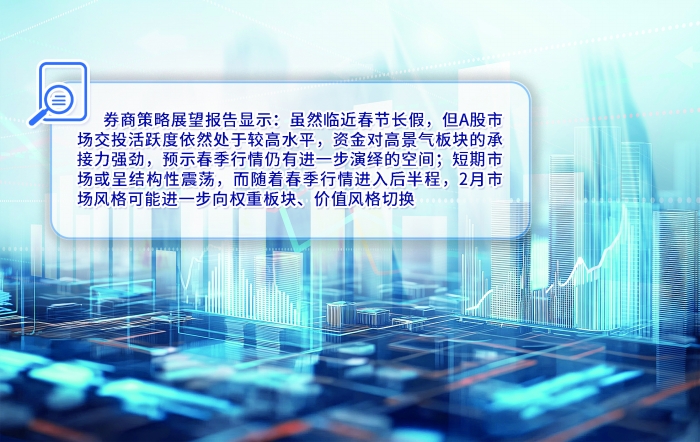
春季行情向纵深演绎 机构判断市场风格或趋于均衡
Shang Hai Zheng Quan Bao· 2026-02-01 18:14
Group 1 - The A-share market is experiencing accelerated sector rotation, with previously strong-performing sectors like computer and new energy facing corrections, while previously lagging sectors such as liquor and real estate are performing well [2][5] - Despite external disturbances, the A-share market shows signs of a phase of adjustment, but the medium-term outlook remains positive with ample opportunities [3][4] - The upcoming Spring Festival holiday is not dampening trading activity, indicating strong market engagement and potential for further development in the spring market [2][3] Group 2 - The market may see a style switch as the spring rally progresses, with a shift from small-cap stocks to large-cap stocks and a focus on quality over speculation [5][6] - The recent performance of liquor and real estate sectors suggests a convergence in market structure as the spring rally enters its latter half, with expectations of balanced upward trends [5][6] - Long-term prospects for the metals sector remain positive due to anticipated demand from AI data centers and renewable energy, despite short-term corrections providing better entry points [6]