智能手机

Search documents
三星Z Fold7 5G仅9799元
Xin Lang Cai Jing· 2026-01-07 01:45
Core Insights - The Samsung Galaxy Z Fold7 5G folding phone is currently priced at 13,999 yuan on JD.com, with a promotional price of 9,799 yuan on the Paiyide platform [2][3] - The device features a powerful Snapdragon 8 Gen 2 processor, ensuring excellent performance for multitasking and running large applications [2][3] - It comes with 12GB of RAM and 512GB of storage, catering to the needs of office work, entertainment, and large data storage [2][3] - The phone's design includes a sleek flexible screen and a precision hinge, allowing for seamless folding and an immersive visual experience [2][3] - It supports high-speed 5G networks, enhancing capabilities for photography, live streaming, and video calls [2][3] - The Galaxy Z Fold7 is positioned as an ideal choice for business professionals and tech enthusiasts, marking a new chapter in mobile living [2][3]
iPhone 17系列中国销量破1500万 标准版成增长主力
Xin Lang Cai Jing· 2026-01-07 01:40
Core Insights - The iPhone 17 series has shown strong sales performance in the Chinese market, surpassing 15 million units sold, with a cumulative sales figure of 15.57 million units as of week 52 of 2025, indicating robust market appeal [2][3] - The standard model of the iPhone 17 has become the key driver of overall sales growth, with its sales nearly doubling compared to the previous generation during the same period [2][3] - The growth in sales is attributed to a more competitive product positioning, with significant upgrades including an increase in base storage capacity from 128GB to 256GB and the introduction of a 120Hz ProMotion adaptive refresh rate display, enhancing user experience [2][3] Industry Position - Apple maintains a solid lead in the high-end smartphone market, facing competition from local brands that have not yet posed a substantial challenge in this segment [3] - With ongoing product innovation and strong user loyalty, Apple is expected to continue leading global smartphone shipments through 2026 [3]

摩托罗拉moto Signature旗舰曝光:骁龙8 Gen 5+三摄+165Hz屏
Xin Lang Cai Jing· 2026-01-07 01:40
1月6日,网络信息显示,知名产品爆料人Evan Blass在社交平台发布一组图片,首次完整展示了摩托罗 拉即将推出的高端旗舰手机moto Signature。该机型提供黑色与金色两种配色,机身尺寸为162.1毫米 ×76.4毫米×6.99毫米,重量为186克,具备IP68、IP69以及MIL-STD-810H防护认证,兼顾日常使用与极 端环境下的耐用性。 1月6日,网络信息显示,知名产品爆料人Evan Blass在社 交平台发布一组图片,首次完整展示了摩托罗拉即将推 出的高端旗舰手机moto Signature。该机型提供黑色与金 色两种配色,机身尺寸为162.1毫米×76.4毫米×6.99毫 米,重量为186克,具备IP68、IP69以及MIL-STD-810H 防护认证,兼顾日常使用与极端环境下的耐用性。 设备正面配备一块6.8英寸的Extreme AMOLED LTPO显 示屏,分辨率达到2780×1264,刷新率最高支持165Hz, 屏幕峰值亮度可达6200尼特,并集成屏下超声波指纹识 别技术。背部影像系统由三颗5000万像素摄像头构成, 分别为广角、超广角及长焦镜头,满足多场景拍摄需 求。音频方面, ...
马斯克旗下xAI公司完成200亿美元融资;微信辟谣好友太多会被封
Sou Hu Cai Jing· 2026-01-07 01:30
Group 1 - The State Administration for Market Regulation will accelerate the update and upgrade of a batch of national standards for green consumption [2] - The administration aims to create a favorable market environment and enhance public satisfaction through various initiatives [2] - Key initiatives include improving energy and water efficiency labeling systems, promoting "green dining" services, and strengthening law enforcement against violations in green product areas [2] Group 2 - Starting January 1, 2026, cosmetic surgery will be subject to VAT, while medical services provided by medical institutions will remain exempt [3] - The definition of "medical institutions" excludes profit-driven beauty medical institutions [3] Group 3 - Bawang Tea Ji responded to a viral video of a staff member preparing tea with bare hands, stating it was a staged act for social media and not for sale [3] - The company has taken disciplinary actions, including indefinite closure of the store and termination of the involved staff [3] Group 4 - Lee Jae-Yong, Chairman of Samsung Electronics, was spotted shopping in Beijing, purchasing 100 Labubu items [4][5] - This event occurred after his attendance at a China-Korea business forum [4] Group 5 - Elon Musk's xAI company completed a $20 billion funding round with investors including Nvidia and Qatar Investment Authority [5] - The funding has been in preparation for several months, although specific investment amounts from each party were not disclosed [5] Group 6 - Nvidia CEO Jensen Huang announced new AI products at CES 2026, including the next-generation Rubin architecture GPU [6] - The new GPU's performance is significantly improved compared to the previous Blackwell GB200 model [6] - Nvidia is also releasing several new models targeting various AI applications, including autonomous driving and robotics [6] Group 7 - Xiaomi announced disciplinary actions following an investigation into its team's interaction with KOLs, resulting in the dismissal of involved personnel [6] Group 8 - WeChat clarified that rumors about new account restrictions are false, emphasizing that normal social behavior will not be limited [7][8] Group 9 - Apple responded to criticism regarding the price of a Year of the Horse phone case, stating that the design is a collaboration and the price reflects its quality [8] Group 10 - Xiaohongshu is testing a paid note feature, allowing creators to charge for high-quality content with various payment models [9] Group 11 - KKV store in Shenzhen faced a forced closure due to alleged rent arrears, leading to employee injuries and emotional distress [10] Group 12 - Magic Cube Life Service Group is facing operational disputes in multiple cities, with claims of unpaid rent and forced tenant evictions [11] - The company stated it is optimizing its store operations and remains committed to expanding new projects [11] Group 13 - Tesla announced a new financing plan for Model 3 and Model Y vehicles, including a 5-year interest-free option [12] Group 14 - Moutai's Year of the Horse liquor is being resold at inflated prices, with some resellers offering up to 3000 yuan for a bottle originally priced at 1899 yuan [12] Group 15 - Great Wall Motors has officially implemented a full weekend off policy for all employees, marking a significant change in its work schedule [13] Group 16 - A recent incident involving a physical altercation between a pilot and co-pilot on a flight has been addressed by the airline, confirming compliance with operational standards [14] Group 17 - The C919 aircraft has successfully carried over 4 million passengers, with ongoing developments in new aircraft models and engine certifications [15] Group 18 - GAC Honda announced a two-week production halt due to semiconductor supply issues and production line upgrades, stating that the impact on overall production will be manageable [16]






山东公安部署开展“冬季守护”专项工作,深入打击治理电诈犯罪等被列入重点工作
Da Zhong Ri Bao· 2026-01-07 01:00
Core Viewpoint - The Shandong Provincial Public Security Department has launched a "Winter Guardian" initiative aimed at intensifying the crackdown on telecom fraud and other related crimes, significantly improving public safety and satisfaction levels [2][3]. Group 1: Crime Prevention and Law Enforcement - The "Winter Guardian" initiative has led to a total of 1.478 million police cases being handled, marking a year-on-year decrease of 6.11%, with criminal and public order cases down by 30.53% and 13.66% respectively [2]. - A total of 3,454 suspects related to telecom fraud and associated crimes have been apprehended, with 27 cases involving losses exceeding 1 million yuan being solved [2]. - A significant operation dismantled a telecom fraud gang with over 3.6 billion yuan in illicit funds, resulting in the arrest of more than 1,500 suspects and the freezing of over 27 million yuan in assets [3]. Group 2: New Crime Techniques - The emergence of "company-style" emotional fraud networks has been identified, where scammers use dating apps to create fake personas, leading victims to invest money under the guise of maintaining relationships [4][5]. - The police discovered that the funds obtained through these scams were split between the chatters and the company, complicating the investigation due to the organized nature of the operation [5]. - New crime methods have been characterized by scripted designs, where criminals meticulously plan their actions to manipulate victims, as seen in street scams involving "borrowing phones" [7][8]. Group 3: Technological Crime - A new type of crime involving the use of AI technology to generate and disseminate negative content about electric vehicle brands has been reported, indicating a shift towards tech-driven criminal activities [11]. - The police have identified over 3,000 negative articles linked to a network of accounts that exploit AI to create misleading content, disrupting normal business operations [11][12]. - The operation led to the arrest of 12 suspects and the shutdown of over 8,000 illegal accounts, highlighting the ongoing efforts to combat evolving criminal tactics [12][13].
8点1氪:机长、副机长被传驾驶舱内打架,长荣航空回应;小米正式回应米黑KOL合作事件;霸王茶姬通报“徒手搅拌奶茶”事件
36氪· 2026-01-07 00:33
Group 1 - EVA Air has suspended the flight duties of the involved captain following an incident where the captain and co-pilot reportedly had a physical altercation in the cockpit during taxiing at Los Angeles Airport. The airline stated that the aircraft's taxi speed was within operational norms and regulations [2] - Xiaomi has responded to a controversy involving a collaboration with a KOL, stating that the engagement has been terminated and that the responsible personnel will face dismissal. The company emphasized that the incident violated its principles and harmed its relationship with fans [2] Group 2 - xAI announced the completion of its Series E funding round, raising $20 billion, exceeding its initial target of $15 billion. Notable investors include Valor Equity Partners and Qatar Investment Authority, with strategic support from Nvidia and Cisco [4] - Tesla has introduced a 5-year interest-free car purchase plan for its Model 3 and Model Y vehicles, with down payments starting at 79,900 yuan and monthly payments as low as 1,918 yuan [7] Group 3 - The Chinese tax law will exclude profit-making medical beauty institutions from VAT exemptions starting January 1, 2026, marking a significant change in the tax landscape for the industry [6] - NIO's CEO Li Bin highlighted that the biggest cost pressure in the automotive industry for 2026 will be the rising prices of memory chips, as the automotive sector competes with the AI industry for resources [9] Group 4 - The first commercial rocket company in China is set to change ownership, with a 29.5904% stake being offered for approximately 3.299 billion yuan, valuing the company at around 11.2 billion yuan [14] - CATL and NIO have signed a five-year strategic cooperation agreement focusing on battery technology and battery swap systems, aiming to enhance collaboration in the electric vehicle market [14]




小米公关紧急道歉!雷军评论区彻底沦陷了
Sou Hu Cai Jing· 2026-01-06 15:35
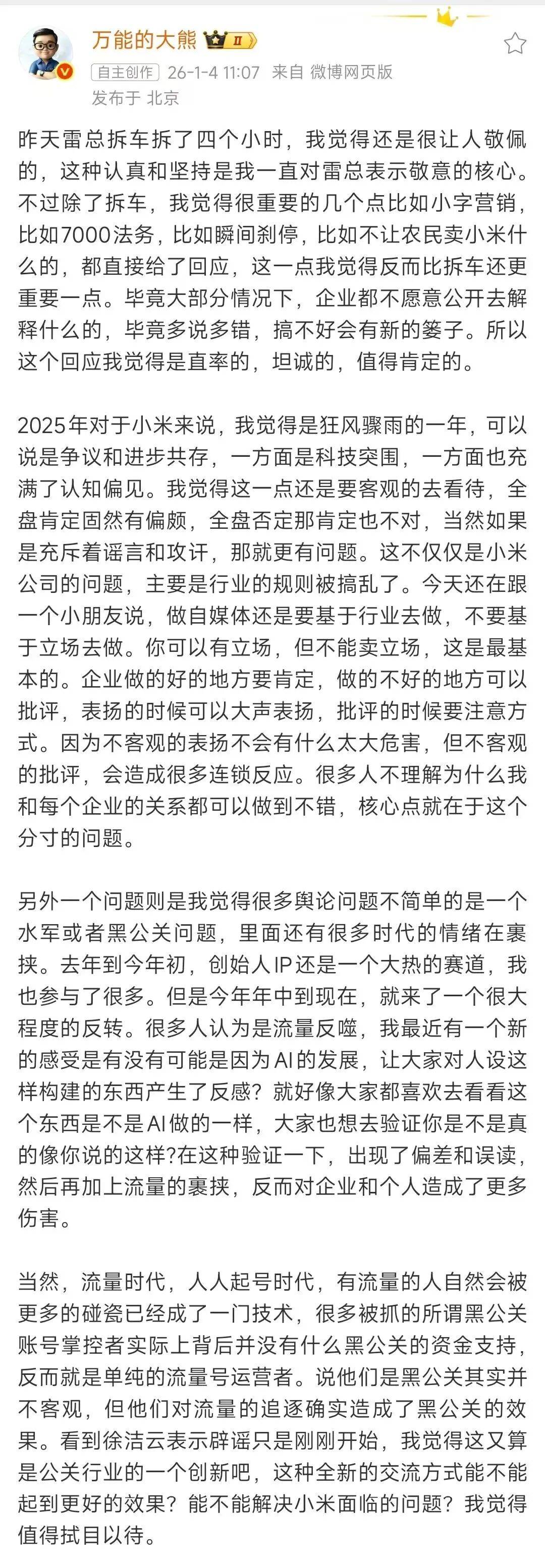
Core Viewpoint - The article discusses the recent public relations challenges faced by Xiaomi, highlighting the tension between the company's marketing strategies and its relationship with loyal customers, particularly in light of controversies surrounding product issues and public statements made by the company [2][14]. Group 1: Public Relations and Marketing Strategies - Xiaomi's recent marketing efforts, including collaborations with influencers who have previously criticized the brand, have sparked backlash among its loyal customer base, raising concerns about the company's understanding of its core audience [14]. - The company's approach to addressing product-related issues, such as the "7000 legal issues" and "instant brake failures," has been perceived as insufficient, leading to a growing trust crisis among consumers [2][14]. - The article emphasizes the importance of transparent communication in public relations, suggesting that the company's recent actions may exacerbate existing dissatisfaction rather than resolve it [14]. Group 2: Industry Context and Consumer Sentiment - The article notes a shift in consumer sentiment towards brands, influenced by the rise of AI and changing perceptions of authenticity, which may affect how companies like Xiaomi engage with their audiences [3]. - There is a growing concern that the current marketing landscape, characterized by aggressive pursuit of online traffic, can lead to unintended negative consequences for brands, including the emergence of "black public relations" tactics [3]. - The discussion highlights the need for companies to balance marketing strategies with genuine engagement and support for their loyal customers, as failure to do so can lead to significant reputational damage [14].

雷军回应小字营销:行业陋习,但我们改/DeepSeek开年「王炸」,梁文锋署名论文发布/马斯克立新年Flag:大规模量产脑机接口
Sou Hu Cai Jing· 2026-01-06 13:46
Group 1 - Lei Jun, the founder of Xiaomi, addressed the controversy surrounding "small font marketing," stating it is an industry habit that needs to be changed, emphasizing the importance of legal compliance while acknowledging the need for clearer communication with consumers [3][4] - Xiaomi plans to standardize product annotations using larger fonts in the future, aiming to improve clarity and consumer understanding [4] - In a recent live stream, Lei Jun revealed that Xiaomi's automotive division aims to deliver over 410,000 vehicles by 2025, with the Xiaomi YU7 model becoming the best-selling mid-to-large SUV for four consecutive months [5][7] Group 2 - BMW China announced a systematic price adjustment for 31 key models starting January 1, 2026, with the highest price drop reaching 300,000 yuan, reflecting a long-term strategy rather than a short-term price war [11][12] - The flagship electric model i7 M70L saw a price reduction from 1.899 million yuan to 1.598 million yuan, a decrease of approximately 16%, while the iX1 eDrive25L's price dropped by 24% [12] - The automotive industry is experiencing significant shifts, with multiple companies reporting their sales figures for 2025, indicating a competitive landscape [7] Group 3 - OpenAI is reportedly working on multiple AI hardware projects, including a pen-shaped device and portable audio equipment, aiming to create an ecosystem of products rather than a single offering [9][10] - The new audio model being developed by OpenAI is expected to provide more natural and expressive responses, enhancing user interaction with AI devices [10] Group 4 - Elon Musk announced that Neuralink plans to begin large-scale production of brain-machine interface devices in 2026, with a focus on simplifying the surgical process for implantation [16][18] - The company aims to enable users to control computers directly through neural signals, with previous successful trials involving a limited number of patients [18] Group 5 - Microsoft CEO Satya Nadella emphasized that 2026 will be a pivotal year for AI, marking a transition from initial exploration to widespread application, with a focus on reshaping human-AI relationships and engineering paradigms [27][29][30] - Nadella highlighted the need for AI to demonstrate tangible positive impacts in the real world to gain societal acceptance [30]


三星利润将飙升160%!
国芯网· 2026-01-06 11:32
Core Viewpoint - The article highlights the unprecedented surge in memory prices in 2025, leading to a significant shortage in the consumer electronics industry, with memory manufacturers reaping substantial profits [2][4]. Group 1: Memory Price Surge - In 2025, memory prices have skyrocketed, causing an unprecedented shortage and price increase in the consumer electronics sector, affecting both manufacturers and consumers [2]. - Analysts predict that Samsung's operating profit for Q4 2025 will reach 16.9 trillion KRW (approximately 816 billion RMB), a 160% increase from 6.49 trillion KRW in the same period last year [2][4]. - This profit is expected to be the highest quarterly profit since Q3 2018, with some optimistic analysts raising profit expectations to over 20 trillion KRW [4]. Group 2: Causes of the Price Surge - The surge in memory prices is primarily driven by the high demand for AI chips from major companies like NVIDIA, forcing semiconductor manufacturers to allocate significant production capacity to high-bandwidth memory [4]. - This shift has resulted in reduced production of traditional DRAM (such as DDR4 and DDR5) and NAND flash memory, leading to a comprehensive supply shortage [4]. - The benchmark price for DDR4 has increased nearly sevenfold over the past year, reaching the highest level since 2016 [4]. Group 3: Impact on Samsung - Samsung, as the largest smartphone manufacturer globally, is experiencing severe profit erosion in its mobile business due to skyrocketing memory costs [4]. - TM Roh, Samsung's co-CEO, stated that no company can escape the impact of this unprecedented situation, which affects not only smartphones but also other consumer electronics like TVs and home appliances [4]. - There is a possibility of raising product prices due to the unavoidable impact of rising memory chip prices [4].

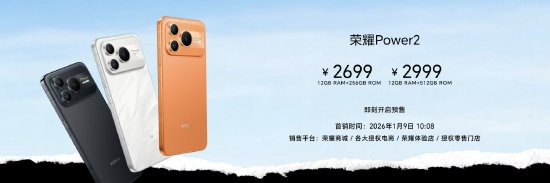
荣耀Power2发布:搭载10080mAh第四代青海湖电池,售价2699元起
Xin Lang Cai Jing· 2026-01-06 11:22
Core Insights - Honor recently launched the "outdoor light flagship" Honor Power2, starting at a price of 2699 yuan [2][5] Group 1: Product Specifications - The new Honor Power2 features a 10080mAh fourth-generation Qinghai Lake battery, an increase of 2080mAh compared to the previous generation, while maintaining a thickness of 7.98mm [2][5] - It supports 80W super fast charging and 27W reverse charging [2][5] - The device is equipped with the Dimensity 8500 Elite chipset, featuring a full big core configuration and a 25% improvement in GPU performance [2][5] - The Honor Power2 includes a liquid cooling system with a total heat dissipation area exceeding 40000mm² [2][5] - The device has an IP68, IP69, and IP69K rating for dust and water resistance [2][5] Group 2: Display and Camera Features - The Honor Power2 is equipped with a 6.79-inch 1.5K Honor Oasis eye protection screen, with a peak brightness of 8000 nits and 3840Hz PWM dimming for eye safety [3][6] - It features a 50MP OIS optical stabilization main camera, supporting 5.0-level CIPA stabilization [3][6] - The upgraded AI outdoor mode offers screen enhancement and network optimization, along with AI anti-fraud features, full-scene NFC, and infrared remote control capabilities [3][6] Group 3: Pricing and Variants - The Honor Power2 is available in three colors: "Sunrise Orange," "Snow White," and "Phantom Black" [3][6] - The pricing for the 12GB + 256GB version is 2699 yuan, while the 12GB + 512GB version is priced at 2999 yuan, with national subsidy prices of 2294.15 yuan and 2549.15 yuan respectively [3][6]