
家具

Search documents
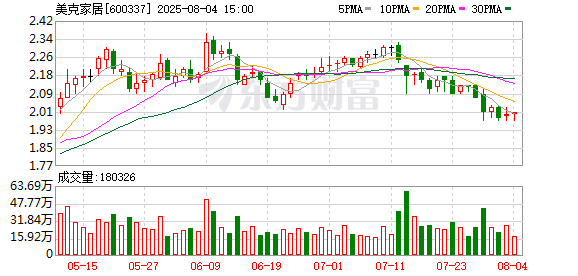
美克家居:累计回购公司股份179万股
Zheng Quan Ri Bao· 2025-08-04 12:51
(文章来源:证券日报) 证券日报网讯 8月4日晚间,美克家居发布公告称,截至2025年7月31日,公司已累计回购股份179万 股,占公司总股本的0.12%。 ...


国家税务总局最新增值税发票数据显示:上半年全国企业销售收入平稳增长
Yang Shi Wang· 2025-08-04 10:13
Group 1 - The core viewpoint of the articles highlights the steady growth of national enterprise sales revenue in the first half of the year, driven by various positive factors [1][2] Group 2 - Manufacturing industry shows stable quality improvement, with sales revenue growth rate 1.5 percentage points faster than the overall national enterprise growth rate; high-end manufacturing is progressing steadily, with equipment manufacturing and high-tech manufacturing sales revenue increasing by 8.9% and 11.9% year-on-year respectively [1] - New productive forces are being cultivated rapidly, with high-tech industry sales revenue growing by 14.3% year-on-year, indicating the continuous expansion of innovative industries; the integration of digital economy and real economy is accelerating, with digital economy core industry sales revenue increasing by 10.1% and enterprise procurement of digital technology rising by 9.9% year-on-year [1] - The effectiveness of "two new" policies is evident, with national enterprise machinery equipment procurement amount increasing by 11.1% year-on-year; consumer demand is being released more quickly, with retail sales of home audio-visual equipment and daily appliances increasing by 45.3% and 56.6% respectively, and furniture retail growing by 34% year-on-year [1] - The construction of a unified national market is progressing steadily, with inter-provincial sales accounting for 40.7% of national enterprise sales revenue, an increase of 0.6 percentage points compared to the same period last year, reflecting deepening inter-provincial trade connections [2]
朱啸虎:中国的财富密码,变了
创业家· 2025-08-04 10:11
Core Viewpoint - The article emphasizes the importance of recognizing market trends and the concept of "beta" (market-driven returns) over "alpha" (excess returns), suggesting that success in investment and entrepreneurship is largely driven by the prevailing market conditions and demographic shifts in China [5][6][9]. Group 1: Market Trends and Opportunities - The article identifies the aging population in China as a significant market opportunity, with 20 million new retirees each year who are willing to spend [12]. - It highlights that the current generation of retirees differs from previous ones, as they have both the financial means and the willingness to consume [13]. - The article suggests that the future market opportunities lie in sectors that cater to the elderly, indicating a shift in focus from previously popular sectors like maternal and infant products, which are now seen as negative "beta" [10][11]. Group 2: Learning from Japan's Market - The article discusses an upcoming study trip to Japan, aimed at understanding how Japanese brands thrive in a low-growth, aging society, which can provide insights for Chinese entrepreneurs [16][21]. - It outlines three core principles of successful Japanese brands: supply chain-driven private label products, continuous iteration of key products, and creating emotional resonance with consumers [22][23]. - The article emphasizes the need for Chinese brands to learn from Japan's experience in navigating economic challenges and consumer behavior changes, particularly in the context of the "loneliness economy" [24][30]. Group 3: Strategic Insights for Entrepreneurs - The article stresses the importance of controlling scale and enhancing safety margins as a key strategy for the next 5 to 10 years [14][15]. - It encourages entrepreneurs to focus on understanding market demands and consumer insights rather than solely pursuing innovative ideas that may not align with market realities [7][8]. - The article also highlights the significance of emotional value creation in products, as seen in successful Japanese brands, which can be a crucial factor for Chinese brands to win over consumers [23][30].

美克家居:累计回购179万股
Mei Ri Jing Ji Xin Wen· 2025-08-04 09:51
美克家居(SH 600337,收盘价:2.01元)8月4日晚间发布公告称,截至2025年7月31日,公司已累计回 购股份179万股,已回购股份占公司总股本的0.12%,购买的最高价为1.57元/股,最低价为1.47元/股, 已支付的总金额为267.48万元。 2024年1至12月份,美克家居的营业收入构成为:家具行业占比98.89%,其他业务占比1.11%。 (文章来源:每日经济新闻) ...
尺素金声 | 财政资金精准发力,“两新”政策持续显效
Sou Hu Cai Jing· 2025-08-04 03:27
Core Insights - The "Two New" policies have effectively boosted consumption demand, expanded effective investment, promoted transformation and upgrading, and improved social welfare, contributing significantly to the economic recovery [1][5][7] Group 1: Policy Impact - As of July 16, 2.8 billion people have applied for subsidies under the consumption upgrade program, leading to sales exceeding 1.6 trillion yuan [4] - Retail sales of major appliances and audio-visual equipment increased by 30.7%, while retail sales of passenger cars grew by 10.8%, driving a 5% year-on-year increase in total retail sales of consumer goods [4][5] - The investment in equipment and tools rose by 17.3%, significantly outpacing overall investment growth [4] Group 2: Mechanisms and Coordination - A robust coordination mechanism between central and local governments, as well as across departments, has enhanced the efficiency of policy implementation [6][7] - The Ministry of Finance has mandated that provincial finance departments finalize funding allocation plans within 30 days of receiving budget indicators, improving the speed of fund distribution [6] - Multi-department collaboration has ensured market regulation and quality control, effectively preventing fraudulent activities [6][7] Group 3: Future Outlook - The scale of special long-term bonds for equipment upgrades is set to increase to 200 billion yuan by 2025, expanding into new sectors such as electronic information and agricultural facilities [5][8] - The third batch of 69 billion yuan in special long-term bond funds has been allocated, with a fourth batch expected in October, indicating ongoing support for consumption and supply [8] - The "Two New" policies are anticipated to create a solid foundation for sustainable economic growth by enhancing the supply-demand balance [8]

财政资金精准发力,“两新”政策持续显效
Ren Min Ri Bao· 2025-08-04 02:46
Core Viewpoint - The "Two New" policies have effectively stimulated consumption demand, expanded effective investment, promoted transformation and upgrading, and improved social welfare, contributing significantly to the economic recovery [1][5]. Group 1: Consumption and Investment Impact - As of July 16, 2.8 billion people have applied for subsidies under the consumption upgrade program, leading to sales exceeding 1.6 trillion yuan [4]. - Retail sales of major household appliances and related products saw year-on-year growth rates of 30.7%, 25.4%, 24.1%, and 22.9%, while passenger car retail volume increased by 10.8%, contributing to a 5% year-on-year growth in total retail sales of consumer goods [4]. - Investment in equipment and tools rose by 17.3% year-on-year, significantly outpacing overall investment growth [4]. Group 2: Policy Mechanism and Coordination - The "Two New" policy focuses on creating a dynamic balance between supply and demand, emphasizing the importance of upgrading consumption through targeted subsidies for durable goods [6]. - A robust coordination mechanism among central and local governments, as well as across departments, has been established to enhance policy execution efficiency [7]. - The fiscal department mandates that provincial financial departments finalize funding allocation plans within 30 days of receiving budget indicators, significantly improving the speed of fund distribution [7]. Group 3: Innovation and Local Implementation - Local governments are actively exploring unique implementation strategies, creating a tripartite benefit structure involving the central government, local authorities, and enterprises [8]. - The policy has evolved from mere promotion to intensified support, with an expanding coverage and increasing impact on the economy [8]. - The integration of long-term special bonds with tax incentives and financial credit has created a positive feedback loop for funding, technology, and production capacity [8]. Group 4: Future Outlook and Continued Support - Recent announcements indicate a commitment to further enhance the effectiveness of the "Two New" policies, focusing on key products and equipment while ensuring strict supervision and risk prevention [9]. - The third batch of 69 billion yuan in long-term special bond funds has been allocated, with a fourth batch expected to follow in October, reinforcing the dual approach of stimulating consumption and strengthening supply [9]. - The ongoing efforts are anticipated to inject vitality into the current economy and lay a solid foundation for sustainable economic growth in the future [9].

*ST亚振连收4个涨停板
Zheng Quan Shi Bao Wang· 2025-08-04 02:00
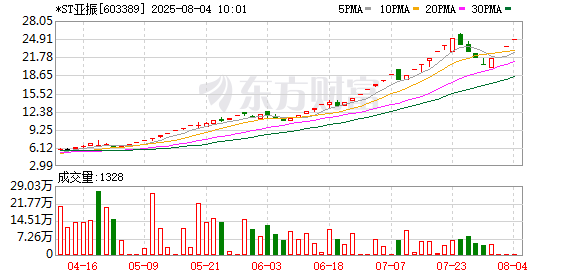
近日该股表现 | 日期 | 当日涨跌幅(%) | 换手率(%) | 主力资金净流入(万元) | | --- | --- | --- | --- | | 2025.08.01 | 5.01 | 0.17 | 43.81 | | 2025.07.31 | 4.98 | 0.09 | 111.85 | | 2025.07.30 | 4.99 | 1.81 | 292.68 | | 2025.07.29 | -5.01 | 1.68 | -2065.00 | | 2025.07.28 | -4.98 | 2.03 | -647.11 | | 2025.07.25 | -4.75 | 3.03 | -2534.42 | | 2025.07.24 | -4.91 | 2.56 | -2801.11 | | 2025.07.23 | 4.99 | 2.45 | -1380.24 | | 2025.07.22 | 5.02 | 1.61 | -1155.60 | | 2025.07.21 | 5.00 | 0.35 | -623.57 | 注:本文系新闻报道,不构成投资建议,股市有风险,投资需谨慎。 *ST亚振盘中涨停,已连 ...
朱啸虎:现在只有两类人能融到资
创业家· 2025-08-01 10:13
Core Viewpoint - The article emphasizes that only two types of individuals can secure funding in the current market: "White Horses" who have impressive resumes and align with trending sectors, and "Black Horses" who focus on solid business practices and product validation [2][4][6]. Group 1: Types of Entrepreneurs - "White Horses" are characterized by their strong backgrounds and ability to present compelling narratives [2][3]. - "Black Horses" are those who build their companies steadily, proving their products and market viability before seeking investment [4][5]. Group 2: Learning Opportunity in Japan - A learning trip to Japan is scheduled from September 21 to September 26, focusing on the operational secrets behind enduring Japanese brands [7]. - The program aims to explore how Japan has nurtured leading companies despite low growth, aging population, and other challenges [8]. Group 3: Insights on Japanese Brands - The article outlines three core philosophies of resilient Japanese brands: supply chain-driven private label (PB) products, continuous iteration of key products, and defining lifestyles that resonate emotionally with consumers [14]. - Examples include Kobe Bussan's integration of supply chain and product development, and Nitori's application of automotive supply chain standards to furniture [16][26]. Group 4: Consumer Behavior and Market Trends - The article discusses the shift in consumer behavior towards rational and emotional purchasing, highlighting the importance of understanding Japanese market evolution as a predictive model for China's future consumer landscape [12][18]. - It notes that the failure of traditional traffic-driven strategies will lead to missed opportunities in engaging with new consumer generations [12]. Group 5: Event Details and Structure - The event includes various expert sessions and company visits, featuring insights from industry leaders such as 7-11 and Shiseido, focusing on their successful strategies in the current market [23][28]. - The program is designed for 35 participants, specifically targeting company founders, with a comprehensive itinerary that includes lectures, company visits, and practical learning experiences [31].

如何成为独角兽公司?
创业家· 2025-08-01 10:13
Core Viewpoint - Companies that become unicorns must adhere to the "3S" principle: significant market, scalable growth, and sustainable competitive advantages [1] Group 1: Insights on Japanese Brands - Japanese brands have developed strategies to thrive in low-growth, aging, and declining birthrate environments, providing valuable lessons for Chinese consumer brands [7][8] - The concept of "loneliness economy" is highlighted, where emotional value creation becomes crucial for brands to resonate with consumers [10] Group 2: Key Strategies of Successful Japanese Companies - Supply chain-driven private brand (PB) products are emphasized, showcasing companies like Kobe Bussan, which operates over 1,000 stores with a scale of 20 billion RMB through integrated supply chains [8][16] - Continuous iteration of major products is a strategy used by companies like Kikkoman, which evolves from merely producing soy sauce to creating a soy sauce culture [8][19] - Defining lifestyles and evoking emotional resonance are critical, as seen in brands like Muji, which redefines user experience with no-logo affordable products [10][20] Group 3: Learning Opportunities - The article promotes a study trip to Japan, focusing on understanding the operational secrets behind successful Japanese brands and their adaptability in changing markets [3][4][21] - Participants will engage with industry leaders and explore innovative business models that can be applied to the Chinese market [12][14]

沪深300耐用消费品指数报15239.70点,前十大权重包含格力电器等
Jin Rong Jie· 2025-08-01 07:40
Core Viewpoint - The Shanghai Composite Index decreased by 0.37%, while the CSI 300 Durable Consumer Goods Index reported 15,239.70 points, reflecting a decline of 0.53% over the past month, 1.75% over the past three months, and 3.98% year-to-date [1] Group 1: Index Performance - The CSI 300 Durable Consumer Goods Index has shown a decline of 0.53% in the last month [1] - The index has decreased by 1.75% over the last three months [1] - Year-to-date, the index has fallen by 3.98% [1] Group 2: Index Composition - The CSI 300 Index is categorized into 11 primary industries, 35 secondary industries, over 90 tertiary industries, and more than 200 quaternary industries [1] - The index is based on a sample of 300 stocks, with a base date of December 31, 2004, and a base point of 1,000.0 [1] Group 3: Market Share and Sector Allocation - The Shenzhen Stock Exchange accounts for 80.09% of the holdings in the CSI 300 Durable Consumer Goods Index, while the Shanghai Stock Exchange accounts for 19.91% [1] - Within the index, white goods represent 84.57%, appliance parts and others account for 9.48%, small appliances make up 4.72%, and furniture constitutes 1.24% [1] Group 4: Sample Adjustment - The index samples are adjusted biannually, specifically on the next trading day following the second Friday of June and December [2] - Weight factors are generally fixed until the next scheduled adjustment, with temporary adjustments made in response to special events affecting sample companies [2]
