
服务业

Search documents
宏观数据观察:东海观察9月制造业PMI好于预期,经济总体产出保持扩张
Dong Hai Qi Huo· 2025-09-30 05:32
Group 1: Report Industry Investment Rating - No relevant content provided Group 2: Report's Core View - In September, due to the traditional peak season, corporate production and business activities accelerated. The manufacturing PMI, non - manufacturing business activity index, and composite PMI output index were 49.8%, 50%, and 50.6% respectively, showing an overall recovery and indicating that China's economic output remained in an expansion phase. However, there were still weaknesses in investment, and consumption growth slowed down. Exports maintained resilience but might slow down in the future. Overall, demand improved, production accelerated, and prices showed different trends [2] - The demand side saw short - term acceleration in external demand and short - term recovery but still weak internal demand. In production, industrial production accelerated significantly in September and was expected to slow down but continue to grow at a relatively high rate in the fourth quarter. Prices of domestic and foreign demand - type commodities showed different trends [2] Group 3: Summary by Related Catalogs Manufacturing - In September, the manufacturing PMI was 49.8%, better than the expected 49.7% and up 0.4 percentage points from the previous month. The manufacturing market demand improved, with the new order index rising 0.2 percentage points to 49.7%. Production expanded faster, with the production index rising 1.1 percentage points to 51.9%. Both external and internal demand in foreign trade increased, with the new export order index and import index rising 0.6% and 0.1% respectively [3] - Manufacturing market prices dropped slightly. The main raw material purchase price index and the ex - factory price index decreased by 0.1 and 0.9 percentage points respectively. Industrial production accelerated, but investment demand in infrastructure and real estate was weak. Domestic "anti - involution" policies supported domestic - demand commodities, and international commodity prices rebounded [3][4] - Both the finished - product inventory and raw material inventory increased. The finished - product inventory index rose 1.4 percentage points to 48.2%, and the raw material inventory index rose 0.5 percentage points to 48.5%. Enterprises actively replenished raw material inventory and passively replenished finished - product inventory [4] Non - manufacturing - In September, the non - manufacturing business activity index was 50.0%, down 0.3 percentage points from the previous month. The service industry remained in the expansion range, with some industries in a high - level boom range and others falling below the critical point due to the end of the summer vacation effect. The construction industry's business activity index rose 0.2 percentage points to 49.3%, and its market expectation improved [5] Composite - In September, the composite PMI output index was 50.6%, up 0.1 percentage points from the previous month, indicating that the overall expansion of Chinese enterprises' production and business activities continued to accelerate [5]
9月制造业采购经理指数为49.8%
Guo Jia Tong Ji Ju· 2025-09-30 05:22
Group 1: Manufacturing PMI Overview - The manufacturing Purchasing Managers' Index (PMI) for September is 49.8%, an increase of 0.4 percentage points from the previous month, indicating continued improvement in manufacturing sentiment [1] - Large enterprises have a PMI of 51.0%, up 0.2 percentage points, indicating expansion; medium-sized enterprises have a PMI of 48.8%, down 0.1 percentage points; small enterprises have a PMI of 48.2%, up 1.6 percentage points, but still below the critical point [4] - The production index is at 51.9%, up 1.1 percentage points, indicating accelerated production expansion; the new orders index is at 49.7%, up 0.2 percentage points, suggesting improved market demand [4] Group 2: Non-Manufacturing PMI Overview - The non-manufacturing business activity index for September is 50.0%, a decrease of 0.3 percentage points, indicating overall stability in non-manufacturing business volume [7] - The construction business activity index is at 49.3%, up 0.2 percentage points; the service industry index is at 50.1%, down 0.4 percentage points, with certain sectors like postal and financial services showing strong performance [9] - The new orders index for non-manufacturing is at 46.0%, down 0.6 percentage points, indicating a decline in market demand; the input prices index is at 49.0%, down 1.3 percentage points, suggesting a decrease in input costs [14] Group 3: Employment and Expectations - The employment index for manufacturing is at 48.5%, up 0.6 percentage points, indicating improved hiring sentiment in manufacturing [5] - The employment index for non-manufacturing is at 45.0%, down 0.6 percentage points, indicating a decline in hiring sentiment; the construction sector's employment index is particularly low at 39.7% [15] - The business activity expectations index for non-manufacturing is at 55.7%, down 0.5 percentage points, but still indicates optimism among most non-manufacturing enterprises [15] Group 4: Comprehensive PMI Insights - The comprehensive PMI output index for September is 50.6%, an increase of 0.1 percentage points, indicating continued expansion in production and business activities across sectors [15]

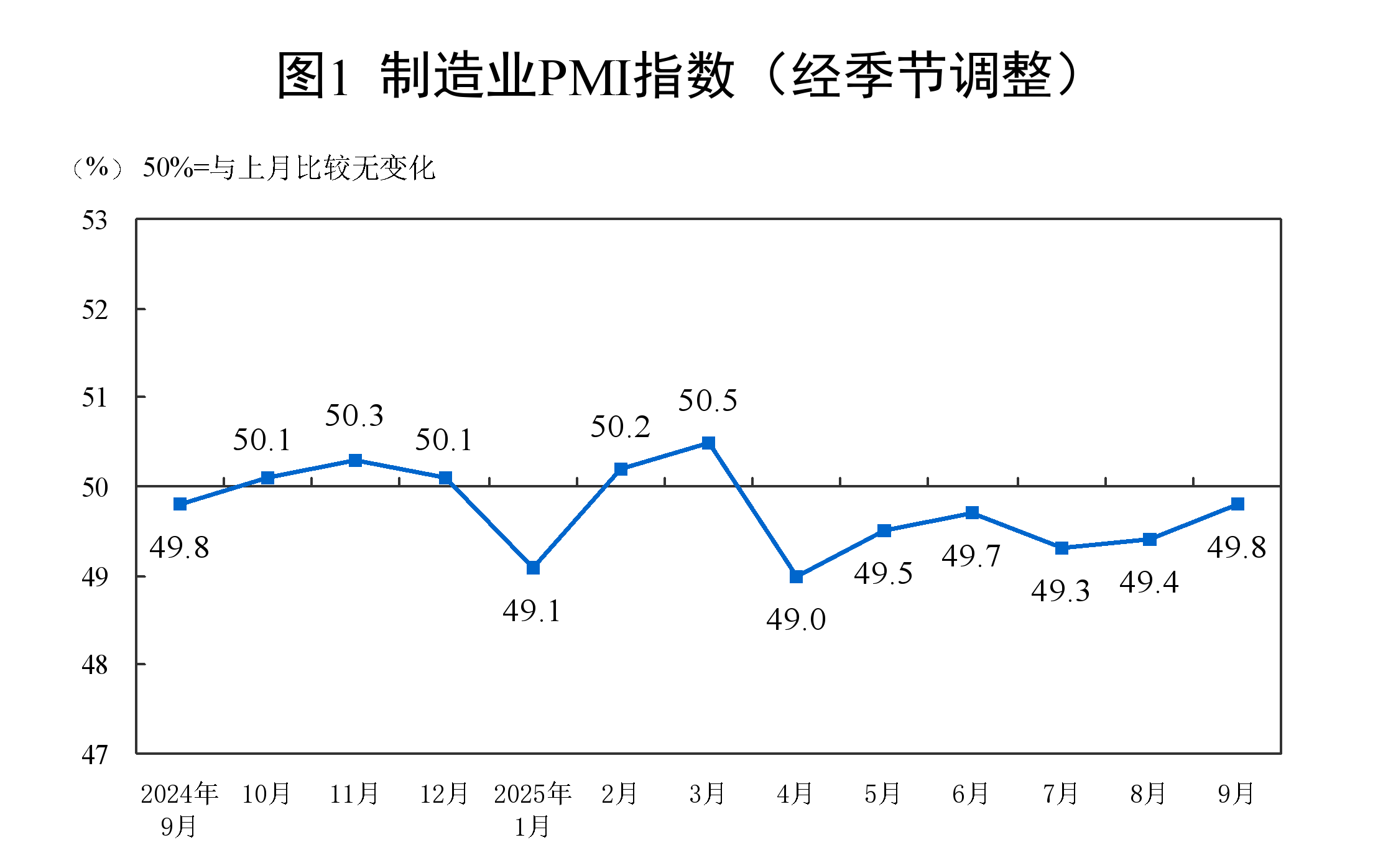
2025年9月中国采购经理指数为49.8%
Guo Jia Tong Ji Ju· 2025-09-30 05:00
Group 1: Manufacturing PMI Overview - In September, the Manufacturing Purchasing Managers' Index (PMI) was 49.8%, an increase of 0.4 percentage points from the previous month, indicating continued improvement in manufacturing sentiment [1] - Large enterprises had a PMI of 51.0%, up 0.2 percentage points, while medium-sized enterprises' PMI was 48.8%, down 0.1 percentage points, and small enterprises' PMI was 48.2%, up 1.6 percentage points [1] - The production index was 51.9%, an increase of 1.1 percentage points, indicating accelerated production expansion in the manufacturing sector [1][2] Group 2: Non-Manufacturing PMI Overview - In September, the Non-Manufacturing Business Activity Index was 50.0%, a decrease of 0.3 percentage points, indicating overall stability in non-manufacturing business volume [3] - The construction industry Business Activity Index was 49.3%, up 0.2 percentage points, while the service industry index was 50.1%, down 0.4 percentage points [3] - The new orders index was 46.0%, down 0.6 percentage points, indicating a decline in market demand in the non-manufacturing sector [3][4] Group 3: Price Indices in Non-Manufacturing - The input price index was 49.0%, down 1.3 percentage points, indicating a decrease in the overall price level of inputs for non-manufacturing enterprises [3][4] - The sales price index was 47.3%, down 1.3 percentage points, indicating a continued decline in the overall sales price level in the non-manufacturing sector [4] Group 4: Employment and Expectations in Non-Manufacturing - The employment index was 45.0%, down 0.6 percentage points, indicating a decline in employment sentiment in the non-manufacturing sector [4] - The business activity expectations index was 55.7%, down 0.5 percentage points, but still indicates optimism among most non-manufacturing enterprises regarding market development [4] Group 5: Comprehensive PMI Output Index - In September, the Comprehensive PMI Output Index was 50.6%, an increase of 0.1 percentage points, indicating that production and operational activities of enterprises continued to expand [6]

【数据发布】2025年9月中国采购经理指数运行情况
中汽协会数据· 2025-09-30 03:35
Group 1: Manufacturing PMI Overview - In September, the Manufacturing Purchasing Managers' Index (PMI) was 49.8%, an increase of 0.4 percentage points from the previous month, indicating continued improvement in manufacturing sentiment [1]. - By enterprise size, large enterprises had a PMI of 51.0% (up 0.2 percentage points), medium enterprises at 48.8% (down 0.1 percentage points), and small enterprises at 48.2% (up 1.6 percentage points) [3]. - Among the five sub-indices of the manufacturing PMI, the production index and supplier delivery time index were above the critical point, while the new orders index, raw material inventory index, and employment index were below the critical point [3]. Group 2: Key Sub-Indices of Manufacturing PMI - The production index was 51.9%, up 1.1 percentage points, indicating accelerated production expansion in the manufacturing sector [4]. - The new orders index was 49.7%, up 0.2 percentage points, suggesting a continued improvement in market demand [5]. - The raw materials inventory index was 48.5%, up 0.5 percentage points, indicating a narrowing decline in the inventory of major raw materials [6]. - The employment index was 48.5%, up 0.6 percentage points, reflecting an improvement in employment sentiment within manufacturing [6]. - The supplier delivery time index was 50.8%, up 0.3 percentage points, indicating a continued acceleration in the delivery times from suppliers [6]. Group 3: Non-Manufacturing PMI Overview - In September, the Non-Manufacturing Business Activity Index was 50.0%, a decrease of 0.3 percentage points, indicating overall stability in non-manufacturing business volume [10]. - By industry, the construction business activity index was 49.3% (up 0.2 percentage points), while the service industry index was 50.1% (down 0.4 percentage points) [11]. Group 4: Non-Manufacturing Sub-Indices - The new orders index for non-manufacturing was 46.0%, down 0.6 percentage points, indicating a decline in market demand [15]. - The input price index was 49.0%, down 1.3 percentage points, suggesting a decrease in the overall level of input prices for non-manufacturing enterprises [15]. - The sales price index was 47.3%, down 1.3 percentage points, indicating a continued decline in the overall level of sales prices in non-manufacturing [15]. - The employment index was 45.0%, down 0.6 percentage points, reflecting a decline in employment sentiment in the non-manufacturing sector [15]. Group 5: Composite PMI Overview - In September, the Composite PMI Output Index was 50.6%, an increase of 0.1 percentage points, indicating that production and business activities in China continued to expand [21].
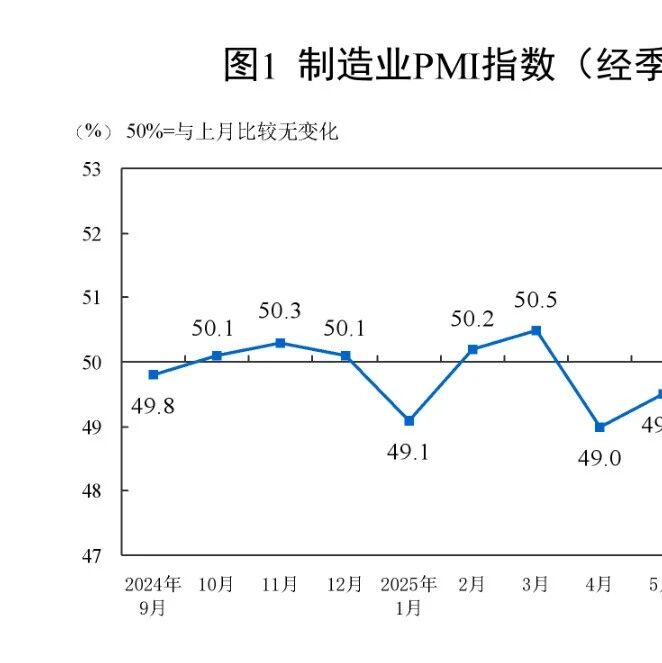
国家统计局:9月份制造业采购经理指数继续回升
Xin Hua Cai Jing· 2025-09-30 03:23
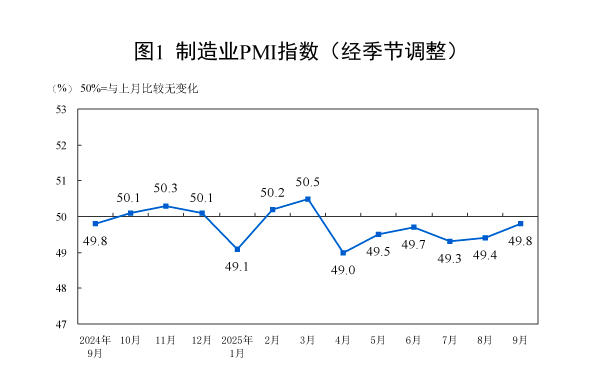
Core Insights - The manufacturing purchasing managers' index (PMI) rose to 49.8% in September, indicating a slight improvement in economic activity, while the non-manufacturing business activity index remained stable at 50.0% [1][2][5] Manufacturing Sector - Manufacturing production activities accelerated, with the production index reaching 51.9%, the highest in nearly six months, and the new orders index increased to 49.7%, reflecting improved market demand [2] - Key industries such as food and beverage, automotive, and aerospace showed production and new orders indices above 54.0%, indicating robust demand, while sectors like wood processing and non-metallic mineral products fell below the critical point [2] - Small enterprises saw a PMI increase to 48.2%, while large enterprises maintained a PMI of 51.0%, indicating stable expansion [2] Key Industries - The equipment manufacturing, high-tech manufacturing, and consumer goods sectors reported PMIs of 51.9%, 51.6%, and 50.6%, respectively, all above the manufacturing average, suggesting active supply and demand [3] - The high-energy-consuming industries experienced a decline in PMI to 47.5% [3] Market Expectations - The production and business activity expectation index rose to 54.1%, indicating a positive outlook among manufacturing firms for market development [3] - Industries such as agricultural processing and automotive maintained high expectation indices above 57.0%, reflecting strong confidence in future growth [3] Non-Manufacturing Sector - The non-manufacturing business activity index stood at 50.0%, indicating stability, with the service sector index at 50.1%, showing continued expansion [4] - The construction sector's business activity index slightly improved to 49.3%, with a business activity expectation index of 52.4%, suggesting increased confidence among construction firms [4] Composite PMI - The composite PMI output index rose to 50.6%, indicating continued acceleration in production and business activities across sectors [5]
2025广西企业100强榜单发布
Guang Xi Ri Bao· 2025-09-30 03:10
在2025广西企业100强榜单中,14家企业新晋上榜,55家企业排名稳步提升,其中民营企业首次进 入前三——广西盛隆冶金有限公司成为首家跻身榜单前三的民营企业;从行业分布看,制造业企业共53 家,服务业企业35家,其他行业12家;在地域分布上,半数企业集中在西部陆海新通道产业发展轴,共 有54家企业入围,成为我区深度融入西部陆海新通道建设的核心支撑。(梁菁惠) 广西投资集团有限公司以营业收入2372.577亿元位居榜首,连续九年领跑全区;广西电网有限责任 公司、广西盛隆冶金有限公司分别以营业收入1174.3077亿元、1113.069亿元占据榜单第二、三位。 《报告》显示,面对复杂严峻的国内外形势,2025广西企业100强总体规模保持稳定,累计实现营 业收入21639.13亿元;资产总额持续增长,达到71757.54亿元,连续十年保持扩容态势;净利润总额创 下历史新高,达729亿元,较上年大幅提升42%;企业研发投入持续增强,共计投入研发经费260.59亿 元, 研发强度达1.20%,为历史新高;企业专利数和发明专利数量持续增长,共拥有专利31103件,发 明专利9850件,发明专利占比31.7%,达到新高。 ...
制造业PMI连续两月回升 下阶段走势如何
Di Yi Cai Jing· 2025-09-30 02:57
Core Insights - The manufacturing PMI in China rose to 49.8% in September, indicating a slight recovery but still below the expansion threshold [1] - The non-manufacturing business activity index decreased to 50.0%, reflecting a slight slowdown in non-manufacturing activities [1] Manufacturing Sector - The manufacturing production index increased to 51.9%, marking a continuous expansion for five months [4] - The purchasing volume index rose to 51.6%, indicating improved procurement activities [4] - New orders index reached 49.7%, showing a stabilization in market demand [4] - The export new orders index improved to 47.8%, suggesting a narrowing decline in export demand [4] - The manufacturing purchase price index was 53.2%, while the factory price index fell to 48.2%, indicating mixed price trends across sectors [5] Non-Manufacturing Sector - The non-manufacturing business activity index remained stable at 50.0%, with the construction index at 49.3% and the services index at 50.1% [8] - The business activity expectation index for non-manufacturing remained above 55%, indicating stable optimism among enterprises [8] - The postal industry showed significant growth, with indices above 60%, reflecting active online shopping [8][9] Future Outlook - The manufacturing sector is expected to see continued growth in Q4, driven by macro policies and seasonal demand [5] - Non-manufacturing activities are anticipated to stabilize and recover, supported by year-end effects and holiday demand [10]
9月份制造业采购经理指数继续回升 供需两端表现良好
Yang Shi Wang· 2025-09-30 02:56
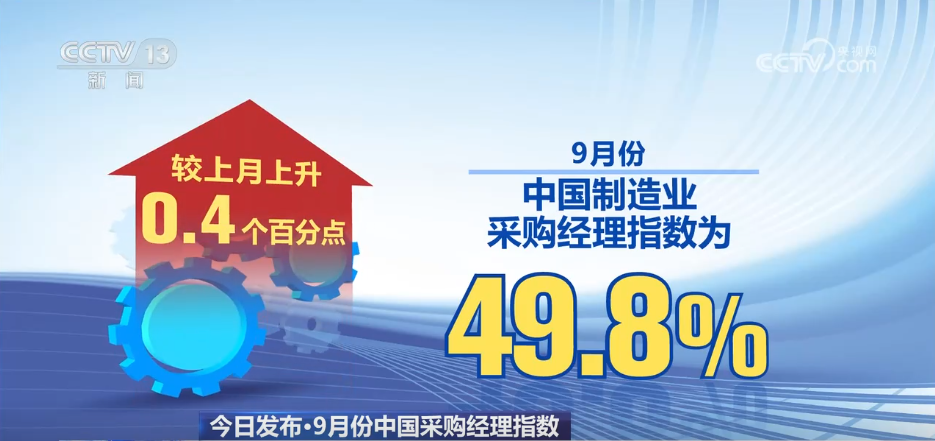
Core Insights - The Purchasing Managers' Index (PMI) for China's manufacturing sector in September is 49.8%, indicating a 0.4 percentage point increase from the previous month, marking two consecutive months of improvement in economic conditions [3] - The production index has reached a six-month high, reflecting increased manufacturing activity, supported by the easing of extreme weather conditions and ongoing domestic demand stimulation policies [3][5] - The employment index rose by 0.6 percentage points to its highest level since March, indicating an improving job market [5] Manufacturing Sector - The equipment manufacturing PMI is at 51.9%, up 1.4 percentage points from last month, while high-tech manufacturing remains stable above 51% for two consecutive months [7] - The consumer goods manufacturing PMI reached 50.6%, a 1.4 percentage point increase, driven by seasonal factors such as the upcoming holiday and back-to-school period [7] - Large enterprises continue to show growth, maintaining an expansion trend for five consecutive months, while small enterprises also saw a 1.6 percentage point increase in their PMI, indicating improved conditions [7] Market Expectations - The production and business activity expectation index is at 54.1%, up 0.4 percentage points, reflecting improved market sentiment [9] - Industries such as agricultural processing, automotive, and aerospace have high expectation indices above 57%, indicating strong confidence in future growth [9] Non-Manufacturing Sector - The non-manufacturing business activity index is at 50.0%, indicating stability, while the service sector continues to expand with a business activity index of 50.1% [10] - The construction sector's business activity index slightly increased to 49.3%, with a business activity expectation index of 52.4%, suggesting improved confidence among construction firms [12]
制造业PMI连续两月回升,下阶段走势如何
Di Yi Cai Jing· 2025-09-30 02:53
Group 1: Macroeconomic Policy and Manufacturing Sector - The macroeconomic policy is expected to be strengthened and implemented, with the manufacturing PMI showing a slight recovery to 49.8% in September, up 0.4 percentage points from the previous month, indicating ongoing policy effects [1] - The production index rose to 51.9%, marking a continuous expansion for five months, while the new orders index increased to 49.7%, suggesting a stabilization in market demand [4] - The manufacturing sector is experiencing a seasonal peak in production and sales, with procurement activities and employment showing positive trends [4] Group 2: Price Trends and Future Outlook - The purchasing price index for manufacturing decreased to 53.2%, while the factory price index fell to 48.2%, indicating a mixed price trend across different industries [5] - There is an expectation of improved market conditions in the fourth quarter, driven by holiday demand and infrastructure projects, which will likely boost consumption and production activities [5] - The manufacturing production expectation index rose to 54.1%, reflecting increased optimism among manufacturers regarding market developments [6] Group 3: Non-Manufacturing Sector Performance - The non-manufacturing business activity index remained stable at 50.0%, with slight declines in the service sector and construction industry, indicating a mild slowdown [9] - The postal industry showed significant growth, with business activity and new orders indices rising over 5 percentage points, reflecting strong online shopping trends [9][10] - Overall, the non-manufacturing sector is expected to stabilize and recover in the fourth quarter, supported by seasonal effects and ongoing macroeconomic policies [10]
9月制造业PMI为49.8%,连续两月回升
Guan Cha Zhe Wang· 2025-09-30 02:33
Manufacturing PMI Overview - In September, the Manufacturing Purchasing Managers' Index (PMI) was 49.8%, an increase of 0.4 percentage points from the previous month, indicating continued improvement in manufacturing sentiment [1] - Large enterprises reported a PMI of 51.0%, up 0.2 percentage points, while medium-sized enterprises had a PMI of 48.8%, down 0.1 percentage points, and small enterprises reported a PMI of 48.2%, an increase of 1.6 percentage points, but still below the critical point [4] - Among the five sub-indices of the manufacturing PMI, the production index and supplier delivery time index were above the critical point, while the new orders index, raw material inventory index, and employment index were below the critical point [5] Sub-Indices Performance - The production index was 51.9%, up 1.1 percentage points, indicating accelerated production expansion in the manufacturing sector [5] - The new orders index was 49.7%, up 0.2 percentage points, suggesting a continued improvement in market demand [5] - The raw material inventory index was 48.5%, up 0.5 percentage points, indicating a narrowing decline in the inventory of major raw materials [5] - The employment index was 48.5%, up 0.6 percentage points, reflecting an improvement in employment sentiment within manufacturing [5] - The supplier delivery time index was 50.8%, up 0.3 percentage points, indicating faster delivery times from raw material suppliers [5] Non-Manufacturing PMI Overview - In September, the Non-Manufacturing Business Activity Index was 50.0%, a decrease of 0.3 percentage points from the previous month, indicating overall stability in non-manufacturing business volume [9] - The construction industry business activity index was 49.3%, up 0.2 percentage points, while the service industry business activity index was 50.1%, down 0.4 percentage points [11] Non-Manufacturing Sub-Indices Performance - The new orders index for non-manufacturing was 46.0%, down 0.6 percentage points, indicating a decline in market demand [15] - The input price index was 49.0%, down 1.3 percentage points, suggesting a decrease in the overall price level of inputs used by non-manufacturing enterprises [15] - The sales price index was 47.3%, down 1.3 percentage points, indicating a continued decline in the overall sales price level [15] - The employment index for non-manufacturing was 45.0%, down 0.6 percentage points, reflecting a decrease in employment sentiment [17] - The business activity expectation index was 55.7%, down 0.5 percentage points, but still indicating optimism among most non-manufacturing enterprises [17] Comprehensive PMI Overview - The Comprehensive PMI Output Index was 50.6%, an increase of 0.1 percentage points from the previous month, indicating a continued acceleration in production and business activities across enterprises [21]