
软件

Search documents
又一次踩踏式崩盘。。黄仁勋、但斌发声!
Xin Lang Cai Jing· 2026-02-05 09:43
Group 1 - The core issue in the market is the fear surrounding AI, leading to a significant sell-off in software stocks, with a 15% drop over two days and a total market value loss of $1 trillion this year [1][3][4] - The catalyst for this panic appears to be the introduction of a new AI automation tool by Anthropic, which has raised concerns about AI directly replacing software rather than merely enhancing it [5][6] - Analysts are now questioning the future growth paths of software companies, suggesting that the traditional subscription model of SaaS may be disrupted as AI tools take over tasks previously requiring multiple software solutions [6][8] Group 2 - The semiconductor and storage chip sectors, which had previously seen significant gains, are now experiencing sharp declines, with companies like SanDisk and AMD seeing drops of 16% and 17% respectively [1][7] - NVIDIA's CEO Jensen Huang has publicly refuted the notion that AI will replace software tools, arguing that AI will instead utilize existing software to enhance productivity [8][9] - The Hang Seng Tech Index has shown volatility, entering a technical bear market but also demonstrating resilience with a 0.7% increase after a series of declines [12][14] Group 3 - Despite the downturn, there has been a notable inflow of capital into the Hang Seng Tech Index, with a net inflow of 66.73 billion yuan during a period of five consecutive declines [17][24] - The market is witnessing a shift in investment strategies, with funds increasingly buying into technology indices despite the recent sell-off, indicating a potential long-term confidence in the sector [20][26] - The overall sentiment in the market reflects a complex interplay between fear of AI disruption and the recognition of potential opportunities within the tech sector [6][12][18]


美股软件行业,市值蒸发万亿美元
财联社· 2026-02-05 09:17
Core Insights - Hedge funds are increasing short positions in software stocks, contributing to significant sell-offs in the sector this year [1] - Hedge funds have made $24 billion in profits from shorting software stocks since 2026, while the total market capitalization of the U.S. software industry has decreased by $1 trillion during the same period [1] - The focus of short-selling appears to be on companies providing basic automation services, which are at risk of being replaced by new AI tools [1] Group 1 - Hedge funds are currently net short on the software industry, indicating a bearish outlook [2] - The stocks facing the largest short bets include TeraWulf and Asana, with over 35% and 25% of their tradable shares shorted, respectively [2] - Dropbox and Cipher Mining have 19% and 17% of their float shorted [2] Group 2 - The worst-performing stocks in the iShares Expanded Tech Software ETF (IGV) this year include Intuit and DocuSign, both down over 30% [3] - Major stocks within the ETF, such as Microsoft and Oracle, have also suffered, with declines of 15% and 21% respectively, while Salesforce, Adobe, and ServiceNow have dropped over 20% [4] - The recent sell-off was triggered by concerns over AI disruption, particularly following the release of a new tool by AI startup Anthropic [4] Group 3 - Despite the sell-off, there is currently no widespread panic in the credit markets, as corporate revolving credit lines remain untapped [5] - Analysts suggest that market sentiment may shift soon with several software companies set to release earnings reports [6]

美股科技软件板块大崩盘,罪魁祸首竟是这家公司?
阿尔法工场研究院· 2026-02-05 07:48
Core Viewpoint - The emergence of native AI models, exemplified by Anthropic's new automation tools, poses a significant threat to traditional software companies, raising questions about the sustainability of their business models and competitive advantages [2][3]. Group 1: Impact of Anthropic's Tools - Anthropic's release of a legal tool plugin for its Claude Cowork platform has triggered panic selling in the software sector, particularly affecting legal software and data service companies [2]. - Major companies like Thomson Reuters and LegalZoom saw their stock prices plummet by 21% and over 20% respectively, as their core business models were directly challenged by the cost-effective and integrated solutions offered by AI [3]. - The market fears that if companies can use a single AI plugin to handle legal compliance tasks that previously required multiple expensive software subscriptions, the subscription value of traditional SaaS companies will be severely undermined [3]. Group 2: Subscription Model Crisis - The term "SaaSpocalypse" reflects the growing concern that AI advancements may not just assist growth but could potentially replace traditional subscription models entirely [5]. - The traditional software industry's reliance on high-margin recurring revenue from seat-based billing is threatened as AI agents can perform tasks that previously required multiple personnel [5]. - This shift in expectations regarding future growth is a key driver behind the current wave of panic selling in the software sector [5]. Group 3: Performance Discrepancies - Among S&P 500 software stocks, only 69% reported revenues above expectations, significantly lower than the tech sector's overall 85% success rate, indicating a weak position in the AI-driven market [6]. - Even strong performers like Microsoft are under scrutiny as their Azure cloud business shows signs of slowing growth, leading to a decline in stock price over four consecutive trading days [6]. - In contrast, Palantir emerged as a rare "safe haven" with a 70% revenue increase in Q4, suggesting that the market is selectively favoring companies that can effectively leverage AI to enhance productivity [6]. Group 4: Market Reallocation - Despite the Nasdaq's poor performance, the S&P 500 shows a "seesaw" effect, with companies like FedEx and Walmart gaining market value, indicating a shift of funds from vulnerable software stocks to more defensively positioned sectors [7]. - The selling pressure on software stocks is characterized by a "surrender" mentality among investors, who are eager to exit positions regardless of price [7]. - From an investment perspective, extreme panic often creates opportunities, as evidenced by Microsoft's valuation dropping to a three-year low with a forward P/E ratio around 25 [7]. Group 5: Future Outlook - The year 2026 is anticipated to be a pivotal moment for the software industry, as AI programming and automation lower development barriers and diminish traditional business moats [8]. - The consensus on Wall Street has shifted fundamentally, with software no longer seen as a guaranteed profit generator in the face of competition from companies like Anthropic that possess foundational AI models [8]. - Investors are advised to focus on identifying companies with core competencies that are not easily replaceable by automation, rather than blindly attempting to catch falling stocks [8].




1322元→1565元!一周之前,为什么没人相信茅台会涨?
Mei Ri Jing Ji Xin Wen· 2026-02-05 07:46
Market Overview - The three major indices in the A-share market experienced a decline, with the Shanghai Composite Index down by 0.64%, the Shenzhen Component Index down by 1.44%, and the ChiNext Index down by 1.55% [1] - The total market turnover was 2.18 trillion yuan, a decrease of 304.8 billion yuan compared to the previous trading day [1] Sector Performance - The consumer sector saw significant gains, while the financial sector strengthened in the afternoon [1] - Conversely, sectors such as non-ferrous metals, electric grid equipment, and oil and gas faced notable declines [1] Specific Stock Movements - Guizhou Moutai, referred to as the "king of stocks," saw its price fluctuate, reaching a low of 1322.01 yuan per share before rebounding to 1565 yuan per share, indicating a significant price recovery [4][8] - The white liquor sector, which had previously been overlooked, began to attract market attention, with increased trading volume noted [5][11] Market Sentiment and Trends - The market sentiment shifted positively towards the white liquor sector, with Guizhou Moutai's price recovery contributing to a broader interest in consumer stocks [9][11] - Other sectors such as film and television, tourism, beauty care, and home appliances also began to show signs of activity after a period of minimal performance [10] Investment Strategies - Analysts suggest a balanced investment strategy focusing on technology sectors, raw material price increases, and defensive high-dividend assets like coal [16] - The market is expected to benefit from the gradual reduction in stock ETF redemptions and the anticipated economic recovery post-Chinese New Year [16]


万亿市值一夜蒸发,Claude Cowork血洗全球软件业,老黄急了
3 6 Ke· 2026-02-05 07:40
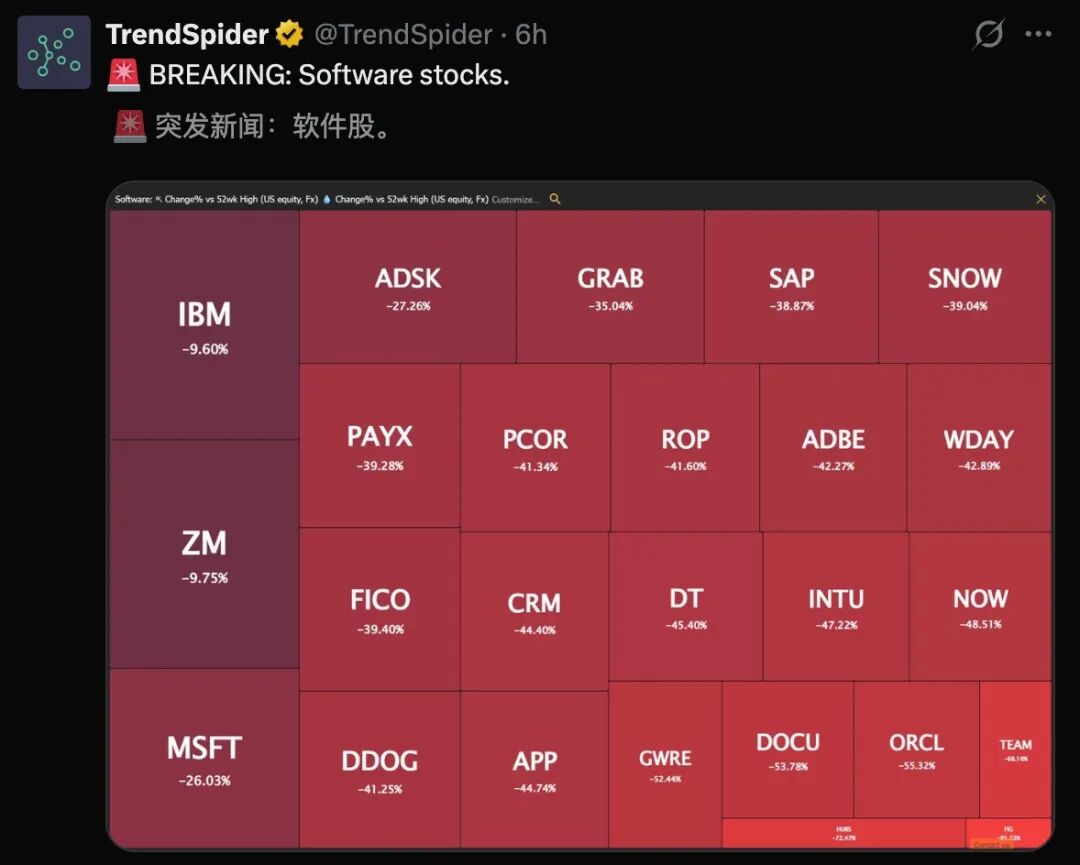
又崩了!硅谷软件巨头短短一夜,蒸发3000亿美金,过去一周全球近万亿美金没了。令人想不到的是,罪魁祸首竟是Anthropic推出的一款插件。 瞳孔地震!一夜之间,全球软件股集体跳水,蒸发3000亿美金。 如今,整个硅谷都在说:软件(SaaS)已死! | 90 0 0 00 | TrendSpider & @TrendSpider · 6h * BREAKING: Software stocks. | | | | | | | | | | --- | --- | --- | --- | --- | --- | --- | --- | --- | --- | | | * 突发新闻:软件股。 | | | | | | | | | | | Softwarn: & Change% vs 52wk High (US equity, Fx) & Change% vs 52wk High (US equity, Fx) Customze ... | | Q | | | | | | × | | | IBM -9.60% | ADSK -27.26% | | GRAB -35.04% | | SAP -38.87% | | SNOW ...



1月资金行为跟踪:资金再平衡:公募和融资的预期差
ZHESHANG SECURITIES· 2026-02-05 07:28
- The report does not include any specific quantitative models or factors for analysis, construction, or testing results. It primarily focuses on market dynamics, fund flows, and sectoral trends without detailing quantitative methodologies or factor-based approaches[1][2][3]
美股软件抛售潮拖累港股,黄仁勋发声驳斥
Di Yi Cai Jing Zi Xun· 2026-02-05 06:53
Core Viewpoint - The software industry is currently experiencing a significant downturn, particularly in the US stock market, with ongoing selling pressure expected to persist for some time [2] Group 1: Market Trends - The US software sector is facing severe sell-off pressure, exacerbated by the recent launch of AI Agent products like Anthropic's Claude Cowork, which has heightened concerns about the impact on the software market [2] - The market sentiment has shifted from viewing AI as an enabler of software to a potential replacement, leading to fears that AI could eliminate intermediary SaaS products [2] Group 2: Company Responses - Palantir Technologies has been notably affected by this downturn, with its stock dropping 11.62% despite reporting earnings that exceeded Wall Street expectations [3] - Alphabet's CEO Sundar Pichai dismissed concerns that AI tools could undermine the pricing power of large SaaS companies, emphasizing the importance of addressing capacity constraints in computing resources [3] Group 3: AI Development Perspectives - NVIDIA's CEO Jensen Huang stated that AI will utilize existing tools rather than replace them, suggesting that the focus should be on how software can be integrated with AI capabilities [4] - Huang also highlighted the importance of accumulating knowledge through software, indicating that the value lies in the questions posed by businesses rather than just the answers provided [4] Group 4: AI Limitations and Market Outlook - Current large language models (LLMs) are still limited in their capabilities, with significant challenges in areas such as reasoning and multi-modal alignment, leading to overly optimistic market assessments [5] - Despite the rising mention of AI in corporate earnings reports, practical applications remain limited to simpler tasks, with performance declining in more complex scenarios [5] - The analysis suggests that aggressive mergers and acquisitions (M&A) may be the most effective strategy for software companies in the face of GenAI technology, although historical market sentiment towards M&A in the software sector has been negative due to concerns over growth and integration risks [5]

美股软件抛售潮拖累港股,黄仁勋发声驳斥
第一财经· 2026-02-05 06:47
2026.02. 05 本文字数:1562,阅读时长大约3分钟 Anthropic发布的面向企业法务的Claude Cowork 插件,可自动化完成合同审查、NDA 分类、合规追踪、法律简报生成等核心法务工作,直接冲击法律 信息服务与专业SaaS板块,二级市场情绪从"AI赋能软件"迅速转向"AI取代软件",担忧AI从工具直接升级为替代者,淘汰中间环节SaaS产品。 Palantir Technologies(PLTR.O)是近期该轮回调主要"受害者",即使官方在本周早些时候发布了一份高于华尔街预期的财报,股价却最终收跌 11.62%。 面对该轮踩踏,多位企业高层对外否认担忧。谷歌母公司Alphabet财报电话会上,CEO桑达尔·皮查伊并不认可"AI工具可能会损害大型软件SaaS公司定 价权"这一观点。他表示,当前最关键的问题是计算能力相关的限制——包括电力、土地、供应链等方面的约束,以及如何扩大产能以满足当前激增的需 求、确保长期投资的合理性,同时在这一过程中提升效率、保持行业领先水平。 英伟达创始人CEO黄仁勋近日在与思科CEO对谈中表示,AI不会做工具,而是会用工具。就像人不会重新发明螺丝刀,AI 也会直 ...

抛售潮!国际巨头股价暴跌!资金“踩踏式”出逃……
Sou Hu Cai Jing· 2026-02-05 06:43
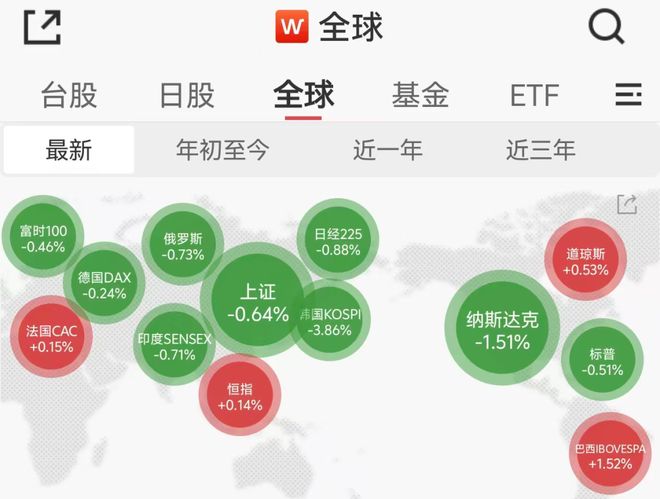
当地时间周三,市场针对软件股的抛售潮蔓延并扩大,芯片制造商超威半导体(AMD)新财年一季度业绩指引不够强 劲,股价周三暴跌17.31%,加剧了投资者对AI基础设施相关股票的看空情绪,导致资金从高估值的存储芯片股"踩踏 式"出逃,引发科技股大面积下跌,纳指跌去今年以来所有涨幅,美国三大股指周三涨跌不一。截至收盘,道指涨 0.53%,标普500指数跌0.51%,纳指下跌1.51%。 公司方面,谷歌在周三盘后发布2025财年第四季度财报,公司当季营收、每股收益等指标全线优于华尔街预期,因公司 全力押注AI,将2026财年的资本支出指引提升至前一年的近两倍,引发部分投资者担忧。财报发布后,谷歌母公司字母 表股价一度重挫7.5%,之后又一度转涨,公司市值短时间内波动幅度达数千亿美元,这显示出市场在风险偏好低迷之 际,对AI投资热潮的矛盾情绪。 对冲基金大举做空美股软件股 记者:高岩 欧洲方面,欧盟统计局周三公布的初步统计数据显示,欧元区1月通胀率按年率计算为1.7%,与市场预期一致,没有出 现投资者担忧的物价水平过快下降的情况。当天出炉的多份财报使得欧洲股市板块走势分化,医药、银行和工业等行业 的多数蓝筹股下跌,使得德 ...


美股软件抛售潮拖累港股 黄仁勋发声驳斥!
Di Yi Cai Jing· 2026-02-05 06:35
Core Viewpoint - The software industry is currently experiencing a significant downturn, with the U.S. software sector facing intense selling pressure, which is expected to persist for some time [1] Group 1: Market Conditions - The U.S. software sector is undergoing a painful phase, exacerbated by the recent release of AI products like Anthropic's Claude Cowork, which has heightened concerns about the sector's performance [1] - The market sentiment has shifted from viewing AI as an enabler of software to a potential replacement, leading to irrational sell-offs [1] - Palantir Technologies has been notably affected, with its stock dropping 11.62% despite reporting earnings that exceeded Wall Street expectations [1] Group 2: Corporate Responses - Executives from major companies like Alphabet and NVIDIA have downplayed concerns regarding AI's impact on SaaS pricing power, emphasizing the importance of addressing capacity constraints and efficiency improvements [2] - NVIDIA's CEO highlighted that AI will utilize existing software rather than replace it, suggesting that the focus should be on how tools can be integrated with AI [2] Group 3: AI Tool Limitations - Despite the advancements in AI tools, there are still significant limitations in their development and application, with current AI models not yet reaching human cognitive capabilities [3] - The accuracy of AI agents in real-world applications remains unsatisfactory, particularly in complex scenarios, despite improvements in benchmark testing [3] Group 4: Strategic Recommendations - In light of the GenAI technology wave, aggressive mergers and acquisitions (M&A) may be the most effective strategy for software companies, although the market historically views M&A negatively due to concerns over growth and integration risks [4] - The U.S. macroeconomic environment is improving, and as AI products become more established, the performance of U.S. software companies is expected to gradually improve, though at a slow rate [4]