珠宝业

Search documents
黄金,4连涨
Zhong Guo Xin Wen Wang· 2025-11-13 09:33
Core Insights - International gold prices have experienced a significant increase, marking a fourth consecutive day of gains, with prices surpassing $4200 per ounce [1][3]. Gold Market Dynamics - On November 12, COMEX gold rose by 2.07% to $4201.4 per ounce, while London spot gold closed at $4194.605 per ounce, up 1.68% [1]. - Domestic gold jewelry prices have adjusted accordingly, with notable increases in prices from major retailers such as Chow Tai Fook and Chow Sang Sang [3]. - The recent rise in gold prices is influenced by a decline in U.S. Treasury yields and expectations of a potential interest rate cut by the Federal Reserve in December [3][4]. Economic Factors - The U.S. government shutdown has created economic pressures, leading to a reliance on private indicators for economic assessment [3]. - The labor market in the U.S. remains weak, as indicated by data from ADP, contributing to the demand for gold as a safe-haven asset [3][4]. Central Bank Actions - The trend of monetary easing continues, with expectations of a cumulative 25 basis points rate cut by the Federal Reserve this year, supporting the value of gold [4]. - Global central banks have maintained a strong demand for gold, with an average net purchase of over 1000 tons per year since 2022, significantly above previous averages [4]. Investor Behavior - The demand for gold as a hedge against uncertainty remains robust, driven by various geopolitical risks [4]. - Investors are advised to monitor market changes closely and manage their gold investments based on personal risk tolerance and investment needs [4]. Banking Adjustments - Recent adjustments in gold accumulation business by domestic banks, such as Citic Bank and China Construction Bank, reflect changing market conditions [4][6]. - China Construction Bank has introduced new rules regarding large redemptions, which may affect liquidity for investors [6].



黄金税收新政后 在哪儿买 “金条”更划算
Xin Hua Wang· 2025-11-13 08:24
Core Viewpoint - The new tax policy on gold, effective from November 1, 2023, aims to clarify the distinction between investment and non-investment uses of gold, introducing differentiated VAT rules to address tax evasion issues in the gold market [3][4]. Group 1: Tax Policy Details - The new tax regulations categorize gold based on purity and function, defining investment gold and non-investment gold, which will impact procurement and production costs [3][4]. - Investment gold includes items with a purity of 99.5% or higher, while non-investment gold is defined as gold used for purposes other than investment [3][4]. - For physical delivery, investment gold members can enjoy immediate VAT refunds, while non-investment gold purchases will see a reduction in input tax deduction from 13% to 6%, increasing costs by 7% [4]. Group 2: Market Impact - Following the announcement of the new tax policy, gold jewelry prices have increased significantly, with some brands raising prices by over 5% within a day [5]. - The price of gold jewelry on platforms like JD and Taobao has surged to over 1000 yuan per gram, an increase of more than 70 yuan per gram compared to pre-policy prices [5]. - The cost pressures from the new tax policy may not yet be fully reflected at retail levels, but future price discrepancies are expected between different sales channels [6]. Group 3: Investment Trends - The new tax policy is likely to decrease the attractiveness of non-exchange physical gold investments, while bank products like gold accumulation accounts and ETFs may gain popularity [7][9]. - Several banks have raised the minimum investment thresholds for gold accumulation products following the new tax regulations, indicating a shift in investment strategies [7][9]. - The domestic gold ETF holdings have seen significant growth, with a year-on-year increase of 164.03% in the first three quarters of 2025 [9].
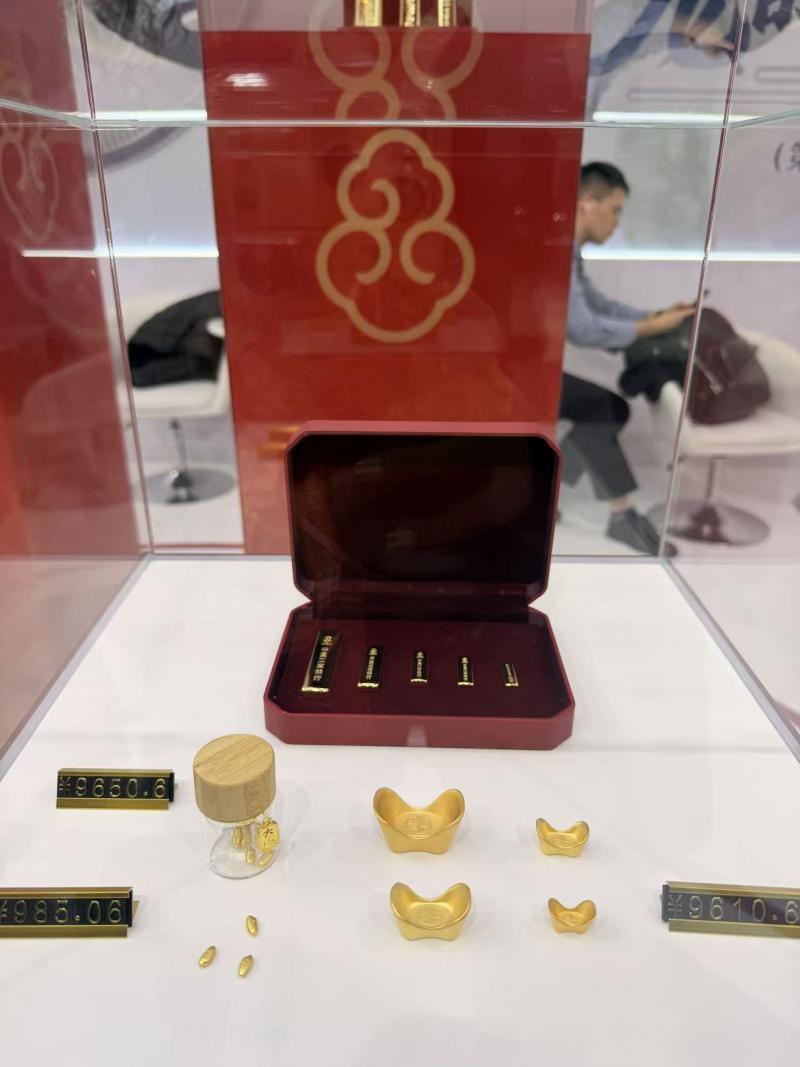
黄金价格多少一克?11月13日黄金价格
Sou Hu Cai Jing· 2025-11-13 05:16
Core Viewpoint - The global gold market experienced a strong upward trend, with international spot gold stabilizing above $4200 per ounce, driven by expectations of a Federal Reserve rate cut due to weak U.S. economic data [1][7] Group 1: International and Domestic Market Trends - As of November 13, the London spot gold price was reported at $4207.3 per ounce, with U.S. gold at $4211.7 per ounce, breaking through the key resistance level of $4160 and reaching a high of $4211, the highest since October 21 [3] - Domestic gold prices also rose, with the base gold price at 959.2 yuan per gram, silver at 12 yuan per gram, and platinum at 373.5 yuan per gram [3] Group 2: Retail Jewelry Price Adjustments - Retail gold jewelry prices have collectively increased, with several brands surpassing 1330 yuan per gram: Chow Tai Fook and King Fook reached 1333 yuan, a daily increase of 20 yuan; while other brands like Luk Fook and China Gold rose to 1331 yuan and 1320 yuan respectively [5] - Other brands such as Chow Sang Sang and Caibai saw price increases of 17 yuan, reaching 1326 yuan and 1285 yuan respectively [5] Group 3: Market Impact and Consumer Guidance - The recent price surge is attributed to the anticipation of a Federal Reserve rate cut due to weak economic data, prompting consumers and investors in mainland China and Hong Kong to make rational decisions based on demand [7] - The attractiveness of gold as a safe-haven asset has increased, although short-term volatility risks should be considered [7]
金价大拐点!今天行情拐点已现,黄金市场或将迎来更大变盘?
Sou Hu Cai Jing· 2025-11-08 18:46
Core Viewpoint - The recent changes in gold tax policy in China have led to significant price discrepancies in the gold market, affecting both retail prices and recovery rates, with a notable increase in costs for consumers [1][7]. Market Phenomenon - The price of gold jewelry has surged to 1268 yuan per gram, while bank investment gold bars hover around 930 yuan per gram, indicating a clear distinction based on purchase intent: consumption versus investment [3]. - Consumers are exhibiting caution in their purchasing decisions, with some opting to delay purchases until after the release of CPI data, reflecting concerns over potential price corrections [3]. - The gold recovery market is active but characterized by significant price gaps, with recovery prices from major brands being substantially lower than retail prices, leading to potential losses for consumers [3]. Data Insights - As of November 8, 2025, international gold prices have stabilized above 4000 USD per ounce, with a daily increase of 0.33% [5]. - The Shanghai Gold Exchange reported a closing price of 917.42 yuan per gram, reflecting a minor increase, while the price fluctuations indicate a growing divergence between bullish and bearish market sentiments [5]. Policy Impact - The new tax regulations effective from November 1 have increased the tax burden on gold used for investment, leading to a rapid increase in retail prices in various markets [7]. - The policy has caused temporary confusion in market pricing, prompting industry associations to issue guidelines for compliance [7]. Institutional Movements - Central banks globally have significantly increased their gold purchases, with China's central bank holding a record 2304 tons of gold as of October, indicating a strategic shift towards gold accumulation [10]. - Emerging market central banks are becoming the primary drivers of gold demand, reflecting a broader trend towards diversifying foreign exchange reserves [10]. International Factors - The direction of the Federal Reserve's monetary policy is a key factor influencing short-term gold price fluctuations, with market expectations leaning towards a potential interest rate cut [12][13]. - Geopolitical risks have shown a cooling effect on gold prices, as recent developments have reduced immediate demand for gold as a safe-haven asset [13]. Investment Strategies - Current technical analysis suggests that gold prices are at a critical juncture, with key resistance and support levels identified [15]. - The growing popularity of gold ETFs among younger investors highlights a shift towards more flexible investment options that do not require physical storage [15]. - Significant price differences between various purchasing channels indicate that consumers need to be aware of the cost implications when investing in gold [15]. Market Outlook - The gold market is currently experiencing a tension between long-term support from central bank purchases and short-term pressures from changing monetary policies and geopolitical stability [17]. - Analysts predict that gold prices could test higher levels in the future, but caution that the market has not yet reached critical thresholds that typically signal a market downturn [17].
今日黄金多少钱一克?11月6日黄金价格跌价
Sou Hu Cai Jing· 2025-11-06 17:51
Core Insights - The international gold market price is quoted at $3955.9 per ounce, while domestic gold prices have been adjusted to 907.8 yuan per gram, with various brands offering different retail prices [1] Jewelry Brand Gold Price Reference - Chow Tai Fook: 1265 yuan per gram [2] - Luk Fook Jewelry: 1259 yuan per gram [1] - Chow Sang Sang: 1260 yuan per gram [3] - Lao Feng Xiang: 1260 yuan per gram [2] - Lao Miao Gold: 1260 yuan per gram [3] - Zhou Liufu: 1247 yuan per gram [4] - Zhou Dazheng: 1255 yuan per gram [5] - China Gold: 1180 yuan per gram [6] Platinum and Palladium Prices - Platinum prices have decreased, with Industrial and Commercial Bank's paper platinum at $1532.65 per ounce, down by $10.20 (0.66%) [7] - In RMB, paper platinum prices also fell, with a price of 351.40 yuan per gram, down by 2.44 yuan (0.69%) [7] - Palladium prices also saw a decline, with Industrial and Commercial Bank's paper palladium at $1374.88 per ounce, down by $5.23 (0.38%) [8] - In RMB, paper palladium prices decreased to 316.12 yuan per gram, down by 1.30 yuan (0.41%) [8] Gold Coin Collections and Prices - Panda Gold Set (2025 version): 56120 yuan per set [9] - 1g Panda Gold Coin: 1258 yuan each [9] - 3g Panda Gold Coin: 3472 yuan each [9] - 8g Panda Gold Coin: 3612 yuan each [9] - 15g Panda Gold Coin: 14880 yuan each [9] - 30g Panda Gold Coin: 28005 yuan each [9] - 100g Panda Gold Coin: 78270 yuan each [9] - 150g Panda Gold Coin: 127815 yuan each [9] - 1kg Gold Coin: 90000 yuan each [9] - 150g Colored Coin: 88000 yuan each [9] - Fan-shaped Gold and Silver Commemorative Coin: 7500 yuan per set [9] New Tax Policy Impact - A new announcement states that transactions involving standard gold at the Shanghai Gold Exchange will not incur VAT if the seller is a member unit or customer, aiming to enhance Shanghai's status as an international gold trading center [9] - The policy distinguishes between "investment" and "non-investment" uses of gold, with different tax treatments for each [9] - The new policy is expected to increase the circulation costs of investment gold, as it cuts the VAT deduction chain for investment gold entering downstream circulation [10][12]
宝城期货资讯早班车-20251104
Bao Cheng Qi Huo· 2025-11-04 01:53
1. Macroeconomic Data Overview - GDP growth rate at constant prices in Q3 2025 was 4.8% year-on-year, down from 5.2% in the previous quarter but up from 4.6% in the same period last year [1] - Manufacturing PMI in October 2025 was 49.0%, down from 49.8% in the previous month and 50.1% in the same period last year [1] - Non-manufacturing PMI for business activities in October 2025 was 50.1%, up slightly from 50.0% in the previous month but down from 50.2% in the same period last year [1] 2. Commodity Investment Reference 2.1 Comprehensive - China's S&P Manufacturing PMI in October was 50.6, down from 51.2 in the previous month, with the expansion trend slowing [2] - In the first three quarters, the added value of large-scale electronic information manufacturing increased by 10.9% year-on-year, outperforming the overall industry and high-tech manufacturing [2] - China and the EU held export control dialogue consultations in Brussels, aiming to promote the stability and smoothness of the industrial and supply chains [2] 2.2 Metals - Industrial and Commercial Bank of China suspended and then resumed its gold accumulation business on November 3 [5] - Lithium carbonate prices have been rising recently, driven by unexpected demand and accelerated inventory depletion [6] - The three-month zinc futures on the London Metal Exchange reached $3,097 per ton, a new high since December 2024 [6] 2.3 Coal, Coke, Steel, and Minerals - Baosteel adjusted its production capacity target to "over 80 million tons", focusing on synergy and value creation [8] - Global iron ore shipments from October 27 to November 2 decreased by 174.5 tons compared to the previous period [8] 2.4 Energy and Chemicals - On November 3, the main contract of US crude oil closed higher after OPEC+ decided to suspend the planned production increase in Q1 2026 [9] - BP's CEO expects electricity demand to grow from 1% to 10% of the global economy in the next 5 - 10 years, driven by AI [9] 2.5 Agricultural Products - As of last Thursday, the planting progress of Brazil's 2025/26 soybean crop reached 47% of the expected area [11] - India's soybean oil imports in the 2024/25 fiscal year soared by 61.6% year-on-year to a record 5.56 million tons [11] 3. Financial News Compilation 3.1 Open Market - On November 3, the central bank conducted 783 billion yuan of 7-day reverse repurchase operations, resulting in a net withdrawal of 259 billion yuan [12] 3.2 Key News - China's S&P Manufacturing PMI expansion slowed in October, but upcoming policies may support the index [13] - Goldman Sachs raised its forecasts for China's export growth and real GDP growth [15] - The 8th China International Import Expo will be held from November 5 - 10 in Shanghai [15] 3.3 Bond Market Summary - China's bond market showed narrow fluctuations, with long-term bonds performing slightly better [19] - The main contracts of treasury bond futures mostly declined, and the 30-year main contract fell 0.11% [19] 3.4 Foreign Exchange Market - The onshore RMB closed at 7.1225 against the US dollar on November 3, down 90 points from the previous trading day [24] - The US dollar index rose 0.15% to 99.87 in New York trading [24] 3.5 Research Report Highlights - Xingzheng Fixed Income believes that the bond market will likely remain range-bound, and investors should focus on medium-term, high-coupon credit bonds [25] - Yangtze River Fixed Income expects the bond market to recover in Q4, with the yield of the 10-year treasury bond (tax-exempt) potentially falling to 1.65% - 1.7% [25] 4. Stock Market Key News - A shares rebounded after hitting a low, with Hainan Free Trade Zone and AI application themes leading the gains [30] - The Shanghai Composite Index rose 0.55% to 3,976.52 points, and the total turnover of A shares was 2.13 trillion yuan [30] - The Hang Seng Index rose 0.97% to 26,158.36 points, and southbound funds had a net purchase of HK$5.472 billion [30]
突然大反转!工行刚宣布:恢复!
中国基金报· 2025-11-03 12:01
Core Viewpoint - Industrial and Commercial Bank of China (ICBC) has announced the resumption of the "Ruyi Gold Accumulation" business application, which had been suspended due to macroeconomic policy impacts [2][4]. Group 1: Business Resumption and Policy Impact - ICBC will resume accepting applications for the "Ruyi Gold Accumulation" business starting November 3, 2023, after a temporary suspension due to risk management requirements [2][4]. - China Construction Bank (CCB) also announced the suspension of its "Easy Gold" business, affecting real-time purchases and physical gold exchanges, while existing plans remain unaffected [5]. - The Ministry of Finance and the State Taxation Administration released new tax policies regarding gold, effective from November 1, 2025, which will impact the taxation of gold transactions [6]. Group 2: Price Adjustments and Market Reactions - Chow Tai Fook Jewelry announced price adjustments for certain gold products starting November 3, 2023, due to increased costs from the new tax policies [8]. - On November 3, 2023, A-share gold jewelry concept stocks experienced declines, with notable drops including Chao Hong Ji at a 10% limit down and others like Pengxin Resources and Lao Feng Xiang falling over 3% [8][9]. - In the Hong Kong stock market, gold jewelry stocks also saw significant declines, with Chow Tai Fook dropping 8.67% and Lao Pu Gold down 7.16% [10]. Group 3: Tax Policy Implications - The new tax regulations are expected to have three main impacts: increased costs for non-investment gold jewelry companies due to reduced input tax deductions, advantages for investment gold sales, and potential price increases for consumers purchasing gold jewelry [10].



11.3犀牛财经晚报:LME铝价迈向逾三年高点 金价上涨周大生却一年关店560家
Xi Niu Cai Jing· 2025-11-03 10:25
Group 1: Gold Tax Policy and Market Impact - The new gold tax policy announced by the Ministry of Finance and the State Taxation Administration has led to adjustments in gold pricing, with China Merchants Bank including tax in the price of physical gold bars [1] - The announcement of the tax policy has negatively impacted retail gold stocks, with companies like Luk Fook Holdings experiencing a drop of nearly 9% in stock price [4] - The policy aims to enhance the distinction between gold as a commodity and its financial attributes, indicating a supportive stance towards the gold industry compared to international markets [4] Group 2: Aluminum and Glass Market Trends - Aluminum prices have surged, reaching their highest closing price since May 2022, with a monthly increase of over 7% in October [1] - The domestic photovoltaic glass market is facing an increase in production capacity, with new furnaces being activated, leading to a slight increase in supply despite some production constraints [2] Group 3: Company Developments and IPOs - Shukong Technology, a unicorn in AI medical imaging, is preparing for an IPO, with a valuation reaching 9.4 billion yuan after its last funding round [2] - Juhua Materials is planning to issue H-shares and list on the Hong Kong Stock Exchange, with details still under discussion [6] - Several companies, including Keren Co. and Pingzhi Information, have signed significant procurement contracts, indicating active business operations in their respective sectors [10][11] Group 4: Retail and Store Closures - Zhou Dashing has reported a net closure of 560 stores over the past year, primarily in franchise locations, despite rising gold prices [5]

金饰克价一夜大涨60元
Xin Lang Cai Jing· 2025-11-03 06:50
Group 1 - International gold prices have rebounded above $4000 per ounce, with spot gold in London closing at $4015.57, up 0.32% [1] - Domestic gold jewelry prices have adjusted accordingly, with notable increases: Lao Miao gold at 1256 RMB per gram (up 5.28%), Chow Sang Sang at 1255 RMB (up 5.20%), and Chow Tai Fook at 1259 RMB (up 5.09%) [1] - In October, gold prices initially surged, reaching a peak of $4300 per ounce on October 20, followed by a significant drop, including a record single-day decline of 6.3% on October 21 [1] Group 2 - The World Gold Council reported a 47% year-on-year increase in global gold investment demand in Q3, totaling 537 tons, which accounted for 55% of total demand [2] - The total global gold demand in Q3 reached 1313 tons, with a monetary value of $146 billion, marking the highest quarterly demand on record [2] - Morgan Stanley forecasts gold prices could rise to $4500 per ounce by mid-2026, driven by strong physical demand from ETFs and central banks amid economic uncertainty [2] Group 3 - Wall Street consensus is forming around bullish gold price predictions, with JPMorgan setting a target of $5055 per ounce for Q4 2026, and Goldman Sachs raising its Q1 2026 target to $4440 and Q4 target to $5055 [3] - Analysts believe recent price corrections are normal within a bull market and provide a buying opportunity for investors [3] - UOB maintains a positive long-term outlook for gold, adjusting its price forecasts upward, expecting $4000 per ounce by Q4 2025 and $4100 by Q1 2026 [3]
金价跌声一片,2025年10月27日各品牌报价走向成谜?
Sou Hu Cai Jing· 2025-10-29 21:54
Group 1 - The core viewpoint of the article highlights the volatility in gold prices, with a significant drop of 12 yuan per gram in domestic gold jewelry prices, while major brands like Chow Tai Fook maintain prices at 1232 yuan per gram, indicating a disparity in pricing strategies [1][3] - International gold prices experienced a dramatic decline of 6%, marking the largest single-day drop since 2020, with prices falling to 4080 USD before rebounding to over 4100 USD. This reflects a broader trend of fluctuating gold prices influenced by market dynamics [3][4] - Morgan Stanley predicts that gold prices could reach 5055 USD per ounce by the end of next year, driven by strong demand from central banks and investors, who are expected to consume 566 tons of gold each quarter [3][4] Group 2 - The article discusses the varying prices of gold jewelry among different brands, with Chow Tai Fook and others maintaining higher prices, while some stores like Sun Gold offer lower prices at 1099 yuan per gram, suggesting a competitive market landscape [3] - The long-term outlook for gold remains positive despite short-term volatility, as it is considered a stable asset in uncertain times. Investors are advised to compare prices and consider recovery channels before making purchases [4] - The article raises questions about the pricing strategies of major gold retailers, suggesting that the current market dynamics may not favor average consumers, who could be caught in a cycle of price fluctuations [4]