
通信等

Search documents
行业轮动周报:ETF流入金融与TMT,连板高度与涨停家数限制下活跃资金处观望态势-20250707
China Post Securities· 2025-07-07 14:45
- Model Name: Diffusion Index Model; Model Construction Idea: The model is based on the principle of price momentum; Model Construction Process: The model tracks the weekly changes in the diffusion index of various industries, ranking them based on their diffusion index values. The formula used is $ \text{Diffusion Index} = \frac{\text{Number of Stocks with Positive Momentum}}{\text{Total Number of Stocks}} $; Model Evaluation: The model captures industry trends effectively but may face challenges during market reversals[5][27][28] - Model Name: GRU Factor Model; Model Construction Idea: The model utilizes GRU (Gated Recurrent Unit) deep learning networks to analyze minute-level price and volume data; Model Construction Process: The model ranks industries based on their GRU factor values, which are derived from the GRU network's analysis of trading information. The formula used is $ \text{GRU Factor} = \text{GRU Network Output} $; Model Evaluation: The model performs well in short cycles but may struggle in long cycles or extreme market conditions[6][13][33] - Diffusion Index Model, IR value 2.05%, weekly average return 0.24%, monthly excess return -1.00%, annual excess return 2.05%[25][30] - GRU Factor Model, IR value -4.52%, weekly average return 1.32%, monthly excess return 0.77%, annual excess return -4.52%[32][37] - Factor Name: GRU Industry Factor; Factor Construction Idea: The factor is derived from GRU deep learning networks analyzing minute-level trading data; Factor Construction Process: The factor values are calculated based on the GRU network's output, ranking industries accordingly. The formula used is $ \text{GRU Factor} = \text{GRU Network Output} $; Factor Evaluation: The factor captures short-term trading information effectively but may face challenges in long-term or extreme market conditions[6][13][33] - GRU Industry Factor, IR value -4.52%, weekly average return 1.32%, monthly excess return 0.77%, annual excess return -4.52%[32][37]
粤开市场日报-20250702
Yuekai Securities· 2025-07-02 09:00
Market Overview - The A-share market saw most indices decline today, with the Shanghai Composite Index down 0.09% closing at 3454.78 points, the Shenzhen Component down 0.61% at 10412.63 points, the Sci-Tech 50 down 1.22% at 982.64 points, and the ChiNext Index down 1.13% at 2123.72 points [1] - Overall, there were 3282 stocks that fell, while 1943 stocks rose, and 192 stocks remained flat. The total trading volume in the Shanghai and Shenzhen markets was 13770 billion yuan, a decrease of 890.48 billion yuan compared to the previous trading day [1] Industry Performance - Among the Shenwan first-level industries, sectors such as steel, coal, building materials, agriculture, banking, and non-ferrous metals led the gains, while electronics, communications, defense, computing, beauty care, and biomedicine sectors experienced declines [1] Sector Highlights - The top-performing concept sectors today included aquaculture, photovoltaic rooftops, deep-sea technology, BC batteries, silicon energy, solar thermal power, HJT batteries, selected cement manufacturing, photovoltaic, central enterprise coal, selected coal mining, perovskite batteries, lithium mining, new energy, and poultry industry [1]
A股趋势与风格定量观察:短期情绪波动较大,适度乐观但更需注重结构
CMS· 2025-06-29 09:07
- Model Name: Short-term Quantitative Timing Model; Model Construction Idea: The model is based on market sentiment indicators, valuation, macro liquidity, and macro fundamentals to generate timing signals; Model Construction Process: The model uses various indicators such as manufacturing PMI, long-term loan balance growth rate, M1 growth rate, PE and PB valuation percentiles, Beta dispersion, volume sentiment score, volatility, monetary rate, exchange rate expectation, and net financing amount to generate signals. For example, the formula for the volume sentiment score is: $$ \text{Volume Sentiment Score} = \frac{\text{Current Volume} - \text{Mean Volume}}{\text{Standard Deviation of Volume}} $$ where the current volume is the trading volume of the current period, the mean volume is the average trading volume over a specified period, and the standard deviation of volume is the standard deviation of trading volumes over the same period. The model evaluates these indicators to determine the overall market sentiment and generates a timing signal accordingly[9][14][15]; Model Evaluation: The model is highly sensitive to market sentiment indicators, which can lead to frequent signal changes[9] - Model Name: Growth-Value Style Rotation Model; Model Construction Idea: The model uses economic cycle analysis to determine the allocation between growth and value styles; Model Construction Process: The model evaluates the slope of the profit cycle, the level of the interest rate cycle, and the changes in the credit cycle. For example, the formula for the profit cycle slope is: $$ \text{Profit Cycle Slope} = \frac{\text{Current Profit} - \text{Previous Profit}}{\text{Previous Profit}} $$ where the current profit is the profit of the current period, and the previous profit is the profit of the previous period. The model also considers PE and PB valuation differences and turnover and volatility differences between growth and value styles to generate allocation signals[25][26]; Model Evaluation: The model provides significant improvement over the benchmark in terms of annualized returns and Sharpe ratio[25][26] - Model Name: Small-Cap vs. Large-Cap Style Rotation Model; Model Construction Idea: The model uses economic cycle analysis to determine the allocation between small-cap and large-cap styles; Model Construction Process: The model evaluates the slope of the profit cycle, the level of the interest rate cycle, and the changes in the credit cycle. For example, the formula for the interest rate cycle level is: $$ \text{Interest Rate Cycle Level} = \frac{\text{Current Interest Rate} - \text{Mean Interest Rate}}{\text{Standard Deviation of Interest Rate}} $$ where the current interest rate is the interest rate of the current period, the mean interest rate is the average interest rate over a specified period, and the standard deviation of interest rate is the standard deviation of interest rates over the same period. The model also considers PE and PB valuation differences and turnover and volatility differences between small-cap and large-cap styles to generate allocation signals[30][31][32]; Model Evaluation: The model provides significant improvement over the benchmark in terms of annualized returns and Sharpe ratio[30][31][32] - Model Name: Four-Style Rotation Model; Model Construction Idea: The model combines the conclusions of the growth-value and small-cap vs. large-cap rotation models to determine the allocation among four styles: small-cap growth, small-cap value, large-cap growth, and large-cap value; Model Construction Process: The model uses the signals generated by the growth-value and small-cap vs. large-cap rotation models to allocate the portfolio among the four styles. For example, if the growth-value model suggests overweighting value and the small-cap vs. large-cap model suggests overweighting large-cap, the allocation would be adjusted accordingly[33][34]; Model Evaluation: The model provides significant improvement over the benchmark in terms of annualized returns and Sharpe ratio[33][34] Model Backtest Results - Short-term Quantitative Timing Model: Annualized Return 16.24%, Annualized Volatility 14.70%, Maximum Drawdown 27.70%, Sharpe Ratio 0.9613, IR 0.5862, Monthly Win Rate 68.21%, Quarterly Win Rate 68.63%, Annual Win Rate 85.71%[16][19][22] - Growth-Value Style Rotation Model: Annualized Return 11.51%, Annualized Volatility 20.85%, Maximum Drawdown 43.07%, Sharpe Ratio 0.5316, IR 0.2672, Monthly Win Rate 58.00%, Quarterly Win Rate 60.00%, Annual Win Rate 85.71%[27][29] - Small-Cap vs. Large-Cap Style Rotation Model: Annualized Return 11.92%, Annualized Volatility 22.75%, Maximum Drawdown 50.65%, Sharpe Ratio 0.5283, IR 0.2386, Monthly Win Rate 60.67%, Quarterly Win Rate 56.00%, Annual Win Rate 85.71%[32] - Four-Style Rotation Model: Annualized Return 13.03%, Annualized Volatility 21.60%, Maximum Drawdown 47.91%, Sharpe Ratio 0.5834, IR 0.2719, Monthly Win Rate 59.33%, Quarterly Win Rate 62.00%, Annual Win Rate 85.71%[34][35]
主力资金动向 43.46亿元潜入电子业
Zheng Quan Shi Bao Wang· 2025-06-18 09:43
Core Insights - The electronic industry experienced the highest net inflow of main funds, amounting to 4.346 billion yuan, with a price change of 1.50% and a turnover rate of 2.52% [1][2] - The pharmaceutical and biological industry faced the largest net outflow of main funds, totaling -3.729 billion yuan, with a price change of -0.85% and a turnover rate of 2.10% [1][2] Industry Summary - **Electronic**: - Trading volume: 6.941 billion shares - Change in trading volume: +28.91% - Net inflow: 4.346 billion yuan - **Banking**: - Trading volume: 3.791 billion shares - Change in trading volume: +22.07% - Net inflow: 1.314 billion yuan - **Communication**: - Trading volume: 2.926 billion shares - Change in trading volume: +3.33% - Net inflow: 1.088 billion yuan - **Pharmaceutical and Biological**: - Trading volume: 5.722 billion shares - Change in trading volume: -20.00% - Net outflow: -3.729 billion yuan - **Steel**: - Trading volume: 1.171 billion shares - Change in trading volume: -9.34% - Net outflow: -0.169 billion yuan [1][2]
粤开市场日报-20250612
Yuekai Securities· 2025-06-12 09:00
Market Overview - The A-share market showed mixed performance today, with the Shanghai Composite Index rising by 0.01% to close at 3402.66 points, while the Shenzhen Component Index fell by 0.11% to 10234.33 points. The ChiNext Index decreased by 0.30% to 977.97 points, and the Growth Enterprise Market Index increased by 0.26% to 2067.15 points. Overall, there were more decliners than gainers, with 2864 stocks declining and 2325 stocks rising across the market. The total trading volume in the Shanghai and Shenzhen markets reached 12718 billion, an increase of 163.10 billion compared to the previous trading day [1][2]. Industry Performance - Among the primary industries, sectors such as non-ferrous metals, media, beauty care, pharmaceutical biology, telecommunications, and comprehensive services led the gains, while industries like home appliances, coal, food and beverage, agriculture, forestry, animal husbandry, fishery, real estate, and national defense and military industry experienced declines [1][2]. Sector Highlights - The top-performing concept sectors today included optical modules (CPO), gold and jewelry, contract research organizations (CRO), innovative drugs, optical communications, partnerships with Pinduoduo, short drama games, millet economy, weight loss drugs, quantum technology, rare earth permanent magnets, generic drugs, high-speed copper connections, Chinese language corpus, and virtual humans [2].
构建互利共赢的国际科技合作新格局
Ke Ji Ri Bao· 2025-06-11 08:18
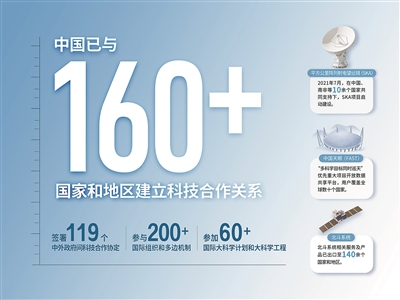
Core Viewpoint - China emphasizes open scientific cooperation to benefit humanity, establishing partnerships with over 160 countries and regions, and signing 119 intergovernmental agreements on scientific collaboration [2][5]. Group 1: International Cooperation Platforms - The SKA project, known as the "Earth's Giant Eye," is being developed with support from China and over ten other countries, aiming to create the world's largest radio telescope [3]. - China plays a significant role in the SKA project, contributing to key technology development and infrastructure construction [3]. - The FAST telescope, known as "China's Eye," has an open data sharing platform that serves users from dozens of countries, showcasing international collaboration in scientific research [3]. Group 2: Equal International Dialogue - Chinese and German academic institutions have innovated cooperation models, fostering a new generation of young academic leaders through various collaborative initiatives [6]. - The "Tengchong Scientist Forum" in Yunnan has become a platform for advanced academic exchanges and international cooperation in science and technology [7]. Group 3: Effective Innovation Networks - China has established over 70 "Belt and Road" joint laboratories in various fields, enhancing international scientific collaboration [8]. - The "China-Uruguay Joint Laboratory" focuses on soybean genetics research and aims to become an international scientific innovation platform [9]. Group 4: Nurturing a Cooperative Ecosystem - The "Xishuangbanna Biodiversity Platform" was launched to provide a new window for exploring tropical biodiversity, showcasing collaborative efforts in ecological research [11]. - The Chinese government is committed to creating a conducive environment for scientific innovation and cooperation, focusing on practical and efficient funding mechanisms [12].

【盘中播报】沪指涨0.09% 银行行业涨幅最大
Zheng Quan Shi Bao Wang· 2025-06-10 04:29
Market Overview - As of 10:28 AM, the Shanghai Composite Index increased by 0.09%, with a trading volume of 485.53 million shares and a transaction value of 592.605 billion yuan, representing a decrease of 6.99% compared to the previous trading day [1] Industry Performance - The banking sector showed the highest increase at 1.10%, with a transaction value of 162.50 billion yuan, up by 26.80% from the previous day, led by Minsheng Bank which rose by 2.83% [1] - The oil and petrochemical industry rose by 0.73%, with a transaction value of 35.64 billion yuan, down by 14.10%, with Renji Co. leading at 5.40% [1] - The comprehensive sector increased by 0.68%, with a transaction value of 20.07 billion yuan, up by 117.47%, led by Yuegui Co. which rose by 5.00% [1] - The public utilities sector increased by 0.46%, with a transaction value of 99.63 billion yuan, up by 8.07%, led by Leshan Electric Power which rose by 10.01% [1] - The real estate sector increased by 0.44%, with a transaction value of 65.97 billion yuan, up by 27.69%, led by Zhujiang Co. which rose by 9.25% [1] Declining Industries - The defense and military industry experienced the largest decline at 1.66%, with a transaction value of 224.39 billion yuan, down by 27.80%, led by Jieqiang Equipment which fell by 14.00% [2] - The computer sector declined by 1.25%, with a transaction value of 574.06 billion yuan, down by 1.37%, led by the delisted Longyu which fell by 39.06% [2] - The telecommunications sector decreased by 0.91%, with a transaction value of 287.09 billion yuan, down by 23.11%, led by the delisted Pengbo which fell by 59.68% [2]
今日62只A股封板 综合行业涨幅最大
Zheng Quan Shi Bao Wang· 2025-06-04 04:16
Market Overview - The Shanghai Composite Index increased by 0.43% as of the morning close, with a trading volume of 621.67 million shares and a total transaction value of 742.5 billion yuan, a decrease of 2.70% compared to the previous trading day [1]. Industry Performance - The top-performing sectors included: - Comprehensive sector with a rise of 2.49%, leading stock being Dongyangguang with a gain of 6.15% [1]. - Non-ferrous metals sector increased by 1.66%, with Sruy New Materials as the top stock, up by 12.66% [1]. - Building materials sector rose by 1.42%, led by Wanli Stone, which gained 10.02% [1]. - The sectors with the largest declines were: - Transportation sector decreased by 0.51%, with Jiangxi Changyun dropping by 5.71% [2]. - Public utilities sector fell by 0.06%, led by Nanfang Energy, down by 4.32% [2]. - Banking sector saw a slight decline of 0.04%, with Yunan Rural Commercial Bank decreasing by 1.68% [2]. Detailed Industry Data - Comprehensive: 21.82 billion yuan in transaction value, up 24.70% from the previous day [1]. - Non-ferrous metals: 343.28 billion yuan in transaction value, up 23.52% from the previous day [1]. - Building materials: 59.94 billion yuan in transaction value, down 0.74% from the previous day [1]. - Electronic: 662.13 billion yuan in transaction value, up 2.41% from the previous day [1]. - Communication: 364.12 billion yuan in transaction value, up 53.09% from the previous day [1].
5月29日医药生物、有色金属、通信等行业融资净卖出额居前
Zheng Quan Shi Bao Wang· 2025-05-30 03:15
Core Insights - As of May 29, the latest market financing balance is 1,797.58 billion yuan, showing a decrease of 1.13 billion yuan compared to the previous trading day [1][2] Industry Summary - **Industries with Increased Financing Balance**: - The computer industry saw the largest increase, with a financing balance up by 0.406 billion yuan, totaling 134.234 billion yuan [1] - Other industries with notable increases include banking (up 0.276 billion yuan), food and beverage (up 0.158 billion yuan), and retail (up 0.071 billion yuan) [1] - **Industries with Decreased Financing Balance**: - The pharmaceutical and biological sector experienced the largest decrease, down by 4.44 billion yuan, totaling 123.887 billion yuan [2] - Other sectors with significant declines include non-ferrous metals (down 3.22 billion yuan), telecommunications (down 2.43 billion yuan), and coal (down 1.53 billion yuan) [2] - **Financing Balance Growth Rates**: - The comprehensive industry recorded the highest growth rate at 1.26%, with a latest financing balance of 30.97 billion yuan [1] - Other industries with notable growth rates include beauty care (1.13%), banking (0.52%), and environmental protection (0.46%) [1] - **Financing Balance Decline Rates**: - The coal industry had the highest decline rate at 0.96%, with a financing balance of 15.766 billion yuan [2] - Other industries with significant declines include non-ferrous metals (0.41%), real estate (0.40%), and telecommunications (0.40%) [2]
建信基金:聚焦科技金融 跑出科创加速度
Cai Jing Wang· 2025-05-28 03:58
Core Insights - Technology finance is a crucial driver for social progress, economic growth, and national competitiveness, with significant implications for technological innovation and industrial upgrading [1] - Long-term capital plays a vital role in supporting technology enterprises, helping them overcome challenges related to lengthy R&D cycles and high risks [1] - The relationship between public funds and technology innovation enterprises is deepening, with public funds providing comprehensive financial services throughout the lifecycle of technology companies [1] Group 1: Policy and Strategic Focus - The 2025 policy aims to channel more financial resources into technology innovation, encouraging investments that are early-stage, small-scale, long-term, and focused on hard technology [2] - The company is optimizing resource allocation in technology finance, focusing on equity and bond investments to enhance financing channels for technology enterprises [2] - As of the end of 2024, the company has invested in 1,142 technology enterprises across various sectors, with a focus on new-generation information technology, new energy vehicles, and the biopharmaceutical industry [2] Group 2: Product Development and Performance - The company has established dedicated funds for key industries, with a notable focus on the new energy sector, and has launched several industry-specific funds [3] - By the end of 2024, technology investments accounted for approximately 70% of the company's equity assets, with several products performing well in their respective categories [3] - The company has successfully launched a technology-focused ETF that raised 2.982 billion yuan within 45 minutes of its debut, indicating strong market interest [4] Group 3: Research and Development Capabilities - The company is enhancing its investment research capabilities by cultivating talent and optimizing its organizational structure to better understand technology development cycles [5] - A comprehensive research system has been established to analyze technological trends and industry competition, enabling the identification of technology enterprises with long-term growth potential [5] - The company plans to continue improving its research capabilities and innovate its product offerings to capitalize on emerging technology investment opportunities [5]