
医药

Search documents
大消费行业 2026 年 1 月金股推荐
Changjiang Securities· 2025-12-29 14:31
Investment Rating - The report maintains a "Buy" rating for all recommended stocks in the consumer sector [11][12][13][14][16][17][21][22]. Core Insights - The report highlights nine advantageous sectors within the consumer industry, including agriculture, retail, social services, automotive, textiles, light industry, food, home appliances, and pharmaceuticals, with key stock recommendations for January 2026 [4][7]. - The report emphasizes the expected growth and profitability of the recommended companies, projecting significant increases in net profits and improvements in cash flow over the next few years [11][12][13][14][16][17][21][22]. Summary by Sector Agriculture - Recommended Stock: Muyuan Foods (牧原股份) - Projected net profits for 2025-2027 are 154.9 billion, 160.2 billion, and 225.5 billion respectively, with corresponding PE ratios of 18, 17, and 12 [11][27]. Retail - Recommended Stock: Shangmei Co., Ltd. (上美股份) - Projected net profits for 2025-2027 are 11.2 million, 14.0 million, and 17.0 million respectively, with corresponding PE ratios of 24, 19, and 16 [12][27]. Social Services - Recommended Stock: Jinjiang Hotels (锦江酒店) - Projected net profits for 2025-2027 are 9.53 million, 10.57 million, and 11.63 million respectively, with corresponding PE ratios of 28, 25, and 23 [13][27]. Automotive - Recommended Stock: Top Group (拓普集团) - Projected net profits for 2025-2027 are 27.8 million, 34.1 million, and 43.3 million respectively, with corresponding PE ratios of 45, 37, and 29 [14][27]. Textiles - Recommended Stock: HLA (海澜之家) - Projected net profits for 2025-2027 are 21.6 million, 23.1 million, and 24.5 million respectively, with corresponding PE ratios of 14, 13, and 12 [16][17][27]. Light Industry - Recommended Stock: Craft Home (匠心家居) - Projected net profits for 2025-2026 are 9.2 million and 12.0 million respectively, with corresponding PE ratios of 22 and 17 [17][27]. Food - Recommended Stock: Wancheng Group (万辰集团) - Projected net profits for 2025-2027 are 12.81 million, 20.46 million, and 26.81 million respectively, with corresponding PE ratios of 30, 19, and 14 [18][27]. Home Appliances - Recommended Stock: Anker Innovations (安克创新) - Projected net profits for 2025-2027 are 26.57 million, 31.98 million, and 38.95 million respectively, with corresponding PE ratios of 22.5, 18.7, and 15.4 [21][27]. Pharmaceuticals - Recommended Stock: Zhaoyan New Drug (昭衍新药) - Projected net profits for 2025-2027 are 0.61 million, 0.85 million, and 0.97 million respectively, with corresponding PE ratios of 31.8, 22.9, and 19.9 [22][27].


重整之路彻底终结!*ST长药三年造假,退市终成“无解”局
Tai Mei Ti A P P· 2025-12-29 14:22
图片由AI生成 今日,*ST长药(长江医药控股股份有限公司,股票代码300391.SZ)竞价阶段即封死跌停,股价报1.18元/股,总市值仅剩4.13亿元。 晚间公司同步披露:收到湖北省十堰市中级人民法院裁定,不予受理其重整申请并终结预重整程序,旗下湖北长江星医药等七家子公司实质合并重整程序终 止且被宣告破产。 这场双重崩塌的背后,是12月26日证监会下发的《行政处罚事先告知书》——公司2021年至2023年连续三年财务造假,累计虚增营收7.33亿元、利润1.68亿 元,已触及重大违法强制退市红线,被叠加实施退市风险警示。 距年末仅剩两天,债务豁免、注资等保壳动作已无落地时间窗口,-6.43亿净资产无法转正,财务类退市与重大违法退市双重风险叠加,加之重整之路全面 终结,这家跨界"光伏+医药"的上市公司,终因长期造假与经营溃败走向末路。 | 最高: 1.18 | 今开: 1.18 | 涨停:1.76 | | --- | --- | --- | | 曼低:1.18 | 昨收:1.47 | 跌停:1.18 | | 换手:2.54% | 盘后量:32手 | 量比:0.19 | | 振幅:0.00% | 盘后额:3776 ...



财政部、税务总局最新公告!
Sou Hu Cai Jing· 2025-12-29 13:30
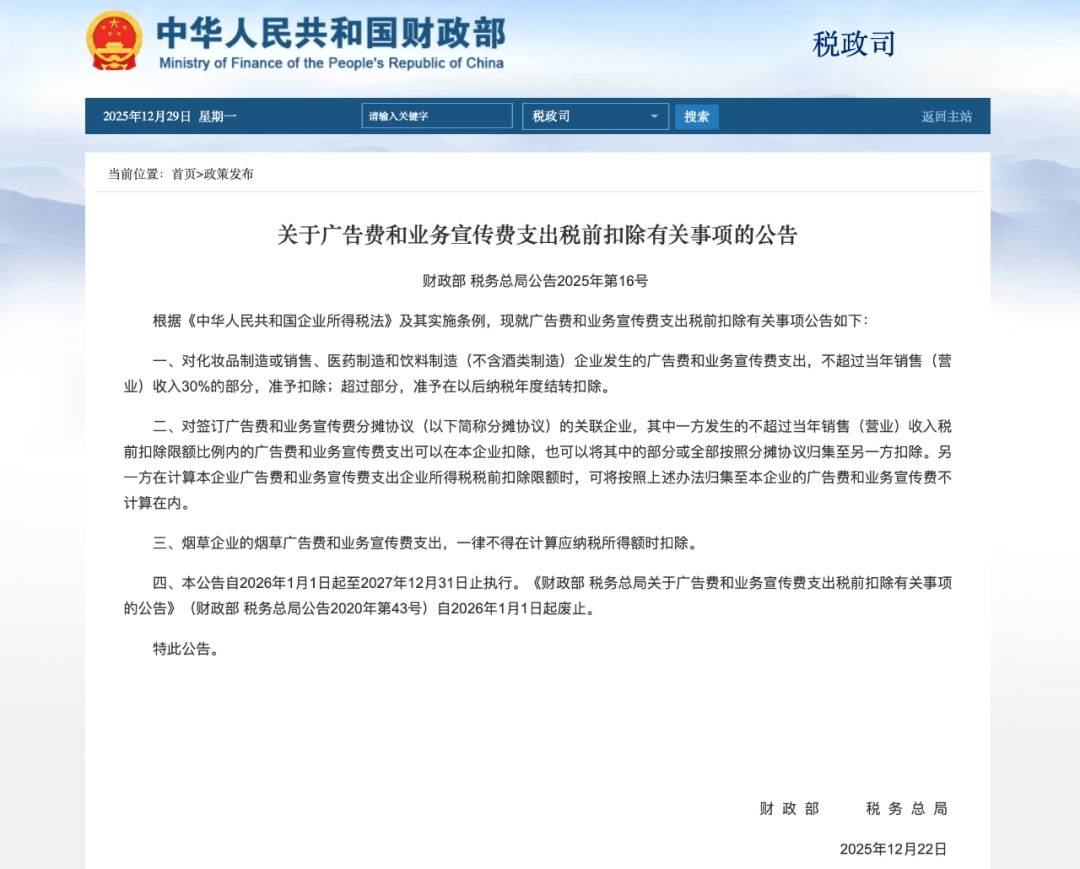
关于广告费和业务宣传费支出税前扣除有关事项的公告 财政部 税务总局公告2025年第16号 根据《中华人民共和国企业所得税法》及其实施条例,现就广告费和业务宣传费支出税前扣除有关事项公告如下: 一、对化妆品制造或销售、医药制造和饮料制造(不含酒类制造)企业发生的广告费和业务宣传费支出,不超过当年销售(营业)收入30%的部分,准予 扣除;超过部分,准予在以后纳税年度结转扣除。 三、烟草企业的烟草广告费和业务宣传费支出,一律不得在计算应纳税所得额时扣除。 四、本公告自2026年1月1日起至2027年12月31日止执行。《财政部 税务总局关于广告费和业务宣传费支出税前扣除有关事项的公告》(财政部税务总局 公告2020年第43号)自2026年1月1日起废止。 特此公告。 财政部 税务总局 2025年12月22日 转自:财政部网站 来源:中国财经报 二、对签订广告费和业务宣传费分摊协议(以下简称分摊协议)的关联企业,其中一方发生的不超过当年销售(营业)收入税前扣除限额比例内的广告费 和业务宣传费支出可以在本企业扣除,也可以将其中的部分或全部按照分摊协议归集至另一方扣除。另一方在计算本企业广告费和业务宣传费支出企业所 得税 ...
1月十大金股推荐
Ping An Securities· 2025-12-29 11:53
Group 1: Market Outlook - The equity market is expected to continue its upward trend due to clear domestic policy, strong economic growth momentum, and relatively loose market liquidity[3] - Investors are advised to actively position for the spring market, focusing on sectors with improving performance and benefiting from policies[3] Group 2: Recommended Stocks - BeiGene (688235.SH): Global sales of its core product, Zanubrutinib, reached $2.78 billion in the first three quarters of 2025, a year-on-year increase of 53.2%[4] - Beijing Junzheng (300223.SZ): The storage cycle is on the rise, and the company is expected to benefit from the L3 autonomous driving market[11] - Haiguang Information (688041.SH): The company is a leading domestic computing power provider, with revenue maintaining rapid growth in the first three quarters of 2025[18] - Daotong Technology (688208.SH): The company has seen rapid revenue growth and is advancing its AI strategy[26] - Penghui Energy (300438.SZ): The company ranks among the top three globally in household storage cell shipments in the first three quarters of 2025[32] - Goldwind Technology (002202.SZ): The gross margin for wind turbine and component business reached 7.97% in the first half of 2025, showing significant improvement[39] - Chifeng Gold (600988.SH): The company is expected to benefit from rising gold prices and increased production from new mining projects[46] - Luoyang Molybdenum (603993.SH): The company is positioned to benefit from rising copper prices and increased production[52] - Huaxin Cement (600801.SH): The company reported a 120.7% year-on-year increase in net profit attributable to shareholders in Q3 2025[57] - China Pacific Insurance (601601.SH): The company has maintained a high dividend yield, exceeding 3% since 2018[65]




两部门明确广告费和业务宣传费支出税前扣除有关事项
Xin Hua Wang· 2025-12-29 10:53
Core Viewpoint - The Ministry of Finance and the State Taxation Administration announced new tax deduction rules for advertising and business promotion expenses for certain industries, effective from January 1, 2026, to December 31, 2027 [1] Group 1: Tax Deduction Rules - Advertising and business promotion expenses for cosmetics manufacturing or sales, pharmaceutical manufacturing, and beverage manufacturing (excluding alcoholic beverages) can be deducted up to 30% of the annual sales revenue [1] - Any expenses exceeding the 30% threshold can be carried forward to future tax years for deduction [1] Group 2: Exclusions - Tobacco companies are explicitly prohibited from deducting any advertising and business promotion expenses when calculating taxable income [1]
华安基金:2025即将收官,创业板50指数年内涨幅近60%
Xin Lang Cai Jing· 2025-12-29 09:37
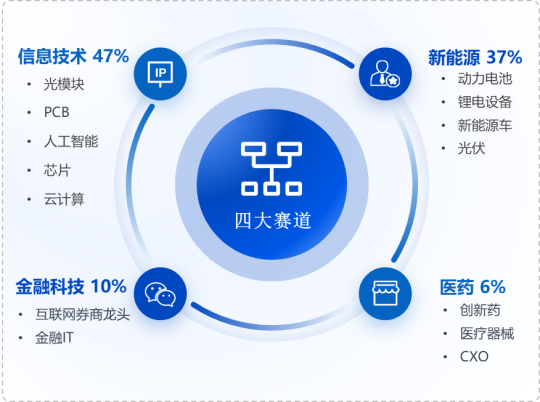
Market Overview - The A-share market showed an overall upward trend last week, with major indices rebounding: CSI 300 rose by 1.95%, CSI 500 increased by 4.03%, CSI 1000 gained 3.76%, ChiNext 50 climbed 4.07%, and STAR 50 went up by 2.84% [1][11] - The average daily trading volume in the A-share market was approximately 1.97 trillion yuan, indicating a resurgence in market investment enthusiasm [1][11] - Market hotspots included sectors such as optical modules, robotics, commercial aerospace, lithium batteries, liquid cooling servers, semiconductor equipment, non-ferrous metals, PCB concepts, and the chip industry chain, with commercial aerospace and robotics remaining particularly active [1][11] Investment Opportunities - It is recommended to focus on policy-driven and recovery trends, particularly in technology growth and high-end manufacturing sectors, exemplified by the ChiNext 50 index, which has seen a year-to-date increase of 59.86% [1][11] - The ChiNext serves as a direct financing platform for innovative and entrepreneurial enterprises, emphasizing the "three innovations (innovation, creation, creativity)" and "four new (new technologies, new industries, new business formats, new models)" [1][11] Sector Analysis Technology, AI, and Communication - The ChiNext 50 index includes 50% of the information technology sector, with 23% weight in optical modules, which rebounded last week [3][13] - The demand for 800G optical modules is expected to maintain rapid growth through 2026, with 1.6T optical modules entering their commercial year and 3.2T research and development commencing [3][13] - AI-driven infrastructure expansion is accelerating, with domestic AI chips capitalizing and large model applications speeding up [3][13] New Energy Photovoltaics - The new energy photovoltaic sector saw significant gains last week, with stable prices across the supply chain: silicon materials, batteries, and glass prices remained steady, while component and silicon wafer prices slightly decreased [5][14] - The energy storage industry is experiencing rapid growth, supported by domestic electricity market reforms and increasing overseas demand for energy storage solutions [5][14] Pharmaceutical and Biotechnology - The pharmaceutical sector's performance was flat last week, with the sixth batch of national high-value consumables procurement starting, introducing anchor pricing and multiple reactivation mechanisms to prevent malicious low-price competition [6][16] - Several innovative drugs and medical devices received approval, including targeted HER2 ADC drugs and various inhibitors entering clinical trials [6][16] - The industry remains active due to policy support and technological innovation, with breakthroughs in innovative drugs and medical devices being reported [6][16] ChiNext 50 ETF Overview - The ChiNext 50 ETF (159949) tracks the ChiNext 50 index, focusing on high-quality leading companies in five key technology sectors: new energy vehicles, biomedicine, electronics, photovoltaics, and internet finance [7][17] - The ETF has a current valuation of 42.45 times earnings, with a ten-year percentile of 44.36% [3][13] - The ETF's average daily trading volume over the past year was 1.463 billion yuan, ranking it among the top ETFs on the Shenzhen Stock Exchange [7][17] Top Holdings Performance - The top ten weighted stocks in the ChiNext 50 index include CATL (21.64% weight, +0.11%), Zhongji Xuchuang (12.08% weight, +9.67%), and others, with notable performances in the communication and power equipment sectors [8][18]

两部门:烟草企业的烟草广告费和业务宣传费支出, 一律不得在计算应纳税所得额时扣除
Sou Hu Cai Jing· 2025-12-29 09:16
一、对化妆品制造或销售、医药制造和饮料制造(不含酒类制造)企业发生的广告费和业务宣传费支 出,不超过当年销售(营业)收入30%的部分,准予扣除;超过部分,准予在以后纳税年度结转扣除。 二、对签订广告费和业务宣传费分摊协议(以下简称分摊协议)的关联企业,其中一方发生的不超过当 年销售(营业)收入税前扣除限额比例内的广告费和业务宣传费支出可以在本企业扣除,也可以将其中 的部分或全部按照分摊协议归集至另一方扣除。另一方在计算本企业广告费和业务宣传费支出企业所得 税税前扣除限额时,可将按照上述办法归集至本企业的广告费和业务宣传费不计算在内。 财政部 税务总局公告2025年第16号 根据《中华人民共和国企业所得税法》及其实施条例,现就广告费和业务宣传费支出税前扣除有关事项 公告如下: 财政部、税务总局发布《关于广告费和业务宣传费支出税前扣除有关事项的公告》提出,对化妆品制造 或销售、医药制造和饮料制造(不含酒类制造)企业发生的广告费和业务宣传费支出,不超过当年销售 (营业)收入30%的部分,准予扣除;超过部分,准予在以后纳税年度结转扣除。 对签订广告费和业 务宣传费分摊协议(以下简称分摊协议)的关联企业,其中一方发生的 ...
财政部、税务总局:烟草企业的烟草广告费和业务宣传费支出 一律不得在计算应纳税所得额时扣除
Sou Hu Cai Jing· 2025-12-29 09:16
财政部、税务总局现就广告费和业务宣传费支出税前扣除有关事项公告如下:一、对 化妆品制造或销 售、医药制造和 饮料制造(不含酒类制造)企业发生的广告费和业务宣传费支出,不超过当年销售 (营业)收入30%的部分,准予扣除;超过部分,准予在以后纳税年度结转扣除。 二、对签订广告费 和业务宣传费分摊协议(以下简称分摊协议)的关联企业,其中一方发生的不超过当年销售(营业)收 入税前扣除限额比例内的广告费和业务宣传费支出可以在本企业扣除,也可以将其中的部分或全部按照 分摊协议归集至另一方扣除。另一方在计算本企业广告费和业务宣传费支出企业所得税税前扣除限额 时,可将按照上述办法归集至本企业的广告费和业务宣传费不计算在内。 三、烟草企业的烟草广告费 和业务宣传费支出,一律不得在计算应纳税所得额时扣除。 四、本公告自2026年1月1日起至2027年12 月31日止执行。《财政部 税务总局关于广告费和业务宣传费支出税前扣除有关事项的公告》(财政部 税务总局公告2020年第43号)自2026年1月1日起废止。 ...
两部门发布关于广告费和业务宣传费支出税前扣除有关事项的公告
Xin Hua Cai Jing· 2025-12-29 09:14
(文章来源:新华财经) 新华财经北京12月29日电财政部、税务总局发布关于广告费和业务宣传费支出税前扣除有关事项的公 告。其中提到,对化妆品制造或销售、医药制造和饮料制造(不含酒类制造)企业发生的广告费和业务 宣传费支出,不超过当年销售(营业)收入30%的部分,准予扣除;超过部分,准予在以后纳税年度结 转扣除。对签订广告费和业务宣传费分摊协议的关联企业,其中一方发生的不超过当年销售(营业)收 入税前扣除限额比例内的广告费和业务宣传费支出可以在本企业扣除,也可以将其中的部分或全部按照 分摊协议归集至另一方扣除。另一方在计算本企业广告费和业务宣传费支出企业所得税税前扣除限额 时,可将按照上述办法归集至本企业的广告费和业务宣传费不计算在内。烟草企业的烟草广告费和业务 宣传费支出,一律不得在计算应纳税所得额时扣除。本公告自2026年1月1日起至2027年12月31日止执 行。 ...
两部门:烟草企业的烟草广告费和业务宣传费支出,一律不得在计算应纳税所得额时扣除
Zheng Quan Shi Bao Wang· 2025-12-29 09:04
人民财讯12月29日电,财政部、税务总局发布关于广告费和业务宣传费支出税前扣除有关事项的公告, 一、对化妆品制造或销售、医药制造和饮料制造(不含酒类制造)企业发生的广告费和业务宣传费支出, 不超过当年销售(营业)收入30%的部分,准予扣除;超过部分,准予在以后纳税年度结转扣除。 三、烟草企业的烟草广告费和业务宣传费支出,一律不得在计算应纳税所得额时扣除。 四、本公告自2026年1月1日起至2027年12月31日止执行。《财政部税务总局关于广告费和业务宣传费支 出税前扣除有关事项的公告》(财政部税务总局公告2020年第43号)自2026年1月1日起废止。 二、对签订广告费和业务宣传费分摊协议(以下简称分摊协议)的关联企业,其中一方发生的不超过当年 销售(营业)收入税前扣除限额比例内的广告费和业务宣传费支出可以在本企业扣除,也可以将其中的部 分或全部按照分摊协议归集至另一方扣除。另一方在计算本企业广告费和业务宣传费支出企业所得税税 前扣除限额时,可将按照上述办法归集至本企业的广告费和业务宣传费不计算在内。 ...