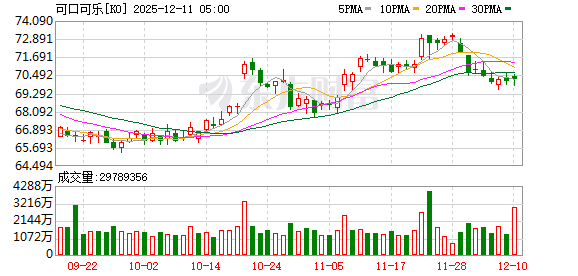
饮料

Search documents
可口可乐选定新CEO
Bei Jing Shang Bao· 2025-12-11 15:29
Core Insights - Coca-Cola has appointed Henrique Braun as the new CEO, effective March 31, 2026, succeeding James Quincey, who will become the executive chairman after nearly nine years as CEO [1] - Braun has extensive experience within Coca-Cola, having joined in 1996 and held various positions across different regions, including a significant role in the Greater China and Korean markets [1][2] - Under Quincey's leadership, Coca-Cola optimized its brand portfolio by eliminating over 200 underperforming brands and introducing more than 10 billion-dollar brands, resulting in a total of 30 billion-dollar brands currently [2] Company Strategy and Market Position - Coca-Cola is focusing on the Chinese market, which is its third-largest globally, and Braun's familiarity with this market may lead to continued emphasis on local innovation [2][3] - The company reported a 1% increase in global case volume and a 5% revenue growth to $12.455 billion in Q3, with a net profit of $3.683 billion, reflecting a 29% increase [3] - Despite overall growth, Coca-Cola faces challenges in the Asia-Pacific region, where case volumes have declined due to weakened consumer spending and increased competition [3][4] Challenges in the Chinese Market - Coca-Cola's Costa Coffee has seen a significant reduction in store numbers, dropping to approximately 334 locations, with only 11 new stores planned for 2025, far below the previously set target of 1,000 stores by 2025 [3] - The brand's market share in China is projected to be only 12.3% in 2024, less than half of Starbucks' share, indicating intense competition from local brands and other beverage categories [3][4] - Analysts suggest that despite Coca-Cola's investments in production capacity and product innovation, the current product offerings and marketing strategies have not yet effectively driven sales growth in the face of changing consumer preferences and competition [4]

可口可乐换帅
Bei Jing Shang Bao· 2025-12-11 12:56
Core Viewpoint - Coca-Cola has announced the appointment of Henrique Braun as the new CEO, effective March 31, 2026, succeeding James Quincey, who will transition to the role of Executive Chairman after a nine-year tenure as CEO. The company faces challenges such as intensified industry competition and declining sales in the Asia-Pacific market [1][3]. Leadership Transition - The board of directors has elected Henrique Braun as the new CEO, with his term starting on March 31, 2026. James Quincey will become the Executive Chairman after serving as CEO for nine years [3]. - Braun has been with Coca-Cola since 1996, holding various positions across North America, Europe, Latin America, and Asia. He has been the Chief Operating Officer since January 1, 2023, overseeing all global operations [3]. - During his tenure, Quincey optimized the brand and product portfolio, eliminating over 200 underperforming sub-brands and introducing more than 10 billion-dollar brands, bringing the total to 30 [4]. Market Challenges - China is Coca-Cola's third-largest market globally, following the U.S. and Mexico. In Q3, Coca-Cola reported a 1% increase in global case volume and a 5% revenue growth to $12.455 billion, with a net profit of $3.683 billion, up 29% [5]. - However, the Asia-Pacific market saw a decline in sales due to weakened consumer spending and poor industry performance. For instance, the number of COSTA stores in China has significantly decreased, with only 334 stores remaining as of December 11, 2023, and new store openings dropping from 92 in 2023 to just 11 planned for 2025 [5][6]. - The competitive landscape is intensifying, with local beverage brands gaining market share and competition in ready-to-drink tea and coffee segments becoming fierce [5][6]. Strategic Initiatives - In response to market pressures, Coca-Cola has increased investments and launched new products in China. Collaborations with bottlers have led to the establishment of new production facilities, and the company has introduced health-oriented products like prebiotic sparkling water [6]. - Despite these efforts, the decline in sales in the Asia-Pacific region indicates that existing product innovations and marketing strategies have not yet fully stimulated growth, with price adjustments becoming a more significant factor [7]. - Braun's experience in the Greater China region is expected to help him understand market complexities and consumer needs, potentially accelerating localized product innovation and digital operations to address the sales decline [7].

可口可乐任命公司元老担任新任首席执行官
Xin Lang Cai Jing· 2025-12-11 08:52
Core Insights - Coca-Cola announced that its Chief Operating Officer, Enrique Braun, will become the next CEO starting in Q1 2026, with current CEO James Quincey transitioning to Executive Chairman [1][5] - Braun has been with Coca-Cola for 30 years and has held various leadership roles across different regions and functions [1][5] - Quincey, who has been CEO for 9 years, successfully launched over ten billion-dollar brands and led the company into the alcoholic beverage market [2][6] Leadership Transition - Enrique Braun will officially take over as CEO on March 31, 2026, while James Quincey will remain actively involved as Executive Chairman [1][5] - Braun's extensive experience includes overseeing operations in Brazil, Latin America, Greater China, and South Korea, as well as managing supply chain, new business development, marketing, and innovation [1][5] Achievements Under Quincey - During Quincey's tenure, Coca-Cola introduced significant brands such as BodyArmor and Fairlife, and entered the hard seltzer market with Topo Chico [2][6] - Quincey also led a major restructuring in 2020, reducing the number of brands and focusing investments on high-growth products like Simply and Minute Maid [2][6] Current Challenges - As Quincey steps down, Coca-Cola faces challenges including weak demand for its products in the U.S. and Europe, and increasing consumer scrutiny over ingredients [7] - The company plans to launch a classic Coke version using cane sugar instead of high fructose corn syrup, responding to consumer preferences [7] Future Outlook - The board believes Braun will leverage the company's existing strengths to identify new growth opportunities globally [3][7] - Coca-Cola's stock price remained stable in after-hours trading following the announcement [4][7]
食品饮料行业2026年度投资策略报告(一):需求多元、供给升级,大众消费的嬗变与曙光-20251211
Guoxin Securities· 2025-12-11 08:04
Investment Rating - The report maintains an "Outperform" rating for the food and beverage industry [1][4][5] Core Viewpoints - The food and beverage sector is experiencing a transformation driven by diverse consumer demands and supply upgrades, with structural opportunities expected to persist in 2026 despite a moderate recovery in overall demand [2][29] - The report highlights the importance of adapting to new retail channels and consumer preferences, emphasizing the need for product differentiation and quality enhancement [2][29] Summary by Sections Review of 2025 - The overall industry performance was weak, with a decline of 5.3% in the food and beverage sector, underperforming the CSI 300 index by 19.4 percentage points [1][25] - Consumer confidence remained low, with urban residents' disposable income growth slowing to 4.4% year-on-year [1][12] - The soft drink sector maintained relative strength, while the snack industry showed mixed results, with leading companies continuing to expand [1][20] Outlook for 2026 - Structural opportunities are anticipated, with a focus on channel diversification and supply upgrades [2][29] - The report predicts a shift in consumer preferences towards high-quality, reasonably priced products, with an emphasis on additional value attributes such as convenience and health [2][29] - The beverage sector is expected to benefit from the development of non-traditional channels and the introduction of differentiated products [33][47] Investment Recommendations - The report suggests focusing on companies that enhance product quality and service, such as Baba Foods and Wanchen Group [3][4] - It highlights high-growth categories with health attributes, recommending companies like Dongpeng Beverage and Nongfu Spring [3][4] - The report also identifies companies with strong performance recovery potential, such as Anjijia Foods and Yihai International [3][4] Key Company Earnings Forecasts and Investment Ratings - Companies such as Yanjing Beer, Weilong Delicious, and Yili Group are rated as "Outperform" with projected earnings per share (EPS) growth [4][5] - The report provides detailed earnings forecasts and price-to-earnings (PE) ratios for various companies, indicating a generally positive outlook for the sector [4][5]
国投证券:首次覆盖华润饮料予“买入-A”评级 怡宝作为头部品牌行业地位稳固
Zhi Tong Cai Jing· 2025-12-11 07:50
Core Viewpoint - Guotou Securities reports that China Resources Beverage (02460) is a leading player in the bottled water industry, with its Yibao brand maintaining a strong market position. The demand for packaged water is expected to remain stable in the long term, supported by the company's dual strategy of promoting both bottled water and beverage segments, indicating strong long-term competitiveness. The company is given a "Buy-A" investment rating with a target price of 13.86 CNY based on a 22x valuation, referencing comparable companies' average valuation for 2025 [1]. Industry Insights - The bottled water industry is expanding steadily as health awareness among residents increases. The market size for bottled water in China is projected to reach 245 billion CNY in 2024, with a compound annual growth rate (CAGR) of approximately 5.7% from 2016 to 2024. By 2025, the market size is expected to grow to 251.7 billion CNY, reflecting a year-on-year increase of 2.75%. As a leading player in the bottled water sector, the company is well-positioned to benefit from this industry expansion [2]. Company Performance - In the first half of 2025, the company reported revenue of 6.206 billion CNY, a year-on-year decrease of 18.52%, and a net profit attributable to shareholders of 805 million CNY, down 28.63%. The revenue breakdown shows that packaged water and beverages generated 5.25 billion CNY and 960 million CNY, respectively, with year-on-year changes of -23.1% for packaged water and +21.28% for beverages. The revenue from small-sized bottled water, medium and large-sized bottled water, and barrel water was 3.19 billion CNY, 1.83 billion CNY, and 230 million CNY, reflecting declines of -26.2%, -19.4%, and -1.5% respectively. The beverage segment, which is being developed as a secondary growth avenue, launched 14 new SKUs in the first half of 2025, contributing to a revenue share increase to 15.4%. The company is enhancing its distribution network across various channels and is associated with international sports events to boost brand recognition [3]. Future Outlook - The company plans to establish two new factories in the second half of 2025, with the self-built factory in Zhejiang expected to commence production in Q4, which is anticipated to improve production efficiency. Revenue growth projections for 2025 to 2027 are estimated at -11.97%, 6.61%, and 8.64%, while net profit growth rates are forecasted at -7.10%, 9.32%, and 5.49%. The average valuation for comparable companies in 2025 is estimated at 21.49x [3].
国投证券:首次覆盖华润饮料(02460)予“买入-A”评级 怡宝作为头部品牌行业地位稳固
智通财经网· 2025-12-11 07:49
Core Viewpoint - Guotou Securities reports that China Resources Beverage (02460) is a leading player in the bottled water industry, with its Yibao brand maintaining a strong market position. The demand for packaged water is expected to remain stable in the long term, supported by the company's dual strategy in packaged water and beverage segments, indicating strong long-term competitiveness [1]. Industry Summary - The bottled water industry is experiencing steady expansion due to rising health awareness among consumers. The market size for bottled water in China is projected to reach 245 billion CNY in 2024, with a compound annual growth rate (CAGR) of approximately 5.7% from 2016 to 2024. By 2025, the market size is expected to grow to 251.7 billion CNY, reflecting a year-on-year increase of 2.75%. As a leading player, the company is well-positioned to benefit from this industry growth [2]. Company Performance Summary - In the first half of 2025, the company reported revenue of 6.206 billion CNY, a decrease of 18.52% year-on-year, and a net profit attributable to shareholders of 805 million CNY, down 28.63% year-on-year. The revenue breakdown shows that packaged water and beverages generated 5.25 billion CNY and 960 million CNY, respectively, with packaged water declining by 23.1% and beverages growing by 21.28%. The company launched 14 new product SKUs in the beverage segment, contributing to a revenue share increase to 15.4% [3]. - The company plans to open two new factories in the second half of the year, with the self-built factory in Zhejiang expected to commence production in Q4, which is anticipated to enhance production efficiency. Revenue growth projections for 2025 to 2027 are -11.97%, 6.61%, and 8.64%, while net profit growth rates are projected at -7.10%, 9.32%, and 5.49% respectively. The average valuation for comparable companies in 2025 is estimated at 21.49X [3].
美联储宣布降息25个基点,鲍威尔透露关键信号;再降1000万!催收巨头贱卖总部大楼丨每经早参
Mei Ri Jing Ji Xin Wen· 2025-12-11 07:15
Group 1: Federal Reserve Actions - The Federal Reserve announced a 25 basis point rate cut, lowering the federal funds rate target range to 3.5%-3.75%, marking the third consecutive cut since September 2023 and the sixth since the current easing cycle began in September 2024 [2][4] - Chairman Powell stated that the Fed's monetary policy actions are guided by the dual mandate of promoting full employment and price stability, with current inflation risks skewed upward and employment risks downward [2][4] - The cumulative rate cut over the past three meetings amounts to 0.75 percentage points, aimed at stabilizing the labor market and restoring inflation to a downward trend towards the 2% target [2][4] Group 2: Stock Market Performance - Major U.S. stock indices closed higher, with the Dow Jones up 1.05%, Nasdaq up 0.33%, and S&P 500 up 0.68%, driven by gains in large tech stocks [5] - Notable stock movements included Tesla, Amazon, Broadcom, and Google rising over 1%, while Meta and Microsoft saw declines of over 1% and 2%, respectively [5] Group 3: Economic Indicators - The U.S. government reported a budget deficit of $173 billion for November, with total expenditures of $509 billion, down from $669 billion in November 2024, partly due to delayed payments from a recent government shutdown [5] Group 4: International Developments - The International Monetary Fund (IMF) raised its economic growth forecast for China, predicting a 5.0% growth in 2025, an increase of 0.2 percentage points from the previous outlook [10] Group 5: Corporate Developments - Yongxiong Group, facing difficulties since being investigated by police in April 2023, announced a further price reduction of 10 million yuan on the sale of its headquarters building, now priced at 60 million yuan, to raise funds for loan repayments [26] - Oracle's second-quarter earnings fell short of analyst expectations, reporting adjusted revenue of $16.1 billion compared to the forecast of $16.21 billion [28] - PepsiCo reached a strategic reform agreement with activist investor Elliott Management to address declining performance and market pressures, planning to cut nearly 20% of its product line in the U.S. by 2026 [29]

消费市场不断变化 如何在传统行业中探索增长之道?
Zhong Guo Jing Ying Bao· 2025-12-11 07:02
Core Insights - The rise of Generation Z is reshaping consumer preferences, emphasizing value for money and quality-price ratio, which are becoming mainstream trends in the market [1][2] - Companies need to continuously understand market demands and enhance their competitive edge to adapt to these changes [1] Consumer Trends - Consumers are increasingly focused on extreme cost-performance ratios and single-category champions, with many Chinese brands successfully creating standout products [2] - Emotional consumption is gaining traction, with consumers valuing the emotional connection to products [2] - Comfort marketing is essential, as brands must communicate their values from the consumer's perspective rather than imposing their own views [2] Value Recognition - Consumers are willing to pay for products they perceive as valuable, as illustrated by a personal anecdote regarding a product priced higher due to its unique context [2] - The concept of value recognition is crucial, as consumers have already established their own value positioning for products before making a purchase [2] Brand Strategies - Companies like Dayao Beverage are focusing on high-quality price-performance strategies, ensuring that consumers receive better quality for lower prices [3] - Product quality is a key focus, with strict raw material selection and innovative production processes to enhance consumer experience [3] - Scene-based marketing is vital, with brands optimizing product suitability for common consumption scenarios [3] Industry Innovation - The beverage industry is undergoing innovation through new processes that enhance consumer experiences, as seen with products like "Good Comfort" from Yuanqi Forest [4] - Companies are investing in new technologies and processes to meet rising consumer quality demands [4] - A culture of allowing trial and error is encouraged within companies to foster continuous innovation [4] Strategic Growth - Traditional companies like New Hope Group are exploring business innovations while remaining within familiar sectors to mitigate risks [5] - The focus on product innovation should be narrowed to meet specific consumer needs, rather than overwhelming the market with numerous SKUs [5] Future Market Trends - There is a growing market for functional products as consumer health awareness increases, alongside opportunities for industrializing native products [6] - Cross-industry innovation requires a comprehensive understanding of supply chains, organizational structures, and market dynamics [6]

宗馥莉“心腹”祝丽丹又退出两家公司,严学峰卸任一家公司监事
Xin Lang Cai Jing· 2025-12-11 05:39
天眼查App显示,12月9日,白山宏胜饮料有限公司发生工商变更,祝丽丹卸任法定代表人、总经理, 由许思敏接任。该公司成立于2002年9月,注册资本1380万美元,宗馥莉为该公司董事,经营范围包括 饮料生产、食品销售、食品用塑料包装容器工具制品生产及销售等,由盛佳集团有限公司、杭州娃哈哈 集团有限公司、娃哈哈商业股份有限公司共同持股。 同一天,合肥娃哈哈饮料有限公司也发生工商变更,祝丽丹卸任法定代表人、总经理,盛文龙接任法定 代表人并担任经理;同时,严学峰卸任该公司监事。该公司成立于2006年7月,注册资本1600万美元, 宗馥莉为该公司董事,经营范围包括饮料生产、乳制品生产、食品生产、食品销售等,由荣辉投资有限 公司、丽水盛佳饮料有限公司共同持股。 祝丽丹和严学峰都被外界视为宗馥莉的"心腹",在娃哈哈体系中占据重要地位。 天眼查相关信息显示,截至12月11日,祝丽丹在与娃哈哈有关联的101家公司中担任法定代表人,任119 家公司的总经理或经理。严学峰在与娃哈哈有关联的186家公司中担任监事等高管职务,任6家公司的法 定代表人。 自宗馥莉9月向娃哈哈集团正式提交辞职申请,辞去公司法定代表人、董事及董事长等核心职 ...
可口可乐,CEO大消息:60岁詹鲲杰即将卸任 接任者曾任大中华区总裁
Mei Ri Jing Ji Xin Wen· 2025-12-11 05:26
Group 1 - The core point of the article is the announcement of Coca-Cola's CEO succession plan, with Henrique Braun set to become the new CEO on March 31, 2026, while current CEO James Quincey will transition to Executive Chairman after his term ends [2][3] - James Quincey, aged 60, has been with Coca-Cola since 1996 and has played a significant role in transforming the company from a single carbonated beverage producer to a "total beverage company," adding over 10 billion-dollar brands during his tenure [4] - Under Quincey's leadership, Coca-Cola has focused on digital transformation and marketing innovation to enhance resilience against challenges like the COVID-19 pandemic, while divesting non-core assets [4] Group 2 - Henrique Braun, the new CEO, has extensive experience within Coca-Cola, having held various significant positions across North America, Europe, Latin America, and Asia since joining in 1996 [4] - Braun's key tasks will include identifying global growth opportunities, aligning the company closer to consumer needs, and leveraging technology to drive business performance and growth [5] - In the third quarter of 2025, Coca-Cola reported a revenue increase of 5% to $12.455 billion and a net profit growth of 29% to $3.683 billion, with global single-serve sales increasing by 1% [5]