
酒店

Search documents
听柬埔寨旅游从业者讲述战乱之苦
Huan Qiu Shi Bao· 2025-12-25 22:54
Core Insights - The tourism industry in Cambodia, particularly in Siem Reap where Angkor Wat is located, is experiencing a "chronic shock" due to renewed border conflicts with Thailand, leading to safety concerns and a decline in tourist arrivals [1][2] Tourism Impact - Cambodia received approximately 5.173 million international visitors in the first 11 months of this year, a decrease of 13.8% year-on-year [1] - Thai tourists numbered around 1 million, down 47% compared to the previous year, while Vietnamese and South Korean tourists also saw declines of 7.3% and 16% respectively [1] - The Cambodia Travel Agents Association (CATA) noted that many tourists who planned to enter through the Thai-Cambodian border have canceled or postponed their trips due to the ongoing border tensions [1] Local Business Sentiment - Popular tourist areas like Siem Reap, Phnom Penh, and Kampot are witnessing reduced foot traffic, with businesses reporting a significant drop in customer engagement [2] - Hotel bookings, which typically surge near the New Year, have declined due to the ongoing conflict, affecting the festive atmosphere [2] - Local guides and tourism workers express concern over their livelihoods but maintain a sense of hope that the situation will improve in the future [2]
机构展望2026年中国股市:科技成长与高股息策略成焦点
Hua Xia Shi Bao· 2025-12-25 11:52
Core Viewpoint - The outlook for the 2026 stock market emphasizes the long-term value reassessment of quality companies amid China's rising global industrial competitiveness [1] Group 1: Market Trends and Opportunities - The current macroeconomic environment and structural changes are shaping a new market landscape, with technology industries, particularly artificial intelligence, entering a substantial development phase [1] - Traditional industries are being reassessed for their profitability and dividend potential after undergoing supply-side adjustments and international upgrades, indicating unique allocation value [1] - The market style is expected to become more balanced and diversified, with both technology growth and stable returns being significant investment paths [2] Group 2: Key Investment Directions - The lithium battery sector is highlighted as a key area, with expectations of a "not-so-dull" off-season in Q1 next year, supported by strong production plans from major companies and steady demand [2] - The consumer electronics sector is seen as having multiple growth drivers, including the anticipated launch of foldable iPhones by Apple, which could revitalize the industry and trigger a significant device upgrade cycle [3] - The "self-indulgent" consumption sector, including airlines, hotels, and tourism, is showing signs of recovery, with operating data turning positive year-on-year since September and October [3] Group 3: Value Reassessment and Global Expansion - The long-term outlook for equities is optimistic, with a focus on cyclical industries like non-ferrous metals, which are transitioning from strong cyclical stocks to value stocks with stable cash flows and potential for increased dividends [5] - High-end manufacturing industries are expanding overseas, leveraging China's strong supply chain and efficiency advantages, with a focus on capturing higher value-added segments [6] Group 4: High-Growth Sectors - The lithium and energy storage industries are expected to see structural changes, with energy storage becoming the primary driver of lithium demand growth due to increasing needs for grid construction and energy security [7] - Investment opportunities driven by artificial intelligence technology are emphasized, with a focus on practical advancements in AI applications and hardware in 2026 [8] - For conservative investors, the Hong Kong stock market presents structural opportunities, particularly if the quality of listed assets can gain international investor recognition [8]


起拍价5.1亿元!王健林名下一小额贷款公司股权被法拍
Xin Lang Cai Jing· 2025-12-25 09:12
Core Viewpoint - Wanda Group is facing significant financial challenges, leading to the judicial auction of its 70% stake in Shanghai Wanda Microfinance Co., with a starting price of over 510 million yuan and an estimated value of approximately 730 million yuan. This situation arises from previous debt disputes, with Wanda Group being subject to over 12 billion yuan in forced executions and having over 81 billion yuan in total executed amounts across multiple cases [1][5]. Group 1: Financial Distress and Legal Issues - Wanda Group has been involved in multiple legal disputes, resulting in it being listed as a defendant in various cases, with total execution amounts exceeding 81 billion yuan [1][4]. - The company has faced several forced executions since 2025, including a notable case with an execution amount of 17.1 billion yuan and another for over 1.8 billion yuan [4][8]. - There are multiple instances of share pledges and internal restructuring as the company seeks to raise funds amid its financial difficulties [2][6]. Group 2: Asset Sales and Corporate Structure - Since 2023, Wanda Group has sold over 80 Wanda Plazas, including a significant sale of 48 plazas in May 2025 [6]. - The company was founded in September 1992, with a registered capital of 1 billion yuan, and its business scope includes commercial real estate investment, hotel management, and cultural industry investments [6][1]. - In early 2025, Wang Jianlin pledged 240,000 shares of Wanda Group to raise funds, indicating ongoing efforts to manage liquidity [2][6].

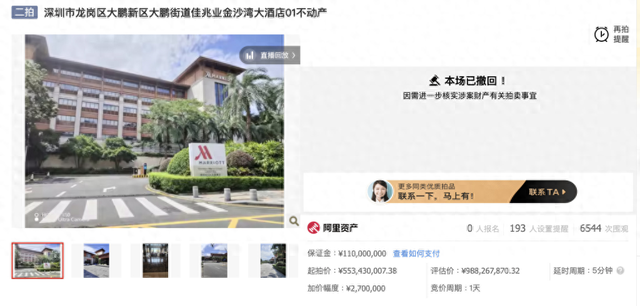
深圳大鹏佳兆业金沙湾大酒店二次拍卖被撤回,原起拍价5.53亿元
Xin Lang Cai Jing· 2025-12-25 08:50
Group 1 - The auction for the "Kaisa Group Holdings Limited's Shenzhen Dapeng New District Hotel" was withdrawn due to the need for further verification of the auction-related matters [2] - The second auction was scheduled for December 25, 2025, with a starting price reduced to 553 million yuan from an estimated value of 988 million yuan [2] - The property includes a land area of 34,449.48 square meters designated for hotel use, with a usage period until November 4, 2052 [2] Group 2 - The auction attracted 6,544 views but received no bids, marking a continuation of previous unsuccessful auction attempts [3] - The property had previously been withdrawn from auction in December 2023 and had failed to attract bids in both its first and second auctions in May 2024 [3] - The court has not provided clarity on whether the property will be re-listed for auction in the future [3]
五粮液西湖文化体验馆暨五粮炙造潮饮店开业 以酒为媒绘就传统与新潮交融范式
Xin Hua Cai Jing· 2025-12-25 08:24
Core Viewpoint - The opening of the Wuliangye West Lake Cultural Experience Hall and Wuliang Zhi Zao West Lake Trendy Drink Store marks a significant collaboration between two century-old brands, Wuliangye and Xinxin Hotel, aiming to blend traditional Chinese liquor culture with modern lifestyle trends [1][2]. Group 1: Project Overview - The Wuliangye West Lake Cultural Experience Hall and Wuliang Zhi Zao West Lake Trendy Drink Store are located in a historic area near West Lake, enhancing the cultural landscape with a mix of historical significance and contemporary vibrancy [1][2]. - The Xinxin Hotel, established in 1913, is recognized as the first modern hotel in Hangzhou, while Wuliangye has a rich history dating back to the pre-Qin period, making this collaboration a fusion of heritage and modernity [1][2]. Group 2: Experience and Offerings - The venue features five themed areas designed for immersive experiences, including calligraphy demonstrations, unique drink tastings, and live performances, creating a cultural gathering that appeals to both traditional and contemporary tastes [2][3]. - Wuliang Zhi Zao offers innovative drinks that combine Wuliangye liquor with coffee and oolong tea, catering to the younger demographic's preference for lighter drinking experiences [3]. Group 3: Strategic Goals - Wuliangye aims to replicate and standardize the "Wuliang Zhi Zao" concept nationwide, connecting with younger consumers and integrating into urban cultural landmarks [4]. - The initiative seeks to provide a modern expression of liquor culture while serving as a transformative model for the industry, balancing tradition with contemporary trends [4].

从"四季长白山"到"四季冰雪" 万达酒店及度假村驶入发展快车道
Ge Long Hui· 2025-12-25 06:54
Core Insights - The opening of the Wanda Mall in Changchun and the indoor ski resort marks a significant expansion in Wanda's leisure and tourism offerings, with the ski resort being the largest indoor ski area in Asia, featuring a vertical drop of 85 meters [1] - The acquisition of Wanda Hotel Management by Tongcheng Travel is seen as a strategic move that combines the strengths of both companies, enhancing Wanda's growth potential in the leisure sector [1][4] Group 1: Business Expansion - Wanda Hotel and Resort has successfully expanded its ski resort projects to three locations, significantly increasing its capacity to attract winter tourism [2] - The transition from outdoor to indoor skiing represents a major upgrade for Wanda's winter tourism offerings, allowing for year-round operations and broader geographic reach [2][6] - The indoor ski resort model is expected to alleviate seasonal and geographical constraints, potentially leading to expansion into southern cities [2] Group 2: Strategic Advantages - Wanda's first mover advantage in the ski resort sector, particularly with the Changbai Mountain resort, provides a strong foundation for future project expansions [4] - The integration of Wanda's hotel management expertise with Tongcheng Travel's digital marketing capabilities is anticipated to enhance operational efficiency and customer engagement [4][5] - The collaboration is expected to yield significant benefits in member marketing and product innovation, positioning Wanda for accelerated growth [5] Group 3: Market Potential - The Chinese ice and snow economy is projected to reach a total scale of 1,005.3 billion yuan by 2025, with a compound annual growth rate exceeding 14% from 2015 to 2025 [6] - The ice and snow tourism industry in Jilin Province is expected to attract 170 million domestic tourists and generate 295 billion yuan in total spending during the 2024-2025 winter season, reflecting substantial growth [6] - The current market gap between high-quality consumer demand and supply presents a significant opportunity for Wanda to leverage its operational expertise in high-end ski resorts [6]

双秘境联动引爆百万流量,隐奢逸境"山湖星约"重塑星空奢旅新范式
Xin Lang Cai Jing· 2025-12-25 06:06
北京2025年12月24日 /美通社/ -- 隐奢逸境运营管理的丽江金茂璞修雪山酒店与凉山文旅泸沽湖隐奢逸境 酒店联合推出"山湖星约•逸境相逢"2025双子座流星雨特别观星活动,在玉龙雪山之巅与泸沽湖静谧之 畔同步开启这场极致浪漫的旅程,为天文爱好者与旅行者呈现了一场为期4天的星空探索与人文体验盛 宴。 来源:美通社 隐奢逸境充分整合两家酒店独特的区位优势、专属的暗夜环境与稀缺的观星资源,通过精准的市场定位 与差异化运营,打造了集天文观测、星空摄影、在地文化体验于一体的高品质文旅活动。此次活动不仅 登陆央视直播间,吸引160万人次观看,更携手《中国国家地理》获得百万流量;同时获得当地媒体与 公众的高度关注,新媒体平台收获共计近30万自然浏览量,形成了多渠道、高曝光的传播矩阵,以酒店 为重要支点,通过国际化服务标准与在地文旅深度融合,为地方打造高端休闲IP,推动乡村振兴与可持 续发展,充分展现了隐奢逸境在高端酒店营销创新方面的专业能力。 双秘境联动:酒店差异化运营与文旅融合实践 "山湖星约"不仅是地理意义上的"一山一湖"双地联动,更是同一片星空下的两种观星体验,这充分体现 了隐奢逸境"一店一策"的差异化运营哲学 ...

君亭酒店跌2.04%,成交额4033.36万元,主力资金净流出332.34万元
Xin Lang Cai Jing· 2025-12-25 02:29
Core Viewpoint - Junting Hotel's stock price has experienced fluctuations, with a current market value of 5.143 billion yuan and a year-to-date increase of 28.12% as of December 25 [1] Group 1: Stock Performance - On December 25, Junting Hotel's stock fell by 2.04%, trading at 26.45 yuan per share with a turnover of 40.33 million yuan and a turnover rate of 0.85% [1] - The stock has seen a slight decline of 0.08% over the last five trading days, but has increased by 11.79% over the past 20 days and 4.61% over the last 60 days [1] Group 2: Financial Performance - For the period from January to September 2025, Junting Hotel reported a revenue of 506 million yuan, reflecting a year-on-year growth of 0.58%, while the net profit attributable to shareholders decreased by 45.92% to 9.9033 million yuan [2] Group 3: Shareholder Information - As of September 30, 2025, the number of shareholders for Junting Hotel was 17,700, a decrease of 5.33% from the previous period, with an average of 10,034 circulating shares per person, an increase of 5.40% [2] - The company has distributed a total of 139 million yuan in dividends since its A-share listing, with 98.8459 million yuan distributed over the past three years [3] Group 4: Institutional Holdings - As of September 30, 2025, the fourth largest circulating shareholder is the Fuguo CSI Tourism Theme ETF, holding 1.5298 million shares, an increase of 519,000 shares from the previous period [3] - The Huaxia CSI Tourism Theme ETF is a new entrant among the top ten circulating shareholders, holding 353,800 shares [3]
三亚丽思卡尔顿酒店被卖,不止为钱
3 6 Ke· 2025-12-25 02:22
Core Viewpoint - The opening of public REITs to hotel assets marks a significant shift in the capital market, with companies like China Jinmao seizing the opportunity for asset securitization [1][6]. Group 1: Asset Sale - China Jinmao announced the sale of 100% equity in Sanya Yalong Bay Ritz-Carlton Hotel for 2.265 billion yuan, indicating a strategic move towards asset securitization [3][4]. - This sale is part of a broader trend in the hotel industry, where companies are restructuring to enhance their financial positions [3][4]. - The transaction reflects a shift in China Jinmao's strategy from asset disposal for cash flow to exploring asset securitization [3][4]. Group 2: Financial Strategy - The establishment of a Special Purpose Vehicle (SPV) for the securitization process allows for risk isolation and the issuance of asset-backed securities supported by future cash flows [4]. - China Jinmao has subscribed to 4% of the asset-backed securities, with the remaining 96% held by various institutional investors, ensuring no single entity has control [4]. - This move is aimed at maximizing the valuation of hotel assets and optimizing the company's financial statements [4]. Group 3: Market Context - The National Development and Reform Commission has included four-star and above hotels in the public REITs application scope, making the timing of China Jinmao's actions significant [6]. - The sale of the Ritz-Carlton hotel is seen as a strategic attempt to activate existing assets and improve future growth potential [6]. - The hotel meets the criteria for REITs, being a five-star property with stable cash flow and clear ownership [6]. Group 4: Performance Metrics - The Ritz-Carlton hotel has shown strong performance metrics, with an average room price of 2,054 yuan and an occupancy rate of 80.5% in the first half of this year [8]. - Historical data indicates that the hotel maintained high average room prices and occupancy rates even during challenging periods, such as the pandemic [7][8]. - The hotel’s parent company reported total assets of approximately 1.113 billion yuan and net assets of about 691 million yuan as of March 31, 2025 [8]. Group 5: Future Prospects - If successful, this initiative could create a complete cycle of investment, financing, construction, management, and exit for hotel assets [8]. - China Jinmao's portfolio includes several high-quality hotels, which could be leveraged for future REITs offerings [8]. - The competitive landscape for public REITs is evolving, with other companies like Jin Jiang International also entering the market [8].
君亭酒店12月24日获融资买入1991.99万元,融资余额1.16亿元
Xin Lang Cai Jing· 2025-12-25 01:31
Group 1 - The core viewpoint of the news is that Junting Hotel has experienced a decline in stock performance and financial metrics, indicating potential challenges in its operations and market position [1][2]. - On December 24, Junting Hotel's stock fell by 0.48%, with a trading volume of 199 million yuan. The net financing buy was negative at -16.09 million yuan, indicating more selling than buying in the financing market [1]. - As of December 24, the total balance of margin trading for Junting Hotel was 117 million yuan, with the financing balance accounting for 2.21% of the circulating market value, which is below the 40th percentile level over the past year, suggesting a low level of investor confidence [1]. Group 2 - For the period from January to September 2025, Junting Hotel reported a revenue of 506 million yuan, reflecting a year-on-year growth of 0.58%. However, the net profit attributable to shareholders decreased by 45.92% to 9.90 million yuan [2]. - The number of shareholders as of September 30 was 17,700, a decrease of 5.33% from the previous period, while the average circulating shares per person increased by 5.40% to 10,034 shares [2]. - Junting Hotel has distributed a total of 139 million yuan in dividends since its A-share listing, with 98.84 million yuan distributed over the past three years [3].