半导体芯片

Search documents
国际消费电子展如约而至 AI成主角
Jin Rong Shi Bao· 2026-01-08 01:07
Group 1: CES Overview - The 2026 International Consumer Electronics Show (CES) took place from January 6 to January 9 in Las Vegas, showcasing innovations in AI, XR Metaverse, smart home technology, digital health, electric vehicles, semiconductor chips, and sustainable technologies [1] - The event featured 4,112 global companies, with major players like Nvidia, AMD, Hisense, and TCL participating, despite Apple's absence [1] - AI and robotics emerged as the central themes of this year's CES, with a focus on comprehensive discussions and competitions surrounding AI technologies [1] Group 2: Nvidia's Developments - Nvidia's CEO Jensen Huang highlighted the demand for AI chips and introduced the open-source physical AI inference model Alpamayo, designed for autonomous driving scenarios [2] - The Alpamayo model operates on a visual-language-action architecture, enabling multi-step reasoning in complex road environments [2] - Nvidia's latest AI superchip platform, Vera Rubin, has entered full-scale production, boasting double the capabilities of its predecessor while improving assembly efficiency and energy control [2] Group 3: AMD's AI Strategy - AMD's CEO Lisa Su presented the company's AI product lineup, noting a surge in active AI users from 1 million to 1 billion since the launch of ChatGPT [3] - Su projected that active AI users could reach 5 billion by 2030, necessitating a 100-fold increase in global computing power in the coming years [3] - AMD introduced a series of new AI processors, positioning AI-driven personal computers as a core focus for future development [3]


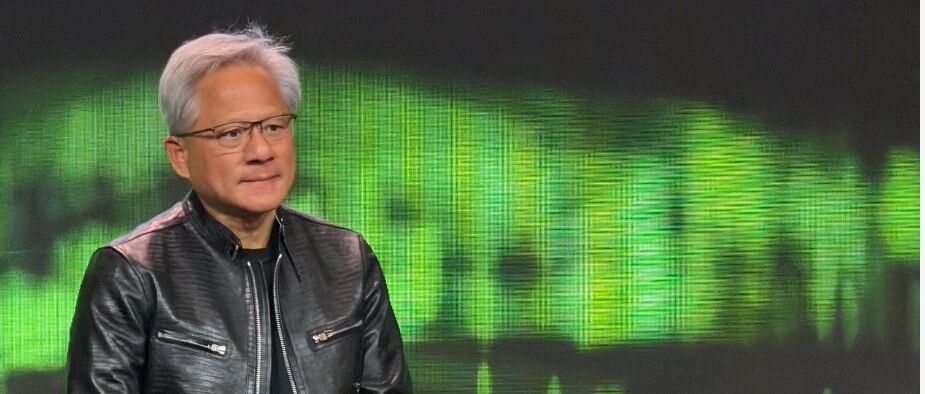
黄仁勋新年首场采访,谈了做CEO的秘诀
第一财经· 2026-01-07 10:47
Core Insights - The article discusses the increasing demand for computing power in the AI sector, with predictions that global computing capacity needs to increase by 100 times in the coming years [3][4] - NVIDIA's CEO Jensen Huang emphasizes the necessity for significant advancements in chip performance and energy efficiency to meet this demand, indicating a shift from traditional semiconductor improvements to a more holistic approach involving entire computing systems [4][8] Group 1: AI Demand and Chip Performance - AMD and NVIDIA executives highlight the exponential growth in model sizes and inference outputs, with NVIDIA's chips achieving 10 times the throughput of previous generations [3][4] - Huang mentions that the performance improvements are becoming increasingly difficult to achieve solely through chip manufacturing processes, necessitating a focus on system-level optimizations [4][8] - The introduction of new architectures like Blackwell and Rubin aims to enhance throughput while reducing costs, with Huang stating that each generation should ideally see a 10-fold increase in throughput and a 10-fold decrease in costs [6][8] Group 2: Energy Efficiency and System Design - Huang points out that energy efficiency is critical for supporting AI development, with a need for sustainable energy sources to power the growing demand [6][7] - The concept of a new "Moore's Law" is introduced, where improved energy efficiency leads to higher revenue through increased token generation without additional power consumption [7][8] - NVIDIA is focusing on collaborative designs that encompass the entire data center, including CPUs, GPUs, and storage systems, to ensure scalability and efficiency [9][10] Group 3: Storage and Ecosystem Investments - Huang discusses the revolutionary changes needed in storage systems to accommodate AI workloads, indicating that NVIDIA may become a leading storage company through partnerships rather than direct manufacturing [11][14] - The company is actively investing in its supply chain, including memory suppliers and ecosystem partners, to ensure a robust infrastructure for AI applications [14][15] - NVIDIA's strategy includes investing in both foundational technologies and emerging startups to enhance its ecosystem and maintain a competitive edge [14][15] Group 4: AI Applications and Future Outlook - The article highlights NVIDIA's expansion into various sectors, including autonomous driving and robotics, with expectations for significant advancements in these areas within the next few years [18][19] - Huang predicts that robots will achieve human-like capabilities this year, addressing labor shortages and driving economic growth through increased automation [20] - The potential for AI to transform gaming is also discussed, with expectations for more realistic character interactions and enhanced gaming experiences [19][20]

连续涨停!多家上市公司紧急回应 多数强调业务尚处早期
Shang Hai Zheng Quan Bao· 2026-01-07 00:44
Core Viewpoint - The brain-computer interface (BCI) sector is experiencing a surge in investor interest, driven by technological breakthroughs and product approvals in China, alongside Elon Musk's announcement of mass production of BCI products by Neuralink within the year [1][3]. Industry Developments - The BCI industry is in a high-growth phase, supported by technological advancements, policy backing, and collaborative expectations within the robotics ecosystem, with projections indicating the global BCI medical application market could reach $40 billion by 2030 and $145 billion by 2040 [3]. - Recent breakthroughs include the first clinical trial of a fully implanted, wireless BCI product by Brain Tiger Technology, which offers hope for patients with severe paralysis [3][4]. Company Responses - Multiple A-share listed companies have responded to the heightened interest in the BCI sector, with announcements detailing their business progress in this area [1][6]. - Xiangyu Medical reported a 44% cumulative increase in stock price, emphasizing its focus on non-invasive BCI technology, while acknowledging that its products have not yet achieved significant sales [6][9]. - Weisi Medical also clarified that its BCI products are in the early market cultivation stage and primarily focus on non-invasive technologies, with limited revenue contribution [9][10]. Strategic Collaborations - Companies are actively forming partnerships to enhance their BCI capabilities. Baiyang Pharmaceutical announced a collaboration with Capital Medical University to establish a joint laboratory focused on neuroscience and BCI research [11]. - Kefu Medical disclosed investments in non-invasive BCI robotics and implantable BCI companies, aiming for business synergy [11]. Technological Innovations - Companies like Sanbo Brain Science are making progress with their BCI technologies, including the development of a flexible microelectrode system for brain signal acquisition [12]. - In the semiconductor sector, companies are producing specialized chips for high-precision measurement of biological signals, which are essential for BCI applications [13]. Market Recognition - Domestic BCI products are gaining international recognition, with Shenzhou Rehabilitation's spinal interface product receiving breakthrough therapy designation from the FDA, marking a significant achievement for Chinese companies in the BCI field [4].
A股迎“开门红”!上证指数重返4000点 沪深北成交额2.57万亿
Sou Hu Cai Jing· 2026-01-05 11:36
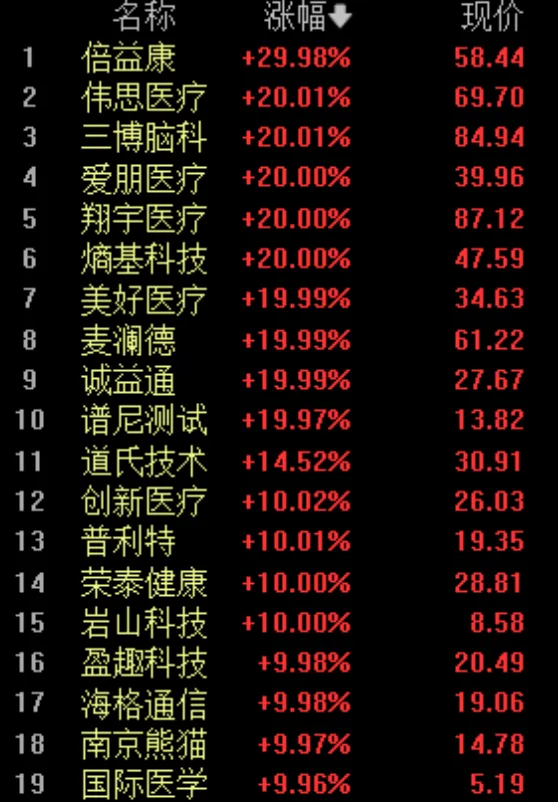
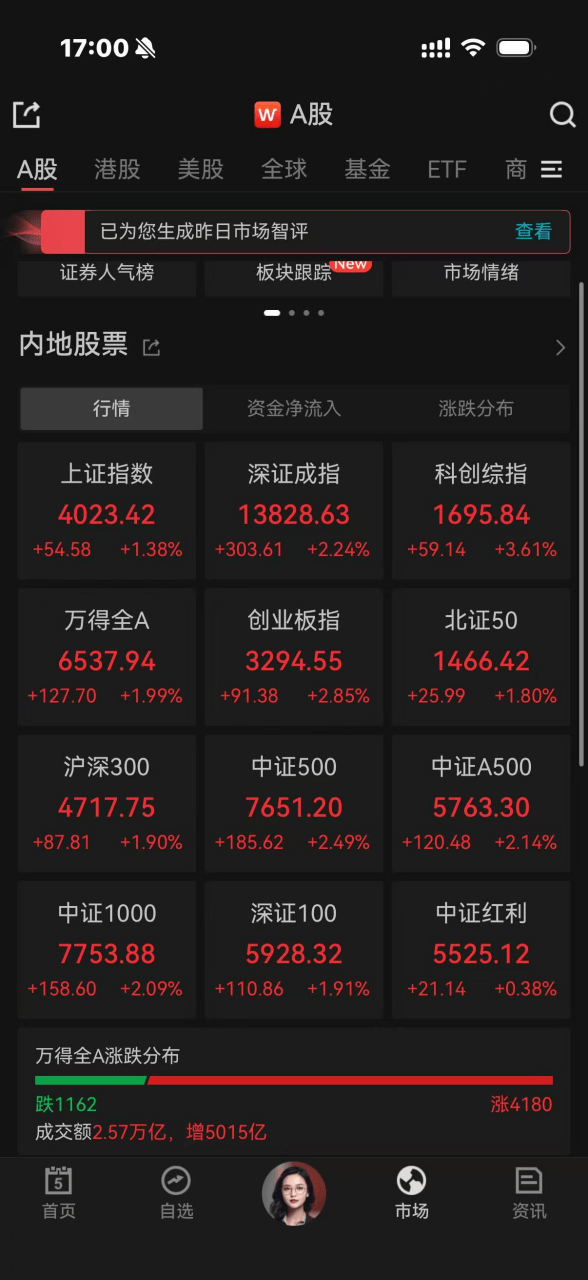
元旦假期后的首个交易日,A股市场迎"开门红",上证指数收复4000点。 1月5日,上证指数高开高走,盘中突破4000点大关,截至收盘,上证指数报4023.42,涨1.38%。Wind 数据显示,A股4180只股票上涨,全市场成交额2.57万亿元,较前一交易日增量5015亿元。 "2026年的行情有望延续自2024年9月份开启的这轮慢牛、长牛行情。"前海开源基金首席经济学家、基 金经理杨德龙指出,2025年大盘一度站上4000点,确立了这轮牛市的走势,在四季度出现了一定回调, 而在元旦之前市场走出11连阳,重新开始上攻,节后延续了上攻走势,大盘再次站上4000点关口,并实 现12连阳,牛市氛围愈发浓厚。 三大指数大幅上涨 "科技牛"行情有望延续 1月5日,A股三大指数均高开高走。截至收盘,沪指涨1.38%报4023点,深证成指涨2.24%,创业板指涨 2.85%。板块方面,脑机接口、创新药、保险、存储芯片、AI应用、军工装备、有色金属板块涨幅靠 前。 1月5日,A股三大指数均大幅上涨。Wind数据截图 盘面上,脑机接口板块全线大涨,创新医疗、岩山科技、三博脑科、南京熊猫、塞力医疗、爱朋医疗、 国际医学、伟思医疗 ...
创业板指涨逾2% 脑机概念掀起涨停潮
Xin Lang Cai Jing· 2026-01-05 03:46
每经AI快讯,1月5日,指数走强,创业板指拉升涨逾2.00%,沪指涨0.90%,深成指涨1.57%。脑机接 口、保险、半导体芯片、贵金属等涨幅居前,沪深京三市上涨个股近4000只。 每经AI快讯,1月5日,指数走强,创业板指拉升涨逾2.00%,沪指涨0.90%,深成指涨1.57%。脑机接 口、保险、半导体芯片、贵金属等涨幅居前,沪深京三市上涨个股近4000只。 ...

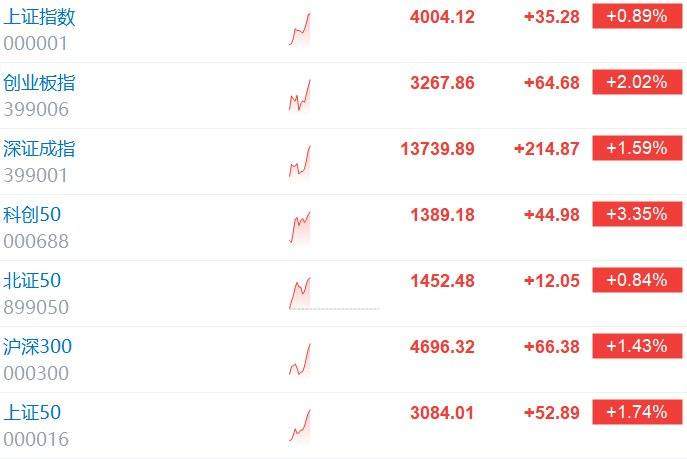
A股三大指数集体拉升!创业板指涨超2%,深成指涨1.59%,沪指涨0.89%,脑机接口板块掀涨停潮,近4000股上涨
Ge Long Hui· 2026-01-05 02:45
| 上证指数 | | 4004.12 | +35.28 | +0.89% | | --- | --- | --- | --- | --- | | 000001 | | | | | | 创业板指 | M | 3267.86 | +64.68 | +2.02% | | 399006 | | | | | | 深证成指 | | 13739.89 | +214.87 | +1.59% | | 399001 | M | | | | | 科创50 | | 1389.18 | +44.98 | +3.35% | | 000688 | | | | | | 北证50 | | 1452.48 | +12.05 | +0.84% | | 899050 | | | | | | 沪深300 | | 4696.32 | +66.38 | +1.43% | | 000300 | N | | | | | F证50 | | 3084.01 | +52.89 | +1.74% | | 000016 | | | | | 格隆汇1月5日|A股主要指数拉升,创业板指涨超2%,深成指涨1.59%,沪指涨0.89%。脑机接口板块 掀涨停潮,保险、半导体芯片 ...
突破“芯”高度!科创芯片设计ETF天弘(认购代码:589073)今日正式首发!
Sou Hu Cai Jing· 2026-01-05 02:36
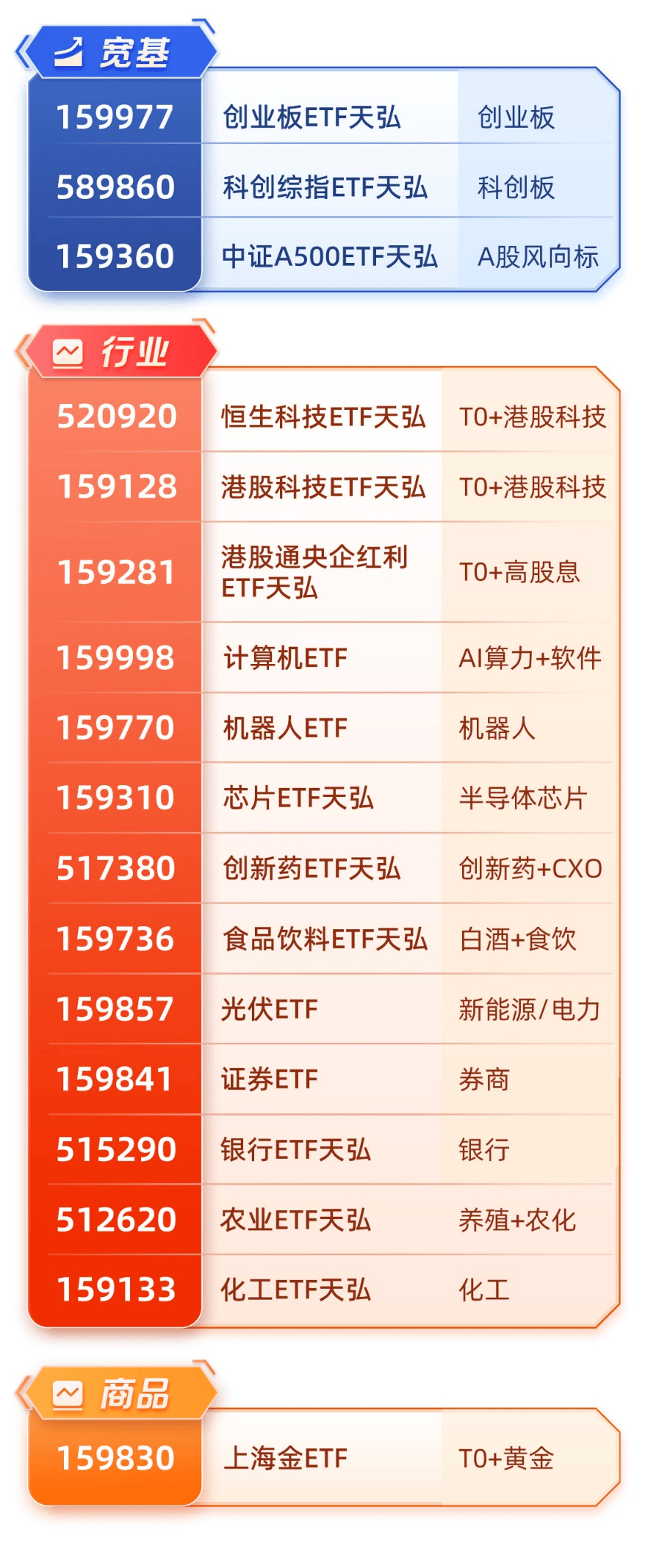
基金公告显示,天弘上证科创板芯片设计主题交易型开放式指数证券投资基金(场内简称:科创芯片设计ETF天弘,认购代 码:589073,基金代码:589070)于今日(1月5日)正式发行! 【产品亮点】 科创芯片设计ETF天弘(589070)紧密跟踪上证科创板芯片设计主题指数,一键跟踪芯片设计领域优质上市公司。选取科创板内业 务涉及芯片设计领域的上市公司证券作为指数样本,以反映科创板芯片设计领域上市公司证券的整体表现。 【更多产品】 | 乙 宽基 | | | | --- | --- | --- | | 159977 | 创业板ETF天弘 | 创业板 | | 589860 | 科创综指ETF天弘 | 科创板 | | 159360 | 中证A500ETF天弘 | A股风向标 | | 网 行业 | | | | 520920 | 恒生科技ETF天弘 Andred PLPT of a Landon annon annon annon annual proven | T0+港股科技 Salandon 17 17 17 | 【热点事件】 创新赋能高质量发展,国产芯片研发与产业规模双突破 二〇二六年新年贺词强调,我们依靠创新为高质 ...
博时基金肖瑞瑾:2026年AI算力仍是投资主线,应用层爆发需待场景深度融合|基遇2026
Sou Hu Cai Jing· 2025-12-31 10:48
更多访谈点击查看《基金佳问》专栏 【编者按】2025年,A股市场迎来里程碑式发展:总市值站上100万亿元的高峰,上证指数涨破4000点创下近十年新高。站在"十五五"规划的开局之年, 2026年A股市场又将如何演绎?哪些行业将孕育新的投资机遇? 搜狐财经《基金佳问》栏目特别推出"基遇2026"专题系列报道,复盘A股市场细分领域年内行情,展望及预测2026年各热门赛道的投资机遇,把握后市资产 配置的主逻辑,寻找具有投资潜力的基金产品。 出品|搜狐财经 作者|汪梦婷 12月31日,在岁末展望之际,博时基金权益投资四部投资副总监、基金经理肖瑞瑾做客搜狐财经直播间,回顾了过去一年A股的结构性行情,并对2026年的 市场走势、风格切换以及备受关注的AI产业投资脉络进行了深度解析。 肖瑞瑾:关键的变量取决于国内外两个因素。国外需要关注美联储的降息周期。目前市场普遍预期明年还有两次降息。如果美联储本轮降息周期结束,可能 意味着货币宽松周期暂时告一段落,这可能导致全球资金配置和市场份额出现一定变化。国内则关键在于房地产数据何时能够企稳甚至回升,以及国内宏观 经济能否在年内触底回升。如果宏观经济触底回升的预期增强,从利率端看,长 ...

管理层大换血、跨界半导体,金字火腿新东家用意何在?
Bei Ke Cai Jing· 2025-12-31 10:01
Core Viewpoint - Jinzi Ham Co., Ltd. is undergoing significant management changes, with the resignation of President Guo Bo and the appointment of Zheng Hu, the son of the new actual controller Zheng Qingsheng, as the new president. The company is attempting to diversify into the semiconductor industry amid slow growth in its core meat products business, raising questions about the effectiveness of this strategy [1][5][9]. Management Changes - The management transition began in April 2025 when former actual controller Ren Guilong transferred 11.98% of his shares to Zheng Qingsheng for 870 million yuan. Zheng Qingsheng became the new controlling shareholder after the share transfer was completed in June 2025 [1][2]. - The new management team was established in July 2025, with Zheng Qingsheng as chairman, Guo Bo as president and vice chairman, and Zheng Hu as vice president [3][4]. Business Diversification - Jinzi Ham has a history of attempting to diversify into various sectors, including e-commerce, new energy vehicles, and healthcare, but these efforts have often resulted in poor performance and have negatively impacted the company's financial results [2][12]. - The company is now focusing on the semiconductor sector, having established two subsidiaries in July 2025 that will engage in integrated circuit design and semiconductor device sales, with Zheng Hu as the legal representative [6][9]. Investment in Semiconductor - In September 2025, Jinzi Ham announced plans to invest up to 300 million yuan in Zhongsheng Microelectronics to acquire up to 20% equity, targeting the optical communication chip sector. Zhongsheng Microelectronics specializes in high-speed optical module core chip design [7][9]. - Despite being recognized as a potential unicorn and having a promising market outlook, Zhongsheng Microelectronics reported only 20,490 yuan in revenue and a net loss of 38.83 million yuan in 2024, raising concerns about the high valuation of the investment, which is estimated at a 9710% premium [8][9]. Financial Performance - Jinzi Ham's revenue for 2024 was 344 million yuan, less than half of its 2020 revenue of 710 million yuan, with a significant decline in net profit. The company's core meat product revenues have also been declining, with various product lines experiencing year-on-year decreases [10][11]. - The company's financial struggles have led to a pattern of cross-industry attempts that often result in minimal returns or losses, highlighting the challenges of balancing core business operations with diversification efforts [12][14].

这类芯片,威胁英伟达
半导体芯闻· 2025-12-31 08:56
Core Viewpoint - The article discusses the evolving role of integrated graphics (iGPU) in the PC market, highlighting its increasing capabilities and competition with discrete graphics (dGPU), particularly in the context of gaming and high-performance applications. [1][2] Group 1: Integrated Graphics Development - Integrated graphics have traditionally been seen as basic display solutions, but advancements have allowed them to handle more demanding tasks, such as gaming and 3D creation [1] - AMD's Phoenix platform introduced the 780M, which enabled laptops without discrete graphics to perform gaming tasks, leading to the development of the Z1 Extreme for Windows gaming handhelds [1] - Intel has maintained a leading market share in integrated graphics but has struggled to match AMD's performance until the introduction of Meteor Lake, which showed competitive capabilities under sufficient power conditions [1] Group 2: Intel's Strategic Response - Intel is responding to the competitive landscape with its Lunar Lake architecture, which, combined with TSMC's N5 process, positions its 140V integrated graphics to challenge AMD's top integrated graphics, the 890M [2] - The upcoming Panther Lake platform is expected to feature the new Xe3 architecture with a 50% increase in core count, potentially rivaling entry-level discrete graphics like the RTX 4050 [2] - This shift could allow users to experience near-gaming laptop performance in lightweight laptops without the drawbacks of heavier designs and noisy fans [2] Group 3: Market Dynamics and Pricing Challenges - Despite advancements, the new generation of integrated graphics may struggle to fully replace discrete graphics due to high production costs and rising prices of memory and SSDs, leading to higher retail prices for laptops [3] - The entry-level gaming laptop market remains highly competitive, with OEMs driving prices down, allowing them to maintain market space despite less impressive specifications [3] - NVIDIA's established presence in gaming and content creation, along with superior software support, continues to provide a competitive edge, even if integrated graphics show improved performance [3]