
肉牛养殖

Search documents
农业板块2025半年报业绩综述:拨云见日
ZHESHANG SECURITIES· 2025-09-15 13:48
Investment Rating - The industry investment rating is "Positive" [3] Core Viewpoints - The report highlights that the agricultural sector is experiencing a recovery, with specific segments such as the pig and beef industries showing signs of improvement. Cost reduction and efficiency enhancement are key drivers for performance improvement in the pig sector, while the beef sector is witnessing a rebound from a cyclical low [6][7][47]. Summary by Sections 1. Pig Industry - The pig sector has shown significant improvement in performance, with 15 listed pig companies achieving a revenue of 196.98 billion yuan in the first half of 2025, a year-on-year increase of 19%. The net profit attributable to shareholders reached 16.33 billion yuan, up 625% year-on-year [9]. - The average pig price has been under pressure, dropping to a low of 13.96 yuan/kg in June 2025. However, leading companies like Muyuan and Wens continue to maintain high profitability per head due to their efficiency advantages [15][42]. - Recommendations include focusing on low-cost, high-certainty leaders such as Muyuan and Wens, as well as high-growth small pig companies like Shennong Group and Juxing Agriculture [7][43]. 2. Beef Industry - The beef sector is experiencing a cyclical recovery, with live cattle prices increasing significantly since mid-February 2025. As of September 8, 2025, the prices for fattened bulls, calves, and cull cows have risen by 2.39, 8.33, and 3.18 yuan/kg respectively [47]. - The report notes that the overall beef market is supported by a trend towards protein upgrading, which is expected to continue despite economic fluctuations [57]. 3. Animal Health Sector - The animal health sector is stabilizing, with a focus on the development of pet business. The rapid release of pet vaccines is anticipated to enhance valuations across companies [7]. 4. Seed Industry - The seed market is shifting from quantity to quality competition, with a focus on superior varieties as the core competitiveness of seed companies. The report emphasizes the importance of resource integration and mergers in the seed industry [7]. Companies with strong variety reserves, such as Dabeinong and Longping High-Tech, are expected to benefit [7].
路德环境子公司亳州路德拟实施增资扩股并引入投资者
Zhi Tong Cai Jing· 2025-09-15 09:58
Core Viewpoint - Lude Environment (688156.SH) announced that its wholly-owned subsidiary, Lude Biological Environmental Technology (Bozhou) Co., Ltd. (referred to as "Bozhou Lude"), plans to implement a capital increase and introduce investors, which will enhance its operational funds and improve its asset-liability structure [1] Group 1: Investment Details - Bozhou Ketu Investment Fund will contribute 20 million RMB to subscribe for an additional registered capital of 20 million RMB in Bozhou Lude [1] - Bozhou Life and Health Industry Fund will contribute 10 million RMB to subscribe for an additional registered capital of 10 million RMB in Bozhou Lude [1] - The company will waive its preemptive subscription rights for this capital increase [1] Group 2: Strategic Implications - The Bozhou Ketu Investment Fund primarily invests in high-tech fields such as biomedicine, focusing on advanced technological achievements in Bozhou [1] - The Bozhou Life and Health Fund mainly invests in modern medicine, traditional Chinese medicine, and medical devices, targeting the health industry in Bozhou [1] - The introduction of these funds will deepen cooperation with Anhui Gujing Distillery (000596) and local liquor companies regarding distiller's grains, while also leveraging the "Three Sevens Hundred" goal of revitalizing the beef cattle industry in Bozhou to expand into the Central Plains beef cattle breeding market [1]

四季度展望:风格切换,逢低布局大盘蓝筹
Haitong Securities International· 2025-09-07 12:03
The provided content does not contain any specific quantitative models or factors, nor does it include detailed construction processes, formulas, or backtesting results related to quantitative analysis. The document primarily discusses macroeconomic trends, sectoral outlooks, and investment strategies without delving into quantitative methodologies. If you have another document or specific section that includes quantitative models or factors, please provide it for analysis.
江西农业大学食品科学与工程学院暑期三下乡:将“行走的课堂”搬到田间地头
Zhong Guo Shi Pin Wang· 2025-08-25 07:41
Group 1 - The core viewpoint emphasizes the importance of food safety education and hands-on agricultural experience in rural revitalization efforts [2][3][5] - The practice team utilized a dual approach of "food safety education + household surveys" to effectively communicate food safety knowledge to local residents [2][3] - The initiative included addressing health concerns of the elderly, particularly chronic diseases, and promoting healthy eating habits [2][3] Group 2 - The practice team engaged in agricultural activities, such as rice seedling thinning and weed removal, to gain firsthand experience of farming challenges [4][5] - The collaboration with Jiangxi Shenglong Cattle Industry Group highlighted the integration of academic research with industry practices, focusing on beef cattle technology and product development [4] - The experience allowed team members to deepen their understanding of agricultural realities and the significance of food production [4][5]
宁夏中卫:金融积极支持海原肉牛产业发展
Jin Rong Shi Bao· 2025-08-21 04:56
Core Insights - The meat cattle industry in Haiyuan County is crucial for rural revitalization and increasing farmers' income, experiencing rapid growth due to rising market demand and policy support [1][2] - Financial institutions are focusing on the financing needs of the meat cattle industry, enhancing credit products and services to facilitate industry transformation and upgrading [1][2] Group 1: Industry Development - As of June 2025, Haiyuan County has seen a meat cattle output of 49,900 heads, representing an 18.2% year-on-year increase [1] - The loan balance for the meat cattle industry reached 1.63 billion yuan, accounting for 16% of the agricultural loan balance in Haiyuan County and 38.10% of the total meat cattle loans in Zhongwei City [1] Group 2: Financial Support Mechanisms - The People's Bank of China in Zhongwei City has guided local financial institutions to create a whitelist system for meat cattle farmers, allowing prioritized credit approval and interest rate discounts [2] - Haiyuan Rural Commercial Bank has issued 1.306 billion yuan in loans for the meat cattle industry, making up 19.28% of its total loans [2] Group 3: Tailored Financial Products - Financial institutions have developed specialized credit products for the meat cattle industry, such as "Smart Livestock Loan" and "Agricultural Benefit e-Loan," optimizing loan amounts, terms, and interest rates [4] - Agricultural Bank of Haiyuan has implemented a "5+X" credit model to support impoverished households in expanding production, providing additional credit beyond the initial 50,000 yuan loan [4] Group 4: Risk Management and Insurance - The Haiyuan County government has established a special guarantee fund to support financing for meat cattle enterprises and farmers, offering risk compensation for qualifying guarantee businesses [5] - Insurance companies have expanded coverage for meat cattle insurance, developing products for different growth stages to mitigate risks in the breeding process [5]




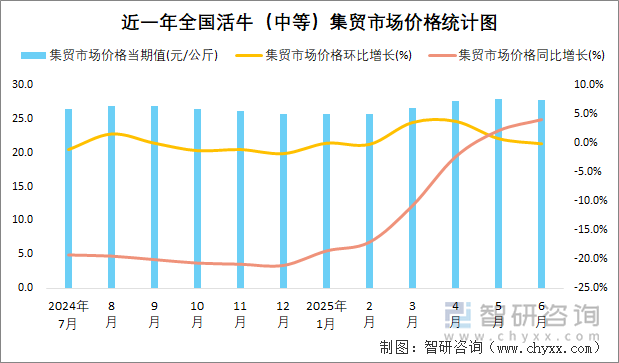
2025年6月全国活牛(中等)集贸市场价格当期值27.82元/公斤,同比增长4.1%
Chan Ye Xin Xi Wang· 2025-08-15 03:28
Price Trends - The national market price for medium live cattle in June 2025 is 27.82 yuan per kilogram, which represents a decrease of 0.03 yuan per kilogram compared to May 2025 [1] - The month-on-month decline is 0.1%, with a reduction of 0.9 percentage points in the rate of decline [1] - Year-on-year, the price has increased by 4.1%, with an increase of 1.9 percentage points in the growth rate compared to the previous year [1]
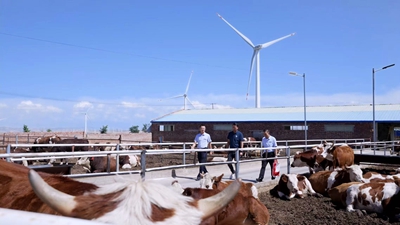
我国自主培育的华西牛市场占有率超过20%
Xin Hua Wang· 2025-08-12 06:09
Core Insights - The market share of the domestically bred beef cattle breed, Huaxi Cattle, has exceeded 20% in China [1] - The Huaxi Cattle breed, developed over 43 years, has established itself as the first internationally competitive beef cattle breed in China, reducing reliance on imported core breeding sources [1] - The sixth National Bull Auction held in Inner Mongolia showcased the achievements of China's beef cattle breeding industry, with a total auction amount of 16.715 million yuan, of which Huaxi Cattle accounted for 13.675 million yuan [1] Industry Developments - The auction featured 73 quality bulls, with 62 sold, indicating strong interest and participation from various breeding farms and cooperatives across the country [1] - China's beef consumption market is on the rise, with beef production expected to reach 7.79 million tons in 2024, representing 8.1% of total meat production [1] - The proportion of large-scale beef cattle farming (50 or more cattle) is approaching 50% nationally, reflecting significant progress in the beef cattle industry [1] Future Outlook - Zhang Junmin emphasized the need for collaboration and innovation within the industry to enhance breeding, promotion, and application systems, aiming for high-quality development of the beef cattle industry [2]
“一链一策”助特色产业高质量发展
Jin Rong Shi Bao· 2025-08-12 02:34
Group 1 - The core viewpoint emphasizes the role of financial support in enhancing the quality and efficiency of local agricultural industries, particularly in the context of the "one county, one industry, one product" initiative [1][2] - The financial institutions in Pingliang have issued a total of 6.15 billion yuan in loans to the Pingliang beef industry, benefiting 20,000 enterprises, cooperatives, and farmers [2] - The value of the Jingning apple brand has surpassed 18 billion yuan, showcasing its significance in the Gansu apple export market [2][3] Group 2 - The digital cloud platform for the Jingning apple industry has integrated 34 core enterprises and 7,155 quality fruit farmers, facilitating online transactions worth 22.99 million yuan [3] - Financial institutions have issued 11.96 billion yuan in loans to the Jingning apple industry, benefiting 24,000 fruit enterprises, cooperatives, and farmers [3] - The "cooperative + base + farmer" service model has created over 1,000 jobs by supporting the establishment of greenhouses and agricultural parks [3] Group 3 - The introduction of the "Chinese herbal medicine industry loan" has helped local enterprises upgrade their processing equipment, significantly improving product quality [4] - The area planted with Chinese medicinal materials has exceeded 120,000 acres, indicating growth in the local herbal medicine industry [4] - Financial institutions have issued 1.42 billion yuan in loans to the traditional Chinese medicine industry, benefiting 2,134 enterprises, cooperatives, and farmers [4]
农业的“新”周期和“大”趋势
2025-08-11 14:06
Summary of Key Points from the Conference Call Industry Overview - The conference call primarily discusses the **agriculture industry**, focusing on **animal protein sectors** such as **pig farming**, **dairy farming**, and **beef cattle farming** [1][2][34]. Core Insights and Arguments Pig Farming - The **pig farming cycle** is driven by production capacity, with the number of breeding sows being a critical leading indicator. This needs to be cross-verified with data on sow feed sales [1][2]. - The **African swine fever** has normalized, raising the industry's cost base, which affects the peak and elasticity of the cycle [1][4]. - **Scale farming** may extend the pig cycle and amplify price fluctuations. Secondary fattening increases price disturbances, influenced by short-term price expectations [1][5]. - The **反内卷 (anti-involution) policy** aims to reduce the number of breeding sows and lower slaughter weights to support pig prices [1][11]. - The average price of pigs is expected to rise to over **16 RMB per kilogram** by **2026**, with **牧原股份 (Muyuan Food)** potentially achieving a profit of nearly **500 RMB per head** [1][14]. Dairy Farming - The dairy industry faces challenges due to falling milk prices, currently around **3 RMB per kilogram**, down from **4.5 RMB**. However, there is potential for demand improvement due to increased willingness to have children and government subsidies for newborns [1][17]. - The beef cattle sector has a long growth cycle and is heavily reliant on imports, with significant industry clearing observed [1][18][20]. Market Dynamics - The **white chicken farming** sector is significantly impacted by overseas breeding policies, with potential for market share growth for **圣农 (Sannong)** during periods of import disruption [3][25]. - The **seafood feed** segment is expected to improve due to rising prices of common aquatic products, with **海大集团 (Haida Group)** showing strong performance in this area [3][27]. Other Important Insights - The **agricultural new consumption trends** include rapid growth in pet food and pet healthcare sectors, indicating new growth potential beyond traditional areas [6][34]. - The **agricultural input products** like feed and veterinary products serve as lagging indicators in the animal protein supply chain, aiding in capacity data assessment [7][34]. - The **grain security** theme is increasingly important, with policies and market dynamics needing close attention [8][30]. Investment Recommendations - Focus on core assets like **牧原 (Muyuan)** and **温氏 (Wens Food)**, which have strong cost control and are less affected by the anti-involution policy [12][13]. - The **港股 (Hong Kong stock market)** upstream livestock companies are currently in a challenging phase but are expected to improve by **2026** as the new cycle begins [22]. - **海大集团 (Haida Group)** is recommended for its strong market position and growth potential in both domestic and international markets [27]. Future Trends - The pig farming sector is expected to benefit from the anti-involution policy, leading to a new upward price cycle in **2026** [15][34]. - The **meat cattle industry** is facing significant challenges, including price declines and industry losses, with a low degree of scale [20][21]. This summary encapsulates the key points discussed in the conference call, providing insights into the current state and future outlook of the agriculture industry, particularly in the animal protein sectors.


探索建立肉牛和马铃薯产业动态监测机制
Jin Rong Shi Bao· 2025-08-08 07:58
Core Viewpoint - The People's Bank of China (PBOC) in Guyuan City is enhancing its monitoring and analysis of key industries, specifically focusing on the beef cattle and potato sectors, to improve the effectiveness of monetary policy and promote high-quality development in these industries [1][2]. Group 1: Industry Monitoring Mechanism - The PBOC has established a long-term dynamic monitoring mechanism for the beef cattle and potato industries, aiming to enhance the systematic, holistic, and coordinated analysis of these sectors [1]. - A collaborative monitoring network has been created involving 15 financial institutions in Guyuan City, which will focus on key processing and sales enterprises as well as agricultural households [2]. - The monitoring will cover various aspects of the industry, including raw material supply, production processing, and market sales, forming a statistical monitoring index system for future policy-making [2]. Group 2: Data Analysis and Research - The PBOC is developing a regular and scientific data analysis mechanism, considering key economic indicators such as costs, income, and profits, as well as social indicators like loan conditions and employment [3]. - The bank is employing part-time investigators to conduct on-site surveys and is collaborating with government departments to obtain authoritative data on industry output and product prices [3]. - Over 40 key monitoring indicators are being analyzed using various statistical methods to identify trends and issues within the industry, enhancing the foresight and targeted nature of the monitoring [3]. Group 3: Results Sharing and Policy Recommendations - The PBOC is building a platform for data monitoring, analysis, and research to address potential issues in the industry and provide actionable policy recommendations [4]. - The bank has produced several high-quality analytical reports based on monitoring data, which have informed local government and central bank decision-makers [4]. - Key findings from these reports highlight challenges faced by the beef cattle industry, such as declining prices and financial risks, which are crucial for informed decision-making [4].