
锂离子电池

Search documents
7月中国工业生产较快增长 工业机器人产量同比增逾两成
Zhong Guo Xin Wen Wang· 2025-08-15 08:00
Core Insights - In July, China's industrial added value for large-scale enterprises grew by 5.7% year-on-year, indicating sustained rapid growth [1] - The manufacturing sector's added value increased by 6.2% year-on-year, outpacing the overall industrial growth [1] - High-tech manufacturing added value rose by 9.3% year-on-year, with significant growth in integrated circuits and electronic materials, which increased by 26.9% and 21.7% respectively [1] - The production of green and low-carbon products saw substantial growth, with new energy vehicles, lithium-ion batteries, and wind turbine generators increasing by 17.1%, 29.4%, and 19.3% year-on-year [1] - The digital and intelligent product manufacturing sector experienced an 8.4% year-on-year increase, driven by advancements in artificial intelligence and robotics [1] - The shipbuilding and related equipment manufacturing sector saw a remarkable 29.7% increase in added value, while electric motor manufacturing grew by 15.9% [2] - The consumption upgrade policy led to a 45.3% increase in electric bicycle production and an 8.1% increase in 5G smartphone production [2]

向新、向好、向未来!一组数据见证中国经济“含新量”
Yang Shi Xin Wen Ke Hu Duan· 2025-08-15 07:24
Core Insights - China's new quality productivity is steadily growing, contributing to high-quality development and injecting new momentum into the economy [1][5] Group 1: Technological Advancements - In 2024, China's R&D expenditure is expected to exceed 3.6 trillion yuan, with an intensity of 2.68%, surpassing the EU and approaching OECD averages [1] - High-tech industries are experiencing rapid growth, with the value added in the integrated circuit manufacturing and electronic materials sectors increasing by 26.9% and 21.7% year-on-year in July [2] - The digital economy is expanding quickly, with the value added in the digital product manufacturing sector growing by 8.4% year-on-year in July [3] Group 2: Green Development - In July, the production of new energy vehicles and lithium-ion batteries increased by 17.1% and 29.4% year-on-year, respectively [4] - The production of green materials such as carbon fiber and bio-based chemical fibers grew by 43.8% and 19.8% year-on-year [4] - The comprehensive utilization of waste resources saw a year-on-year increase of 11.7% in July [5] Group 3: Investment Trends - Investment in aerospace and equipment manufacturing increased by 33.9% year-on-year from January to July, while investment in computer and office equipment manufacturing grew by 16% [6] - The service sector, particularly in information services and R&D, is also experiencing significant growth, with double-digit revenue increases reported [8] Group 4: Economic Resilience - From January to July, the total retail sales of consumer goods grew by 4.8% year-on-year, indicating stable consumer demand [8] - Despite challenges, China's foreign trade remains resilient, with a 7.3% increase in goods exports during the same period [8][12] - The contribution rate of final consumption expenditure to economic growth reached 52% in the first half of the year, an increase of 7.5 percentage points compared to the previous year [11] Group 5: Policy Impact - The implementation of proactive macroeconomic policies has effectively stimulated production demand and supported stable economic growth [13][14] - The construction of a unified national market and the promotion of integrated domestic and international trade are expected to enhance economic vitality [12]
发布会纪要|消费趋势、反内卷成效......国家统计局最新回应
Di Yi Cai Jing· 2025-08-15 06:06
Group 1: Economic Overview - The trend of expanding consumption in China remains unchanged, with new consumption drivers continuing to grow [1] - Despite facing risks and challenges, the long-term positive support conditions and basic trends of the economy have not changed [1] - The macroeconomic policies are showing effectiveness, with market demand expanding and new productive forces developing [1] Group 2: Export Growth - China's exports are expected to grow in the second half of the year due to several favorable conditions, including the diversification of foreign trade and enhanced competitiveness of export products [2] - The overall stability of consumer prices in July indicates positive changes, although the market still faces weak demand [2] - Policies aimed at expanding domestic demand and promoting a unified national market are expected to continue yielding positive effects [2] Group 3: Investment Landscape - Investment in China continues to expand, with structural optimization, although there are temporary pressures on investment growth [3] - There is significant potential for investment, as per capita capital stock remains lower compared to developed countries [3] - Efforts to promote a unified national market and optimize the investment environment are crucial for stimulating private investment and expanding effective investment [3] Group 4: Green Development - China is focusing on creating new growth areas in green development, achieving significant results with an increasing "green content" in economic development [4] - In July, production of new energy products such as electric vehicles and lithium-ion batteries saw year-on-year growth of 17.1% and 29.4%, respectively [4] Group 5: Industrial Production - Industrial production remained stable in July, with ongoing improvements in development quality, despite external complexities and pressure on industrial profits [5] - There are favorable conditions for the positive development of industrial production, emphasizing the need to expand domestic demand and strengthen innovation [5]


发布会纪要|消费趋势展望、反内卷成效......国家统计局最新回应
Di Yi Cai Jing· 2025-08-15 04:12
Group 1 - The trend of expanding consumption remains unchanged, with a solid foundation for reasonable price recovery [1][7] - The macroeconomic policies are showing effectiveness, supporting stable economic operation and improving development quality [5][9] - There are favorable conditions for export growth in the second half of the year, including diversification of foreign trade and enhanced competitiveness of export goods [6][10] Group 2 - The overall stability of consumer prices in July indicates positive changes, although supply remains strong and demand weak [7][8] - The governance of disorderly competition among enterprises is improving market supply-demand relationships, leading to positive price changes [8][9] - Investment growth faces temporary pressures, but there is still significant potential for investment expansion, especially in new productive forces and urban-rural coordination [10][12] Group 3 - The focus on green development is creating new growth points, with significant increases in the production of new energy products [12][13] - Industrial production remains stable, but challenges persist in certain sectors, necessitating a push for innovation and transformation in traditional industries [13]

国家统计局:着力打造绿色发展新的增长极 经济发展“含绿量”不断提升
Zheng Quan Shi Bao Wang· 2025-08-15 03:15
Core Viewpoint - The Chinese government is focusing on green development as a new growth driver, achieving significant results in enhancing the "green content" of economic development [1] Industry Summary - In July, the production of new energy products such as electric vehicles and lithium-ion batteries increased by 17.1% and 29.4% year-on-year, respectively [1] - The production of green materials, including carbon fiber and bio-based chemical fibers, saw year-on-year growth of 43.8% and 19.8% [1] - The green transition has created favorable opportunities for the development of the green circular economy, with the added value of waste resource utilization industry increasing by 11.7% year-on-year in July [1]
深圳参与制定3000余项国际标准
Ren Min Wang· 2025-08-07 02:13
Core Viewpoint - Shenzhen has become a hub for innovative companies like Huawei, BYD, and DJI, excelling in both domestic and international markets through active participation in the formulation of international standards [20][21]. Group 1: International Standards Participation - As of the end of 2024, Shenzhen enterprises have participated in the formulation of 3,379 international standards, covering various industries such as photovoltaics, drones, gene testing, and graphene [20]. - The company BetterRay has maintained a leading position in the lithium-ion battery anode material sector for over a decade and is a major supplier to well-known battery manufacturers like CATL [20]. - BetterRay's involvement in international standard formulation was catalyzed by a critical email that prompted them to engage in the process [20][21]. Group 2: Technological Innovations - The graphene international standard initiated by BetterRay was officially established in 2017 and filled a significant gap in the field [22]. - Meituan's drone delivery service exemplifies the need for advanced perception and obstacle avoidance capabilities in complex urban environments, leading to the establishment of international standards in this area [22][23]. - The international standard for drone perception and obstacle avoidance systems was officially published in May 2023, following collaborative efforts between Chinese and Japanese teams [23]. Group 3: Supportive Ecosystem - Shenzhen's success in international standard formulation is attributed to strong support in policies, funding, and talent, fostering an ecosystem that prioritizes standards [25]. - BYD's participation in the global technical regulations for electric vehicle safety was recognized at the United Nations World Forum, showcasing China's leadership in international standardization [24]. - Huawei contributed nearly 12,000 standard proposals to global standard organizations in 2023, demonstrating its active role in shaping industry standards [24].

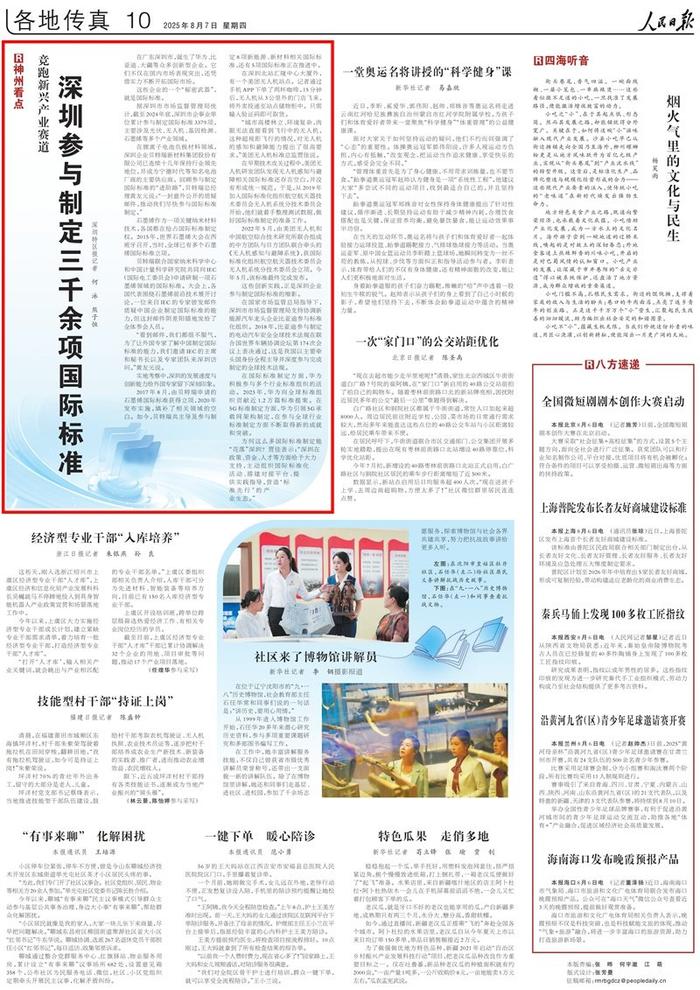
深圳参与制定三千余项国际标准(神州看点)
Ren Min Ri Bao· 2025-08-06 22:49
Core Insights - Shenzhen has become a hub for innovative companies like Huawei, BYD, and DJI, excelling in both domestic and international markets through participation in international standard-setting [1] Group 1: International Standards Participation - As of the end of 2024, Shenzhen enterprises have participated in the formulation of 3,379 international standards, covering industries such as photovoltaics, drones, genetic testing, and graphene [1] - Better Ray New Materials Group has maintained a leading position in the lithium-ion battery anode materials sector and is a major supplier to well-known battery manufacturers like CATL [1] - The push for Better Ray to participate in international standard-setting was catalyzed by a critical email questioning Chinese companies' capabilities, which inadvertently reached all conference attendees [2][1] Group 2: Drone Technology Standards - Better Ray's application for an international standard in graphene was approved in 2017, and the standard was implemented in 2020, filling a gap in the field [3] - Meituan's drone delivery service highlights the need for advanced perception and obstacle avoidance capabilities, leading to the identification of gaps in existing international standards [3] - In May 2022, a joint team from Meituan and the China Aviation Industry Corporation led the establishment of an international standard for drone perception and obstacle avoidance systems, which was completed in May 2023 [4] Group 3: Support for Standardization - Shenzhen's market supervision bureau has supported leading enterprises like BYD in participating in standardization organizations, resulting in the approval of global technical regulations for electric vehicle safety [5] - Huawei has actively contributed to global standard organizations, submitting nearly 12,000 standard proposals in 2023 and leading the development of 5G standards [5] - The conducive environment in Shenzhen, characterized by strong policy support, funding, and talent, has fostered a "standard-first" industrial ecosystem [5]


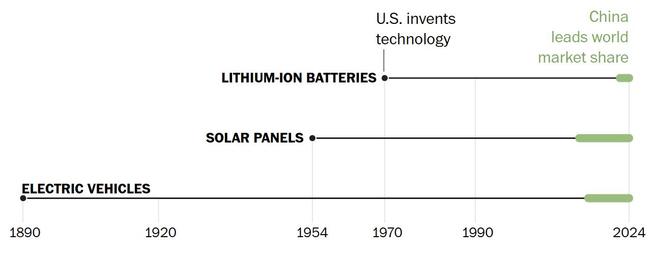
美学者哀叹:到底怎么输给中国的,回看60年就知道了
Guan Cha Zhe Wang· 2025-08-01 04:22
Core Insights - China's goods trade import and export value reached a historical high of 21.79 trillion yuan in the first half of the year, with electric vehicles, lithium-ion batteries, and solar cells becoming key export products [1] - The export value of electromechanical products was 7.8 trillion yuan, a year-on-year increase of 9.5%, accounting for 60% of total exports [1] - The growth of high-end equipment related to new productivity exceeded 20%, while the "new three items" products grew by 12.7% [1] Group 1: Market Dynamics - U.S. media expressed complex emotions regarding China's dominance in clean energy technologies, which originated in the U.S. but are now led by China [1] - Experts attribute China's success to stable policies and strong promotion of new technology applications [1][2] - The U.S. has struggled with policy inconsistency, while China has maintained stable policies that have allowed it to surpass the U.S. in these sectors [1] Group 2: Electric Vehicles - The U.S. began large-scale electrification of vehicles in the 1930s, but the existing gasoline distribution network favored gasoline engines [4] - California's regulations in the 1990s briefly promoted electric vehicles, but the focus shifted back to traditional fuel vehicles [4][5] - China invested heavily in electric vehicles, with approximately $231 billion spent on promoting electric vehicle adoption, resulting in a significant increase in sales from 1,000 units in 2010 to 6.4 million units last year [5] Group 3: Lithium-Ion Batteries - The first functional lithium-ion battery was invented in the 1970s in the U.S., but the lack of market support led to the failure of early U.S. battery companies [7] - China invested heavily in battery technology and supply chain stability, leading to a significant increase in production capacity [8] - Currently, China holds 85% of global battery cell production capacity, with 94% of the market share in lithium iron phosphate batteries [8] Group 4: Solar Cells - The U.S. was a pioneer in solar cell technology but retreated from the market in the 1980s due to policy shifts favoring traditional energy sources [11][12] - China capitalized on the demand for solar cells in the early 2000s, investing $50 billion in solar power production capacity [13] - Currently, eight of the top ten solar panel manufacturers are based in China, reflecting its dominance in the global solar supply chain [13] Group 5: Export Performance - The "new three items" have become a new hallmark of China's foreign trade, with exports showing remarkable resilience despite trade tensions [16] - In the first four months of 2025, the total import and export value of the "new three items" reached $49.35 billion, a year-on-year increase of 3.1% [16] - The export proportions of lithium-ion batteries, electric vehicles, and solar cells were 45.1%, 36.7%, and 18.2%, respectively, with lithium-ion batteries and electric vehicles seeing increases in their export shares [17]
可再生能源vs化石燃料,谁将主导未来?
天天基金网· 2025-07-30 11:30
Core Viewpoint - The article highlights the contrasting paths of China and the United States in the renewable energy sector, with China leading significantly in renewable energy capacity and technology while the U.S. continues to invest heavily in fossil fuels [1][3][7]. Renewable Energy Capacity - In 2024, China's total power generation is projected to reach 10,073 TWh, compared to the U.S. at 4,387 TWh, showcasing China's dominance in renewable energy projects [1][3]. - China's renewable energy accounts for 34% of its total power generation, while the U.S. stands at 24% [1][3]. - Specific renewable energy capacities show China leading in solar (834 TWh vs. 303 TWh), wind (992 TWh vs. 453 TWh), hydro (1354 TWh vs. 236 TWh), and biomass (208 TWh vs. 47 TWh) [2]. Electric Vehicle Market - China exported electric vehicles worth $38 billion in the previous year, three times more than Tesla's annual exports of approximately $12 billion [4]. - The market share of electric vehicles in China has surpassed 50% and is expected to exceed 60% by the end of the year [6]. - The U.S. electric vehicle market is hindered by low charging infrastructure and unstable subsidy policies, while China is rapidly expanding its charging network [4][6]. Battery Technology - China dominates the lithium-ion battery market, with exports reaching $65 billion, which is 22 times that of the U.S. [4][6]. - The article emphasizes that the country with battery manufacturing capabilities will gain significant economic and geopolitical advantages, with China currently being the only winner in this domain [6]. Policy and Strategic Direction - The U.S. is focusing on reviving fossil fuel industries, while China is committed to renewable energy development, as evidenced by significant investments in solar, wind, and hydro projects [3][7]. - Historical patterns show that U.S. energy policies have fluctuated with political changes, while China maintains a consistent long-term strategy for renewable energy [8][10]. Global Influence - China is expanding its influence in the global renewable energy market by investing in projects across various countries, including Hungary, Saudi Arabia, and Indonesia [10]. - The article notes that most countries are not following the U.S. fossil fuel path, instead opting for renewable energy investments, which aligns with China's growing global influence [10].


9.5% 创新动能加快积聚
Jing Ji Ri Bao· 2025-07-21 22:04
Group 1: Economic Growth and Innovation - The added value of high-tech manufacturing in China increased by 9.5% year-on-year in the first half of the year, contributing 23.3% to the overall industrial growth [1] - R&D expenditure as a percentage of GDP in China has approached 2.7%, surpassing the EU average and nearing the OECD average [2] - The number of effective invention patent applications in China reached nearly 5 million in the first five months, growing by 12.8% [2] Group 2: Technological Advancements - Significant technological achievements include the launch of DeepSeek model, amphibious firefighting aircraft AG600 receiving certification, and advancements in quantum computing and nuclear fusion [2][3] - The number of national-level manufacturing innovation centers has reached 33, supporting the industrialization of technological achievements [2] Group 3: Industry Transformation - The structure of the economy is steadily adjusting, with high-tech manufacturing and high-tech service investments growing by 9.5% and 8.6% respectively [4] - The production of industrial robots increased by 32% year-on-year, and the added value of smart vehicle equipment manufacturing grew by 26.8% [4] Group 4: Green Development - The production of new energy vehicles, lithium-ion batteries for vehicles, and solar batteries increased by 36.2%, 53.3%, and 18.2% respectively in the first half of the year [4] Group 5: Financial Support for Innovation - The total amount of loans for technological innovation and technological transformation reached 1.7 trillion yuan, 1.9 times that of the end of last year [7] - A new "technology board" in the bond market has been established to promote the construction of a technology finance system [6][7]