家用电器

Search documents
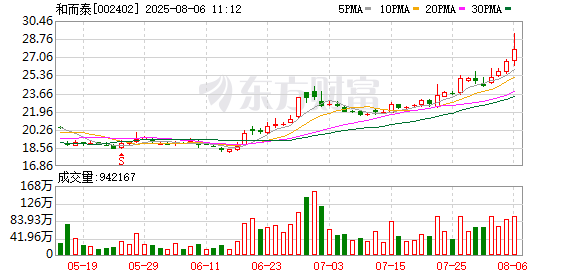
和而泰涨4.61%,股价创历史新高
Zheng Quan Shi Bao Wang· 2025-08-06 03:12
和而泰股价创出历史新高,截至9:51,该股上涨4.61%,股价报27.89元,成交量3120.68万股,成交金额 8.45亿元,换手率3.87%,该股最新A股总市值达257.93亿元,该股A股流通市值224.75亿元。 证券时报·数据宝统计显示,和而泰所属的家用电器行业,目前整体涨幅为0.20%,行业内,目前股价上 涨的有40只,涨幅居前的有和晶科技、爱仕达、和而泰等,涨幅分别为6.38%、6.01%、4.61%。股价下 跌的有62只,跌幅居前的有彩虹集团、荣泰健康、倍益康等,跌幅分别为4.76%、2.64%、2.30%。 公司发布的一季报数据显示,一季度公司共实现营业收入25.85亿元,同比增长30.44%,实现净利润 1.69亿元,同比增长75.41%,基本每股收益为0.1831元,加权平均净资产收益率3.55%。 7月11日公司发布上半年业绩预告,预计实现净利润3.27亿元至3.66亿元,同比变动区间为 65.00%~85.00%。(数据宝) (文章来源:证券时报网) 两融数据显示,该股最新(8月5日)两融余额为18.40亿元,其中,融资余额为18.35亿元,近10日增加 1.21亿元,环比增长7.04 ...


轻工行业积极推进绿色低碳循环发展战略
Xiao Fei Ri Bao Wang· 2025-08-06 02:52
Group 1 - The central government of China has elevated the construction of a green, low-carbon, and circular development economic system to a national strategy, emphasizing the need to improve the green development standard system [1] - The National Development and Reform Commission, along with other ministries, has initiated a plan to support the establishment of zero-carbon parks, aiming for a step-by-step transition towards low-carbon and zero-carbon modifications in various parks and enterprises [1] - The China Light Industry Federation plans to enhance the green product standards, certification, and labeling system during the 14th Five-Year Plan period, aiming to select 100 benchmark enterprises in green manufacturing [1] Group 2 - Various light industry organizations and enterprises are actively responding to national calls by developing relevant standards and conducting training courses to establish a unified carbon footprint management system [2] - The China Lighting Electrical Association has released three group standards for carbon footprint accounting related to lighting products, while other associations have also published standards for household appliances, bicycles, and paper products [2] - The China Plastics Processing Industry Association has organized training sessions for professionals in carbon footprint evaluation and carbon asset management [2] Group 3 - The China Light Industry Information Center is exploring the use of information technology to implement carbon footprint accounting in the light industry [3] - Carbon labeling is identified as a core tool for quantifying the carbon emissions of products throughout their lifecycle, facilitating the identification of emission reduction points in the industrial chain [3] - The China Light Industry Information Center has issued a call for light industry enterprises to establish a carbon labeling system, promoting the construction of standard systems and service platforms to support the green and digital transformation of the industry [3]
426只个股流通市值不足20亿元
Zheng Quan Shi Bao Wang· 2025-08-06 01:36
| 001300 | 三柏硕 | 8.71 | 32.08 | 122.90 | 轻工制造 | | --- | --- | --- | --- | --- | --- | | 301388 | 欣灵电气 | 8.81 | 33.00 | 221.40 | 电力设备 | | 301222 | 浙江恒威 | 8.90 | 30.76 | 36.88 | 电力设备 | | 301429 | 森泰股份 | 8.96 | 24.05 | 32.90 | 建筑材料 | (文章来源:证券时报网) 具体来看,目前两市流通市值最小的前3只股票分别为*ST紫天4.40亿元、利仁科技5.99亿元、博菲电气 6.10亿元。总市值最小的前3只股票分别为*ST紫天4.44亿元、*ST元成7.46亿元、*ST苏吴8.03亿元。 (数据宝) 流通市值低于20亿元部分个股一览 | 证券代码 | 证券简称 | 流通市值(亿元) | 总市值(亿元) | 市盈率(倍) | 申万行业 | | --- | --- | --- | --- | --- | --- | | 300280 | *ST紫天 | 4.40 | 4.44 | 39.34 | 传媒 ...

养老金二季度现身3只股前十大流通股东榜
Zheng Quan Shi Bao Wang· 2025-08-06 01:31
财报披露季,机构最新持股动向逐渐明朗。二季度末养老金账户出现在宏发股份、东睦股份、海信家电 前十大流通股东榜。 基本养老保险基金八零七组合、基本养老保险基金一五零二二组合为宏发股份第九、第七大流通股东, 合计持股量为2822.27万股,占流通股比例1.93%。基本养老保险基金一二零五组合为东睦股份第六大流 通股东,持股量为626.64万股,占流通股比例1.02%。基本养老保险基金一二零四组合为海信家电第十 大流通股东,持股量为459.61万股,占流通股比例0.50%。(数据宝) 养老金持股明细 (文章来源:证券时报网) | 代码 | 简称 | 持股量(万股) | 环比(%) | 占流通股比例(%) | 行业 | | --- | --- | --- | --- | --- | --- | | 600885 | 宏发股份 | 2822.27 | 64.93 | 1.93 | 电力设备 | | 600114 | 东睦股份 | 626.64 | 43.23 | 1.02 | 机械设备 | | 000921 | 海信家电 | 459.61 | 新进 | 0.50 | 家用电器 | ...


海信家电股价微涨0.08% 欧洲制冷产品需求受关注
Jin Rong Jie· 2025-08-05 19:05
Group 1 - The latest stock price of Hisense Home Appliances is 25.44 yuan, with a slight increase of 0.08% from the previous trading day [1] - The company operates in the home appliance industry, focusing on the research, production, and sales of products such as air conditioners and refrigerators [1] - Recent high temperatures in Europe have led to increased demand for cooling appliances, with Hisense's portable air conditioners gaining popularity among Italian consumers [1] Group 2 - Hisense's 2024 ESG report indicates that over 90% of its first and second-level energy consumption products are energy-efficient, with a commitment to peak carbon emissions by 2026 [1] - As of the end of Q2, the Basic Pension Insurance Fund's 1204 combination has become the company's tenth largest circulating shareholder, holding 4.5961 million shares [1] - On August 5, the net outflow of main funds for Hisense Home Appliances was 4.0337 million yuan, while the cumulative net inflow over the past five days was 85.2901 million yuan [2]
23家北交所公司获机构调研
Zheng Quan Shi Bao Wang· 2025-08-05 08:47
Group 1 - In the past month (from July 6 to August 5), 23 companies listed on the Beijing Stock Exchange (BSE) were investigated by institutions, with Minshida being the most notable, receiving attention from 96 institutions [1] - The types of institutions conducting the research included 20 brokerages, 9 funds, 8 private equity firms, and 3 insurance companies [1] - The companies that received the most institutional attention were Minshida, Xingtum Control, Taihu Snow, and Yuanhang Precision, with 96, 37, 36, and 23 institutions participating in their investigations, respectively [1] Group 2 - The most frequently investigated companies included Xingtum Control, Hanwei Technology, and Hengli Drill Tools, each receiving two rounds of institutional research [2] - Companies that were investigated by institutions saw an average stock price increase of 8.93% over the month, with notable gainers including Hengli Drill Tools (up 172.72%), Guangxin Technology (up 14.15%), and Sanwei Equipment (up 13.68%) [2] - The average market capitalization of all companies on the BSE was 3.136 billion yuan, while the average market capitalization of the companies that received institutional research was 3.609 billion yuan [2] Group 3 - A detailed list of companies investigated includes Minshida, Xingtum Control, Taihu Snow, and others, with their respective number of institutions involved, research frequency, latest closing prices, and percentage changes in stock prices [3] - The highest stock price increase was recorded by Hengli Drill Tools, while other companies like Guangxin Technology and Sanwei Equipment also showed significant gains [3]
家电ETF(159996)涨超1.0%,出口链催化与高端升级趋势获关注
Mei Ri Jing Ji Xin Wen· 2025-08-05 06:53
Core Insights - The home appliance and white goods industry is experiencing a catalytic boost in exports due to the third round of China-US tariff negotiations focusing on extending the tariff suspension period [1] - The release of 69 billion yuan in subsidies to local governments by the end of July is expected to stimulate consumption through trade-in programs [1] - The black goods sector is showing a trend of rising in the east and declining in the west, with TCL Electronics and Hisense targeting the high-end market while Korean brands struggle [1] - The white goods sector, led by brands like Haier, is leveraging local manufacturing advantages in the US to capture incremental market share and improve overseas profit margins [1] - The overall industry benefits from supportive export policies and subsidy funding, with a clear trend towards optimization of the industrial chain and high-end upgrades [1] Industry Overview - The home appliance ETF (159996) tracks the home appliance index (930697), which includes publicly listed companies involved in the manufacturing and sales of appliances such as air conditioners, refrigerators, and washing machines [1] - The industry allocation focuses on consumer electronics and durable consumer goods, reflecting strong consumer attributes [1]
现金流ETF(159399)盘中飘红,技术创新领域自由现金流增长显著
Mei Ri Jing Ji Xin Wen· 2025-08-05 05:48
Group 1 - The core viewpoint is that in the current low bond yield environment, the attractiveness of high-quality companies is highlighted, and the semi-annual reports are expected to reinforce the revaluation logic of A-shares [1] - Improvement in free cash flow is driving an increase in the intrinsic value of companies, while the decline in stock yields for high intrinsic return rate stocks is leading to an increase in stock prices, reinforcing this market logic [1] - Certain essential consumer sectors (home appliances, household goods, jewelry, beauty care) and the TMT sector (consumer electronics, communication equipment) are maintaining steady growth or marginal improvement, while the mid-year performance of electricity and chemical pharmaceuticals is also expected to improve [1] Group 2 - The Cash Flow ETF (159399) tracks the FTSE China A-Share Free Cash Flow Focus Index (888888), which selects listed companies with stable free cash flow characteristics from the A-share market as index samples [1] - The index covers multiple industries and reflects the overall performance of listed companies with long-term value growth potential by focusing on financially healthy and cash-rich targets [1] - The fund emphasizes a value investment style, highlighting the intrinsic quality and sustainable operational capabilities of companies [1]
中证A500ETF(159338)盘中飘红,行业配置聚焦景气回升与估值修复逻辑
Mei Ri Jing Ji Xin Wen· 2025-08-05 05:23
Group 1 - The core viewpoint emphasizes the need for industry allocation in the CSI A500 index to focus on "de-involution," high mid-year performance growth, and low valuation sectors [1] - The areas expected to see mid-year performance improvement include high-growth TMT sectors such as semiconductors, optical optoelectronics, consumer electronics, and communication equipment, benefiting from AI innovation and accelerated domestic substitution [1] - The midstream manufacturing sector with global competitiveness, including automotive parts, automation equipment, and military electronics, is also expected to see a marginal recovery in orders [1] Group 2 - Consumer services, particularly home appliances and household goods, are anticipated to improve due to policy-driven demand [1] - Cyclical industries such as precious metals, industrial metals, and electricity are expected to see profit recovery, with resource prices like steel and coal having bottomed out and begun to rise [1] - The CSI A500 Innovation Index is compiled using an internationally recognized "industry balance" method, selecting 500 securities with large market capitalization and good liquidity, covering all secondary and 97% of tertiary industries in the CSI [1]
社保基金二季度现身14只股前十大流通股东榜
Zheng Quan Shi Bao Wang· 2025-08-05 01:34
Group 1 - The core viewpoint of the article highlights the movements of social security funds in the stock market, revealing that they appeared in the top ten circulating shareholders of 14 stocks by the end of the second quarter, with a total holding of 175 million shares valued at 4.237 billion yuan [1][2] - Social security funds increased their holdings in 5 stocks and initiated positions in 4 new stocks, while reducing their stakes in 4 stocks [1][2] - The stock with the highest number of social security fund shareholders is Su Shi Testing, with 3 funds listed among the top ten shareholders, holding a total of 14.862 million shares, accounting for 2.94% of the circulating shares [1][2] Group 2 - Among the stocks held by social security funds, 12 companies reported year-on-year net profit growth in their semi-annual reports, with Ding Tong Technology achieving the highest growth rate of 134.06%, followed by Hui Jia Times and Cangge Mining with increases of 62.64% and 38.80% respectively [2] - The distribution of stocks held by social security funds shows that 10 are from the main board, 2 from the ChiNext board, and 2 from the Sci-Tech Innovation board, with a concentration in the pharmaceutical and electrical equipment industries [2] - Since July, the average increase of stocks heavily held by social security funds is 10.24%, outperforming the Shanghai Composite Index, with Ding Tong Technology showing the best performance with a cumulative increase of 44.64% [2][3]