
资产管理

Search documents
新兴市场股债汇今年均录得两位数涨幅,2026年华尔街悲观论几乎绝迹
Di Yi Cai Jing· 2025-12-22 08:56
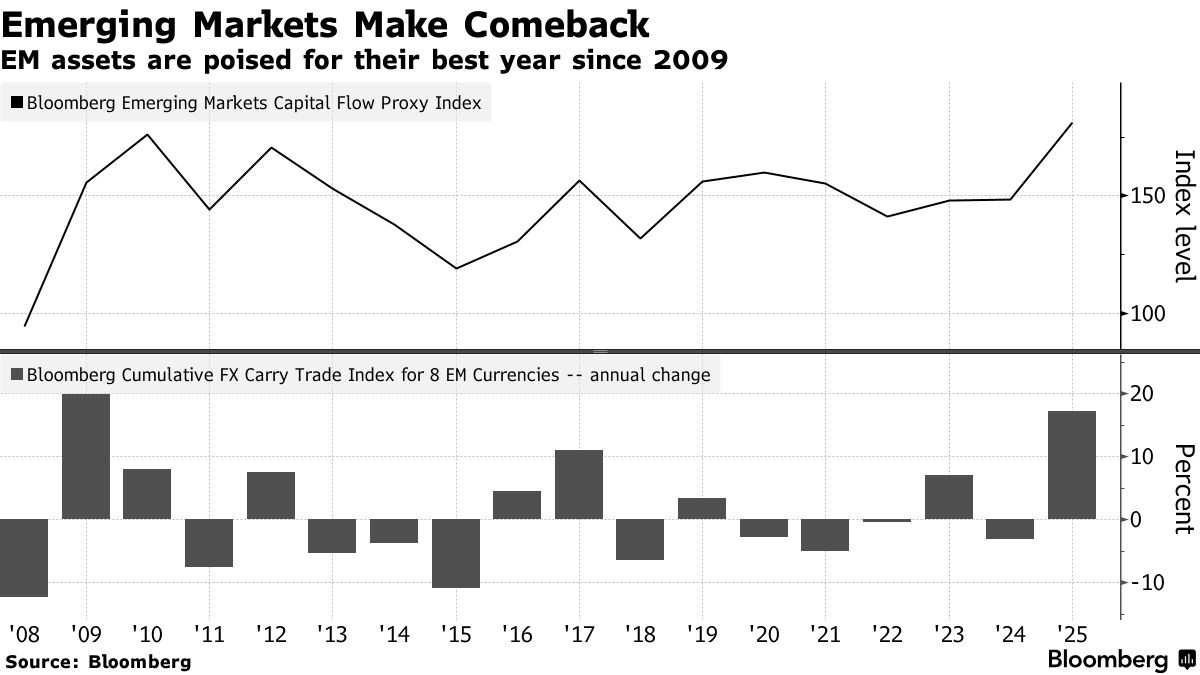
Core Viewpoint - Emerging market assets are expected to perform well in 2026, with a general consensus among institutions that there is little pessimism regarding these markets [1][4][6]. Group 1: Market Performance - Emerging market local currency bonds have risen by 18% and stocks by 26% in 2025, marking a significant recovery from previous years [3]. - Emerging market stocks have outperformed U.S. stocks for the first time since 2017, and the yield spread between emerging market bonds and U.S. Treasuries has narrowed to its lowest level in 11 years [3]. - The Bloomberg Emerging Market Carry Index has achieved a return of 16.71% this year, the best since 2009 [3]. Group 2: Investor Sentiment - A recent survey by Bank of America involving 300 investors revealed that there is almost no pessimism towards emerging markets [4]. - HSBC's December survey indicated that bearish views on emerging markets have completely disappeared, with net bullish sentiment reaching a historical high [4]. - Strategas estimates that U.S. ETFs focused on emerging market stocks attracted nearly $31 billion in 2025, while emerging market bond funds absorbed over $60 billion [4]. Group 3: Economic Outlook - Emerging markets are expected to benefit from a more accommodative global financial environment and stable internal policies, with growth anticipated to outperform developed economies [6]. - The Asian region is highlighted as a key growth engine, with potential for pro-business governments emerging from elections in Latin America [6]. - Structural trends such as geopolitical reshuffling and supply chain restructuring are expected to favor emerging markets, particularly in Asia [5]. Group 4: Investment Strategies - Emerging market bonds are seen as attractive due to high yields and diversification benefits, with a focus on Central and Eastern Europe, parts of Latin America, and Asia [6]. - Investment in technology sectors and industries with clear advantages, such as the electric vehicle supply chain and renewable energy in China, is recommended [6]. - The outlook for Indian markets is positive, driven by the "Make in India" initiative, which is expected to boost manufacturing and infrastructure [6]. Group 5: Currency and Interest Rate Dynamics - The trajectory of the U.S. economy is crucial for the sustained strong performance of emerging market currencies, with expectations of a slowdown encouraging the Fed to maintain loose monetary policy [9]. - JPMorgan and Morgan Stanley predict that emerging markets will benefit from a weaker dollar and the investment boom in AI [9]. - Emerging market currency volatility is currently low, but there are concerns that unfavorable exchange rate movements could erase gains [11].



百强量化私募榜单揭晓!葛卫东押中沐曦股份暴赚;半夏李蓓:自己的组合多为低估值、高股息行业龙头 | 私募透视镜
Jin Rong Jie· 2025-12-22 08:01
Group 1: Quantitative Private Equity Landscape - The top 100 quantitative private equity firms have a threshold of nearly 18% for entry, with 36 firms managing over 10 billion yuan, the highest among all categories [1] - Among the strategies, 76 firms focus on stock strategies, 11 on multi-asset strategies, 10 on futures and derivatives, 2 on bonds, and 1 on fund combinations [1] - The average excess return for stock quantitative long products in the market is 17.25% year-to-date as of November 2025, indicating a strong performance in the quantitative private equity sector [1] Group 2: Private Equity Market Development - The private equity market in China saw the establishment of new funds exceeding 2.2 trillion yuan in the first 11 months of 2025, with the "Central Triangle" region, particularly Hunan, leading in growth [2] - Hunan has surpassed Hubei and Jiangxi with 286 companies receiving investments, and the total committed capital from institutional LPs has increased to 30.4 billion yuan, a 67% rise [2] - State-owned capital plays a significant role in Hunan's private equity market, with government guidance funds and state-owned parent funds creating a diversified support system [2] Group 3: AI in Investment Strategies - AI technology is becoming a core engine driving the evolution of the quantitative investment industry, transitioning from an optional tool to a necessity for competitive advantage [8] - The integration of AI in quantitative investment is enhancing efficiency in data cleaning, factor mining, and trade execution optimization, significantly improving strategy research [8] - The expected increase in trading volume and liquidity in the A-share market in 2025 is anticipated to provide a solid foundation for quantitative strategies to achieve excess returns [8] Group 4: New Entrants in Quantitative Investment - The establishment of Sliang Private Fund Management (Beijing) Co., Ltd. marks a new player in the quantitative investment space, led by former Citadel senior quantitative researcher Zhang Feng [9] - The company has officially registered as a private fund manager, with Zhang holding 80% of the shares, indicating a strong pedigree in quantitative research [10] - Citadel has become a talent hub in the domestic quantitative circle, with many notable figures having experience at the firm [10] Group 5: Corporate Developments - Dongfang Fortune Information Co., Ltd. has undergone a board restructuring and executive appointments, with Huang Jianhai promoted to General Manager and Vice Chairman [11] - The new board consists of six members, including three non-independent directors, one employee representative director, and two independent directors [11] - The company has also restructured its organizational framework, eliminating the supervisory board and compliance director positions, and forming a legal compliance department [11]

摩根资管周奂彤:中长线继续看好内地和香港市场 建议趁市况波动吸纳高息股
Zhi Tong Cai Jing· 2025-12-22 07:27
她续提到,预期明年初可能仍然由增长型股份带动,但年中若重燃通胀担忧,抗跌力会较佳。在市况波 动下,成为增长板块以外的一个避风港。 临近年底,港股交投转淡,上周日均成交续低于2,000亿港元,市场预期资金或留待明年首季才再度大 举涌入。摩根资产管理环球市场策略师周奂彤分析,有两大因素支撑,中长线继续看好内地和香港市 场,人工智能(AI )板块短期或仍有忧虑,建议可趁市况波动吸纳高息股。 她指出,关税战不确定性已延至明年第四季,近期出口数据显示内地市场变得更多元化,相关忧虑的迫 切性已有所减少;内地居民存款率高企,但明年会有更多中长期存款到期,"存款搬家"或带动资金流入 内地和香港市场,利好股市。 她续指,香港多只早前上市的IPO禁售期即将届满,或令资金面短期受压,但近期有不少受欢迎的人工 智能(AI)相关股份准备上市,有机会抵消相关影响。 另一方面,周奂彤亦密切注视生物科技板块,"内地创新药在全球创新药份额已飙升至约3成,行业已非 再由欧美等成熟市场主导。"她补充,市场短期对人工智能泡沫(AI Bubble)仍有忧虑,令投资气氛受到 影响,料明年AI板块不确定性会较今年高。 ...
资管巨头阿波罗开启“避险模式”:囤现金、去杠杆,坐等“坏事发生”?
Hua Er Jie Jian Wen· 2025-12-22 06:50
Core Viewpoint - Apollo Global Management is adopting aggressive defensive measures, including cash accumulation, reducing leverage, and selling high-risk debt assets, in preparation for potential market turmoil [1][2][3] Group 1: Strategic Shift - Apollo's CEO Marc Rowan emphasized the importance of building the "best possible balance sheet" to ensure profitability during challenging credit and equity market conditions [1] - The company is transitioning from aggressive investments to a conservative defensive posture, focusing on cleaning up its balance sheet and maintaining a "cash is king" strategy [1][3] - This strategic shift is seen as a significant change within the industry, given Apollo's substantial presence in the financial market [3] Group 2: Asset Management - Apollo is specifically reducing exposure to high-risk areas, particularly in technology loans susceptible to disruption from artificial intelligence [4] - The company is also retreating from the credit derivatives market, citing unattractive returns in low-rated loan portfolios, particularly collateralized loan obligations (CLOs) [5] - Apollo's insurance subsidiary, Athene, is building liquidity by purchasing hundreds of billions in government bonds and plans to cut its CLO risk exposure by about half to $20 billion [5][6] Group 3: Leverage and Hedging - Apollo's flagship fund, Apollo Debt Solutions, has a net debt-to-equity ratio of 0.58, indicating a lower leverage compared to competitors [6] - The company has increased hedging positions against floating-rate debt to protect profitability amid potential interest rate declines [6] Group 4: Regulatory Concerns - Rowan expressed concerns about systemic risks arising from regulatory arbitrage, particularly in the insurance market, where private capital groups are expanding without adequate oversight [7] - He criticized the practice of transferring assets to offshore jurisdictions like the Cayman Islands, warning of potential contagion risks in the event of defaults [7] Group 5: Market Conditions - Apollo's defensive measures come at a time when the private credit market, valued over $2 trillion, is experiencing significant challenges, including rising default rates and declining investor confidence [8][9] - The market is facing a "clearing moment," with notable declines in stock prices for major players like FS KKR Capital and BlackRock's BDC, despite the S&P 500's overall increase [8][9]

优美利投资贺金龙:让投资者“拿得住、睡得着、赚到钱”
Zhong Guo Zheng Quan Bao· 2025-12-22 04:29
Core Viewpoint - The investment philosophy of the company emphasizes stability and long-term gains over short-term high returns, advocating for low-volatility products that can yield consistent profits for investors [1][2][11]. Group 1: Investment Strategy - The company has shifted its focus from high-volatility products to low and medium-volatility strategies, such as quantitative convertible bond strategies and quantitative hedging strategies, which have proven to be more stable and risk-controlled [1][3]. - The founder believes that the core goal of investing is not to seek short-term excitement but to ensure that investors can "hold on, sleep well, and make money" [1][2]. - The company has developed a "valuation-momentum-risk parity" decision-making system to ensure that investment strategies remain resilient across various macroeconomic environments [3]. Group 2: Risk Management - The company employs a comprehensive risk management framework that integrates artificial intelligence and big data analysis to maintain a high level of sensitivity and responsiveness to market fluctuations [3][4]. - A compliance intelligent recognition module has been added to the risk management system to automatically scan for potential compliance risks, thereby creating a proactive regulatory defense line [5]. - The company emphasizes that risk management is not about limiting returns but about protecting compound growth [5]. Group 3: Performance Metrics - The flagship product, "Youmeili Win Value No. 1 A-Class Share," has achieved a cumulative return of over 150% and an annualized return exceeding 15% since its inception over six years ago [6]. - The company believes that controlling drawdowns effectively allows for the natural compounding of returns, leading to significant long-term growth [6][10]. - The company has maintained a "zero default" record in bond investments over the past decade, attributing this success to disciplined risk management and systematic monitoring of market indicators [7]. Group 4: Technological Integration - The company has invested heavily in technology, with technology expenditures accounting for half of its profits, and has established a complete chain from data collection to risk control [10][11]. - The team comprises members with backgrounds in computer science, mathematics, and financial engineering, which enhances the company's technological capabilities [10]. - The company aims to build a competitive edge through systematic and automated execution capabilities, positioning technology as a foundational element of its investment strategy [10][11].
贝莱德(BlackRock)11.5 万亿的崛起记
Sou Hu Cai Jing· 2025-12-22 02:40
Core Insights - BlackRock has emerged as a dominant player in the global financial landscape, managing over $11.5 trillion in assets and holding stakes in more than 3,000 publicly listed companies across various sectors, including technology and renewable energy [1][3][33]. Group 1: Company History and Evolution - The company was founded by Larry Fink and a team of seven in 1988, initially focusing on creating a robust risk management system known as Aladdin, which has since become a cornerstone of its operations [15][19]. - BlackRock's rise from a startup to a financial powerhouse is marked by strategic decisions, including the acquisition of Merrill Lynch's asset management business in 2006, which significantly increased its assets under management [21]. - The 2008 financial crisis was pivotal for BlackRock, as it played a crucial role in assessing toxic assets for the U.S. government and managing significant financial institutions during the crisis [23][26]. Group 2: Technological and Strategic Innovations - The Aladdin system, developed by BlackRock, utilizes vast data and precise models to enhance risk management, replacing traditional methods reliant on trader experience [17][36]. - The company has expanded its influence beyond asset management, actively participating in shareholder meetings of major corporations like Microsoft and Apple, thereby impacting significant corporate decisions [33]. Group 3: Market Position and Influence - BlackRock's acquisition of Barclays Global Investors in 2009 positioned it as a leader in the U.S. ETF market, controlling approximately 40% of the market share [29]. - The firm has established itself as a key player in the financial ecosystem, with its assets under management exceeding the GDP of the United States, highlighting its substantial market influence [33][42].
阿波罗全球管理:滞胀是美联储明年面临的最大风险之一
Sou Hu Cai Jing· 2025-12-22 02:29
Core Viewpoint - Apollo Global Management's Chief Economist Torsten Sløk indicates that despite the mild inflation data in November, stagflation remains a significant risk for the Federal Reserve in the coming year, potentially threatening the key momentum for stock market growth: the possibility of further interest rate cuts [1] Group 1 - Sløk emphasizes that stagnation inflation is a risk due to emerging headwinds, particularly if artificial intelligence fails to deliver results [1] - He notes that as the new year approaches, economic growth faces downside risks while consumer prices exhibit upside risks [1]
悲观论者“绝迹”!新兴市场证券创16年来最佳表现 华尔街押注“资金回流大周期”开启
智通财经网· 2025-12-22 00:34
Core Viewpoint - Emerging markets are expected to become favored by Wall Street by early 2026, with asset management firms betting on a prolonged inflow cycle that has already begun [1][3] Group 1: Market Performance - Capital inflows into emerging markets this year have reached the best performance since 2009, indicating a shift in investor sentiment towards this previously underperforming asset class [1] - Emerging market stocks have outperformed U.S. stocks for the first time since 2017, and the yield spread between emerging market bonds and U.S. Treasuries has narrowed to the lowest level in 11 years [1] - JPMorgan forecasts that emerging market bond funds could see inflows of up to $50 billion next year, with expectations of price appreciation and yield benefits from local currency bonds [4] Group 2: Investor Sentiment - A recent investment conference by Bank of America revealed that nearly all investors are optimistic about emerging markets, with no significant pessimism reported [3] - AllianceBernstein's Sammy Suzuki noted a shift in perception, stating that questions about the investment value of emerging markets have diminished [3] - Gama Asset Management's Rajeev De Mello believes there is still room for significant over-allocation towards emerging markets [5] Group 3: Global Capital Flows - There is a potential fundamental shift in global capital flows, with portfolio managers eager to diversify away from the U.S. and attracted by progress in debt reduction and inflation control in developing countries [3] - Despite recent rebounds, the overall scale of capital inflows remains relatively small compared to previous outflows, indicating that emerging markets still have insufficient representation in global portfolios [4] Group 4: Risks and Challenges - The recent rebound in emerging markets may mask underlying vulnerabilities, particularly concerning the U.S. dollar, which has declined by 8% this year, providing support for emerging market assets [6] - Citigroup suggests that investors should only buy emerging market assets that can withstand a potential strengthening of the dollar [6] - As of mid-December, emerging market bond funds saw a significant inflow of $4 billion, marking the largest weekly inflow since July [7]
广发资管多添利六个月持有期债券型集合资产管理计划份额折算公告
Zhong Guo Zheng Quan Bao - Zhong Zheng Wang· 2025-12-21 23:21
为满足广大投资者的需求,有效加强对广发资管多添利六个月持有期债券型集合资产管理计划(以下简 称"本集合计划")的运作管理,管理人广发证券资产管理(广东)有限公司(以下简称"管理人")根据 《关于广发资管多添利六个月持有期债券型集合资产管理计划变更管理人并变更注册为广发多添利六个 月持有期债券型证券投资基金有关事项的议案》相关规定,拟对本集合计划进行份额折算(以下简 称"折算"),公告如下: 一、份额折算方案 (一)份额折算 本集合计划份额折算是在保持现有计划份额持有人资产总值不变的前提下,改变本计划单位净值和持有 份额的对应关系,重新列示集合计划资产的一种方式。 假设折算当日,某持有人在折算前持有本集合计划100,000份,折算前单位净值为0.9000元,持有人持有 的资产净值(资产净值=持有份额*单位净值)为90,000元;折算后,单位净值变为1.0000元,该持有人 持有份额变为90,000份,持有人持有的资产净值仍为90,000元。 (二)折算基准日(T日):2025年12月22日 (三)折算对象:折算基准日登记在册的本集合计划份额。 (四)折算方式 2025年12月22日,管理人将根据集合计划份额折算 ...
优美利投资贺金龙: 用时间证明“慢即是快”
Zhong Guo Zheng Quan Bao· 2025-12-21 22:16
Core Viewpoint - The investment philosophy of the company emphasizes stability and long-term gains over short-term volatility, with a focus on low-volatility products that can yield consistent returns for investors [1][2][10]. Group 1: Investment Philosophy - The founder of the company, He Jinlong, believes that the core goal of investing is not to chase short-term excitement but to ensure that investors can "hold on, sleep well, and make money" [1]. - The company has developed a multi-asset quantitative system that prioritizes risk control and stable returns, demonstrating that low volatility does not equate to low returns [6][9]. Group 2: Performance Metrics - The flagship product, "Youmeili Win Value No. 1 A-Class Share," has achieved a cumulative return of over 150% and an annualized return exceeding 15% since its inception over six years ago [6]. - The company has maintained a record of "zero defaults" in bond investments over the past decade, attributing this success to disciplined risk management and a systematic approach [7]. Group 3: Risk Management - The company employs a "valuation-momentum-risk parity" decision-making framework, which aims to balance risk contributions across different assets to maintain resilience in various macroeconomic environments [3]. - An AI-driven risk control and timing management system has been developed to analyze market sentiment and optimize trading efficiency, significantly enhancing execution speed compared to manual trading [4][5]. Group 4: Technological Integration - The company invests heavily in technology, with half of its profits allocated to technological advancements, establishing a complete chain from data collection to risk control [9]. - The team comprises members with backgrounds in computer science, mathematics, and financial engineering, which supports the development of automated execution systems [9][10]. Group 5: Long-term Strategy - The company focuses on a long-term investment strategy, avoiding high-volatility products and instead opting for a diversified approach that includes various strategies such as convertible bonds and quantitative neutral strategies [8][10]. - The belief in compounding returns and the importance of managing drawdowns are central to the company's investment approach, aiming for consistent annual returns rather than chasing high short-term gains [2][6].