银行业

Search documents
金价疯涨并不是牛市,而是警报!全球银行狂囤金,旧秩序正在碎裂
Sou Hu Cai Jing· 2026-02-14 05:14
Core Viewpoint - The surge in gold prices to $4,985 is not indicative of a bull market but rather a warning signal of the loosening global dollar credit system [1] Group 1: Price Volatility - Gold prices experienced extreme fluctuations, with a monthly increase of 13.01% in January 2026, reaching over $5,000, followed by a significant drop of over 9.25% on January 30, marking the largest single-day decline in 40 years [3] - The gold market saw a dramatic adjustment, with prices swinging nearly $700 within a week, prompting exchanges to raise margin requirements for precious metal trading [3][4] - The price discovery mechanism is chaotic, with different market participants (leveraged funds, ETF investors, and central banks) operating on different strategies, leading to amplified volatility [16] Group 2: Central Bank Behavior - Central banks are the primary buyers in the gold market, with China's gold reserves reaching 74.19 million ounces by the end of January 2026, marking a continuous increase for 15 months [3] - In Q4 2025, global central banks net purchased 230 tons of gold, a 6% increase from the previous quarter, with total purchases for 2025 reaching 863 tons [3][4] - The trend of central banks increasing gold holdings contrasts sharply with the erratic behavior of institutional investors [4] Group 3: Institutional Investor Activity - In January 2026, global gold ETFs saw inflows of approximately $19 billion, the highest monthly record, pushing total assets under management to $669 billion, a 20% increase [4][15] - Despite the record inflows, the behavior of institutional investors is characterized by instability, with rapid buying and selling patterns driven by market fluctuations rather than fundamentals [4][16] Group 4: Consumer Behavior - Ordinary consumers are purchasing smaller gold items, reflecting a trend of "light investment" as they seek psychological security amid uncertainty [6] - The retail gold market remains supported by traditional consumption patterns, particularly during the Chinese New Year [6] Group 5: Structural Changes in the Market - The foundation of dollar credit is weakening, with U.S. federal debt exceeding $38 trillion and the dollar's share in global foreign exchange reserves dropping to 56.92%, the lowest since 1995 [6] - The shift towards "de-dollarization" is evident as central banks increase gold holdings while reducing U.S. Treasury holdings [7][9] Group 6: Geopolitical Risks - Geopolitical tensions, such as the U.S.-Iran conflict and the Russia-Ukraine war, have transitioned from short-term market disturbances to long-term pricing factors for gold [7] - The market reacts to geopolitical news, with prices fluctuating based on expectations rather than actual events [7] Group 7: Future Outlook - Analysts have differing views on gold prices, with some predicting a rise to $6,000 by the end of 2026, while others expect short-term fluctuations between $4,800 and $5,200 [13][19] - The gold market is increasingly viewed as a strategic asset rather than a cyclical commodity, reflecting a loss of confidence in the current financial order [9][21]


四部门:统筹建立常态化金融支持机制,助力防止返贫致贫和乡村全面振兴
Xin Lang Cai Jing· 2026-02-14 05:03
Core Viewpoint - The document outlines a comprehensive framework for establishing a normalized financial support mechanism aimed at preventing poverty and promoting rural revitalization in China, emphasizing the need for targeted financial assistance and collaboration among various financial institutions and government bodies [1][4][18]. Group 1: Financial Support Mechanisms - The framework aims to enhance the long-term financial support mechanisms for key populations, including optimizing microcredit policies for impoverished individuals and ensuring continuous support for those at risk of falling back into poverty [1][4][5]. - Financial institutions are encouraged to develop loans for specialized industries and increase credit limits for entrepreneurial support in underdeveloped areas [2][5][6]. - A tiered financial support mechanism will be established for underdeveloped regions, prioritizing financial resources for key rural revitalization counties [7][8]. Group 2: Investment in Key Areas - The document emphasizes the importance of financial resources in enhancing agricultural production capacity and quality, particularly in grain and oil production [2][9]. - It calls for the development of supply chain financial services to meet the financial needs of the entire agricultural industry chain [2][10]. - There is a focus on expanding financial support for county-level industries and improving rural infrastructure through long-term funding [11][12]. Group 3: Financial Service Capacity Building - The framework highlights the need to strengthen the financial organizational system, ensuring that state-owned and commercial banks provide adequate support for rural revitalization [13][14]. - It encourages the development of diverse financial products tailored to the needs of different agricultural sectors and the promotion of digital transformation in financial services [14][15]. Group 4: Multi-Industry Financial Collaboration - Financial institutions are urged to leverage bond markets to raise stable, low-cost funds for local credit investments, particularly in underdeveloped areas [16][17]. - The document advocates for a comprehensive capital market support system to facilitate the listing and financing of rural enterprises [16][17]. Group 5: Policy Implementation and Monitoring - The framework stresses the importance of policy coordination and the need for continuous monitoring and evaluation of financial support policies to ensure their effectiveness [18][19]. - It encourages the documentation and dissemination of successful financial service practices to promote a favorable environment for rural revitalization efforts [18][19].
金价半小时暴跌内幕,别再等了!历史正在重演,机会就在眼前
Sou Hu Cai Jing· 2026-02-14 05:02
Core Viewpoint - The international gold price experienced a significant drop, falling nearly $200 within 30 minutes, while domestic gold prices remained high, leading to a substantial price discrepancy between international and retail gold prices [1][3]. Group 1: Price Levels in the Gold Market - The gold market consists of three distinct pricing tiers: the benchmark price tier, the brand retail tier, and the wholesale and investment tier [3]. - The benchmark price tier is directly linked to the international market, with Shanghai Gold Exchange's AU9999 gold closing at approximately 1110.40 yuan per gram, reflecting the international spot gold price [3]. - The brand retail tier, which is what consumers encounter, shows prices for gold jewelry from major brands like Chow Tai Fook and Lao Feng Xiang ranging from 1550 to 1562 yuan per gram [3]. - The wholesale and investment tier, closer to the raw material cost, has the wholesale price for 999 gold around 1282 to 1289 yuan per gram, with banks offering lower prices for investment gold bars [5]. Group 2: Factors Influencing Gold Price Fluctuations - The primary factor behind the recent gold price drop is the U.S. Federal Reserve's monetary policy, which has seen interest rates lowered multiple times, leading to a shift in market expectations regarding future rate cuts [5][6]. - In 2025, global central banks purchased a total of 863 tons of gold, with the People's Bank of China increasing its reserves significantly, indicating a strategic move to bolster financial security [6]. - Geopolitical tensions, such as conflicts in the Middle East and the ongoing Russia-Ukraine situation, have also contributed to increased demand for gold as a safe-haven asset [8]. Group 3: Cost Structure of Retail Gold Prices - The significant price difference between retail gold and raw gold prices can be attributed to various factors, including design and craftsmanship, which elevate production costs [9][11]. - Retail gold stores incur high operational costs due to prime location rents, staff salaries, and store maintenance, which are reflected in the final retail price [9]. - Marketing expenses also play a role, as brands invest heavily in advertising and promotions to establish trust and recognition among consumers [11]. Group 4: Investment Alternatives and Market Dynamics - For those looking to invest in gold without the premium of retail prices, purchasing investment gold bars from banks is a viable option, with prices closely following the raw material costs [12]. - New investment products like "small gold beans" and gold ETFs have emerged, allowing for flexible and low-barrier entry points for retail investors [12]. - When it comes to selling gold, the market price for gold recovery is significantly lower than retail prices, as recovery businesses deduct costs associated with testing and refining [14].

央行等四部门:加大农村地区企业上市辅导培育力度
21世纪经济报道· 2026-02-14 04:36
Core Viewpoint - The article discusses the joint release of guidelines by several Chinese financial authorities aimed at establishing a regular financial support mechanism to prevent poverty and promote rural revitalization [1]. Group 1: Financial Support Mechanism - The guidelines propose the construction of a comprehensive support system for the capital market [3]. - There will be an increase in guidance and support for enterprises in rural areas to facilitate their listing and financing through multi-tiered capital markets [3]. - A "green channel" policy will continue for companies registered in former poverty-stricken areas to encourage their listing [3]. Group 2: Financing and Risk Management - Eligible listed companies will be supported in refinancing through methods such as additional issuance, rights issues, convertible bonds, and corporate bonds to raise development funds for local specialty industries and agricultural technology innovation [3]. - The introduction of futures and options for specialty agricultural products will be supported to provide more risk management tools that meet the needs of rural industrial development [3]. - The "insurance + futures" model will continue to be promoted in key counties for rural revitalization to enhance project protection [3].

IC Markets外汇平台:美国通胀高企,降息预期再降温
Sou Hu Cai Jing· 2026-02-14 04:33
"通胀大约卡在3%左右,这是不可接受的。"Goolsbee多次强调这一观点,明确当前通胀水平仍高于目 标,且尚未出现持续回落的明确信号,因此现阶段无法支持进一步降息。这一表态也与美联储上月的政 策决策相呼应,上月美联储官员们经过讨论,决定维持当前利率水平不变,并未延续去年年底的降息节 奏。 回顾过往,去年年底,由于美国劳动力市场招聘疲软,美联储曾连续三次实施降息,以缓解经济下行压 力、稳定就业市场。而本周早些时候公布的另一份报告显示,1月份美国就业增长保持稳定,劳动力市 场已呈现企稳态势。 当地时间周五,美国芝加哥联储主席Austan Goolsbee就当前美国通胀形势及美联储利率政策发表公开表 态,结合同日公布的1月份通胀数据,清晰传递出"通胀未达标、降息不急于一时"的核心立场,也进一 步明确了美联储后续货币政策调整的关键依据。 周五早些时候,美国相关部门公布的报告显示,1月份整体物价同比上涨2.4%,涨幅低于市场预期,看 似呈现温和回落态势,但细分数据暗藏隐忧——服务价格上涨速度加快,这也成为Goolsbee重点关注的 焦点。他在表态中重申,自己对服务业通胀的担忧始终未减,这类通胀往往具有持续性,尚未得到 ...

2025年中国官方黄金储备累计增加27吨,年末规模达2306吨
Sou Hu Cai Jing· 2026-02-14 04:30
Core Insights - The People's Bank of China (PBOC) has consistently increased its gold reserves, reflecting a strategic shift towards diversifying foreign exchange reserves as they continue to expand [1][1] Group 1: Gold Purchases - In the fourth quarter, the PBOC increased its gold holdings by 2.8 tons, bringing the total gold reserves to 2,306 tons by the end of 2025, an increase of 27 tons for the year [1] - The proportion of gold in China's total foreign exchange reserves rose from 5.5% at the end of 2024 to 8.5% currently, driven by both rising gold prices and increased gold reserves [1] Group 2: Foreign Exchange Reserves - China's foreign exchange reserves are projected to grow by 8.4% in 2025, reaching $3.7 trillion [1] - The increase in gold reserves is aligned with the overall expansion of China's foreign exchange reserves, indicating a strategic move towards diversification [1]
央行等四部门:统筹建立常态化金融支持机制 助力防止返贫致贫和乡村全面振兴
Zheng Quan Ri Bao Wang· 2026-02-14 04:27
Core Viewpoint - The People's Bank of China, along with other regulatory bodies, has issued guidelines to establish a normalized financial support mechanism aimed at preventing poverty and promoting rural revitalization, in line with the directives from the 20th National Congress of the Communist Party of China [1][2]. Group 1: Financial Support Mechanism - The guidelines propose the establishment of a long-term financial support mechanism for key populations, optimizing microcredit for impoverished individuals and enhancing credit policies for farmers [1][2]. - Financial institutions are encouraged to develop loans for specialized industries and increase the upper limit for entrepreneurial guarantee loans in eligible regions [1][2]. - A tiered financial support mechanism for underdeveloped areas will be established, prioritizing new financial resources for key rural revitalization counties [1][2]. Group 2: Agricultural and Rural Development - The guidelines emphasize the need for financial resources to be directed towards key areas, including grain and oil production, to enhance agricultural production capacity and quality [2]. - Supply chain financial services, such as accounts receivable financing, will be developed to meet the financial needs of the entire agricultural industry chain [2]. - There will be increased investment in rural infrastructure and support for the integration of agriculture, culture, and tourism [2]. Group 3: Financial Services and Innovation - The guidelines call for strengthening the financial service capacity and improving the financial organizational system [2]. - Financial institutions, particularly local ones in underdeveloped areas, are encouraged to issue special financial bonds for small and micro enterprises and agriculture [2]. - The guidelines advocate for the innovation of insurance products and services, as well as the establishment of a monitoring mechanism for the effectiveness of financial support policies [2][3]. Group 4: Collaboration and Implementation - The People's Bank of China will enhance collaboration with regulatory bodies to summarize effective practices in financial support and rural revitalization [3]. - There will be a focus on statistical monitoring and evaluation of the financial services provided for rural revitalization [3]. - The aim is to innovate financing mechanisms to prevent large-scale poverty and promote comprehensive rural revitalization [3].
全国首批!“央妈”民营企业再贷款率先落地广东
Sou Hu Cai Jing· 2026-02-14 04:22
Core Viewpoint - The implementation of the 1 trillion yuan re-loan policy for private enterprises has commenced in Guangdong, marking a significant step in supporting the high-quality development of the private economy in the region [1][2]. Group 1: Policy Implementation - On February 12 and 13, Guangdong's Jiangmen and Dongguan became the first cities in China to implement the re-loan policy, with the People's Bank of China providing 2.5 billion yuan to three local banks [1]. - The People's Bank of China launched a 1 trillion yuan re-loan initiative aimed at bolstering support for small and micro private enterprises [1]. - The Guangdong branch of the People's Bank has developed detailed implementation plans and guidelines to ensure the effective rollout of the re-loan policy [1]. Group 2: Financial Institutions' Response - Local banks are actively engaging with private enterprises to meet their financing needs, simplifying loan processes and reducing internal funding transfer prices [2]. - The Guangdong branch of the People's Bank will continue to leverage structural monetary policy tools, including the re-loan policy, to enhance the financial support for small and micro private enterprises [2].

数字人民币2.0时代启幕
Jin Rong Shi Bao· 2026-02-14 04:15
Core Insights - The digital renminbi has transitioned from version 1.0 to 2.0, evolving from "digital cash" to "digital deposit currency," allowing users to earn interest on their balances [1][2] - This upgrade signifies a fundamental change in the monetary attributes, operational ecology, and strategic potential of the digital renminbi, marking a modernization of financial infrastructure [1][2] Monetary Attribute Redefinition - The new version allows interest to be accrued on balances in real-name digital renminbi wallets, with interest rates aligned with current deposit rates, and these balances are now covered by deposit insurance up to 500,000 yuan [2] - The digital renminbi's positioning has expanded from merely replacing cash (M0) to encompassing broader monetary categories (M1, M2), indicating a significant evolution in its monetary framework [2] Challenges and Solutions - The People's Bank of China has identified four common challenges faced by global central bank digital currencies, including issues related to virtual assets and the incompatibility of centralized accounts with decentralized technologies [3] - The 2.0 version addresses these challenges by maintaining a dual-layer operational structure and introducing deposit currency attributes to create compatible incentives for commercial banks [3] Innovation and Applications - The upgrade allows for more extensive applications of the digital renminbi, breaking previous policy bottlenecks and enabling innovations in corporate services and cross-border payments [4] - The development of smart contracts is enhancing supply chain finance, allowing for precise control of loan funds and improving access for small and micro enterprises [6][7] Cross-Border Payment Potential - The digital renminbi is positioned as a significant innovation in national financial infrastructure, with potential to improve cross-border payment services by addressing traditional inefficiencies [9] - The mBridge project, a multi-currency cross-border payment platform, is a key initiative for the digital renminbi's international application, with significant transaction volumes already recorded [10] Future Outlook - The digital renminbi's upgrade is seen as a paradigm shift in monetary form in the digital age, integrating deposit currency attributes and smart contracts to enhance the existing financial system [12] - Despite challenges such as user habit formation and international competition, the digital renminbi is expected to unlock substantial productivity and innovation potential, marking a transformative change in China's financial landscape [13]

20048亿元、4.71万亿元,稳健运行!从1月金融数据透视经济“开门红”
Yang Shi Wang· 2026-02-14 04:10
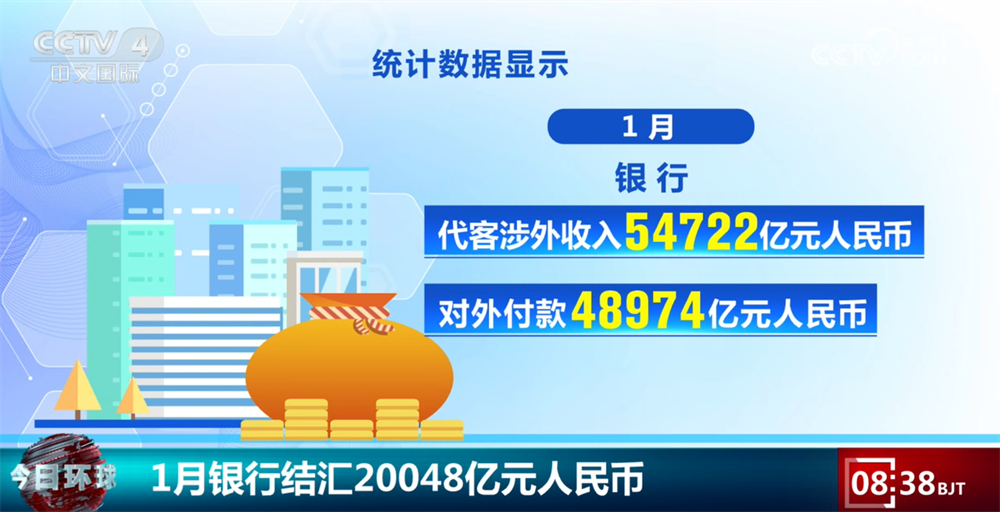
Core Viewpoint - The State Administration of Foreign Exchange (SAFE) reported that China's foreign exchange market remains stable despite increased volatility in international financial markets, with cross-border capital continuing to show net inflows, although the scale has decreased compared to the previous month [1][3]. Group 1: Bank Settlement and Sale Data - In January, banks settled foreign exchange transactions amounting to 20,048 billion RMB and sold 14,457 billion RMB [1][4]. - The net inflow of cross-border funds from non-bank sectors, including enterprises and individuals, decreased by 28% compared to the previous month [3][4]. Group 2: Cross-Border Fund Flows - The net inflow of funds under the goods trade category fell by 27% month-on-month, while the net outflow under the services trade category increased by 23% [3][4]. - The net inflow from securities investments remained stable [3]. Group 3: Financial Data and Credit Growth - In January, the total amount of RMB loans increased by 4.71 trillion RMB, with the total loan balance reaching 276.62 trillion RMB, reflecting a year-on-year growth of 6.1% [5]. - Corporate loans increased by 4.45 trillion RMB in January, with medium- and long-term loans accounting for over 70%, providing significant support to key sectors such as manufacturing and emerging industries [9]. Group 4: Personal Loan Trends - The demand for personal loans has been supported by pre-holiday consumption activities, with various consumer needs being released ahead of the Spring Festival [11]. - The extension of the personal consumption loan interest subsidy policy until the end of 2026 is expected to enhance consumer willingness and support personal loan growth [11].