
国防军工

Search documents
ETF日报|A股放量上攻!国产AI王者归来,科创人工智能ETF(589520)劲涨2.12%!国际机构坚定看好中国经济
Sou Hu Cai Jing· 2025-12-12 14:08
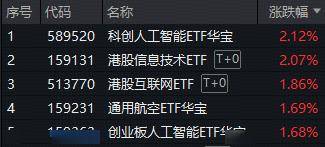
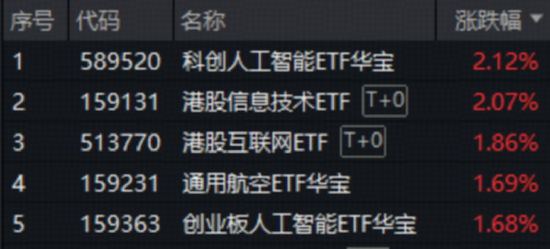
Market Overview - The three major A-share indices collectively rose on December 12, with the Shanghai Composite Index up 0.41%, the Shenzhen Component Index up 0.84%, and the ChiNext Index up 0.97. The total trading volume in the Shanghai and Shenzhen markets reached 2.09 trillion yuan, an increase of over 230 billion yuan compared to the previous day [1] AI Industry - The AI industry chain regained momentum, with the Sci-Tech Innovation Artificial Intelligence ETF (589520) and the ChiNext Artificial Intelligence ETF (159363) both rising over 2% during trading. The former focuses on the domestic AI industry chain [1][4] - The Sci-Tech Innovation Artificial Intelligence ETF saw a significant increase in trading volume, with a rise of 2.12% and a total trading volume of 47.29 million yuan, up 92% from the previous day [4][6] - Among the 30 constituent stocks of the Sci-Tech Innovation Artificial Intelligence ETF, 28 stocks rose, with over 60% of them increasing by more than 2%. Notable performers included Hehe Information, which surged over 13%, and other companies like Chipone and Yuntian Lifei [6][7] Policy and Economic Outlook - A significant meeting held on December 11 outlined economic work for 2025 and analyzed the current economic situation, emphasizing the need for qualitative improvements and reasonable growth in quantity for the upcoming "14th Five-Year Plan" [2] - International organizations such as the World Bank and the International Monetary Fund have raised their economic growth forecasts for China for the coming year, highlighting the country's long-term growth potential through technological innovation and improved resource allocation [2] Defense and Aerospace Sector - The defense and aerospace sector has shown strong performance, with the high-profile Defense Industry ETF (512810) reaching a new high not seen in over a month. This ETF has benefited from themes such as commercial aerospace, controllable nuclear fusion, and superconductivity [1][20] - The defense industry is evolving from a reliance on domestic demand to a model driven by internal demand, foreign trade expansion, and civilian applications, creating a more sustainable growth dynamic [20] Hong Kong Market - In the Hong Kong market, technology stocks experienced a broad rally, with the Hong Kong Information Technology ETF (159131) rising 2.07% and the Hong Kong Internet ETF (513770) increasing by 1.86%, recovering key moving averages [1][12] - The Hong Kong Information Technology ETF focuses on the "Hong Kong chip" industry chain, with a significant portion of its holdings in semiconductor and electronic companies, indicating a strong investment opportunity in this sector [17]

花旗首次覆盖洛克希德·马丁公司,给予“中性”评级
Ge Long Hui A P P· 2025-12-12 12:08
Group 1 - Citigroup initiates coverage on Lockheed Martin with a "Neutral" rating and sets a target price of $505 [1]


A股放量上攻!国产AI王者归来,科创人工智能ETF(589520)劲涨2.12%!国际机构坚定看好中国经济
Xin Lang Cai Jing· 2025-12-12 11:54
Market Overview - The three major A-share indices collectively rose on December 12, with the Shanghai Composite Index up 0.41%, the Shenzhen Component Index up 0.84%, and the ChiNext Index up 0.97. The total trading volume in the Shanghai and Shenzhen markets reached 2.09 trillion yuan, an increase of over 230 billion yuan compared to the previous day [1][22]. AI Industry - The AI industry chain regained momentum, with the Sci-Tech Innovation Artificial Intelligence ETF (589520) and the ChiNext Artificial Intelligence ETF (159363) both rising over 2% during the session. The focus on domestic AI industry chains is evident as these ETFs saw significant trading activity [1][22]. - The Sci-Tech Innovation Artificial Intelligence ETF (589520) experienced a strong increase of 2.12%, with a trading volume of 47.29 million yuan, marking a 92% increase compared to the previous day. This ETF is heavily invested in the domestic AI industry chain, indicating strong buying interest [4][25]. Defense and Aerospace Sector - The high-profile defense and aerospace sector saw the National Defense and Military Industry ETF (512810) reach a new high, driven by themes such as commercial aerospace, controllable nuclear fusion, and superconductivity. This ETF has shown a continuous upward trend over the past three weeks [15][19]. - The National Defense and Military Industry ETF (512810) has outperformed the Shanghai Composite Index and the CSI 300 Index, with a weekly increase of 2.59% and a total trading volume of 4.09 billion yuan [19][16]. Hong Kong Market - In the Hong Kong market, technology stocks surged, with the first ETF focusing on the "Hong Kong chip" industry chain (159131) rising 2.07% and recovering its 5-day and 10-day moving averages. The trading volume for this ETF reached 82.28 million yuan [8][15]. Economic Outlook - The World Bank and the International Monetary Fund have raised their economic growth forecasts for China in 2026, emphasizing the country's potential for long-term growth through technological innovation and improved resource allocation efficiency [3][23]. - The Chinese government is expected to continue implementing proactive fiscal policies and moderately loose monetary policies in 2026, focusing on stabilizing employment, enterprises, and market expectations [3][24]. Investment Opportunities - Analysts suggest focusing on technology growth, dividends, and cyclical resources, particularly in undervalued and policy-sensitive sectors. The emphasis on "domestic demand-driven" and "innovation-driven" strategies aligns with the upcoming 14th Five-Year Plan [3][24]. - The AI sector is anticipated to see significant growth, with a shift in investment logic from hardware and infrastructure to practical applications and commercialization [6][27].
东莞证券财富通每周策略-20251212
Dongguan Securities· 2025-12-12 09:41
Market Overview - The Shanghai Composite Index experienced a fluctuation with a weekly trading volume exceeding 1.7 trillion yuan, reaching over 2 trillion yuan on Monday and Friday. The index fell by 0.34% while the Shenzhen Component Index rose by 0.84%, the ChiNext Index increased by 2.74%, and the STAR 50 Index gained 1.72% [1][3][5] Economic Outlook - The Central Political Bureau and the Central Economic Work Conference held in December set the direction for economic work in 2026, emphasizing the expansion of domestic demand, fostering new growth drivers, and mitigating risks as key tasks to ensure a good start for the 14th Five-Year Plan [2][3][8] - November exports showed resilience with a year-on-year growth rate of 5.9%, while the Consumer Price Index (CPI) continued to recover, increasing by 0.7% year-on-year, marking the highest level since March 2024 [11][12] Policy Insights - The Central Economic Work Conference highlighted the importance of stabilizing employment, enterprises, markets, and expectations, with a focus on quality improvement and effective growth. The policy framework aims to transition from scale growth to quality enhancement, emphasizing the need for better coordination between domestic economic work and international trade challenges [9][10][20] - The meeting introduced new policy measures, including flexible use of monetary tools like reserve requirement ratio cuts and interest rate reductions, to maintain liquidity and support investment recovery [10][20] Sector Recommendations - The report suggests focusing on sectors such as Technology, Media, Telecommunications (TMT), public utilities, finance, and electric power equipment for potential investment opportunities [15][20] Export and Import Dynamics - The report notes that while exports to the U.S. have decreased, exports to emerging markets remain robust, with significant growth in automobile exports, which surged by 53% year-on-year. However, imports showed a modest increase of 1.9% year-on-year, influenced by weak energy prices and sluggish domestic demand [11][12]
金融工程定期:商业航天板块的资金行为监测
KAIYUAN SECURITIES· 2025-12-12 07:12
- The commercial aerospace index (8841877.WI) has increased by 46.52% since April 7, 2025, significantly outperforming the Wind All A Index during the same period, and has risen by 9.35% in December 2025 alone, attracting significant market attention [3][13][14] - Public fund holdings in the commercial aerospace sector have shown an upward trend throughout 2025, based on real-time calculations using public market data such as fund net value, disclosed holdings, and research activities [4][16][18] - ETF fund holdings in the commercial aerospace sector have recently declined, with the total scale of public ETF funds exceeding 5.6 trillion yuan by the end of Q3 2025, reflecting the growing importance of index investment products in the market [4][17][24] - Margin financing balances in the commercial aerospace sector have risen rapidly recently, indicating increased investor optimism about the market outlook [4][20][22] - Institutional research activities in 2025 have been most frequent for companies such as Sichuan Electronics, Chaojie Shares, and Sray New Materials [5][23][26] - Snowball platform influencers have shown the highest interest in companies like Aerospace Development, Aerospace Power, and Shanghai Hanxun since November 20, 2025 [5][27][28] - Main funds have flowed most significantly into companies such as Feilihua, Aerospace Power, and Longxi Shares since November 20, 2025, with large and ultra-large orders used as proxy variables for main fund activity [5][29][30][32] - Companies such as Yaguang Technology, Aerospace Technology, and Aerospace Development have appeared on the Dragon Tiger List since December 1, 2025, reflecting the most active trading dynamics in the market [5][33][34] - High-frequency shareholder data indicates significant increases in shareholder numbers for companies like Feilihua, Zhimingda, and Aerospace Technology, suggesting potential risks for subsequent stock price movements [5][35][36][38]
12月11日20家公司获基金调研
Zheng Quan Shi Bao Wang· 2025-12-12 04:19
Group 1 - On December 11, a total of 33 companies were investigated by institutions, with 20 companies being surveyed by funds, including 5 companies that attracted more than 5 funds each [1] - Chaojie Co., Ltd. was the most popular, with 34 funds participating in the survey, followed by Zhishang Technology and Guanglian Aviation, which had 20 and 7 funds respectively [1] - Among the surveyed companies, 6 were from the Shenzhen Main Board, 12 from the ChiNext, 1 from the Shanghai Main Board, and 1 from the Sci-Tech Innovation Board, covering 9 different industries [1] Group 2 - The total market capitalization of the surveyed companies included 2 with a market cap over 50 billion yuan, and 10 with a market cap under 1 billion yuan, such as Jiama Clothing and Mankalon [1] - In terms of market performance, 15 of the surveyed stocks increased in the last 5 days, with Chaojie Co., Ltd., Zhishang Technology, and Binglun Environment showing gains of 39.03%, 35.00%, and 30.32% respectively [1] - Conversely, 5 stocks experienced declines, with Asia Pacific Technology, Huali Group, and Changhong Meiling showing decreases of 8.74%, 7.51%, and 2.24% respectively [1] Group 3 - Among the surveyed stocks, Chaojie Co., Ltd. had a net capital inflow of 402 million yuan over the last 5 days, the highest among the surveyed companies [2] - Other companies with significant net inflows included Guanglian Aviation and Shaanxi Huada, with inflows of 155 million yuan and 144 million yuan respectively [2] - A detailed list of surveyed companies included Chaojie Co., Ltd. (34 funds, 80.65 yuan, 39.03% increase), Zhishang Technology (20 funds, 103.33 yuan, 35.00% increase), and Guanglian Aviation (7 funds, 23.75 yuan, 23.38% increase) [2][3]

中兵红箭股份有限公司 关于部分募集资金专用账户销户的公告
Zhong Guo Zheng Quan Bao - Zhong Zheng Wang· 2025-12-12 03:19
Group 1 - The company received a request from its wholly-owned subsidiary, Nanyang Beifang Dongfang Industrial Co., Ltd., to cancel its dedicated fundraising account with China Everbright Bank, completing the account closure process [1] - The company raised a total of RMB 204,759.27 million through a non-public offering of 168,804,014 shares at RMB 12.13 per share, with a net amount of RMB 199,131.13 million after deducting issuance costs [1] - After paying a cash consideration of RMB 36,186.92 million to three transaction counterparties, the available amount for project use from the raised funds is RMB 162,944.21 million, verified by an accounting firm [1] Group 2 - To regulate the management and use of raised funds, the subsidiary established a management method and opened a dedicated bank account for storing the funds, signing tripartite and quadripartite supervision agreements with the bank and sponsor [2] - The dedicated account was closed on December 11, 2025, after the completion of the project, with the remaining balance of RMB 24.47 transferred to the general account [2] - The closure of the fundraising account and the termination of the corresponding supervision agreements were in accordance with regulatory guidelines [2]

西测测试股价创新高,融资客抢先加仓
Zheng Quan Shi Bao Wang· 2025-12-12 02:58
(原标题:西测测试股价创新高,融资客抢先加仓) 西测测试股价创出历史新高,截至10:04,该股上涨7.82%,股价报74.00元,成交量587.45万股,成交金 额4.25亿元,换手率10.08%,该股最新A股总市值达62.46亿元,该股A股流通市值43.14亿元。 两融数据显示,该股最新(12月11日)两融余额为2.08亿元,其中,融资余额为2.08亿元,近10日增加 4640.07万元,环比增长28.63%。 公司发布的三季报数据显示,前三季度公司共实现营业收入2.25亿元,同比下降27.90%,实现净利 润-1.06亿元,同比下降11.82%,基本每股收益为-1.2600元。(数据宝)注:本文系新闻报道,不构成 投资建议,股市有风险,投资需谨慎。 证券时报•数据宝统计显示,西测测试所属的国防军工行业,目前整体涨幅为0.32%,行业内,目前股价 上涨的有96只,涨停的有航天长峰、四创电子等3只。股价下跌的有43只,跌幅居前的有江龙船艇、光 电股份、*ST奥维等,跌幅分别为5.22%、4.79%、4.78%。 ...
中央经济工作会议这些新提法指引A股投资
第一财经· 2025-12-12 01:11
会议在部署"改革攻坚"任务时强调"持续深化资本市场投融资综合改革"。 2025.12. 12 本文字数:3725,阅读时长大约6分钟 作者 | 第一财经 杜卿卿 中央经济工作会议12月10日至11日在北京举行,为明年经济工作指明方向。 相比此前,会议在宏观政策取向、产业发展重点以及资本市场改革方向等方面都有不少新提法,为A 股市场投资提供了最新指引。 业内认为,新旧动能交替仍将是2026年的主要线索,科技板块如AI、半导体、机器人等值得关注, 顺应国家战略、具备真实技术壁垒的科技企业将是明年A股投资的重要主线。在政策红利与产业升级 共振下,A股市场长期稳健运行基础将进一步夯实。 "2026年是'十五五'规划的开局之年,金融改革创新的重点领域仍在资本市场。"银河证券首席经济学 家章俊认为,新质生产力正成为经济高质量发展的强劲推动力和支撑力,需要加强资本市场改革,更 好赋能新质生产力。 在他看来,继"十五五"规划建议强调"健全投资和融资相协调的资本市场功能"之后,中央经济工作会 议使用"持续深化"这一表述,是对2026年资本市场开展投融资改革重要性的再次深化。 政策预期:积极、宽松 会议明确,继续实施更加积极的财 ...

中央经济工作会议这些新提法 为A股投资提供最新指引
Di Yi Cai Jing· 2025-12-11 23:56
中央经济工作会议12月10日至11日在北京举行,为明年经济工作指明方向。 相比此前,会议在宏观政策取向、产业发展重点以及资本市场改革方向等方面都有不少新提法,为A股 市场投资提供了最新指引。 业内认为,新旧动能交替仍将是2026年的主要线索,科技板块如AI、半导体、机器人等值得关注,顺 应国家战略、具备真实技术壁垒的科技企业将是明年A股投资的重要主线。在政策红利与产业升级共振 下,A股市场长期稳健运行基础将进一步夯实。 会议在部署"改革攻坚"任务时强调"持续深化资本市场投融资综合改革"。 "2026年是'十五五'规划的开局之年,金融改革创新的重点领域仍在资本市场。"银河证券首席经济学家 章俊认为,新质生产力正成为经济高质量发展的强劲推动力和支撑力,需要加强资本市场改革,更好赋 能新质生产力。 在他看来,继"十五五"规划建议强调"健全投资和融资相协调的资本市场功能"之后,中央经济工作会议 使用"持续深化"这一表述,是对2026年资本市场开展投融资改革重要性的再次深化。 政策预期:积极、宽松 会议明确,继续实施更加积极的财政政策和适度宽松的货币政策,加大逆周期和跨周期调节力度,强调 政策协同性和集成效应。业内认为 ...