
电子信息

Search documents
西部外贸大省变局:渝桂陕前三季度跑出“加速度”
2 1 Shi Ji Jing Ji Bao Dao· 2025-10-22 12:56
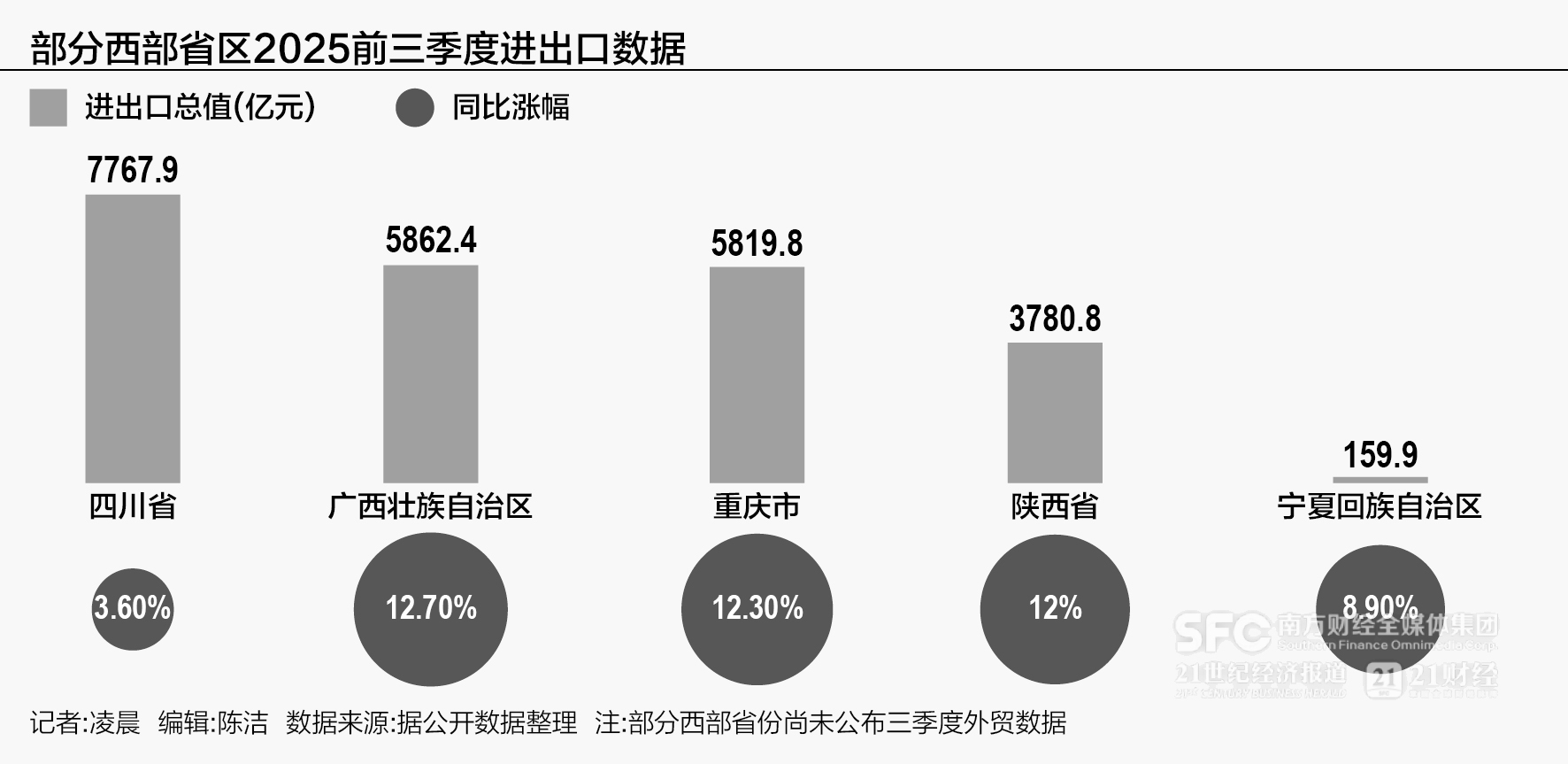
Core Insights - The western provinces of China have shown remarkable performance in foreign trade during the first three quarters of the year, with significant growth rates surpassing the national average [1][5][8] - Key drivers for this growth include deepening economic cooperation with ASEAN and the emergence of new industries [1][5][8] - The transformation from "channel economy" to "industrial economy" is evident in the high-growth provinces, indicating a shift towards more sustainable economic models [9][11] Summary by Category Trade Performance - Shaanxi's total import and export value reached 378.08 billion yuan, with a year-on-year growth rate of 12%, outperforming the national average by 8 percentage points [1][6] - Guangxi's foreign trade value was 586.24 billion yuan, with a growth rate of 12.7%, making it the fastest-growing province in the western region [5] - Chongqing's foreign trade totaled 581.98 billion yuan, achieving a growth rate of 12.3% [5] Key Drivers of Growth - The growth in these provinces is attributed to the continuous deepening of economic cooperation with ASEAN and the diversification of trade methods [5][11] - The "policy empowerment + channel optimization" model has effectively reduced logistics costs and improved customs efficiency [1][8] - The western region is actively undertaking industrial transfers from the eastern provinces and enhancing cooperation with countries along the Belt and Road Initiative [1][2] Industry and Export Trends - In Guangxi, exports of electronic components and computer accessories surged by 56.6% and 146.1%, respectively, indicating a strong integration into the China-ASEAN electronic information supply chain [5][11] - Chongqing's exports of mechanical and electrical products accounted for 90% of its total exports, with notable growth in electric vehicles and laptops [6][11] - Shaanxi's high-tech product exports grew by 11.4%, with "new three types" products (new energy vehicles, lithium-ion batteries, photovoltaic products) seeing a 32.6% increase [6][10] Future Outlook - The western region is expected to gradually form a new foreign trade pattern characterized by multi-point support and internal-external linkage [2][8] - The focus will be on enhancing quality and reducing risks while expanding into high-end equipment and new energy vehicle sectors [7][11] - The integration of policy, industry, and market will be crucial for the future competitiveness of western provinces in foreign trade [11]

广东出台16条措施推动人工智能成制造业“新引擎”
Zhong Guo Xin Wen Wang· 2025-10-22 11:48
Core Viewpoint - Guangdong has introduced a comprehensive action plan to enhance the integration of artificial intelligence (AI) into the manufacturing sector, aiming to establish a globally influential "AI + manufacturing" development demonstration zone by 2027 [1][2]. Group 1: Policy Measures - The action plan includes 16 policy measures focused on strengthening key supply chains and promoting application and adoption of AI in manufacturing [1]. - The initiative emphasizes the construction of vertical large models and scenario-specific small models in key industries such as electronic information and smart home appliances [2]. Group 2: Industrial Support and Infrastructure - Guangdong aims to develop a "diagnosis-transformation-promotion" system for intelligent manufacturing, facilitating the widespread application of AI among small and medium-sized enterprises [2]. - The plan promotes the establishment of AI application pilot bases in cities like Shenzhen and Dongguan, focusing on industrial model applications and technology validation [2]. Group 3: Financial and Talent Support - The government will leverage provincial and municipal special funds and industry development investment funds to support AI-enabled manufacturing, encouraging financial institutions to offer financing services [2]. - There is a focus on cultivating skilled workers through specialized talent policies to enhance the workforce in the AI and manufacturing sectors [2]. Group 4: Innovation Platforms - Guangdong currently hosts 9 national-level innovation platforms and nearly 200 provincial-level platforms, providing robust support for innovation in the manufacturing sector [2]. - The action plan aims to deepen the integration of AI and manufacturing, strengthening the "AI + manufacturing" industry [2].
大涨!LP火力全开
FOFWEEKLY· 2025-10-22 10:21
Core Insights - The article highlights a significant recovery in the private equity market, with institutional LP contributions reaching a peak in September, showing a month-on-month increase of 40.3% and a year-on-year increase of 38.3%, marking the highest level of activity this year [5][29]. - The recovery is supported by a notable increase in fund registrations, with 557 new private equity and venture capital funds registered in September, representing a month-on-month surge of 51.4% and a year-on-year increase of 84.4% [5][29]. Institutional LP Activity - In September, the activity of institutional LPs reached a new high for 2024, with a quarter-on-quarter increase of 9.9% and a year-on-year increase of 11.9% [5]. - The types of LPs contributing to this recovery include industrial, policy, financial, and fiscal LPs, with industrial LPs leading the charge [7][9]. LP Type Structure - The distribution of LP contributions in September shows that industrial LPs accounted for 40.95%, policy LPs for 34.17%, financial LPs for 4.60%, and public LPs for 0.23% [9]. Industrial LP Dynamics - Industrial LPs have regained their dominant position in the market, with a remarkable month-on-month increase of 64% in September, driven primarily by non-listed companies [12][14]. - Government policies, such as tax incentives and relaxed merger loan regulations, have encouraged industrial capital participation, reducing investment costs and risks [12][14]. Policy LP Strategies - Policy LPs remain the largest source of funding, with a month-on-month increase in activity of 17% and a funding scale growth of 41% in September [15][17]. - Government investments are strategically focused on emerging industries aligned with national priorities, such as semiconductors, AI, and renewable energy [15][17]. Financial Institution LPs - Financial institution LPs saw a month-on-month increase in activity of 74% and a funding scale increase of 44% in September, with insurance funds leading the contributions [20]. - The large-scale, long-term investments from insurance funds provide stability to the market, exemplified by significant contributions to various funds [20]. Fiscal LP Contributions - Fiscal LPs have also shown a rapid increase in activity, with a month-on-month rise of 74% in September, aligning their investments closely with local industrial foundations [21]. - Key regions like Guangdong and Shanghai are seeing fiscal LPs focus on sectors such as semiconductors and biomedicine, reflecting a strategic alignment with local industry strengths [21]. Regional Investment Trends - Zhejiang province emerged as the most active region for institutional LP contributions in September, followed by Guangdong and Jiangsu [23]. - Within Zhejiang, cities like Hangzhou, Ningbo, and Jiaxing are leading in contributions, focusing on high-tech sectors such as cloud computing and AI [25]. Overall Market Recovery - The data from September and the third quarter indicate a robust recovery in the primary market, with industrial LPs reclaiming their leading role and policy LPs effectively driving strategic investments [29]. - The collaborative efforts of various LP types and regional strategies demonstrate a strong alignment between capital and local industrial capabilities, fostering a conducive environment for sustained market activity [29].

透视新兴市场“危”与“机”,广交会送上“掘金”指南
21世纪经济报道· 2025-10-22 10:10
Core Viewpoint - The article discusses the opportunities and risks faced by Chinese enterprises as they expand into emerging markets, particularly in the context of the Belt and Road Initiative and the changing global trade environment [1][3]. Group 1: Trade Environment and Market Trends - In the first three quarters of 2025, China's imports and exports to Belt and Road countries reached 17.37 trillion yuan, an increase of 6.2%, accounting for 51.7% of total trade value, up by 1.1 percentage points [1]. - The growth in trade with ASEAN, Latin America, Africa, and Central Asia was 9.6%, 3.9%, 19.5%, and 16.7% respectively, indicating a diversification of China's export markets [1]. - The overall credit risk for small and medium-sized foreign trade enterprises has been on the rise, with an average annual increase of 7.2% in the risk index over the past three years [3][4]. Group 2: Risks in Emerging Markets - The global trade environment is increasingly influenced by protectionism and resource nationalism, leading to heightened uncertainty and risk in international trade [4]. - Labor-intensive industries like textiles and light manufacturing face challenges from trade barriers and raw material cost fluctuations, while technology-intensive sectors like electronics and new energy vehicles encounter rising compliance costs and intense competition [4]. - Emerging market currencies are often volatile, with examples like the Turkish lira experiencing daily fluctuations exceeding 10% [8]. Group 3: Compliance and Legal Risks - Companies expanding into Southeast Asia must be aware of environmental compliance and ESG requirements, as neglecting these can lead to significant penalties and operational disruptions [9]. - Intellectual property risks, such as trademark squatting and technology leakage, are prevalent in Southeast Asia, necessitating proactive measures from companies [9]. Group 4: Strategies for Risk Management - Companies are advised to conduct compliance planning before entering new markets, ensuring that tax compliance is integrated into business strategy [11]. - For managing currency risks, companies can use hedging strategies involving direct transactions with the renminbi or through a two-step process involving the US dollar [11]. - Establishing a knowledge property defense matrix is recommended, including simultaneous IP registration in target countries and monitoring mechanisms to track trademark registrations [13].
一图读懂|《广东省人工智能赋能制造业高质量发展行动方案(2025—2027年)》发布!
机器人圈· 2025-10-22 09:57
Core Viewpoint - The Guangdong Provincial Government has issued the "Action Plan for High-Quality Development of Manufacturing Empowered by Artificial Intelligence (2025-2027)" to promote the digital transformation and intelligent leap of the manufacturing industry through artificial intelligence [4][6][49]. Group 1: Strengthening Key Supply of Industrial AI - Focus on the innovation and development of industrial models, particularly in key industries such as electronic information, smart home appliances, automotive, and robotics [7][15]. - Support the development of vertical large models and specialized small models for quality inspection, process optimization, and equipment maintenance, with funding for eligible projects [7][16]. - Enhance the development and utilization of industrial data by constructing high-quality industry-specific datasets and knowledge repositories [7][17]. - Support the application of intelligent computing power in industrial enterprises, utilizing various data center resources to train and develop industrial models [7][19]. - Promote the creation of high-value industrial intelligent bodies capable of data processing and intelligent decision-making [7][21]. - Foster the development of industrial software and intelligent equipment, integrating AI with industrial internet platforms [7][25]. Group 2: Promoting Large-Scale Application of Industrial AI - Establish a diagnostic and transformation system for manufacturing enterprises, providing guidance on AI application scenarios [8][25]. - Implement benchmark construction actions for "AI + Manufacturing," focusing on various sub-industries to support the penetration of AI applications [8][27]. - Encourage the construction of intelligent supply chains and promote the digital transformation of related enterprises [8][28]. - Accelerate the digital transformation of small and medium-sized enterprises in designated pilot cities, providing funding support for eligible projects [8][29]. - Develop high-standard digital parks to facilitate the intelligent transformation of enterprises within these parks [8][32]. Group 3: Building an AI Support System - Support the establishment of national-level AI application pilot bases and digital transformation promotion centers in cities like Shenzhen and Dongguan [10][36]. - Create innovation platforms for AI in manufacturing, focusing on model algorithm technology and application testing [10][38]. - Promote the landing and application of AI core technologies and products through various initiatives [10][52]. Group 4: Optimizing AI Element Support - Leverage provincial and municipal funds to support the high-quality development of AI in manufacturing, including financial services for AI product development [10][42]. - Cultivate a skilled workforce in AI, focusing on high-level and practical talents through training programs and competitions [10][44]. - Establish an industrial information security service platform to enhance security measures in AI applications [10][46].

重庆市级重点项目前三季度完成投资3566.4亿元
Zhong Guo Xin Wen Wang· 2025-10-22 09:39
Core Insights - Chongqing's key projects completed an investment of 356.64 billion yuan in the first three quarters of the year, significantly contributing to effective investment expansion and economic growth [1] Investment in Key Projects - From January to September, Chongqing's key projects in technology innovation achieved an investment of 3.87 billion yuan, with significant progress in various projects such as the two Jiang New Area industrial development projects reaching 38% completion [1] - The manufacturing sector saw an investment of 68.81 billion yuan, with an annual investment completion rate of 86.1%, exceeding the scheduled progress by 11.1 percentage points [1] Sector-Specific Investments - The new generation electronic information manufacturing sector completed an investment of 14.04 billion yuan, reflecting a year-on-year growth of 29.1% [2] - Investments in intelligent connected new energy vehicles reached 4.99 billion yuan, while advanced materials projects saw an investment of 11.99 billion yuan, achieving an annual investment completion rate of 101.5% [2] Infrastructure Development - Public infrastructure projects in Chongqing completed an investment of 114.43 billion yuan, with significant contributions from rail transit projects (28.17 billion yuan) and urban road and bridge projects (15.22 billion yuan) [3] - The city is focused on enhancing urban safety resilience and optimizing public service supply through these infrastructure investments [3] Future Outlook - The Chongqing Development and Reform Commission emphasizes the importance of the fourth quarter as a critical phase for achieving annual targets, aiming to accelerate project construction and increase tangible work output [3]
工信部发布第七批专精特新“小巨人”企业公示名单 广东新增691家 创历史新高
Nan Fang Ri Bao Wang Luo Ban· 2025-10-22 09:08
Group 1 - Guangdong has a total of 691 enterprises listed in the latest batch of specialized and innovative "little giant" enterprises, marking a historical high and ranking first in the country [1] - The distribution of these enterprises is widespread across 15 cities in Guangdong, with Shenzhen leading with 347 enterprises, followed by Guangzhou, Dongguan, and others [1] - The Guangdong-Hong Kong-Macao Greater Bay Area shows strong innovation momentum, with cities like Shenzhen, Guangzhou, and Dongguan achieving record numbers of "little giant" enterprises [1] Group 2 - The specialized and innovative enterprises are crucial for enhancing the resilience of industrial and supply chains and promoting high-quality economic and social development [2] - The selected enterprises primarily focus on sectors such as artificial intelligence, smart robotics, electronic information, and intelligent manufacturing, indicating a trend towards niche market specialization [2] - Guangdong has accumulated over a thousand enterprises in the artificial intelligence and AR sectors, leading the nation and forming a comprehensive ecosystem of hardware development, algorithm innovation, and application scenarios [2] Group 3 - There is a notable shift in Guangdong's manufacturing sector from focusing on scale and speed to emphasizing technological depth and uniqueness [3] - Many "little and specialized" enterprises are emerging, which may not be prominent but are essential for supporting the next phase of high-quality development [3] - The distribution and direction of these enterprises reflect their increasing integration into core segments of the industrial chain, with some achieving breakthroughs in key materials and components [3]
推动人工智能赋能制造业高质量发展 广东将发放“模型券”“算力券”“训力券”
Nan Fang Ri Bao Wang Luo Ban· 2025-10-22 09:03
Core Viewpoint - Guangdong Province has released an action plan to empower high-quality development in manufacturing through artificial intelligence (AI) from 2025 to 2027, focusing on four main areas and proposing 16 measures to address key challenges in industrial AI implementation [1][2]. Group 1: Key Measures - The action plan emphasizes the establishment of "model vouchers," "computing power vouchers," and "training vouchers" to support enterprises in purchasing industrial model services and reduce costs associated with computing power [1][2][3]. - It aims to strengthen the supply of industrial AI by focusing on key industries such as electronics, smart home appliances, automotive, and robotics, and by supporting the development of large models and specialized small models for specific industrial applications [2][3]. - The plan encourages the construction of high-quality industry-specific data sets and knowledge repositories to facilitate the development of AI applications in manufacturing [2][3]. Group 2: Implementation Strategies - To address the common hesitance among enterprises to adopt AI, the plan proposes providing consulting and diagnostic services to guide industrial enterprises in their digital transformation [4]. - It includes initiatives to establish benchmarks for AI integration in various sectors, such as consumer electronics and advanced materials, and to support projects that meet specific criteria with funding [4][5]. - The plan also outlines the creation of innovation centers in cities like Guangzhou and Shenzhen to foster the development of intelligent systems and core software [3][6]. Group 3: Support and Funding - The action plan emphasizes the importance of a comprehensive support system covering technology validation, platform innovation, and result transformation to ensure AI technologies transition from labs to production lines [6][7]. - It proposes leveraging provincial and municipal funds to support AI-driven manufacturing initiatives, including financial services tailored to AI product development [7]. - The plan aims to cultivate a skilled workforce by designing training programs and establishing training brands to enhance talent in AI and manufacturing [7].
促进先进制造业和现代服务业深度融合
Ren Min Ri Bao· 2025-10-22 07:06
Core Insights - The development of service-oriented manufacturing in China has seen continuous innovation and is widely applied across various manufacturing sectors, covering 36 out of 41 major industrial categories and 161 out of 207 subcategories [1][2] - According to the "Global Service-Oriented Manufacturing Development Index (2024)," China has entered the first tier globally in terms of service-oriented manufacturing development, but still faces challenges such as inadequate understanding, uneven development, and weak supply capabilities of key technologies [1] Group 1 - The key tasks for advancing service-oriented manufacturing include strengthening common technology breakthroughs, exploring new business models and scenarios, and promoting the application and iterative upgrade of research outcomes [1] - There is a focus on stimulating the vitality of business entities by actively cultivating leading enterprises, flagship brands, and transformation solution providers [1] - Local governments are encouraged to focus on their unique advantageous industries to create service-oriented manufacturing hubs [1] Group 2 - The role of productive services in empowering manufacturing should be reinforced, alongside the establishment of a technical promotion service system [1] - The construction of a service-oriented manufacturing standard system is essential, along with strengthening policy support and talent cultivation, and improving public services and international cooperation [1] - The foundation for service-oriented manufacturing development must be solidified by enhancing new information technology infrastructure and developing AI-driven new service scenarios to improve the supply capacity of industrial data elements [1]
成渝双城经济圈这5年:GDP全国占比升至6.5%,人口升至7%
Di Yi Cai Jing· 2025-10-22 06:31
Economic Growth - The Chengdu-Chongqing economic circle has shown significant economic strength and competitiveness, with an average annual GDP growth of 5.4% over the past five years, surpassing the national average by 0.5% [1] - The GDP of the Chengdu-Chongqing economic circle is projected to reach 8.7 trillion yuan by 2024, up from 6.4 trillion yuan in 2019, representing a growth in national share from 6.3% to 6.5% [1] Industrial Development - The region has established four trillion-yuan industrial clusters, including electronic information, equipment manufacturing, advanced materials, and specialty consumer goods, with industrial added value expected to reach 24,230.1 billion yuan by 2024, 1.4 times that of 2019 [1] - The electronic information and biopharmaceutical clusters have been recognized as national advanced manufacturing clusters, and the region has become China's third-largest automotive industry cluster [1] Per Capita Income - Per capita GDP in the Chengdu-Chongqing economic circle has increased significantly, reaching 88,000 yuan by 2024, up from 65,000 yuan in 2019, with an average annual growth rate of 5.3% [2] Population Growth - The permanent resident population in the Chengdu-Chongqing economic circle is expected to reach 98.535 million by the end of 2024, an increase of 435,000 from 2019, accounting for 7% of the national population [2] Urban Development - The economic output of the Chengdu urban area is projected to reach 23,511.3 billion yuan by 2024, while the Chongqing urban area is expected to reach 25,168.5 billion yuan, with both urban areas showing significant growth since 2019 [3] - The Chengdu and Chongqing metropolitan areas have been recognized and are accelerating their development, with their economic totals expected to exceed 29 trillion and 26 trillion yuan respectively by 2024 [3] Regional Integration - The central region of Chengdu-Chongqing is experiencing rapid growth, with an economic total projected to reach 13,963.2 billion yuan by 2024, 1.4 times that of 2019 [3] - Collaborative platforms are being established in neighboring areas, with significant GDP growth in regional center cities such as Nanchong and Dazhou, and Yibin and Luzhou from 2019 to 2024 [3]