新一代信息技术

Search documents
“十五五”时期工业领域重点投资方向研究报告
中国信通院· 2026-01-18 05:46
Investment Trends - The "14th Five-Year Plan" period emphasizes investment in traditional industries focusing on high-end, intelligent, green, and integrated development, with a strong push for technological innovation and transformation[7] - Manufacturing investment growth rates from 2021 to 2024 are projected at 13.5%, 9.1%, 6.5%, and 9.2% respectively, indicating a robust investment environment despite external pressures[17] - In 2025, manufacturing investment growth slowed to 1.9%, a decline of 7.3 percentage points from 2024, highlighting a potential downturn in investment momentum[26] Structural Challenges - Investment efficiency has declined, with the incremental capital output ratio (ICOR) rising to approximately 14.9 from 13.1, indicating increased investment required for each unit of output[32] - The capacity utilization rate for major industrial enterprises was 74.6% in Q3 2025, reflecting a 0.5 percentage point decrease year-on-year, suggesting underutilization of resources[30] - Investment in high-tech manufacturing has significantly slowed, with growth rates dropping below overall manufacturing investment in 2024, indicating structural weaknesses in emerging sectors[32] Strategic Recommendations - Establish a dynamic identification system for investment directions aligned with the "14th Five-Year Plan" to enhance investment effectiveness and adaptability[9] - Focus on four key investment areas: upgrading traditional industries, fostering emerging industries, planning for future industries, and optimizing supply in weak links[44] - Emphasize the importance of human capital alongside material capital in investment strategies to enhance overall economic returns[41]
关于开展2026年度科技成果鉴定工作的通知
机器人圈· 2026-01-16 09:10
Core Viewpoint - The article outlines the organization of the 2026 annual technology achievement appraisal work by the China Electromechanical Integration Technology Application Association, emphasizing the importance of enhancing technological innovation capabilities and the integration of technology and industry [1]. Group 1: Purpose and Principles - The purpose is to enhance the technological innovation strength and level of the industry, accelerating the integration of technological and industrial innovation [2]. - The appraisal work will adhere to principles of independence, fairness, justice, and openness [2]. Group 2: Scope of Appraisal - The appraisal includes new products, processes, methods, materials, equipment, software, designs, technology integration, and applied basic research in fields such as industrial automation, robotics, and intelligent manufacturing [3]. Group 3: Specific Fields of Technology - **High-end Equipment Manufacturing**: Core components of humanoid robots, industrial mother machines, high-end CNC systems, and technologies related to rail transit equipment and new energy equipment [4]. - **Next-Generation Information Technology**: Technologies integrating industrial models, edge computing, AI with manufacturing processes, and data security governance [5]. - **New Energy and Intelligent Vehicles**: Technologies related to solid-state batteries, vehicle-to-grid interactions, and lightweight materials for electric vehicles [6]. - **New Materials and Green Low-Carbon Technologies**: High-performance functional materials, energy-saving technologies, and renewable energy utilization [7]. - **Future Industry Frontiers**: Technologies in brain-computer interfaces, quantum computing, and synthetic biology [8]. - **Traditional Industry Upgrades**: Digital twins, smart production line adaptations, and optimization of key processes [9]. Group 4: Appraisal Conditions - The technology achievements must comply with national laws, industry policies, and be technically mature with innovative characteristics [10][11]. - Achievements should demonstrate leading or advanced performance indicators in their respective fields and have good applicability and promotion prospects [11]. Group 5: Support Policies - Achievements passing appraisal will be included in a project database for quality technology achievements, prioritized for recommendations to government departments for policy support [13]. - Support for participation in national and provincial technology awards and assistance in securing funding for technology transformation [13][14]. - Establishment of platforms for industry-academia-research collaboration and connections with financing institutions [14]. Group 6: Application Process - Projects that meet the appraisal scope can submit written applications to the association, which will conduct formal and technical reviews [15]. Group 7: Material Requirements - Applicants must fill out the technology achievement appraisal application form and submit it in both paper and electronic formats [16]. Group 8: Timeline Requirements - Appraisal materials must be submitted 30 working days prior to the intended appraisal date [17].


20亿,合肥市瑶海科创基金招GP
FOFWEEKLY· 2026-01-14 10:03
Core Viewpoint - The Yaohai Science and Technology Innovation Investment Fund aims to attract social capital into key industries such as new generation information technology, biomedicine, high-end equipment, new materials, new energy, intelligent robotics, and productive services, promoting industrial agglomeration in Hefei's Yaohai District [1][2]. Group 1: Fund Overview - The Yaohai Science and Technology Innovation Investment Fund was established in July 2025 with a total scale of 2 billion yuan [1]. - The fund is managed by Hefei Xingtai Capital Management Co., Ltd. under principles of government guidance, market operation, collaborative interaction, scientific decision-making, and risk prevention [1]. Group 2: Investment Focus - The fund plans to establish up to 2 sub-funds in high-end equipment and new materials, with a maximum commitment of 150 million yuan per sub-fund and a maximum investment ratio of 35% [2]. - Each sub-fund is expected to have a scale of 300 to 500 million yuan, focusing on investments that must not be less than 70% of the declared investment area [2]. - Additionally, the fund plans to set up up to 2 early-stage hard technology sub-funds, primarily investing in seed and angel-stage projects that align with the key industries of Yaohai District, with a maximum commitment of 100 million yuan per sub-fund and a maximum investment ratio of 50% [2].
一图看懂 | 科创综指:科创板新质生产力“全景图”
Xin Lang Cai Jing· 2026-01-14 03:58
(来源:国信证券北京分公司) 编 者 授 近年来,指数体系快速完善,市 场认可度不断提高,指数化投资趋势 加速形成。上交所投教联合中国基金 报、中证指数公司共同推出"一图看 懂指数化投资"系列投教栏目,为广 大投资者带来全面、专业的解读,直 击指数化投资关键要义。 发布背景 随着科创板市场规模的快速扩 大和产业结构的日益完善,投资者迫 切需要一条能够全面、均衡表征科创 板整体运行情况的综合型指数,上证 科创板综合指数(简称科创综指)应 运而生。 科创综指由上海证券交易所与 中证指数有限公司于 2025 年 1 月 20 日发布。该指数的推出,标志着科 创板指数体系建设迈入新阶段,为投 资者提供了首个全面观测和投资科 创板整体走势的权威"全景图 de Property x 8 直 . . . ● . 指数 定位 科创综指定位于覆盖科创板全 市场的综合指数。它纳入了科创板所 有上市时间满一年的非 ST、*ST 证 券,实现对科创板上市公司证券近乎 全域覆盖。目前科创综指样本数量达 576只,市值覆盖度超过90%,总 市值平均数为 163 亿元,与聚焦大 盘龙头股的科创 50 指数形成有效 互补。 总市值平均数 样 ...

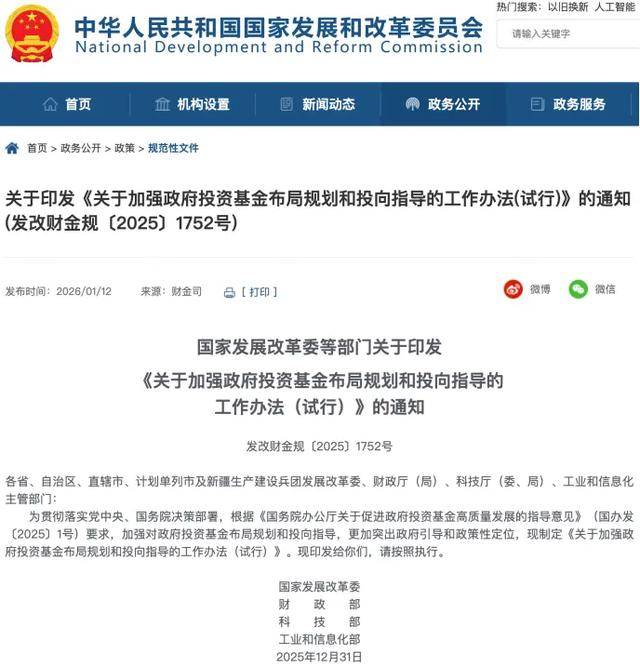
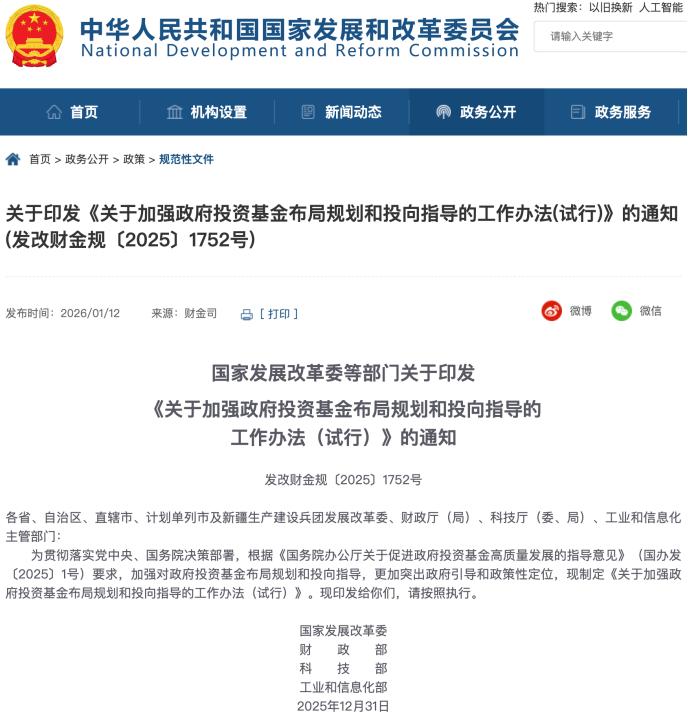
新型储能纳入政府投资基金投向!国家首次作出系统规范
中关村储能产业技术联盟· 2026-01-13 12:15
Core Viewpoint - The article discusses the implementation of a new regulatory framework for government investment funds in China, aimed at optimizing their layout and guiding investment directions to support national strategies and industrial upgrades [2][3][4]. Group 1: Government Investment Fund Overview - Government investment funds are established by various levels of government to guide social capital in supporting industry development and innovation through market-oriented methods such as equity investment [2][12]. - The new framework includes a systematic approach to fund layout and investment direction, marking the first national-level regulation of government investment funds [2][4]. Group 2: Supported Investment Areas - The framework identifies key investment areas, including: - Emerging and future industries such as information technology, new energy, advanced manufacturing, and artificial intelligence [2][3]. - Upgrading traditional industries and supporting high-quality development in manufacturing [3][4]. - Promoting the digital economy through initiatives like "AI+" and the application of 5G technology [3][4]. Group 3: Policy Measures - The framework outlines 14 policy measures focusing on three main aspects: where to invest, how to invest, and who manages the funds [3][4]. - It emphasizes early, small, long-term investments in hard technology and aims to prevent homogeneous competition and crowding out of social capital [11][12]. Group 4: Evaluation Management - An evaluation management method has been established to assess the investment direction of government funds, focusing on compliance with national planning and industry directories [4][5]. - The evaluation system includes three main indicators: policy compliance (60% weight), optimization of productivity layout (30% weight), and policy execution capability (10% weight) [6][7]. Group 5: Specific Evaluation Indicators - The evaluation indicators cover aspects such as support for new productivity, technology innovation, green development, and the promotion of private investment [29][33]. - Specific metrics include the proportion of investments in encouraged industries, the effectiveness of fund management, and the impact on social welfare [29][33][40].
万亿级“国家队”投资方向,明确了
3 6 Ke· 2026-01-13 08:27
Core Viewpoint - The article discusses the newly released "Work Method" which systematically regulates the layout and investment direction of government investment funds for the first time at the national level, aiming to guide the development of trillion-level government investment funds in China [1][7]. Group 1: Policy Measures - The "Work Method" proposes 14 policy measures focusing on three aspects: where to invest, how to invest, and who manages the funds [2][3]. - It emphasizes optimizing fund allocation to support major strategies, key areas, and weak links in resource allocation, promoting deep integration of technological and industrial innovation, and nurturing emerging pillar industries [2]. Group 2: Investment Guidance - Funds must align with national major plans and encourage industries listed in the national industrial directory, avoiding investments in restricted, eliminated, or prohibited sectors [3]. - Provincial development and reform departments are tasked with creating local priority investment lists to optimize fund allocation and direction [3]. Group 3: Evaluation Indicators - The "Management Method" establishes three primary and thirteen secondary indicators for evaluating fund performance, with a focus on policy compliance (60% weight), optimization of productivity layout (30% weight), and policy execution capability (10% weight) [4][6]. - The evaluation will consider whether fund investments support the development of new productive forces, including emerging and future industries such as AI, quantum information, and advanced manufacturing [4][5]. Group 4: Regional Strategy Alignment - The evaluation also assesses the alignment of fund investments with national regional strategies, including support for various regional development initiatives like the Western Development and Northeast Revitalization [6]. - Funds that meet these regional strategy requirements will receive higher evaluation scores [6]. Group 5: Differentiated Development - The National Development and Reform Commission highlights the need for differentiated development of government investment funds, addressing issues like mismatched local resources and homogeneous investment directions [7][8]. - National funds are to focus on supporting the construction of a modern industrial system and overcoming key technological challenges, while local funds should align with local industry foundations and development realities [8].
重磅利好!万亿级“国家队”投向明确了
Zhong Guo Jing Ji Wang· 2026-01-13 02:32
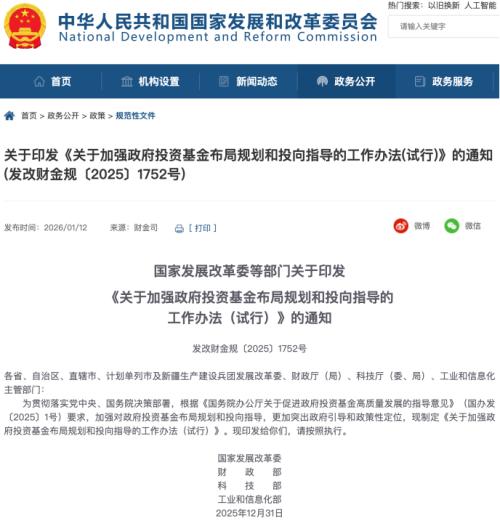
Core Viewpoint - The Chinese government has established a systematic framework for the development and direction of government investment funds, marking the first time such guidelines have been issued at the national level [1]. Group 1: Policy Framework - The "Work Method" outlines three main aspects: where to invest, how to invest, and who manages the funds, proposing 14 policy measures [3]. - The framework emphasizes supporting major strategies and key areas, particularly in sectors where market resources are insufficient, promoting deep integration of technological and industrial innovation, and focusing on nurturing emerging pillar industries [3]. Group 2: Investment Guidance - Funds must align with national major plans and encourage industries listed in the national industrial directory, while avoiding investments in restricted, eliminated, or prohibited sectors [3]. - Provincial development and reform departments are tasked with creating lists of key investment areas to optimize fund allocation [3]. Group 3: Evaluation Metrics - The "Management Method" establishes three primary indicators: 1. Policy compliance (60% weight), assessing the fund's role in supporting new productive forces, technological innovation, and green development [4]. 2. Optimization of productive layout (30% weight), evaluating alignment with national regional strategies and effective capacity utilization [5]. 3. Policy execution capability (10% weight), focusing on fund efficiency and the professional level of fund managers [5]. Group 4: Focus Areas - The investment focus includes emerging industries such as next-generation information technology, new energy, high-end equipment, and green technology, as well as future industries like the metaverse, brain-computer interfaces, and generative artificial intelligence [5].
京津冀协同创新指数年均增速达13.1%
Ren Min Ri Bao· 2026-01-12 22:54
Core Insights - The Beijing-Tianjin-Hebei collaborative innovation index has significantly increased from 100 in 2013 to 388.0 in 2024, with an average annual growth rate of 13.1% [1] - Beijing has established a dense cluster of major scientific and technological infrastructure, with 37 technology facility platforms in the Huairou Comprehensive National Science Center, 29 of which are already in research status [1] - The region has 145 national key laboratories, accounting for nearly 30% of the national total, indicating a strong research capacity [1] - In 2024, Beijing published 11,915 high-level scientific papers in top journals like Nature, Science, and Cell, representing 17.1% of the national share [1] - Beijing has maintained its position as the global leader in fields such as physical sciences, chemistry, and earth and environmental sciences since 2016 [1] Industry Developments - The integration of technological innovation and industrial innovation in the Beijing-Tianjin-Hebei region has shown initial success, with several innovation clusters recognized [2] - The "Beijing-Tianjin-Hebei New Generation Information Technology Application Innovation Cluster," "Beijing-Tianjin-Hebei Safety Emergency Equipment Cluster," "Beijing-Tianjin-Hebei Integrated Circuit Cluster," and "Beijing-Tianjin-Hebei Intelligent Connected New Energy Vehicle Cluster" were included in the second batch of national advanced manufacturing clusters in 2024 [2] - The region now hosts a total of 7 national advanced manufacturing clusters, highlighting its growing industrial capabilities [2]
重磅利好,万亿级“国家队”投向明确了
2 1 Shi Ji Jing Ji Bao Dao· 2026-01-12 16:52
Group 1 - The National Development and Reform Commission, Ministry of Finance, Ministry of Science and Technology, and Ministry of Industry and Information Technology jointly released guidelines for the planning and investment direction of government investment funds, marking the first systematic regulation at the national level [1] - The evaluation of fund investment direction will focus on whether it supports the development of new productive forces, with targeted sectors including emerging industries and future industries [1] - Emerging industries include next-generation information technology, new energy, new materials, high-end equipment, new energy vehicles, green environmental protection, and civil aviation, while future industries encompass the metaverse, brain-computer interfaces, quantum information, and humanoid robots [1] Group 2 - On January 12, the A-share trading volume reached a historical high of 3.6 trillion, with over 4,100 stocks in the market showing positive performance [2]
利好来了!万亿级“国家队”投向明确,四部门联合发布
Sou Hu Cai Jing· 2026-01-12 15:54
Core Viewpoint - The National Development and Reform Commission and three other departments have issued a significant document to guide the planning and investment direction of government investment funds, marking the first systematic regulation at the national level for these funds [1][2]. Group 1: Investment Direction and Areas - The government investment funds will focus on supporting the development of new productive forces, with key areas including emerging industries such as new generation information technology, new energy, new materials, high-end equipment, new energy vehicles, green environmental protection, civil aviation, and marine engineering equipment [1][5][7]. - Future industries highlighted include the metaverse, brain-computer interfaces, quantum information, humanoid robots, generative artificial intelligence, biomanufacturing, biological breeding, future displays, future networks, and new energy storage [1][5][7]. Group 2: Policy Measures and Guidelines - The document outlines 14 policy measures focusing on three main aspects: where to invest, how to invest, and who manages the funds [5][6]. - It emphasizes the need for funds to support major strategies and key areas, particularly in sectors where market resources are inadequately allocated, promoting deep integration of technological and industrial innovation [5][6]. Group 3: Evaluation and Management - The newly established evaluation management method includes three primary indicators: policy compliance (60% weight), optimization of productive force layout (30% weight), and policy execution capability (10% weight) [6][7]. - The policy compliance indicator assesses the fund's role in supporting new productive forces, technological innovation, and green development, among other areas [7][8]. Group 4: Regional Focus and Local Fund Management - Local funds are required to align their investment directions with local industrial foundations and development realities, focusing on industrial upgrades and enhancing innovation capabilities [6][8]. - The document also mandates that local funds support small and micro enterprises and technology-based startups, guiding social capital to participate effectively [6][8].