家电

Search documents
权威数读|这些数据,让“购在中国”熠熠生辉!
Xin Hua She· 2026-01-26 12:20
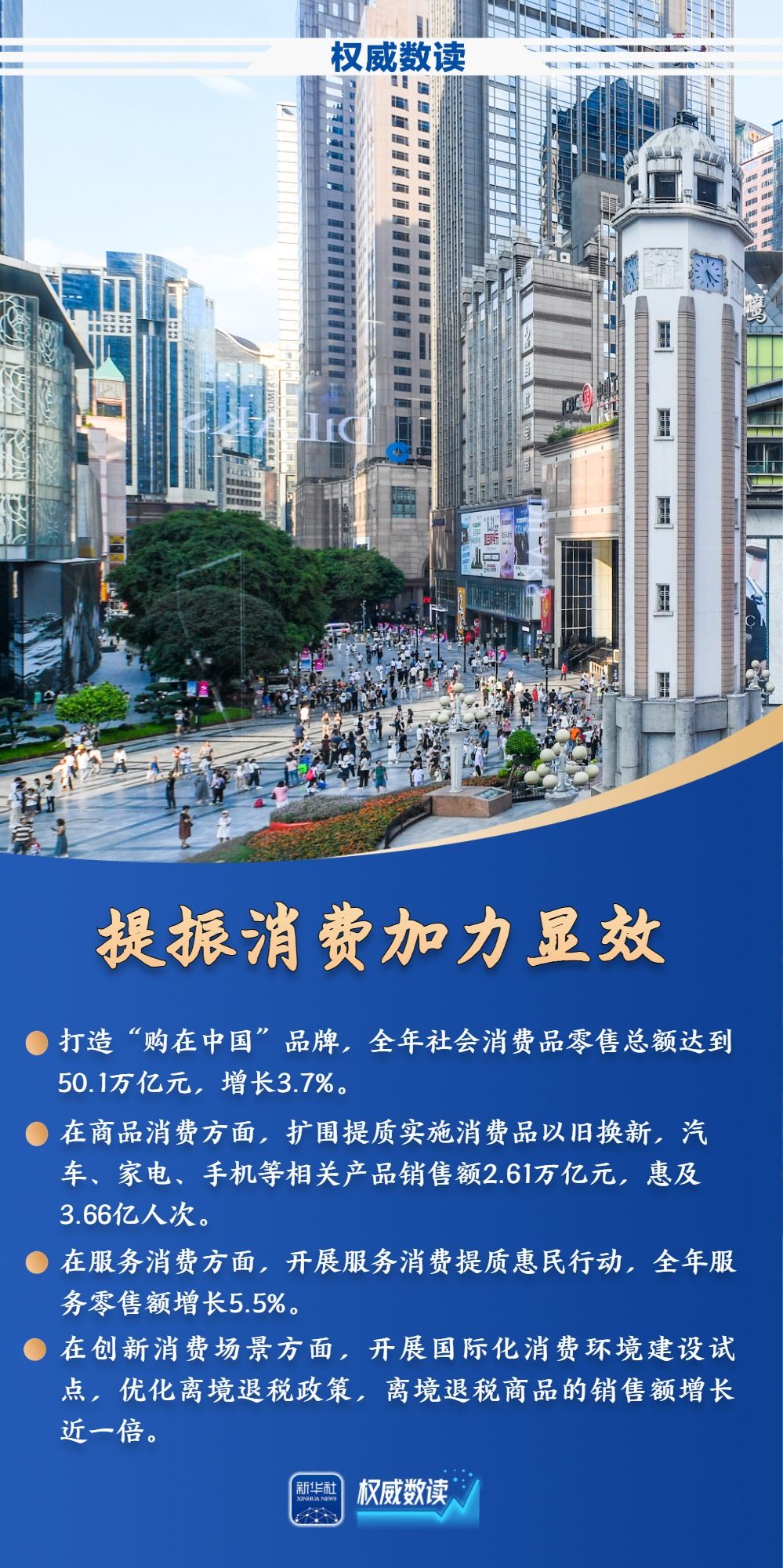
Group 1 - The core viewpoint of the article emphasizes the integration of policies and activities to stimulate consumption, with a target of exceeding 50 trillion yuan in total retail sales of consumer goods in 2025 [1] Group 2 - In terms of goods consumption, the implementation of a trade-in program for consumer goods resulted in sales of 2.61 trillion yuan, benefiting 366 million people [4] - For service consumption, a quality improvement initiative led to a 5.5% increase in service retail sales for the year [4] - The establishment of international consumption environment pilot projects and optimization of the outbound tax refund policy contributed to the growth in sales of tax refund eligible products [4] Group 3 - The development of goods, services, and digital trade as three pillars is being coordinated to expand diversified markets and promote trade innovation [12] - In 2025, the total import and export value of goods is projected to reach 45.47 trillion yuan, reflecting a growth of 3.8%, while service imports and exports increased by 7.1% to 7.2 trillion yuan in the first eleven months [12] - The number of active enterprises with import and export records exceeded 780,000, with private enterprises accounting for 57.3% of total foreign trade [12] Group 4 - The "Invest in China" brand is being continuously enhanced, with over 70,000 new foreign-funded enterprises established in the year, marking a growth of 19.1%, and foreign investment absorption reaching 747.69 billion yuan, with high-tech industries accounting for 32.3% [14] - The overseas comprehensive service system is being improved, with non-financial direct investment abroad reaching 1 trillion yuan for the year [15]

权威数读|社零总额首破50万亿元!2025年提振消费加力显效
Xin Hua She· 2026-01-26 12:20
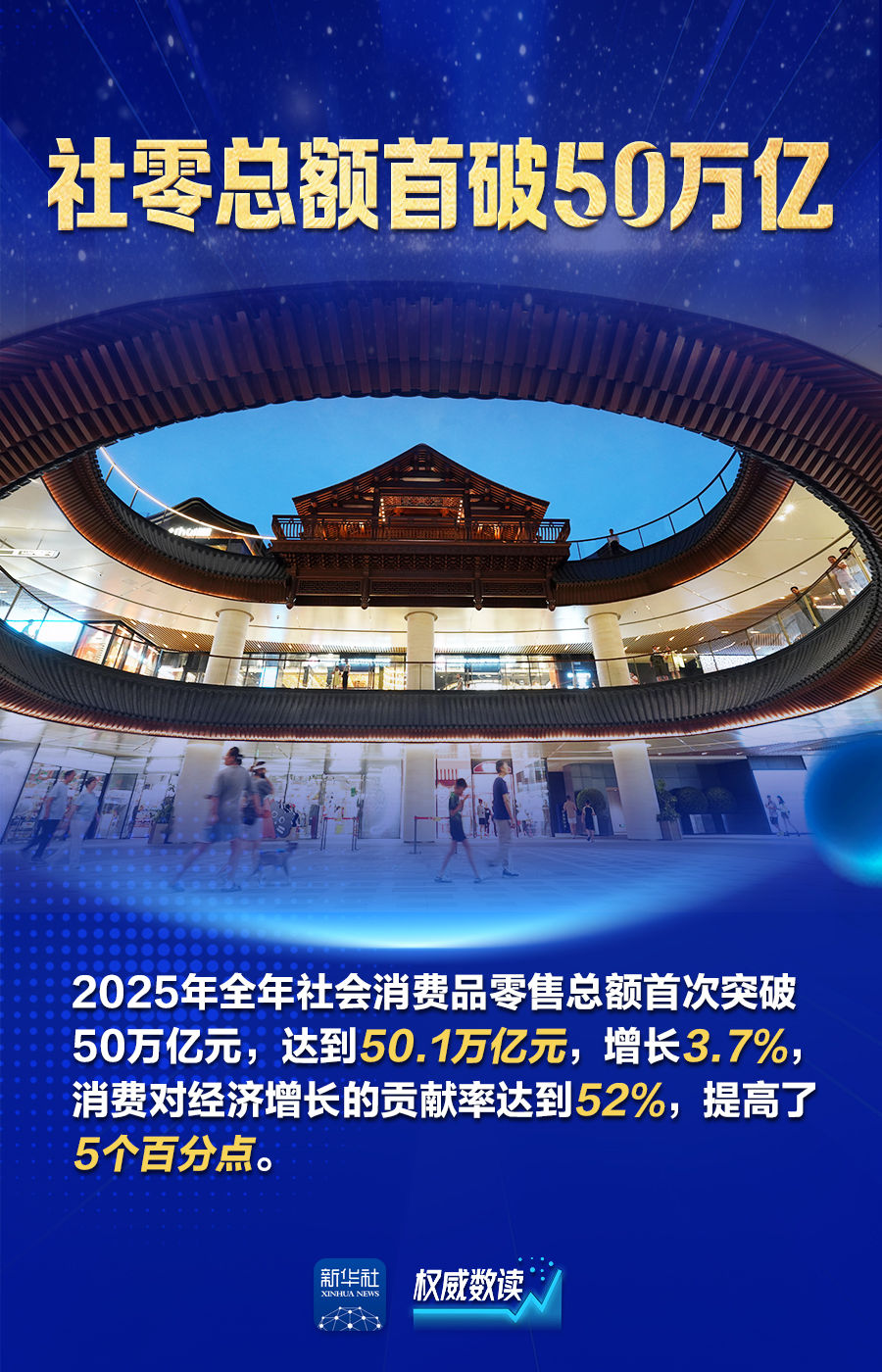
Group 1 - The core viewpoint of the article highlights the robust vitality of China's consumer market in 2025, with total retail sales of consumer goods exceeding 50 trillion yuan for the first time and consumption contributing 52% to economic growth [1] - The "old-for-new" policy and initiatives like "China Purchase" and "Guochao Culture" have become prevalent, indicating a shift in consumer behavior and preferences [1] - The article emphasizes that consumption continues to play a pivotal role as the main engine of economic development, providing significant opportunities for countries worldwide [1] Group 2 - The sales revenue of related products under the "old-for-new" policy, including automobiles, home appliances, and mobile phones, reached 2.61 trillion yuan [4] - Retail sales of household appliances, communication equipment, and furniture increased by 11%, 20.9%, and 14.6% respectively, while passenger car retail volume rose by 3.8% [11] - The online retail sales of physical goods grew by 5.2%, and the market penetration rate of new energy passenger vehicles reached 53.9% [14] Group 3 - Per capita service consumption expenditure increased by 4.5%, accounting for 46.1% of total per capita consumption expenditure, with sectors like leisure, tourism, and transportation showing double-digit growth [8] - Rural retail sales of consumer goods reached 6.8 trillion yuan, growing by 4.1%, outpacing urban growth by 0.5 percentage points [17]
出台扩大入境消费的政策措施!商务部最新发声
Zhong Guo Zheng Quan Bao· 2026-01-26 12:06
Core Viewpoint - The Ministry of Commerce aims to strengthen domestic circulation, facilitate international circulation, and promote high-quality business development to contribute to the successful start of the 14th Five-Year Plan [1] Group 1: Policy Measures - Policies to expand inbound consumption will be introduced [2][6] - A national-level overseas comprehensive service platform will be launched to provide a one-stop service for businesses going abroad [7] Group 2: Market Access and Service Industry - Focus on expanding market access and opening up sectors such as telecommunications, healthcare, and education [3][8] - Support for foreign-funded enterprises in the service industry to extend their value chains and achieve specialized, integrated, and intelligent development [9] Group 3: Consumer Promotion - Implementation of a consumption upgrade program to promote durable goods consumption, including automobiles and home appliances [4][10] - Conducting pilot reforms in automotive circulation consumption to further unleash automotive consumption potential [5][10] Group 4: Trade and Export Development - Strengthening foreign trade policies to support enterprises in reducing costs and increasing efficiency, with a focus on diverse market expansion [6] - Promoting green trade and enhancing the international competitiveness of green low-carbon products [6][7] Group 5: Digital Trade and Innovation - Initiating the establishment of a national digital trade demonstration zone and developing relevant standards for digital trade [7] - Encouraging the digital transformation of service outsourcing and fostering the growth of digital trade entities [7] Group 6: Consumer Environment Improvement - Accelerating the cultivation of international consumer center cities and improving the international consumption environment [10] - Organizing over 20 "Buy in China" themed activities to create a vibrant consumption atmosphere [10]
商务部:将优化实施消费品以旧换新,开展汽车流通消费改革试点
2 1 Shi Ji Jing Ji Bao Dao· 2026-01-26 12:02
Core Insights - The core message of the news is the significant growth in China's consumer market in 2025, with a focus on various consumption sectors and the government's initiatives to boost consumption further in 2026. Group 1: Overall Consumption Growth - In 2025, China's total retail sales of consumer goods exceeded 50 trillion yuan, reaching 50.1 trillion yuan, with a growth rate of 3.7% and a contribution rate to economic growth of 52%, an increase of 5 percentage points [1] - The sales of major consumer goods, including automobiles, home appliances, and mobile phones, amounted to 2.61 trillion yuan, benefiting 366 million people [1] Group 2: Highlights of the Consumption Market - Durable goods consumption saw rapid growth, with retail sales of home appliances, communication equipment, and furniture increasing by 11%, 20.9%, and 14.6% respectively, while passenger car retail volume rose by 3.8% [2] - New consumption trends, such as digital, green, and health consumption, are thriving, with online retail sales of physical goods growing by 5.2% and the penetration rate of new energy passenger vehicles reaching 53.9% [2] - Rural consumption is becoming more active, with retail sales in rural areas reaching 6.8 trillion yuan, growing by 4.1%, outpacing urban growth by 0.5 percentage points [2] - Inbound consumption is increasing, with the expansion of visa-free countries and optimized tax refund policies, leading to a near doubling of sales in tax refund goods [2] Group 3: Future Initiatives for Consumption Boost - The Ministry of Commerce plans to implement special actions to boost consumption, focusing on policy issuance, event organization, and improvement of consumption environments [3][5] - Specific policies will include optimizing the old-for-new consumption program and promoting reforms in automotive circulation to unleash consumption potential [3] - The Ministry will organize over 20 "Buy in China" themed events and support local activities to enhance consumer engagement [5] - Efforts will be made to cultivate international consumption center cities and promote new consumption scenarios and business models [5]
权威数读丨这些数据,让“购在中国”熠熠生辉!
Xin Hua Wang· 2026-01-26 11:52
Group 1 - The core viewpoint of the article emphasizes the integration of policies and activities to stimulate consumption, with the total retail sales of social consumer goods expected to exceed 50 trillion yuan for the first time in 2025, highlighting the "Buy in China" brand [1] Group 2 - In terms of goods consumption, the implementation of a trade-in program for consumer goods resulted in sales of 2.61 trillion yuan, benefiting 366 million people [4] - For service consumption, a quality improvement initiative led to a 5.5% increase in service retail sales for the year [4] - The establishment of international consumption environment pilot projects and optimization of the tax refund policy for outbound tourists contributed to the growth in sales of tax refund goods [4] Group 3 - The foreign trade sector remains robust, with total imports and exports projected to reach 45.47 trillion yuan, reflecting a growth of 3.8%, while service imports and exports increased by 7.1% to 7.2 trillion yuan [12] - The number of active enterprises engaged in import and export activities exceeded 780,000, with private enterprises accounting for 57.3% of the total foreign trade volume [12] Group 4 - The "Invest in China" brand continues to gain traction, with over 70,000 new foreign-funded enterprises established in the year, marking a 19.1% increase, and foreign investment absorption reaching 747.69 billion yuan, with high-tech industries accounting for 32.3% [14] - The overseas comprehensive service system was improved, with non-financial direct investment abroad totaling 1 trillion yuan for the year [15]
海尔智家(06690.HK)1月23日耗资11.1万欧元回购股份
Ge Long Hui· 2026-01-26 11:49
格隆汇1月26日丨海尔智家(06690.HK)公告,1月23日耗资11.1万殴元回购5.3万股D股,回购价格每股 2.08-2.1015欧元。 ...

商务部:优化实施消费品以旧换新,促进汽车、家电等大宗耐用商品消费
Xin Lang Cai Jing· 2026-01-26 11:15
今天(1月26日),国新办就2025年商务工作及运行情况举行新闻发布会。 发布会上介绍,2026年商务部将深入实施提振消费专项行动,围绕出政策、办活动、优场景三个方面开 展工作。 今天(1月26日),国新办就2025年商务工作及运行情况举行新闻发布会。 发布会上介绍,2026年商务部将深入实施提振消费专项行动,围绕出政策、办活动、优场景三个方面开 展工作。 一是出政策,加大惠民力度。优化实施消费品以旧换新,促进汽车、家电、数码和智能产品等大宗耐用 商品消费。开展汽车流通消费改革试点,进一步释放汽车消费潜力。开展好有奖发票试点工作,上周末 有奖发票试点城市名单已经开始公示了。推动出台促进首发经济等一批务实管用的政策举措。 二是办活动,营造消费氛围。聚焦商品消费、服务消费和消费场景三大主题,我们将在今年组织开展20 多场"购在中国"专题活动,组织15个国际化消费环境试点城市举办"城市专场"活动,支持各地举办"地 方站"活动,通过主题统一、特色鲜明的活动矩阵,营造浓厚消费氛围。 三是优场景,改善消费环境。加快国际消费中心城市培育建设,推进国际化消费环境建设试点和消费新 业态新模式新场景试点工作,打造一批带动面广、显 ...
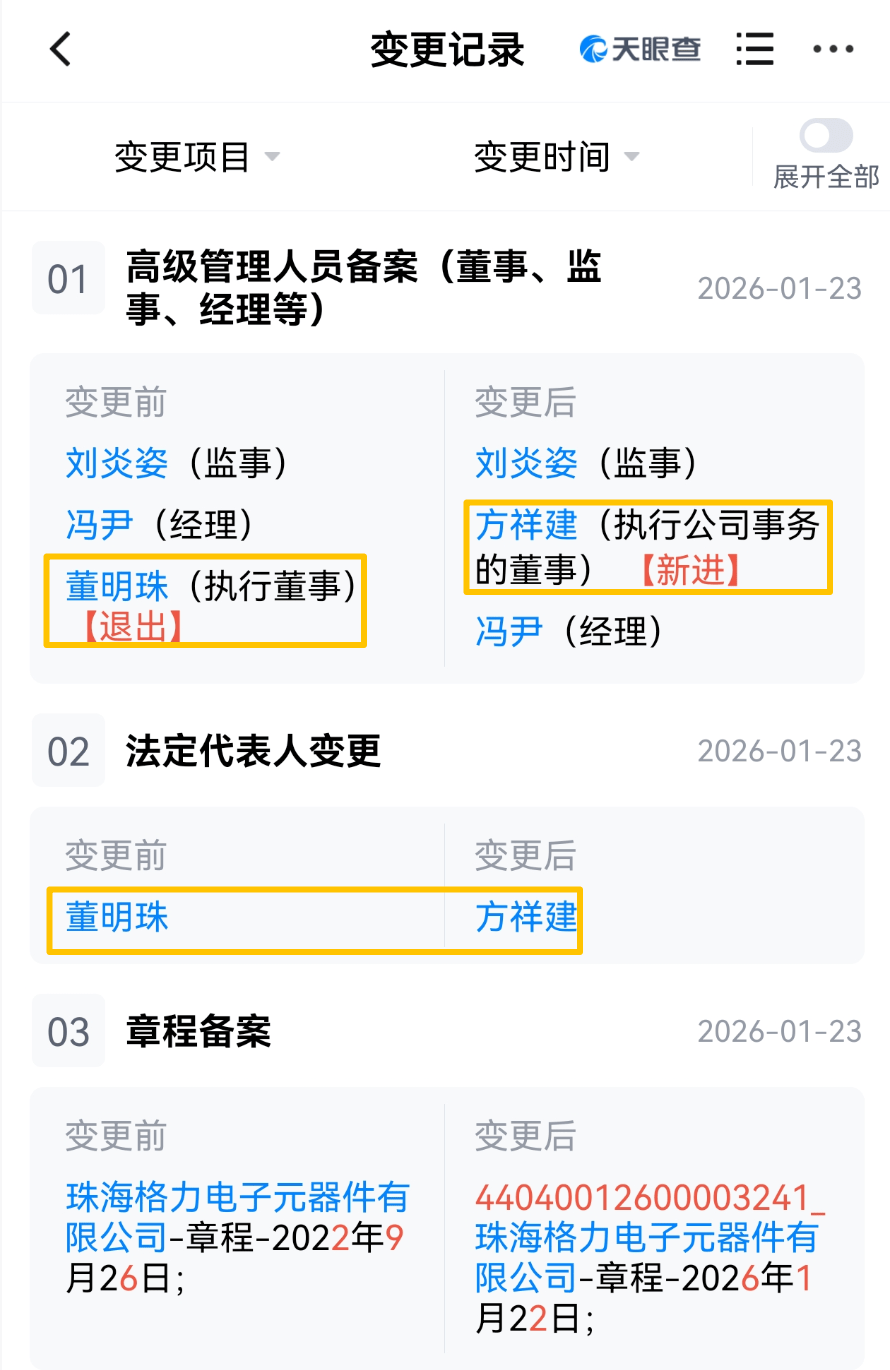
董明珠卸任格力电子元器件公司法定代表人、执行董事,方祥建接任
Sou Hu Cai Jing· 2026-01-26 10:56
Group 1 - Dong Mingzhu has resigned as the legal representative and executive director of Zhuhai Gree Electronics Components Co., Ltd., with Fang Xiangjian taking over these roles [1] - Fang Xiangjian has been with Gree Electric for many years and has served as the vice president since November 2021 [5] - Zhuhai Gree Electronics Components Co., Ltd. was established in July 2022 with a registered capital of 100 million RMB, focusing on the manufacturing and wholesale of electronic components [5] Group 2 - Dong Mingzhu previously stepped down from her position as the legal representative and chairman of Zhuhai Zero Boundary Integrated Circuit Co., Ltd. in June 2025, which focuses on integrated circuit chip design and sales [6] - Gree Electric has been involved in the chip industry since 2015, with a planned annual production capacity of 240,000 pieces for its first-phase chip factory [6] - Gree's self-developed chips are used in home air conditioning products, with approximately 30% of applications being self-researched, and they are also utilized in commercial air conditioning, smart equipment, and industrial robots [6] Group 3 - Gree established the Zero Boundary company in 2018 for chip design and the electronics components company in 2022, focusing on silicon carbide chip design and testing [7] - The silicon carbide chip factory began construction in December 2022, with plans to achieve product line completion by the end of 2023, targeting an annual production capacity of 240,000 six-inch silicon carbide wafers [7] - Gree Electric's chip sales are expected to exceed 300 million pieces in 2025 [7] Group 4 - Recent reports indicate that Gree's silicon carbide chips are expanding into new markets, including photovoltaic energy storage and logistics vehicles [6][7] - There were rumors regarding Gree supplying half of the chips to GAC Group, which GAC has publicly denied, stating that such claims are not factual [7]

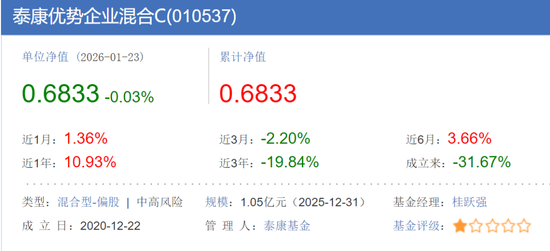
基金满仓老登股血亏30%,自己买科技小登赚翻5000万!泰康基金经理神操作让基民破防了
Xin Lang Cai Jing· 2026-01-26 10:52
来源丨深蓝财经 撰文丨王鑫 基民的钱包在白酒家电的泥潭里越陷越深,同一基金经理的个人账户却在科技股的狂欢中一路高歌。这 不是电影情节,这是正在发生的现实。 基金评论区已经炸锅了。 愤怒的投资者们发现了一个令人心寒的真相:他们信任的基金经理,正用两种完全不同的策略对待资金 ——一种让基民躺平,一种留给自己躺赢。 泰康基金经理桂跃强因此被推上风口浪尖。这位管理着超20亿元资产的"资深人士",用基民的钱五年死 守白酒、家电等传统板块,基金亏损高达30%,管理费却照收不误;而据多方信源透露,他自己的账户 早已重仓科技股,一度浮盈超过5000万元。 1 五年死守"老登股", 基民血亏30% 公开资料显示,桂跃强目前管理6只基金,其中独立管理两只偏股型基金:泰康优势企业混合基金和泰 康蓝筹优势一年持有股票基金。 然而,桂跃强却选择了一条令人费解的道路:死守白酒、家电。 翻开泰康蓝筹优势一年持有股票基金的十大重仓股持仓记录,可以看到一种令人震惊的"稳定性"。 这两只基金自成立以来,业绩均表现惨淡。泰康优势企业混合基金在2020年底成立,至今已超过五年, 目前仍亏损近30%。 | 泰康优势企业混合C(010537) | | ...
2025年最新业绩预告开箱:利润暴增1400%全靠炒股票?
市值风云· 2026-01-26 10:15
Core Viewpoint - Solid growth in core business is essential for companies to navigate through economic cycles [1] Performance Growth Highlights - **XianDao Intelligent (300450)**: Expected net profit of 150 million to 180 million, a year-on-year increase of 424.29% to 529.15% due to recovery in global battery demand and internal digital transformation [6] - **YongChuang Intelligent (603901)**: Expected net profit of 12.8 million to 15.5 million, a year-on-year increase of 721.57% to 894.86% driven by improved delivery efficiency and product structure optimization [7] - **DaoShi Technology (300409)**: Expected net profit growth of 206.01% to 269.76% due to increased production capacity and recovery in cobalt prices [8] - **FuDa Alloy (603049)**: Expected net profit growth of 119.14% to 219.95% supported by stable demand in power equipment and new energy sectors [9] - **ZhaoJin Gold (000506)**: Expected net profit of 12.2 million to 18.2 million, a turnaround from a loss of 127 million last year, driven by increased production and rising gold prices [10] - **SiTeWei (688213)**: Expected net profit of 97.635 million to 103.053 million, a year-on-year increase of 149% to 162% due to increased shipments of smartphone camera products [11] - **ZhongWei Semiconductor (688380)**: Expected net profit of around 28.4 million, a year-on-year increase of approximately 107.55% due to new product launches [12] - **Hunan Gold (002155)**: Expected net profit of 127 million to 160.8 million, a year-on-year increase of 50% to 90% driven by rising sales prices [13] - **NanFang Precision (002553)**: Expected net profit of 30 million to 37 million, a year-on-year increase of 1,130% to 1,417% due to investment project evaluations [14] - **Shanghai YiZhong (688091)**: Expected net profit of 6 million to 7 million, a year-on-year increase of 760.18% to 903.54% due to inclusion in the national medical insurance directory [15] - **RunTu Co., Ltd. (002440)**: Expected net profit of 60 million to 70 million, a year-on-year increase of 181.05% to 227.89% driven by improved operating profits [16] Major Performance Changes - **HeFu China (603122)**: Expected net loss of 36 million to 25 million, a shift from profit due to changes in the macro environment and industry policies [17] - **ChangJiu Logistics (603569)**: Expected net loss of 75 million to 50 million, a shift from profit due to asset impairment and operational challenges [18] - **ZhiChun Technology (603690)**: Expected net loss of 45 million to 30 million, a shift from profit due to increased competition and rising R&D costs [19] - **BaYi Steel (600581)**: Expected net loss of 205 million to 185 million, a shift from profit due to supply-demand imbalance in the steel industry [20] - **AoKeMa (600336)**: Expected net loss of 22 million to 17 million, a shift from profit due to increased competition in the home appliance sector [21] - **HuiDa Sanitary Ware (603385)**: Expected net loss of 21.6 million to 18 million, a shift from profit due to market demand decline [22] - **DongFeng Co. (600006)**: Expected net loss of 48 million to 39 million, a shift from profit due to competitive pressures in the commercial vehicle market [23] Industry Trend Analysis - **High Growth Industries**: Stable demand in new energy sectors benefits companies like FuDa Alloy [24] - **Performance Changes in Industries**: - New energy and lithium battery equipment sectors are experiencing explosive growth [25] - Gold and precious metals sectors are seeing significant profit improvements due to high prices [26] - Semiconductor and automotive electronics are benefiting from trends in smart vehicles [27] - Medical circulation is under pressure from cost control policies [28] - Logistics and transportation are facing profitability challenges due to falling prices [29] - Semiconductor equipment is experiencing short-term performance declines due to cyclical fluctuations [30] - Traditional manufacturing sectors like steel and home appliances are facing intensified competition [31]