
房地产

Search documents
【数据发布】2026年1月中国采购经理指数运行情况
中汽协会数据· 2026-02-02 05:03
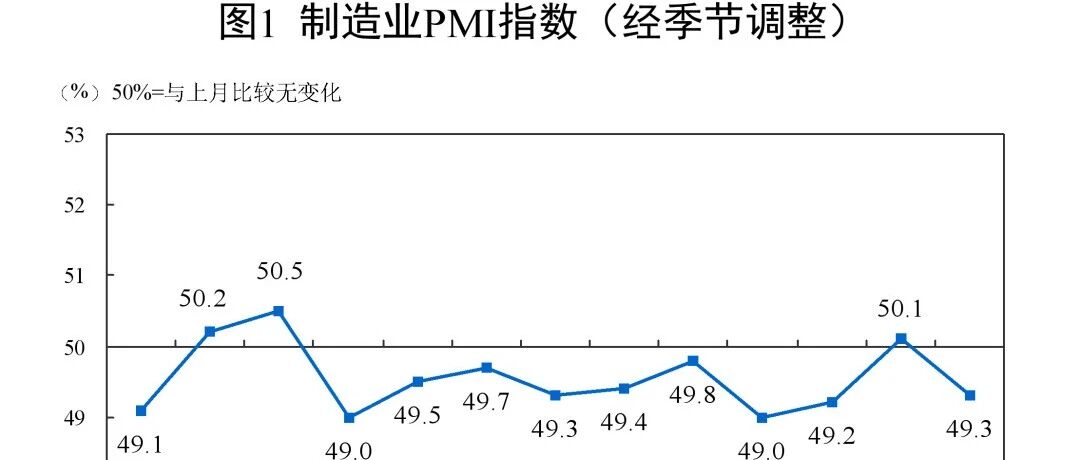
Group 1: Manufacturing PMI Overview - In January, the Manufacturing Purchasing Managers' Index (PMI) was 49.3%, a decrease of 0.8 percentage points from the previous month, indicating a decline in manufacturing activity [1] - Large enterprises had a PMI of 50.3%, down 0.5 percentage points, while medium and small enterprises had PMIs of 48.7% and 47.4%, down 1.1 and 1.2 percentage points respectively, both below the critical point [3] - The production index was 50.6%, down 1.1 percentage points, indicating continued expansion in manufacturing production [3] - The new orders index was 49.2%, down 1.6 percentage points, suggesting a slowdown in market demand [3] - The raw materials inventory index was 47.4%, down 0.4 percentage points, indicating a continued decrease in major raw material inventories [3] - The employment index was 48.1%, down 0.1 percentage points, reflecting a slight decline in employment conditions within manufacturing [3] - The supplier delivery time index was 50.1%, down 0.1 percentage points, indicating that supplier delivery times continued to accelerate [4] Group 2: Non-Manufacturing PMI Overview - In January, the Non-Manufacturing Business Activity Index was 49.4%, a decrease of 0.8 percentage points from the previous month [6] - The construction industry business activity index was 48.8%, down 4.0 percentage points, while the service industry business activity index was 49.5%, down 0.2 percentage points [8] - The new orders index for non-manufacturing was 46.1%, down 1.2 percentage points, indicating a decline in market demand [13] - The input prices index was 50.0%, down 0.2 percentage points, indicating stable input prices for non-manufacturing enterprises [13] - The sales prices index was 48.8%, up 0.8 percentage points, suggesting a narrowing decline in sales prices [13] - The employment index was 46.1%, stable from the previous month, indicating stable employment conditions in non-manufacturing [13] - The business activity expectation index was 56.0%, down 0.5 percentage points, remaining in a high optimism range [14] Group 3: Comprehensive PMI Overview - In January, the Comprehensive PMI Output Index was 49.8%, a decrease of 0.9 percentage points, indicating a general slowdown in production and business activities compared to the previous month [18]

众赢财富通:市场修复窗口期消费与地产链增配预期升温
Cai Fu Zai Xian· 2026-02-02 05:01
Core Viewpoint - The A-share market is gradually stabilizing after previous adjustments, with opportunities for structural recovery in sectors that are relatively undervalued and have clear fundamentals or expectations [1][6] Group 1: Market Sentiment and Fund Behavior - The wide-based ETF is facing redemption pressure, indicating that institutional funds have not significantly increased their allocation to index-weighted sectors [3] - Market risk appetite has not broadly increased but shows clear structural differentiation, with funds favoring sectors with valuation recovery potential rather than simply returning to blue-chip stocks [3][4] - The consumption chain is identified as a clear allocation direction, with the period leading up to the "Two Sessions" being a critical window for increasing exposure to this sector [4][5] Group 2: Sector Analysis - The consumption chain's performance is not a broad-based rally but exhibits structural characteristics, with some sectors having already recovered valuations and being sensitive to short-term data [4] - The real estate chain is also gaining attention, with some sectors becoming desensitized to new construction data, shifting focus to policy support and industry clearing processes [4][5] - Historical trends suggest that the recovery in the real estate chain typically progresses from downstream to upstream, with current strength in building materials driven by valuation recovery and expectation improvement rather than a comprehensive demand rebound [4][6] Group 3: Strategic Insights - Current market conditions present opportunities, particularly in sectors that are relatively undervalued and have clear logic, which are more likely to achieve excess returns during fund rotation [5] - The period around the "Two Sessions" remains a significant window for policy and expectation, with active trading around macro goals and industry policy directions [5][6] - The transition from "emotional recovery" to "structural validation" is crucial, with the consumption and building materials sectors forming key components of the current market narrative [6]

旭辉控股集团(00884)强制可转换债券已转换超8.15亿美元 首次定期强制转换未触发
智通财经网· 2026-02-02 04:36
Core Viewpoint - CIFI Holdings Group (00884) announced that the first scheduled mandatory conversion record date will occur on January 29, 2026, which is one month after the issuance date [1] Group 1 - According to the trust deed, if the total principal amount of the mandatory convertible bonds converted before or on January 29, 2026, does not exceed 20% of the total principal amount of the bonds (approximately $815 million), a scheduled mandatory conversion will be triggered [1] - As the actual total principal amount of the mandatory convertible bonds converted before or on January 29, 2026, has exceeded $815 million, there will be no scheduled mandatory conversion for the first record date [1]
旭辉控股集团强制可转换债券已转换超8.15亿美元 首次定期强制转换未触发
Zhi Tong Cai Jing· 2026-02-02 04:34
Core Viewpoint - CIFI Holdings Group (00884) announced that the first scheduled mandatory conversion record date has occurred on January 29, 2026, which is one month after the issuance date [1] Group 1 - According to the trust deed, if the total principal amount of the converted mandatory convertible bonds before or on January 29, 2026, does not exceed 20% of the total principal amount of the mandatory convertible bonds (approximately $815 million), it will trigger a scheduled mandatory conversion [1] - As the actual total principal amount of mandatory convertible bonds converted before or on January 29, 2026, has exceeded $815 million, there will be no scheduled mandatory conversion for the first scheduled mandatory conversion record date [1]
ETF午评 | 有色板块现跌停潮,黄金股ETF工银、黄金股票ETF跌停
Ge Long Hui· 2026-02-02 04:25
Market Performance - The Shanghai Composite Index fell by 1.32%, while the ChiNext Index decreased by 1.18% [1] - Significant declines were observed in gold and base metals, with oil, gas, coal, chemicals, and steel sectors also experiencing notable drops [1] - Agriculture, semiconductors, and real estate sectors showed considerable declines [1] Sector Highlights - The ultra-high voltage concept stocks rose against the trend, with active movements in the liquor, cultivated diamond, and AI application sectors [1] - In the ETF market, the New Economy ETF from Yinhua and the Education ETF from Bosera increased by 4.73% and 4% respectively [1] - The electric grid equipment sector saw strong gains, with ETFs from Huaxia, Guangfa, and Guotai rising by 2.72%, 2.28%, and 2.23% respectively [1] - The food and beverage sector also performed well, with the liquor ETF from Penghua and the food and beverage ETF from Huabao increasing by 1.85% and 1.55% respectively [1] - The photovoltaic sector was active, with the photovoltaic ETF from Yifangda rising by 1.15% [1] Declines in Specific Sectors - The metals sector faced a wave of limit-downs, with gold stock ETFs such as ICBC, gold stocks ETF, and gold stock ETF hitting the limit down [1] - The semiconductor sector experienced a downturn, with the China-Korea semiconductor ETF dropping by 7% [1]
以后的黄金会是以前的房子吗?
Sou Hu Cai Jing· 2026-02-02 04:02
Core Viewpoint - The recent volatility in precious metal prices, particularly gold and silver, has led to significant financial losses for investors, raising questions about the future of gold as an investment compared to real estate [2][3][5][11]. Precious Metals Market - Gold prices experienced a dramatic drop, with a single-day decline of 9.25% on January 30, marking the largest drop since 1983, falling from $5,627 to $4,682 per ounce [3]. - Silver also saw a significant decline, dropping from a high of $122 to $74.28 per ounce [3]. - The global precious metals market lost over $3.4 trillion in value, equivalent to the total market capitalization of the cryptocurrency market [4]. Investor Impact - Approximately 220,000 investors faced liquidation, with total losses exceeding $900 million, leading to substantial financial distress for many [5]. Comparison of Gold and Real Estate - Gold is viewed as a financial and safe-haven asset, driven by global credit and demand for safety, while real estate is considered a tangible asset with value based on local supply and demand [7][9]. - The current trend shows a shift from a booming real estate market to a more differentiated one, while gold is experiencing increased demand due to central bank purchases [11][14]. Market Dynamics - Real estate prices are influenced by regional factors such as population movement and government policies, while gold prices are determined by global economic conditions, geopolitical risks, and monetary policies [16][19]. - The liquidity of gold is significantly higher than that of real estate, allowing for easier transactions and lower costs [20]. Investment Strategy - Investors are advised to view gold as part of a diversified asset allocation rather than a direct replacement for real estate investments [20].

先导基电股价跌5.12%,国泰基金旗下1只基金位居十大流通股东,持有641.21万股浮亏损失621.97万元
Xin Lang Cai Jing· 2026-02-02 03:34
Group 1 - The stock price of Xian Dao Ji Dian fell by 5.12% to 17.97 CNY per share, with a trading volume of 423 million CNY and a turnover rate of 2.49%, resulting in a total market capitalization of 16.723 billion CNY [1] - Xian Dao Ji Dian, established on October 28, 1991, and listed on April 7, 1993, is primarily engaged in the core equipment for integrated circuits and photovoltaics, as well as real estate [1] - The revenue composition of Xian Dao Ji Dian includes 75.14% from bismuth deep processing and compounds, 14.57% from real estate, 10.18% from specialized equipment manufacturing, and 0.11% from other sources [1] Group 2 - Guotai Fund's Guotai Zhongzheng Semiconductor Materials and Equipment Theme ETF (159516) entered the top ten circulating shareholders of Xian Dao Ji Dian, holding 6.4121 million shares, which is 0.69% of the circulating shares, with an estimated floating loss of approximately 6.2197 million CNY [2] - The Guotai Zhongzheng Semiconductor Materials and Equipment Theme ETF was established on July 19, 2023, with a latest scale of 9.011 billion CNY, and has achieved a year-to-date return of 19.49% [2] - The fund manager of Guotai Zhongzheng Semiconductor Materials and Equipment Theme ETF is Ai Xiaojun, who has a total tenure of 12 years and 24 days, managing assets totaling 186.973 billion CNY [2] Group 3 - Guotai Fund's Guotai Guozheng Real Estate Industry Index A (160218) increased its holdings in Xian Dao Ji Dian by 17,600 shares, bringing its total to 645,200 shares, which constitutes 2.7% of the fund's net value, with an estimated floating loss of about 625,800 CNY [3] - The Guotai Guozheng Real Estate Industry Index A was established on January 1, 2021, with a latest scale of 294 million CNY, and has a year-to-date return of 6.12% [3] - The fund manager of Guotai Guozheng Real Estate Industry Index A is Wu Zhonghao, who has a tenure of 4 years and 7 days, managing assets totaling 24.055 billion CNY [4]

多产品涨价,继续看好大化工板块投资机会
Zhong Guo Neng Yuan Wang· 2026-02-02 03:34
Group 1 - The core viewpoint of the report highlights the strong demand in the AI industry, which is driving the entire related industrial chain upward, with various segments showing significant performance improvements [1][2] - In the equipment segment, ASML reported explosive Q4 performance, with strong storage demand leading to a doubling of orders and an upward revision of the 2026 growth guidance [1][2] - In the power generation segment, GE Vernova's Q4 revenue exceeded expectations, with backlogged orders reaching a historical high of $150 billion [1][2] - In the storage segment, SK Hynix's Q4 operating profit more than doubled year-on-year, marking its strongest performance ever [1][2] - Seagate Technology indicated in a conference call that its 2026 capacity has been fully allocated and discussions for 2027 orders have begun [1][2] - In the chip segment, Intel reported a surge in CPU demand but is facing supply shortages [1][2] Group 2 - The domestic market experienced fluctuations, with the Shenwan Chemical Index dropping by 0.86%, underperforming the CSI 300 Index by 0.94% [2] - Multiple products in the basic chemical industry saw price increases this week, including dyes and para-nitrochlorobenzene, accelerated by the cancellation of export tax rebates [2] - The real estate sector is witnessing the end of the "three red lines" policy, leading to a more stable and healthy market as old cycle risks are gradually cleared [3][4] - ByteDance and Alibaba are set to launch new AI models around the Spring Festival, with Alibaba increasing its investment in AI and cloud computing from 380 billion to 480 billion yuan over the next three years [2] - The Clawdbot AI agent has gained significant attention in the tech community, being viewed as a potential "ChatGPT moment" for 2026 [4]
2026年1月PMI数据点评
Ping An Securities· 2026-02-02 03:34
Group 1: PMI Overview - The comprehensive PMI index for January 2026 is 49.8%, a decrease of 0.9 percentage points from the previous month[3] - The manufacturing PMI is at 49.3%, down 0.8 percentage points, indicating a contraction in the sector[3] - The service sector PMI is 49.5%, reflecting a slight decline of 0.2 percentage points[3] Group 2: Price Trends - The manufacturing raw material purchase price index increased by 3.0 percentage points to 56.1%, indicating accelerated expansion[3] - The factory price index rose by 1.7 percentage points to 50.6%, marking the first time in 20 months it has exceeded the critical point[3] - The service sector sales price index improved by 0.8 percentage points to 48.9%[3] Group 3: Sector Performance - High-tech and equipment manufacturing PMIs are at 52.0% and 50.1%, respectively, remaining above the expansion threshold[3] - The construction sector PMI fell to 48.8%, a decrease of 4 percentage points, influenced by low temperatures and the upcoming Spring Festival[3] - The construction sector's new orders and business activity expectation indices dropped by 7.3 and 7.6 percentage points, respectively[3]
投资前瞻:沪市首份年报将出炉,CME上调期货保证金
Sou Hu Cai Jing· 2026-02-02 02:31
Market News - The central bank will have a total of 17,615 billion yuan in reverse repos maturing this week, with specific maturities of 1,505 billion yuan, 4,020 billion yuan, 3,775 billion yuan, 3,540 billion yuan, and 4,775 billion yuan from Monday to Friday. Additionally, 7,000 billion yuan in 91-day reverse repos will mature on Wednesday [1] - The official manufacturing PMI for January in China has returned to the contraction zone at 49.3%, a decrease of 0.8 percentage points month-on-month. The non-manufacturing PMI also fell to 49.4%, down 0.8 percentage points, indicating a decline in manufacturing and non-manufacturing activity due to seasonal factors and insufficient market demand [2] - A series of new regulations will take effect starting in February, including the "Encouragement of Foreign Investment Industry Catalog (2025 Edition)" and various regulations aimed at promoting fair competition and addressing issues in government procurement [3] - The U.S. Labor Department is set to release the January non-farm payroll report, with expectations of an increase of 64,000 jobs and an unemployment rate holding steady at 4.4% [4] Sector Events - The AWE Asia 2026, an Asian virtual reality XR industry exhibition, will be held in Singapore from February 2 to 4, featuring a new Gaming Hub section for XR game creators and developers [5] - The 2026 Brain-Computer Interface Developers Conference will take place in Tianjin on February 3-4, focusing on open-source technology and commercial applications in the brain-computer interface sector [6] - A seminar on the review of the photovoltaic industry in 2025 and outlook for 2026 will be held in Beijing on February 5, inviting industry leaders and experts to analyze the development of the photovoltaic sector [7] - The Chicago Mercantile Exchange has announced an increase in margin requirements for platinum and palladium futures, effective after the market closes on February 2 [8] Individual Company News - Minexplosion Optoelectronics plans to acquire 51% of Xiamen Xizhi Precision Technology Co., Ltd. in cash, with the stock resuming trading on February 2. This acquisition will expand the company's business into high-end PCB drilling technology [10] - Vanke A announced the suspension of multiple domestic corporate bonds due to changes in subsequent transfer arrangements, effective from February 2 [11] - Jihua Group is planning a change in control as its major shareholder is in discussions to transfer part of its stake, leading to a suspension of trading from February 2 [12] Lock-up Expiration - A total of 42 companies will have lock-up shares released this week, amounting to 4.657 billion shares with a total market value of 1,036.69 billion yuan based on the closing price on January 30. The peak release day is February 2, with 18 companies releasing shares worth 607.1 billion yuan, accounting for 58.56% of the week's total [13][14] New Stock Calendar - Two new stocks are set to be issued this week, with a total issuance of approximately 54.53 million shares and expected fundraising of 1.558 billion yuan [17] Institutional Outlook - CITIC Securities indicates that space photovoltaic technology is transitioning from concept to large-scale deployment, driven by new demands from "space computing + AI" and the global competition for low Earth orbit resources [18][19] - CITIC Securities also predicts that demand for computing power will continue to rise, supported by the increasing need for cloud computing resources and ongoing iterations of AI models [20] - Huatai Securities notes that the recent performance of A-share real estate stocks has outperformed the market, driven by low valuations and improving fundamentals [21] - ShenGang Securities suggests that the white liquor sector may see a recovery in market performance ahead of fundamental improvements, with potential opportunities arising from inventory clearance and operational improvements [22]
