
核能

Search documents
大外交|马克龙欲为东南亚提供“第三条道路”,但“可靠伙伴”人设难掩困局
Xin Lang Cai Jing· 2025-05-27 08:28
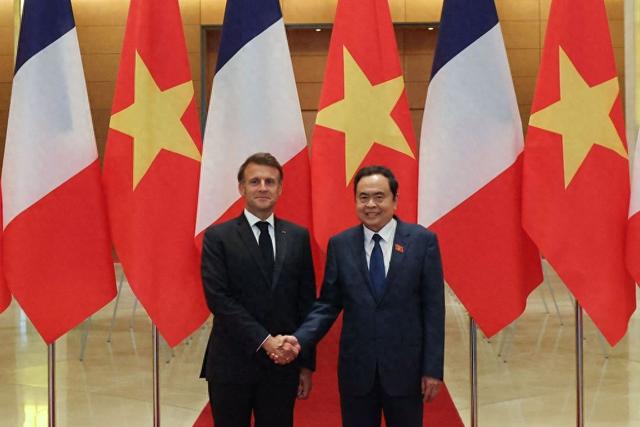
据央视新闻报道,当地时间5月25日,法国总统马克龙抵达越南首都河内开始为期三天的国事访问。这 是法国总统自1973年两国建交以来第五次访问越南,也是马克龙就任总统以来首次访问越南。 当地时间 2025年5月26日,法国总统马克龙与越南国会主席陈青敏在河内国会大厦会晤。视觉中国 图 越南是马克龙此次东南亚之行的首站。据法新社报道,5月25日至5月31日,马克龙将先后对越南、印度 尼西亚和新加坡进行访问,并出席在新加坡举行的香格里拉对话会。法国《西南报》报道,马克龙此行 旨在将法国塑造为东盟国家"可靠、尊重主权与独立"的合作伙伴,为该地区国家提供有别于中美的"第 三条道路"。 上海国际问题研究院东南亚研究中心主任周士新在接受智通财经(www.thepaper.cn)采访时表示,在当 前国际形势发生如此剧烈变动的情况下,马克龙此访一方面为加强法国和欧洲与东南亚国家的经贸关 系,在全球经济形势不确定的情况下,为法国经济发展提供信心。同时,马克龙也希望能够加强和东南 亚国家的安全合作,增强法国在东南亚的"存在度"和"影响力"。 复旦大学中欧关系研究中心主任简军波告诉智通财经(www.thepaper.cn),越南、印尼 ...

港股概念追踪|美国准备大建核电站 天然铀显著受益核电需求增长(附概念股)
智通财经网· 2025-05-27 02:10
作为现有核电技术的直接燃料来源,天然铀的需求增长将伴随美国核能规模扩充、SMR应用推广进一 步强化,而福岛核事故后的10年核电低迷塑造的供给困境虽在近两年缓解,但远期的供需矛盾仍未解 决。 5月以来,笼罩在天然铀市场的不确定性逐步消除,现货价格逐步向上修复至71美元/磅,仍然看好:短 期因贸易情绪所致的价格低迷终将伴随情绪回归理性而逐步修复至长协价格附近水准。 投行Jefferies表示,美国总统特朗普签署的四项以核能为重点的行政命令标志著美国数十年来对核能产 业最大力度的干预。 分析师Daniel Roden表示,这些政策要求美国核能管理委员会进行监管改革,加快先进反应堆的开发, 并支持整个核燃料循环前端。该机构表示,这些行政命令到2035年可能带来约35吉瓦的新增核电装机容 量,同时其他资产将得到升级并延长服役时间。 智通财经APP获悉,5月23日,美国总统特朗普签署4项行政命令推动美国核能产业改革,包括扩大美国 核能规模、核能产业链、缩短核电项目审批周期等;此举或吹响美国核电复兴号角,受政策影响,上周 五美股核能股普遍大涨。 Jefferies表示:"这意味著到2035年,U3O8的需求量预计将从每年4 ...

5月27日电,港股中核国际高开15%,昨日收涨129.78%。
news flash· 2025-05-27 01:26
Group 1 - The stock of China Nuclear International opened 15% higher and closed with a gain of 129.78% on the previous day [1]
晚报 | 5月27日主题前瞻
Xuan Gu Bao· 2025-05-26 15:11
Group 1: Flash Memory Market - TrendForce predicts a 10% quarter-on-quarter increase in NAND flash prices by Q3 2025, driven by AI demand and enterprise SSD growth [1] - Major NAND flash manufacturers, including Samsung and SK Hynix, have reduced production by 10%-15% in Q2 2023 to address oversupply [1] - The storage price trend shows a rebound in Q2 2023, with DRAM and NAND flash contract prices expected to rise by 3%-8% [1] Group 2: Star Flash Technology - Huawei's WATCH5 series will be the world's first smartwatch to support Star Flash technology, which is expected to disrupt the short-range wireless communication market [2] - Star Flash technology is projected to reach a global market size of over $6 billion by 2025, with a compound annual growth rate of 117.2% [2] Group 3: Nuclear Power Industry - The U.S. government plans to construct 10 large nuclear power plants by 2030 and quadruple nuclear power capacity by 2050, aiming to reform the nuclear energy sector [3] - Domestic projects related to nuclear fusion are accelerating, with significant achievements in high-temperature plasma research [3] Group 4: AI Computing Power - Huawei has launched the Ascend Super Node technology, which is the largest scale interconnection in the industry, enhancing AI computing capabilities [4] - The demand for computing power in North America is creating growth opportunities for the AI industry and related supply chains [4] Group 5: Humanoid Robots - The first global competition featuring humanoid robots took place in Hangzhou, marking a significant milestone for the robotics industry [5] - The humanoid robot sector is expected to accelerate development, with increased policy support and market participation from various industry players [5] Group 6: 5G Satellite Communication - The International Telecommunication Union has approved a detailed specification for 5G satellite radio interfaces, enhancing the integration of satellite and terrestrial communication systems [6] - The development of 5G non-terrestrial networks (NTN) is expected to enable seamless global coverage and low-latency communication [6]
欧洲股市大涨!黄金跳水,一度跌破3330美元
21世纪经济报道· 2025-05-26 11:55
Market Overview - European stock markets opened higher, with Germany's DAX index rising by 1.76%, France's CAC40 increasing by 1.32%, and the Euro Stoxx 50 up by 1.64% [1] - As of 19:45, the DAX index was up 1.70%, CAC40 was up 1.18%, and Euro Stoxx 50 was up 1.50% [1] Gold and Currency Trends - Spot gold prices fell below $3,330 per ounce, trading at $3,330.71 per ounce as of 19:45 [2] - The COMEX gold futures were reported at $3,329.80 per ounce [2] - The US dollar index weakened, reported at 99.0539, down 0.07% as of May 26, 19:45 [3] US Debt Market Concerns - The US national debt reached $36.89 trillion, with interest payments projected to rise from $564.24 billion in 2019 to $1.11 trillion by 2025, becoming the second-largest budget item after Social Security [7] - The recent tax and spending bill passed by the House is expected to increase the fiscal deficit by $3.8 trillion over the next decade, raising concerns about the sustainability of US government debt [7] - The 10-year Treasury yield closed at 4.507%, down 0.46%, indicating rising bond prices amid market fears [7] Bond Market Reactions - On May 21, the US Treasury auctioned $15.78 billion in 20-year bonds with a high yield of 5.047%, causing market panic and raising concerns about a potential collapse in the US bond market [8] - The yield on 20-year bonds has significantly increased compared to previous rates, reflecting investor anxiety over inflation due to ongoing tariff negotiations [8] Tariff Policy Impact - The uncertainty surrounding US tariff policies has led to market volatility, with President Trump's threats of increased tariffs causing significant declines in major stock indices and fluctuations in other asset classes [6][10] - The upcoming Personal Consumption Expenditures (PCE) index may reveal different insights compared to the Consumer Price Index (CPI), potentially affecting market expectations [10]


揭秘涨停 | 资金抢筹核聚变龙头
Zheng Quan Shi Bao· 2025-05-26 10:49
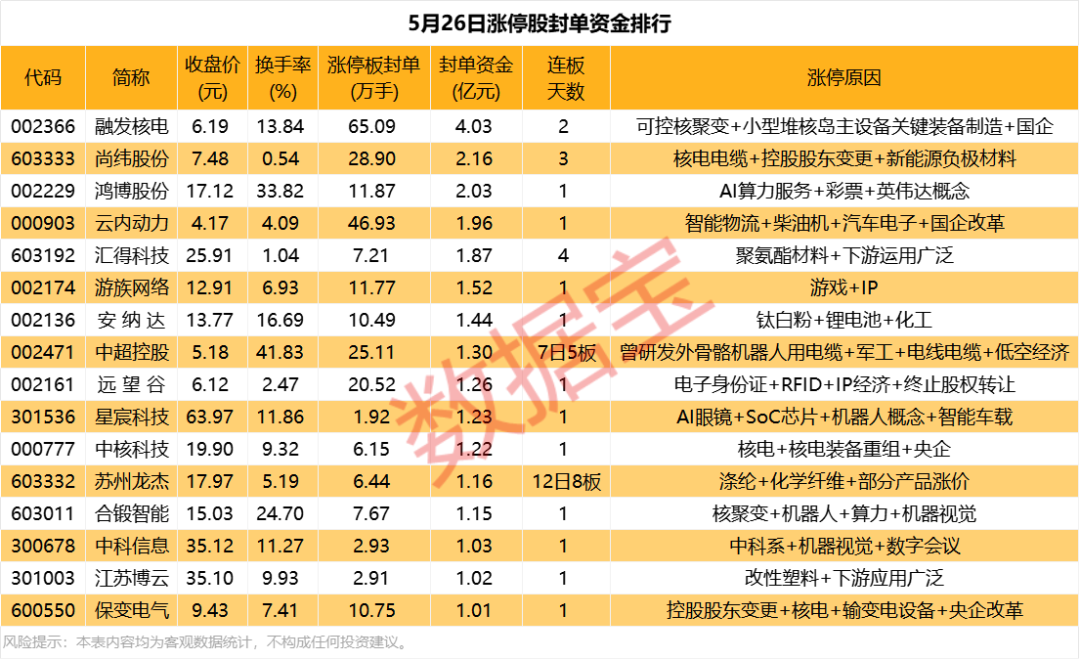
Core Viewpoint - The article highlights the significant trading activity in stocks related to nuclear energy and digital economy sectors, with a focus on the top performers in terms of trading volume and market interest on May 26. Group 1: Nuclear Energy Sector - Rongfa Nuclear Power leads the trading volume with 650,900 shares and a total capital of 403 million yuan, benefiting from its involvement in key nuclear projects like the Huaneng Shidaowan High-Temperature Gas-Cooled Reactor demonstration project [2][3][5]. - Other notable stocks include Shangwei Co. and Hongbo Co., with trading volumes of 289,000 shares and 118,700 shares, respectively, and capital amounts of 216 million yuan and 203 million yuan [2][3][5]. - The sector is experiencing a boost due to recent U.S. administrative actions aimed at reforming nuclear energy regulations, which may accelerate the development of nuclear fusion technology [4]. Group 2: Digital Economy Sector - Stocks such as Zhongke Information and Hongbo Co. are gaining traction, with Zhongke Information focusing on smart governance and urban development, contributing to the digital transformation of traditional industries [7]. - The digital economy segment is also represented by companies like Xiangyou Technology, which supports the postal industry's digital needs, indicating a broader trend towards technological integration in various sectors [7]. Group 3: Trading Activity Insights - A total of 16 stocks had capital exceeding 100 million yuan in trading volume, indicating strong investor interest [3]. - The article notes that institutional investors are actively participating, with significant net purchases in stocks like Xinbang Intelligent and Xingchen Technology, reflecting confidence in these sectors [8].

美银:带你走进核聚变反应堆!不产生钚或浓缩铀,强大到举起航空母舰的超导磁体!
智通财经网· 2025-05-26 10:18
Core Insights - The recent State Council meeting approved the "Manufacturing Green Low-Carbon Development Action Plan (2025-2027)", which is expected to boost nuclear energy, environmental protection, and photovoltaic sectors [1] - Trump's announcement of a new nuclear policy aims to initiate the construction of 10 large nuclear power plants by 2030 and quadruple the U.S. nuclear power capacity by 2050, leading to a surge in nuclear-related stocks [1] - Bank of America organized a field trip to leading nuclear fusion research centers in France, including the CEA and ITER, to provide investors with insights into the latest developments in nuclear fusion technology [1][4] Nuclear Fusion Research - Nuclear fusion is considered a key to decarbonization and is viewed as the "holy grail" of energy transition, offering a safe and sustainable path for clean energy [2] - The ITER project, with a budget of $22 billion, aims to demonstrate the feasibility of large-scale nuclear fusion power generation and is a multinational collaboration involving several countries [3][7] - The CEA's WEST tokamak recently set a world record by maintaining nuclear fusion plasma at 50 million degrees Celsius for 22 minutes, contributing to the testing of components needed for ITER [3][20] Technical Challenges and Innovations - Achieving nuclear fusion requires creating plasma at temperatures ten times hotter than the sun, which presents significant engineering challenges, particularly in material science [2][11] - The ITER project aims for a 10:1 energy gain ratio, which will be achieved by scaling up the machine size compared to existing reactors [12] - Key challenges include developing materials that can withstand extreme temperatures and neutron damage, effective heat management, and ensuring the self-recycling of tritium fuel [13] Economic and Geopolitical Aspects - The ITER project involves seven participating countries, sharing costs and intellectual property, highlighting the importance of international cooperation despite geopolitical tensions [8] - The potential for nuclear fusion to provide zero-carbon energy and serve as a heat source for industrial processes could significantly enhance energy security [6] Future Prospects - The timeline for ITER's full operation has been pushed to 2039 due to technical and regulatory delays, but the project is expected to create commercial potential for various technologies [16] - The construction of superconducting magnets for ITER is underway, with the capability to generate a magnetic field strong enough to lift an aircraft carrier [14] - The operational power demand for ITER during peak plasma operation is projected to be between 110 MW and 620 MW, with significant energy consumption for cooling and low-temperature systems [15]
一度飙涨超180%!可控核聚变概念,大爆发
Zheng Quan Shi Bao Wang· 2025-05-26 09:20
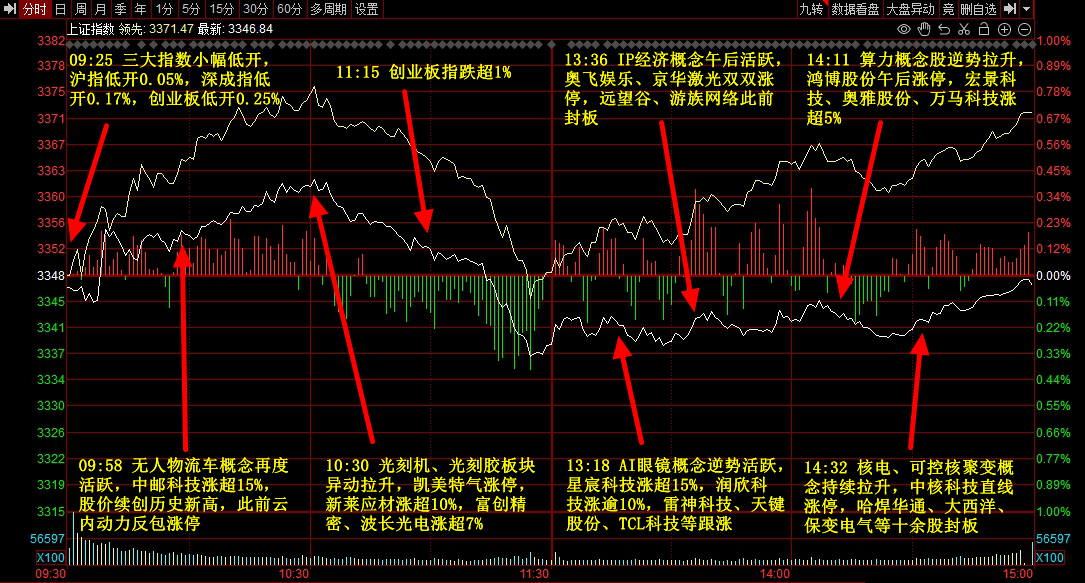
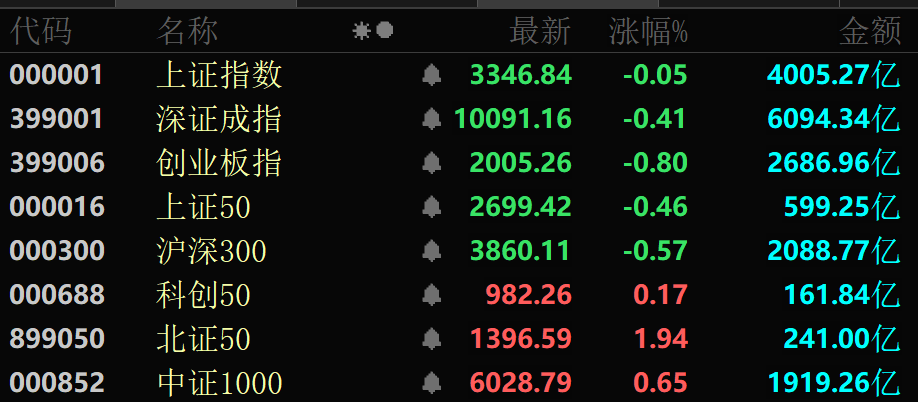
Market Overview - A-shares experienced slight fluctuations with major indices showing mixed results, as the North Stock Exchange 50 surged nearly 2% near the close, while the ChiNext Index barely held above the 2000-point mark, and the Shanghai 50 fell below 2700 points, marking a two-week low [1] - The total trading volume shrank to below 1 trillion yuan, the lowest in over a month [1] Index Performance - The Shanghai Composite Index closed at 3346.84, down 0.05% with a trading volume of 400.53 billion yuan [2] - The Shenzhen Component Index was at 10091.16, down 0.41% with a trading volume of 609.43 billion yuan [2] - The ChiNext Index closed at 2005.26, down 0.80% with a trading volume of 268.70 billion yuan [2] - The North Stock Exchange 50 rose to 1396.59, up 1.94% with a trading volume of 24.10 billion yuan [2] Sector Performance - The controllable nuclear fusion, gaming, artificial intelligence, and millet economy sectors saw significant gains, while passenger vehicles, chemical pharmaceuticals, energy metals, and liquor sectors faced declines [2] - The electronic industry attracted over 6.2 billion yuan in net inflow, while the automotive sector saw a net outflow of over 2.9 billion yuan [3] Investment Insights - Zhongyou Securities noted that the A-share index has rebounded to levels prior to the US-China trade war 2.0, indicating a need for new catalysts to boost market confidence [3] - According to招商证券, external tariff uncertainties remain, and more policy support is needed for stable internal growth, with a focus on sectors like automotive, non-ferrous metals, defense, and chemical pharmaceuticals [3] Nuclear Energy Sector - The nuclear energy sector experienced a significant rally, with the controllable nuclear fusion sector leading the gains, and related stocks like 哈焊华通 (20% limit up) and 常辅股份 also performing strongly [3][4] - The global narrative around nuclear power is expected to strengthen due to new policies from the Trump administration, which aims to expand the US nuclear energy sector significantly by 2050 [5][8] Artificial Intelligence Sector - The artificial intelligence sector saw a strong upward trend, with multiple sub-sectors closing at their highest points, driven by recent conferences and the introduction of new AI standards [5][6] - Companies like 中邮科技 and 星宸科技 saw significant gains, with many stocks hitting their daily limit [5] Conclusion - The current market dynamics indicate a mixed performance across sectors, with notable strength in nuclear energy and artificial intelligence, while broader market indices face challenges that require new catalysts for growth [3][5][6]
香港恒生指数收跌1.35% 恒生科技指数跌1.7%
news flash· 2025-05-26 08:11
Market Performance - The Hong Kong Hang Seng Index closed down by 1.35% [1] - The Hang Seng Tech Index fell by 1.7% [1] Company Movements - Miniso experienced a significant drop of over 18% [1] - Geely Automobile declined by more than 9% [1] - BYD and Leap Motor both saw declines exceeding 8% [1] - China National Nuclear Corporation surged over 130% [1] - Mao Geping's stock increased by more than 7% [1]



特朗普大消息!刚刚,暴涨超100%!
Zhong Guo Ji Jin Bao· 2025-05-26 08:05
【导读】A股调整,特朗普大消息,核电板块暴涨 下跌方面,医药医疗股集体调整,海辰药业跌近10%。 | 代码 | 名称 | 涨幅% | 现价 | | --- | --- | --- | --- | | 300584 | 海辰药业 | -9.56 | 31.80 | | 300147 | ST香雪 | -8.26 | 8.44 | | 000566 | 海南海药 | -7.85 R | 5.40 | | 300723 | 品制 | -6.90 R | 46.04 | | 688336 | 三生国健 | -6.57 િન્દ | 51.08 | | 688443 | 智翔金泰-U к | -5.72 | 26.02 | | 002900 | 哈三联 | -5.68 | 14.61 | | 0025220 | 千红制药 | -5.30 | 6.26 | | 063600 | 康辰药业 | -4.98 | 29.58 | | 002422 | 科伦药业 | -4.96 R | 37.40 | | 688062 | 迈威生物-U к | -4.86 | 22.71 | | 600080 | 金花股份 | -4.80 | ...
