工程机械

Search documents
艾迪精密(603638.SH):公司目前的液压破碎锤产品主要销售给挖掘机主机厂
Ge Long Hui· 2025-12-22 07:36
Group 1 - The core viewpoint of the article is that Aidi Precision (603638.SH) primarily sells its hydraulic breakers to excavator manufacturers, with a small portion sold through specialized dealers [1] Group 2 - The company is actively engaging with investors through an interactive platform to provide updates on its sales strategy [1] - The focus on excavator manufacturers indicates a targeted market approach, which may influence future sales performance [1] - The mention of specialized dealers suggests a dual sales channel strategy, potentially enhancing market reach [1]

【好评中国】让自贸试验区结出更多新成果
Xin Lang Cai Jing· 2025-12-22 03:54
Group 1 - The core viewpoint emphasizes the need for Free Trade Zones (FTZs) in China to act as pioneers in reform and development, promoting exploration in broader and deeper areas to achieve more results in reform and opening-up [1] - FTZs have introduced various institutional and policy outcomes this year, including relaxed market access policies, pilot programs for patent-intensive product insurance, and smart telecommunications quarantine models [1] - In the context of global value chain restructuring and rapid digital economy development, FTZs must establish dynamic international rule benchmarking mechanisms to adapt to changes and seize opportunities in higher-level openness [1] Group 2 - FTZs are tasked with promoting high-quality development and constructing a new development pattern, which involves strengthening the resilience of industrial and supply chains to support domestic and international dual circulation [2] - Systematic reforms are necessary to integrate policies, resources, and business processes around key industries, breaking down departmental barriers to form a systematic innovation ecosystem [2] - The establishment of interdisciplinary teams to tackle key technologies has led to significant breakthroughs, such as achieving autonomy in the main bearing of shield machines and advancing the remanufacturing system in the engineering machinery sector [2] Group 3 - FTZs should adjust their regional scope based on industrial development needs to enhance their ability to drive surrounding areas and improve the quality of international circulation [3] - Examples like the Xinjiang FTZ demonstrate the establishment of efficient logistics channels, while the Guangxi FTZ showcases automated container terminals connecting to 571 ports globally [3] - Collectively, the 22 FTZs contribute approximately one-fifth of the national foreign investment and total import-export volume, highlighting their significant role in the economy [3]
金鹰基金:春季躁动布局正当时 聚焦科技+制造主线
Xin Lang Cai Jing· 2025-12-22 02:47
Group 1: Market Overview - The A-share market experienced a fluctuating recovery pattern last week, with a divergence in index performance, characterized by a stronger Shanghai market compared to Shenzhen [7] - Under the expectation of "expanding domestic demand" policies and high dividend defensive attributes, consumption and non-bank financial sectors became the leading gainers, while previously active AI applications and hardware saw a pullback [7] - The average daily trading volume in the A-share market decreased to 1.76 trillion yuan, indicating a decline in market activity [7] Group 2: Economic Indicators - November consumption showed a significant slowdown due to high base effects and policy exhaustion, while fixed asset investment continued to decline, and the real estate market remained sluggish [7] - External demand was noted as a rare bright spot, but there are expectations for monetary stimulus and fiscal pre-positioning to improve domestic economic conditions in early next year [7] Group 3: Global Economic Context - The Bank of Japan's interest rate hike has led to a moderate recovery in market risk appetite, while the U.S. non-farm employment rate is expected to rise, and CPI is projected to be below market expectations [8] - Despite these indicators, the Federal Reserve is unlikely to take further directional actions in the short term, with expectations that it will not lower interest rates in January [8] Group 4: Industry Focus - The focus is shifting towards technology and manufacturing sectors, with a potential bottoming out of the recent global tech pullback [9] - Key factors for the future strength of the tech sector include improvements in large model capabilities and advancements in AI commercialization [9] - The manufacturing sector is expected to benefit from fiscal and monetary easing, with a focus on export-oriented manufacturing and real estate chains related to emerging markets [9]
2026:AI之光引领成长;反内卷周期反转
2025-12-22 01:45
Summary of Key Points from Conference Call Industry and Company Overview - The conference call discusses the growth potential of the AI industry, particularly in embodied intelligence applications such as humanoid robots and drones, with significant market share competition expected by 2026 [1] - The cyclical industries are anticipated to benefit from overseas market expansion, a rebound in domestic real estate, and increased demand from renewal cycles, with leading companies like XCMG and SANY showing positive trends in construction machinery [1][5] - The industrial gas sector is highlighted, with a 75% year-on-year increase in argon demand driven by photovoltaic silicon demand, making companies like Hangzhou Oxygen worth monitoring [1][5] - The commercial aerospace sector is emphasized, with frequent launches of China's Long March rockets and increasing competition between the US and China, indicating a growing focus on this industry [1][6][7] Core Insights and Arguments - AI technology is expected to continue driving economic growth and influence various industries, with upstream sectors like optical modules and storage benefiting from AI demand [3] - The demand for humanoid robots and drones is projected to peak in 2026, with significant cost and market share effects expected in the latter half of the year [3][4] - Companies like Jiemai Technology are expanding into new markets such as plastic carrier tapes and release films, with the plastic carrier tape market being 1.5 times larger than the paper carrier tape market [2][8] - Jiemai Technology's revenue growth is projected at around 40% for 2026 and 2027, with corresponding P/E ratios of 33 and 24 [3][10] Additional Important Insights - The cyclical industry is expected to reverse in the coming years, driven by factors such as the end of the domestic real estate downturn and supply-side reforms [5] - The commercial aerospace sector is highlighted as having significant potential, with the US's plans to return to the moon and SpaceX's ambitious valuation goals indicating a robust future [7] - Longsheng Technology is noted for its investments in robotics and commercial aerospace, with a focus on precision manufacturing components [11] - Chang'an Dongwu Company is identified as a strong investment opportunity, with a projected 30% growth rate and a focus on high-power engines and data centers [12][13] - Jinlong Automobile is recognized for its improvements in governance, profitability, and advancements in autonomous driving technology, making it a valuable investment prospect [14]
中金公司:逢低布局跨年行情 建议关注三条主线
Zheng Quan Shi Bao Wang· 2025-12-22 00:19
Core Viewpoint - Recent fluctuations in A-shares have led to divergent expectations among investors during the "cross-year" phase, but the short-term impact of internal and external factors on A-shares may be nearing its end, with a relatively loose liquidity environment expected to persist into the first quarter of next year [1] Group 1: Market Environment - The current low-interest-rate environment is likely to continue driving the trend of "deposit migration" among residents, providing a favorable opportunity for investors to position themselves for the "cross-year" market [1] - The recent pullback in indices has created a good entry point for investors looking to capitalize on upcoming market trends [1] Group 2: Investment Strategy - Investors are advised to focus on growth styles during market dips, while dividend styles should emphasize phase-specific and structural opportunities [1] - Three main investment themes are recommended: 1. **Growth in Prosperous Sectors**: The AI technology sector is expected to transition into an application phase next year, with opportunities in computing power, optical modules, and cloud computing infrastructure, particularly in domestic markets. Key application areas include robotics, consumer electronics, intelligent driving, and software applications. Additionally, innovative pharmaceuticals, energy storage, and solid-state batteries are entering a prosperous cycle [1] 2. **External Demand Breakthrough**: The trend of going overseas presents a relatively certain growth opportunity. Sectors to focus on include home appliances, construction machinery, commercial buses, power grid equipment, gaming, and globally priced resources such as non-ferrous metals [1] 3. **Cyclical Reversal**: Attention should be given to sectors nearing improvement points in supply-demand dynamics or benefiting from policy support, such as chemicals, aquaculture, and new energy [1] - Dividend sectors possess defensive attributes but may still be more phase-specific and structural in nature, suggesting a bottom-up stock selection approach based on quality free cash flow [1]

十大券商策略:告别单一叙事!人民币升值指引三条配置线索
Zheng Quan Shi Bao Wang· 2025-12-22 00:12
Group 1 - The core viewpoint is that the market is beginning to focus on the potential for a sustained appreciation of the RMB, which could influence asset allocation strategies [1] - Approximately 19% of industries may see profit margin improvements due to RMB appreciation, leading to increased investor interest in these sectors [1] - Key sectors to watch under a strengthening RMB include aviation, gas, and paper industries driven by short-term muscle memory, as well as upstream resources, consumer goods, and services influenced by profit margin changes [1] Group 2 - The 2026 spring market is anticipated to be active, with a focus on non-mainstream sectors such as policy themes and high-dividend stocks, while the mainline structure (AI industry chain, cyclical stocks) may have limited upward potential [2] - A classic "cross-year-spring" market is forming, with significant institutional investors increasing their holdings in broad-based ETFs, indicating stable incremental capital for the market [3] - The A-share market is expected to resonate upward with global markets, driven by clear mid-term policy and liquidity expectations following the Federal Reserve's interest rate decisions [4] Group 3 - The current market is characterized by a narrow range of fluctuations, influenced by external factors such as U.S. AI bubble concerns and Japan's interest rate hikes, with a potential upward trend as investor sentiment improves [4] - The focus for A-share industry allocation includes dividend value, cyclical recovery, and thematic hotspots, particularly in metals, non-bank financials, and AI sectors [4] - The market is entering a critical window for cross-year layout, with attention on potential signals for a small rally around the New Year [5][6] Group 4 - The market is experiencing a structural trend change, with significant discrepancies in expectations for consumption, non-bank finance, and technology sectors as 2026 approaches [10][11] - Key investment themes include AI applications, commercial aerospace, and nuclear power, with a focus on sectors benefiting from domestic demand recovery and structural policy incentives [12] - The upcoming "15th Five-Year Plan" is expected to drive structural opportunities, particularly in AI, renewable energy, and quantum technology sectors [12]


【十大券商一周策略】告别单一叙事!A股跨年行情+春季躁动或将拉开帷幕
Zheng Quan Shi Bao Wang· 2025-12-21 15:11
Group 1 - The core viewpoint is that a classic "cross-year-spring" market trend is brewing, with significant signals indicating its commencement [3] - Factors driving the appreciation of the RMB are increasing, and investors should adapt their asset allocation accordingly, focusing on industries that may benefit from this trend [1] - The market is expected to see a structural shift with a focus on cyclical sectors, particularly industrial metals, non-bank financials, and sectors related to domestic consumption [3][4] Group 2 - The investment strategy should consider three key clues: dividend value, layout of prosperous industries, and thematic hotspots [4] - The anticipated spring market in 2026 is expected to be driven by a combination of fundamental cyclical improvements and new technological trends [2] - The current market is characterized by a narrow range of fluctuations, influenced by external factors such as U.S. monetary policy and investor sentiment [4][6] Group 3 - The focus on AI and advanced manufacturing is expected to dominate the market, with a potential shift towards value and cyclical styles in the first half of 2026 [2] - The market is likely to experience a "value on stage, growth in action" dynamic, particularly as the Lunar New Year approaches [9] - There is a notable expectation for structural opportunities in sectors like AI, new energy, and controlled nuclear fusion, which are aligned with the "14th Five-Year Plan" [6][10]
机械行业研究:看好拖拉机、燃气轮机和工程机械
SINOLINK SECURITIES· 2025-12-21 14:10
Investment Rating - The report does not explicitly state an investment rating for the industry, but it suggests a positive outlook for specific companies within the machinery sector, particularly in tractor exports and gas turbine orders [5][11]. Core Insights - The SW Machinery Equipment Index decreased by 1.56% in the last week, ranking 29th among 31 primary industry categories, while it has increased by 33.82% year-to-date, ranking 6th [13][16]. - The report highlights strong growth in tractor exports, particularly for medium and large tractors, with a year-on-year increase of 22.6% in November 2025, and anticipates continued growth in 2026 [5]. - Siemens Energy is establishing a gas turbine assembly base in Hainan, which is expected to enhance collaboration with domestic companies like Yingliu, particularly in turbine blade orders [5][24]. - The engineering machinery sector is experiencing an upward trend, with significant increases in sales and operating rates, indicating a positive outlook driven by infrastructure projects [5][33]. Summary by Sections Market Review - The SW Machinery Equipment Index fell by 1.56% over the last week but has risen by 33.82% since the beginning of 2025, outperforming the Shanghai Composite Index [13][16]. Key Data Tracking - General machinery remains under pressure, with a PMI of 49.2% in November, while engineering machinery shows accelerated growth with excavator sales up by 7.8% year-on-year [25][33]. - The railway equipment sector is stable, with fixed asset investments maintaining a growth rate of around 6% [38]. - The shipbuilding sector is experiencing a slowdown, with new ship price indices showing a decline [40]. Industry Dynamics - The gas turbine market is robust, with GEV reporting a 39% year-on-year increase in new orders for the first three quarters of 2025 [48]. - The oil service equipment sector is stabilizing, supported by high demand in the Middle East [43]. - Industrial gas demand is expected to rise as raw material prices decrease and downstream operating rates improve [46].





国金策略:单一产业叙事能够带来的收益已经越来越不稳定和难以把握 抓住行情的窄幅波动期布局2026年新主线
Sou Hu Cai Jing· 2025-12-21 12:44
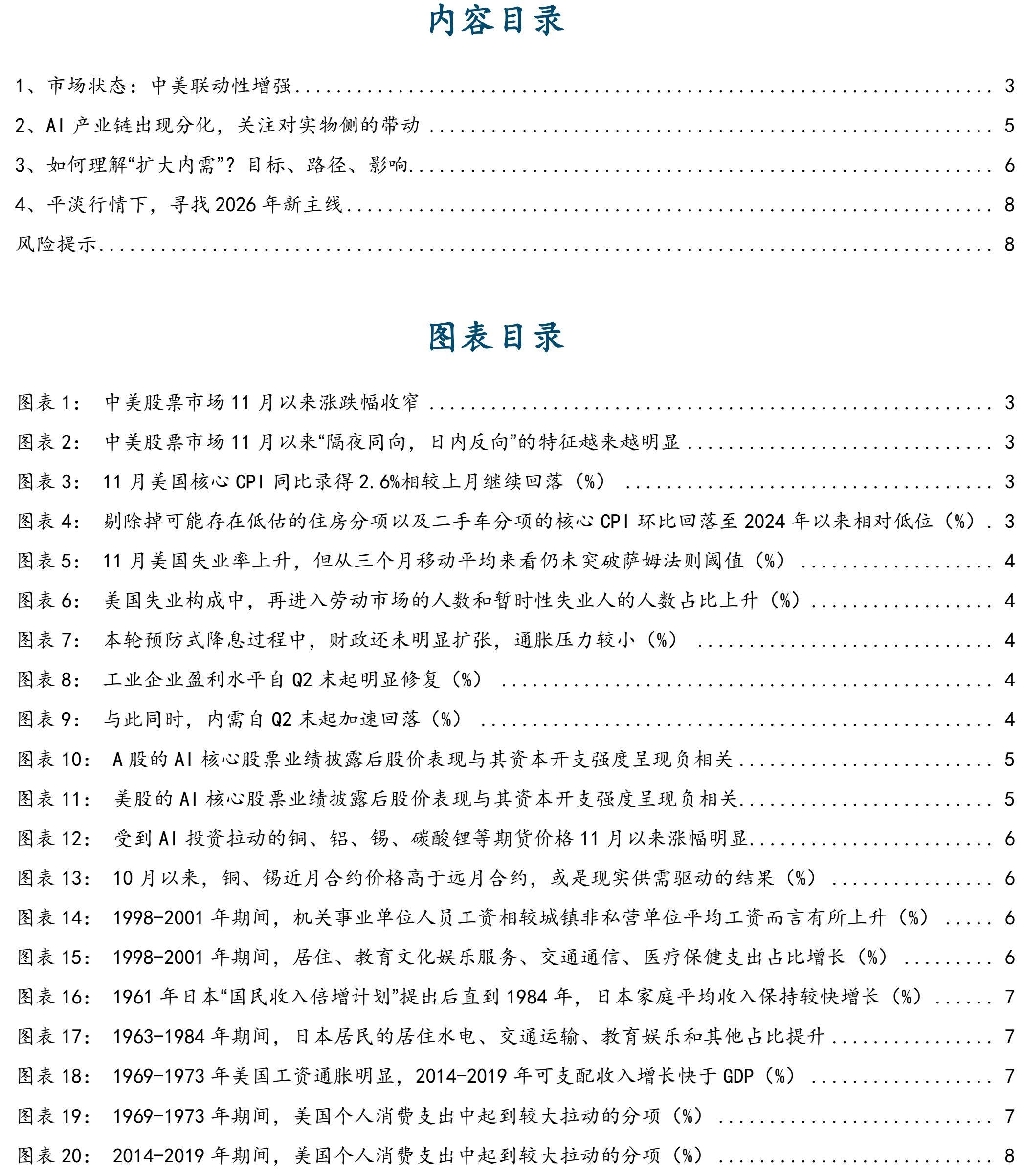
Group 1 - The market status indicates an increased correlation between the US and Chinese markets, with the 20-day rolling correlation of the CSI 300 and S&P 500 rising above the 90th percentile, reflecting a new normal of "overnight alignment and intraday reversal" [2][10][13] - The US core CPI has decreased to 2.6%, the lowest in three and a half years, while the unemployment rate has risen to 4.6%, primarily due to increased labor participation and temporary unemployment, indicating a stable economic environment without significant inflationary pressures [2][10][13] - China's economic fundamentals show a combination of corporate profit bottoming out and a decline in domestic demand, which opens a window for further policy support [2][10][13] Group 2 - The AI industry chain is experiencing a divergence, with broader AI-related assets (copper, lithium, aluminum, energy storage, and electrical equipment) performing better than core AI assets (computing chips, optical modules, PCB) [3][24][25] - Investors are becoming less tolerant of the contradiction between aggressive capital expenditures and the lack of revenue growth in companies within the AI industry chain, leading to a negative correlation between stock performance and capital expenditure as a percentage of revenue [3][24][25] - Commodity prices for copper, aluminum, tin, and lithium carbonate have been rising since late October, driven by demand from AI investments, with near-term contracts for copper and tin outperforming longer-term contracts [3][24][25] Group 3 - The concept of "expanding domestic demand" is emphasized as a strategic move, with a focus on increasing consumer demand supported by income growth and effective investment [4][31][32] - The government plans to enhance the second distribution of income by increasing minimum pension standards and implementing childcare subsidies, while future efforts may focus on optimizing the first distribution through wage reforms [4][31][32] - Historical examples from Japan and the US illustrate that income growth leads to increased service and new-type consumption, suggesting that China's current income growth initiatives could similarly boost consumer spending [4][31][32] Group 4 - The current market environment, characterized by limited macro elasticity and increased industry differentiation, suggests a shift in investment strategy towards tangible demand and domestic policy benefits as the new focus for 2026 [5][42][43] - Recommendations include investing in industrial resource products (copper, aluminum, tin, lithium, crude oil) that benefit from AI investment and global manufacturing recovery, as well as sectors poised for recovery in consumer spending (airlines, hotels, duty-free, food and beverages) [5][42][43] - Non-bank financial institutions (insurance, brokerage) are expected to benefit from capital market expansion and a rebound in long-term asset returns, alongside opportunities in China's equipment export chain and manufacturing sectors [5][42][43]
关注AI设备及耗材、核聚变:机械行业周报(20251215-20251221)-20251221
Huachuang Securities· 2025-12-21 12:14
Investment Rating - The report maintains a "Recommended" rating for the mechanical industry, focusing on AI equipment and consumables, as well as nuclear fusion [1]. Core Insights - The AI wave is initiating a new cycle in intelligent manufacturing, shifting investment focus towards assets that can define the future and support the AI trend [18]. - The nuclear fusion sector is accelerating, with significant project announcements indicating a robust investment environment, projecting a global market size nearing 500 billion USD by 2030 [6][22]. - The report emphasizes the importance of monetary and fiscal policies in stimulating domestic demand, suggesting a new recovery cycle for the equipment industry [6]. Summary by Sections Industry and Company Investment Views - The mechanical industry is expected to benefit from the AI trend, with human-like robots and AI PCB equipment being key areas of growth [18][20]. - Solid-state batteries are projected to see accelerated development, with significant capital expenditure expected in the equipment sector [21]. - The report highlights the potential of controlled nuclear fusion as a sustainable energy source, with ongoing projects enhancing the industry's viability [22]. - Domestic demand for construction machinery is recovering, supported by large infrastructure projects and a global economic rebound [23]. Key Company Earnings Forecasts and Valuations - Companies such as 汇川技术 (Inovance Technology), 法兰泰克 (Falan Tech), and 信捷电气 (Xinjie Electric) are rated as "Strong Buy" with projected EPS growth and favorable PE ratios [2][7]. - The report lists several companies across various sectors, including AI equipment, robotics, and engineering machinery, as key investment opportunities [6][19]. Market Performance - The mechanical sector has shown a mixed performance, with a recent decline of 1.7% in the sector index, while individual stocks have varied significantly in their weekly performance [10][14]. - The report notes that the overall market sentiment remains cautious, with fluctuations in stock prices reflecting broader economic conditions [10][14].