稀土

Search documents
中国恢复稀土供应却暗藏杀招?美国会:中国子弹已经上膛
Sou Hu Cai Jing· 2025-11-15 09:10
美国众议院的这些指责显然颠倒黑白。他们从未提到,中国为何要动用稀土这张王牌。其实,正是美国在特朗普执政时期发起了对中国的关税战争,尽管中 国一再劝解,希望通过和平方式实现互利共赢,但美国坚持对中国发动贸易攻击。面对美国的不听劝告,中国最终被迫采取反制措施,并在适当的时候拿出 了稀土这一"王牌",迫使美国回到谈判桌上,才有了中美之间的短期"休战"。实际上,稀土这一反制手段并非中国主动出击,而是美国的咄咄逼人促使了中 国的回应。那么,美国现在又有什么资格指责中国呢? 讽刺的是,这一策略其实是美国此前采取过的一种做法。美国在化学品和芯片的出口控制中,曾经使用了类似的简化供应体系。如今,中国将这一策略借鉴 并加以运用,用于应对美国。这种做法可谓是"以其人之道还治其人之身",美国似乎被自己的做法反噬。 当然,这个新供应体系是否能够顺利实施,还需要看美国的态度。如果在这一年暂时休战期结束后,美国发现自己仍然无法解决稀土问题,那么美国很可能 会回到谈判桌上,接受中国的条件。届时,这个新供应体系将成为中国在谈判中一个重要的筹码。如果美国仍然坚持不认输,这个体系将会严格执行,以此 来打击美国的嚣张气焰。 对于中国的这一做法,美 ...

欧洲稀土王炸背后:99%股民忽略的关键数据
Sou Hu Cai Jing· 2025-11-13 21:49
一、稀土巨头的阳谋与散户的困局 欧洲稀土巨头索尔维最近干了件大事。他们不仅跟美国两家磁铁制造商签了供应协议,还要扩建法国工厂。这事儿放在全球供应链重构的背景下,简直就是 一记重拳。但有意思的是,当我打开股吧论坛,发现大多数人还在争论明天大盘是涨是跌。 菲利普·凯伦这个老狐狸说得直白:"美国客户已经准备好签合同了。"言下之意就是钱到位了。可咱们的散户朋友呢?还在为要不要补仓纠结得睡不着觉。 这让我想起十八年前刚接触量化系统时的自己——盯着分时图上的每一根波动线,活像个赌场里数牌的菜鸟。 二、牛市幻觉与真实世界的鸿沟 都说牛市来了猪都能飞,但现实是多数人连猪都不如。为什么?因为大多数人根本分不清什么是"看得见的机会",什么是"抓得住的机会"。就像现在稀土概 念炒得火热,但真正能吃到肉的,早在一个月前就通过机构资金流向锁定了目标。 我见过太多人在牛市中赚过又吐回去的故事。上周还有个老友炫耀他抓到了涨停板,结果这周就哭诉"刚解套又套牢"。问题出在哪?他们总把K线图当圣 经,却不知道机构早就在量化数据里留下了蛛丝马迹。 | ∞ 机构库存 高度活跃: 增加 | LULL LLL LLL LLL P | | | " | | ...
杨承新率队拜访中国稀土集团有限公司
Sou Hu Cai Jing· 2025-11-13 19:08
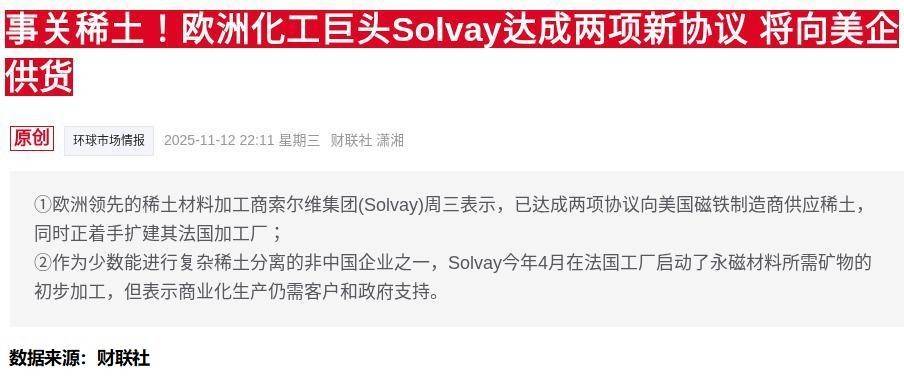
Group 1 - The meeting between Yang Chengxin, the Mayor of Kunming, and Liu Lei Yun, the Chairman of China Rare Earth Group, focused on enhancing cooperation and project development in Kunming [1][2] - Yang expressed gratitude for the support provided by China Rare Earth Group to Kunming's economic and social development, highlighting the company's role as a national leader in the rare earth industry [2] - The discussion emphasized the importance of aligning Kunming's advantages in location, resources, and market with the company's technological and talent strengths to accelerate project progress and achieve mutual benefits [3] Group 2 - Liu introduced the company's operational development and projects in Kunming, acknowledging the city's significant support for the company's growth [3] - China Rare Earth Group is committed to fulfilling its responsibilities as a central enterprise and aims to deepen cooperation with Kunming in various fields to contribute to the city's high-quality development [3]

21专访|陆挺:新老经济并重,要让消费敢为
2 1 Shi Ji Jing Ji Bao Dao· 2025-11-13 12:10
Core Insights - The "15th Five-Year Plan" emphasizes high-quality development over specific growth targets, focusing on sustainable economic growth and addressing social issues [1][4][10] Economic Development Goals - The goal of achieving "per capita GDP at the level of moderately developed countries" requires three core conditions: enhancing industrial value-added, promoting inclusive growth, and improving social security systems [3][4] High-Quality Development - High-quality development involves addressing historical issues in the "old economy," fostering self-reliance in key industries, and ensuring inclusive growth for all demographics [4][5][6] Key Economic Drivers - Consumption is identified as a critical variable for future economic growth, with government policies aimed at boosting consumer spending through subsidies and pension increases [6][7] Export Performance - Over the past five years, China's exports have seen an average annual growth rate of 8%, driven by a strong manufacturing sector and an increase in high-value-added products [8][9] Future Export Trends - Future export growth is expected to stabilize at 2%-4% annually due to high base effects and external economic pressures, indicating a shift towards low-speed, stable growth in foreign trade [10] Addressing "Involution" - To combat "involution," a collaborative approach involving market-driven mechanisms, industry associations, and government guidance is necessary to eliminate inefficiencies and promote healthy competition [11] Regional Development Focus - The Guangdong-Hong Kong-Macao Greater Bay Area is highlighted as a key region for high-quality development, with Shenzhen aiming to become a global financial center by leveraging its unique advantages [12][13]
美国历时25年,终于突破中国“卡脖子”技术!
Sou Hu Cai Jing· 2025-11-13 10:57
Core Insights - The U.S. has successfully produced its first rare earth magnet in 25 years, marking a significant step towards reducing dependence on China for supply chains [1][2] - The announcement reflects a broader strategy to regain control over critical resources, with plans to expand production capabilities in various materials beyond rare earths [3] Group 1: U.S. Rare Earth Production - U.S. Treasury Secretary Besant expressed excitement over the production of the first domestically made rare earth magnet, indicating a shift away from reliance on China [1] - The production is linked to the establishment of a new processing center by eVACMagnetics in South Carolina, which is pivotal for U.S. independence in rare earth materials [3] Group 2: Historical Context and Implications - The U.S. has faced significant challenges in its rare earth supply chain, highlighted by previous tariffs and investigations against China, culminating in a recent export ban by China [1][2] - The ownership of the Mountain Pass mine, the only active rare earth mine in the U.S., remains with Shenghe Resources, which holds a 9.99% stake acquired in 2017 for approximately $110.98 [2] Group 3: Future Outlook - The U.S. economy is showing signs of recovery despite various challenges, and the production of rare earth magnets is seen as the beginning of a broader initiative to secure other critical materials like gallium, germanium, graphite, and fluorite [3] - The U.S. manufacturing sector is expected to experience significant growth in 2026 and 2027, driven by advancements in domestic production capabilities [3]
对华威胁无效,欧盟认输,称短期内无力在稀土出口上左右中国决定
Sou Hu Cai Jing· 2025-11-13 10:44
面对这一现实,欧盟多次尝试通过"威胁与报复"的手段来施压中国。例如,他们曾考虑对中国实行所谓的"实物关税",要求中国 出口商向欧盟提供关键原材料,或者启动《反胁迫工具》,甚至对中国产品加征特别关税等。然而,至今这些方案都没有真正付 诸实施,因为欧盟发现,威胁根本没有效果,若实施制裁,不仅无法伤害中国,反而会损害自身经济。因此,欧盟已经向布鲁塞 尔27国大使通报,表示相关措施仍在商讨阶段,尚未出台任何实质性行动。 在关键稀土出口管制问题上,欧盟最终承认了自己的无力,意识到在短期内无法迫使中国改变其已确定的政策。这一结论不仅揭 示了欧盟策略的失败,也表明全球产业链的格局正在发生深刻变化。 今年4月,中国对一些重要稀土元素实施了出口限制,这引发了欧洲多个行业的警觉,尤其是汽车、电动机、风电和国防制造等领 域。根据欧元区央行的一份专题报告显示,4月以来,中国稀土磁铁的出口量下降了约75%,这让许多欧洲厂商不得不减产或暂停 生产。 彭博社还指出,欧盟内部的高级官员已经私下向各成员国表示:"我们目前无法在短期内对中国的稀土管控政策施加影响。" 与此同时,中国在全球稀土开采与深加工领域的主导地位变得更加明显:全球95%以上 ...

稀土出口禁令暂停了,中国不“让步”还好,一“让步”特朗普反而更紧张了
Sou Hu Cai Jing· 2025-11-13 09:43
Core Viewpoint - The recent trade negotiations between the U.S. and China, particularly regarding rare earth elements, highlight the complexities and tensions in the global supply chain, with China maintaining significant leverage over the U.S. through its control of rare earth supplies [1][5][10]. Group 1: Trade Negotiations - Trump announced a "truce agreement" with China, claiming a temporary halt to the trade war that could potentially harm the global economy [1]. - In exchange for the suspension of export restrictions on rare earth elements, the U.S. agreed to lower tariffs on Chinese goods and suspend port fees for Chinese ships [6][10]. - The agreement includes China's commitment to resume purchasing U.S. soybeans and a temporary pause on restrictions for key minerals like germanium and antimony until November 2026 [5][10]. Group 2: Domestic Reactions - Trump's concessions have sparked strong backlash domestically, particularly from labor unions and the manufacturing sector, which criticize the suspension of port fees as detrimental to the U.S. shipbuilding industry [7][8]. - Labor organizations, such as the United Steelworkers and the International Association of Machinists, have publicly condemned the deal, viewing it as a sacrifice of American interests for the sake of rare earth negotiations [7]. Group 3: Strategic Implications - China controls approximately 90% of the global rare earth supply, positioning itself as a dominant player in this critical resource market [5]. - The ongoing competition for rare earth resources reflects broader geopolitical tensions and the challenges faced by the U.S. in reducing its dependency on Chinese supplies [10]. - The situation underscores the importance of rare earth elements not only for economic interests but also for the future of global technology and military industries [10][11].

国内稀土见底,特朗普掏出杀手锏,一回头却发现中国早已做好准备
Sou Hu Cai Jing· 2025-11-13 07:25
Core Viewpoint - The ongoing trade tensions between the US and China have highlighted the critical dependence of the US on Chinese rare earth elements, particularly in military and semiconductor industries, as China implements export controls to protect its strategic interests [1][2][4]. Group 1: Rare Earth Elements - The US is facing a significant shortage of rare earth elements, with domestic stocks only sufficient for two to three months, raising concerns about delays in electric vehicle and missile projects [1][2]. - China controls over 90% of the global rare earth supply chain, with recent export controls on seven heavy rare earth elements directly targeting US vulnerabilities [1][2]. - The price of rare earths has increased by 8% following China's new regulations, indicating heightened market tension [2][4]. Group 2: US Response and Industry Impact - The US has attempted to counteract China's dominance by suspending exports of critical components, such as the LEAP-1C engine for the C919 aircraft, which has reduced delivery plans from 50 to 25 units [6]. - The US government has also restricted sales of semiconductor design software to Chinese companies, significantly impacting their research and development timelines [8]. - Major US defense contractors, like Lockheed Martin, are exploring alternative materials due to the supply chain risks posed by China's export controls, but performance has reportedly decreased by over 20% [2][4]. Group 3: China's Strategic Position - China's rare earth industry, exemplified by the performance of Ganzhou Rare Earth Group, has shown resilience with a production output of 240,000 tons in the first half of the year, maintaining a complete supply chain from mining to refining [2]. - The Chinese government is prioritizing approvals for EU companies in its rare earth export policies, indicating a strategic pivot towards strengthening ties with Europe while sidelining the US [10]. - The CJ-1000A engine, developed by China, is expected to meet the needs of the C919 aircraft and is on track for certification, showcasing China's advancements in aviation technology despite US sanctions [10][11]. Group 4: Long-term Implications - The US's sanctions may inadvertently accelerate China's innovation in both rare earth and aviation sectors, as China continues to solidify its market position and technological capabilities [11]. - The US's efforts to rebuild its supply chains are projected to take several years, during which time China's production lines remain active, further entrenching its competitive advantage [11].
MP Materials 2025Q3 稀土精矿产量同比减少 4%至 13,254 吨,无精矿销量,NdPr 产销量分别同比增长 51%/增长 30%至 721 吨/525 吨
HUAXI Securities· 2025-11-13 06:48
Investment Rating - The report gives a "Recommended" investment rating for the industry [5]. Core Insights - In Q3 2025, the production of rare earth concentrates decreased by 4% year-on-year to 13,254 tons, with no sales of concentrates due to the cessation of all product sales to China [1][4]. - NdPr production increased by 51% year-on-year to 721 tons, while NdPr sales rose by 30% to 525 tons [2][11]. - The realized price for NdPr oxide was $59 per kg, reflecting a 26% year-on-year increase [2][11]. - MP Materials plans to start commissioning a new heavy rare earth separation facility in mid-2026, with an initial focus on producing dysprosium (Dy) and terbium (Tb) [3]. - The company has halted sales to China to comply with a recent agreement with the U.S. Department of Defense, resulting in no recognized revenue from rare earth concentrates for the quarter [4][6]. Financial Performance - In Q3 2025, total revenue for the materials segment decreased by 50% year-on-year to $31.641 million, primarily due to the halt in sales of rare earth oxides [8][11]. - Adjusted EBITDA for the materials segment fell to -$14.522 million, a decline of 466% year-on-year [11]. - The net loss for Q3 2025 increased to $41.78 million, compared to a loss of $25.516 million in the same quarter of the previous year [12].
25年首度突破,美国宣布造出稀土磁铁,中国的稀土牌打不出去?
Sou Hu Cai Jing· 2025-11-13 06:14
Core Viewpoint - The announcement by U.S. Treasury Secretary Janet Yellen regarding the production of rare earth magnets is seen as a significant political statement rather than a substantial shift in the global rare earth market, particularly in relation to China's dominance in this sector [1][4]. Group 1: U.S. Rare Earth Production - The rare earth magnet production facility inspected by Yellen is primarily funded by a German company and focuses on producing neodymium-iron-boron magnets, which are considered low-end permanent materials [1][2]. - The U.S. still relies heavily on China for most of the components needed for this production, indicating that achieving complete independence in the rare earth sector is a challenging task [1][2]. Group 2: Historical Context and Market Dynamics - Historically, the U.S. led in rare earth extraction technology until the discovery of rich deposits in China in 1969 and the development of cost-effective extraction methods in the 1980s, which shifted the global landscape [2]. - Currently, China accounts for over 80% of global rare earth processing capacity and more than 90% of magnet production, making it difficult for the U.S. to significantly alter this balance [2]. Group 3: Political Implications - The timing of Yellen's announcement coincided with political pressures on the Trump administration, which had recently paused investigations and tariffs against China, suggesting that the declaration was aimed at boosting domestic morale [4][5]. - The production of rare earth magnets in the U.S. is heavily dependent on orders from General Motors, which was facing layoffs and declining production, further complicating the outlook for the U.S. rare earth industry [4]. Group 4: Future Outlook - For the U.S. to effectively compete in the rare earth sector, it must address structural issues such as a shortage of technical talent and the hollowing out of its manufacturing base [5]. - The ongoing competition between the U.S. and China in the rare earth sector is expected to deepen, with China focusing on technological innovation and expanding its production capabilities across various magnet types [5].