
地毯

Search documents
“研发飞地”架起成果转化快速通道——江西新余探索柔性引才新机制
Xin Lang Cai Jing· 2026-02-01 23:26
Core Viewpoint - The "R&D Outpost" model in Xinyu, Jiangxi Province, is an innovative mechanism aimed at attracting high-end talent and enhancing industrial competitiveness through flexible talent acquisition and rapid transformation of research outcomes into practical applications [1][2]. Group 1: R&D Outpost Model - The "R&D Outpost" model allows companies to establish research facilities in high-end talent-rich areas while ensuring that the research outcomes are transferred back to Xinyu for local industrial application [2][3]. - Since 2015, Xinyu has been implementing the "R&D Outpost" model, which promotes an "off-site research, local transformation" collaborative innovation system [2][3]. - As of now, Xinyu has recognized 26 "R&D Outposts," with 25 led by enterprises and one by the government, covering key industries such as lithium batteries, optics, and biomedicine [2][3]. Group 2: Policy Support and Talent Attraction - In August 2022, Xinyu introduced a policy to support the construction of "R&D Outposts," providing 300,000 yuan in funding for recognized outposts located outside the province [2]. - The policy eliminates geographical restrictions, allowing full-time talent recruited for "R&D Outposts" to apply for professional titles in Xinyu without being constrained by household registration or archives [2][3]. - The "R&D Outpost" model has attracted over 600 technology talents, including 4 national-level talents and 35 PhDs [2][3]. Group 3: Economic Impact and Performance Assessment - The "R&D Outposts" have collectively applied for 168 key research projects and developed 487 new products, generating over 5 billion yuan in comprehensive economic benefits [4][5]. - A differentiated performance assessment mechanism will be established by 2025 to evaluate the effectiveness of "R&D Outposts" based on talent recruitment, R&D investment, outcome transformation, and economic benefits [4][5]. - The successful implementation of the "R&D Outpost" model in Xinyu serves as a replicable solution for similar regions facing talent acquisition challenges [5].
进博观察①:从“一”到“八”,看中国机遇“确定性”|大江东
Guo Ji Jin Rong Bao· 2025-11-06 08:37
Core Insights - The 8th China International Import Expo (CIIE) showcases China's commitment to openness and cooperation, aiming to provide confidence and momentum for global development [1][4][7] - The event has grown significantly since its inception in 2018, with increasing participation and transaction volumes, reflecting China's position as the world's second-largest import market for 16 consecutive years [3][4][5] Growth and Development - The first CIIE featured 30,000 square meters of exhibition space with 172 participating countries and a transaction volume of $57.83 billion; the 8th CIIE has expanded to over 430,000 square meters with 4,108 foreign enterprises from 155 countries [3][4] - The transaction volume at the 7th CIIE reached $80.01 billion, indicating a continuous upward trend in international trade facilitated by the expo [3][6] Commitment to Openness - Despite global challenges such as the pandemic and geopolitical tensions, China has maintained its commitment to hosting the CIIE annually, ensuring a stable platform for international cooperation [4][5] - The CIIE has become a symbol of China's unwavering promise to open its market wider, with initiatives like providing free exhibition space for underdeveloped countries [5][6] Global Engagement - The CIIE has fostered deep interactions between China and the world, with significant participation from countries involved in the Belt and Road Initiative, and a notable increase in African enterprises [7][8] - The event has evolved into a platform for high-level openness and a public good for global sharing, addressing the need for certainty in a changing global landscape [7][8]


面对美国50%高关税,最“受伤”的不是印度经济,挨了特朗普的关税闷棍,莫迪转头赴华参会
Sou Hu Cai Jing· 2025-09-01 02:31
Core Viewpoint - The trade conflict between the US and India, particularly the imposition of a 50% tariff by the US, is not just a straightforward trade issue but is deeply rooted in complex geopolitical dynamics, with India adopting a flexible diplomatic stance while facing pressure from the US [1][3]. Group 1: Economic Impact - Indian exporters are projected to lose between $25 billion to $30 billion due to the new tariffs, significantly affecting labor-intensive sectors such as textiles, jewelry, shrimp, furniture, and carpets, with export volumes potentially slashed by 70% [3]. - Despite the tariff impacts, India's economy is not as vulnerable as perceived; the GDP growth rate may drop by 1 percentage point, but this is not catastrophic for the Modi administration, which has implemented various supportive policies like tax reforms and export subsidies [3][8]. - Key sectors such as pharmaceuticals, energy, and electronics remain unaffected by the tariffs, indicating that India still has strategic advantages and reserves [3]. Group 2: Geopolitical Dynamics - Modi's upcoming visit to China for the Shanghai Cooperation Organization summit is strategically timed amidst escalating US-India trade tensions, signaling a potential shift in India's diplomatic focus [4][6]. - The recent thaw in Sino-Indian relations, marked by small diplomatic gestures and a mutual understanding of the need to resolve border issues, suggests that India is looking for opportunities rather than choosing sides in the US-China rivalry [6]. - The narrative of Modi's close relationship with Trump has been undermined, leading to political challenges domestically as opposition parties and even factions within Modi's party question his judgment and approach to US relations [7][8]. Group 3: Trust and Future Outlook - The most significant damage from the tariff situation may not be economic but rather the erosion of trust between India and the US, as well as the disillusionment of Indian elites regarding the benefits of aligning closely with the US [8]. - Modi's response to the crisis indicates a shift towards a more autonomous foreign policy, suggesting that India is willing to explore new partnerships and opportunities beyond its traditional alliances [8].

高关税令美印关系紧张 印度多行业受冲击
Yang Shi Wang· 2025-08-29 06:28
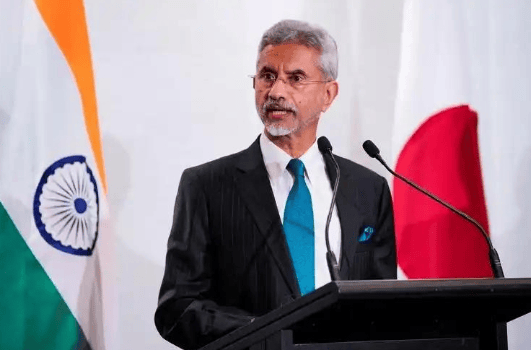
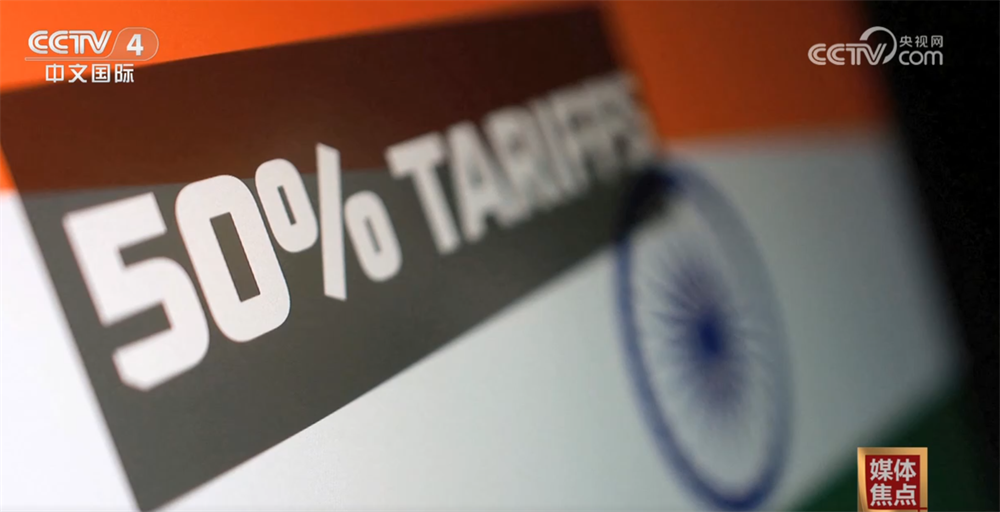
Group 1 - The cumulative tariff rate imposed by the US on Indian products has reached 50%, one of the highest rates faced by US trade partners, aimed at punishing India for purchasing Russian oil, leading to strained US-India relations [1] - Indian Foreign Minister S. Jaishankar stated that importing oil from Russia aligns with India's national interests and helps stabilize international oil prices, emphasizing India's commitment to independent decision-making in oil imports [3] - The high tariffs are expected to put over half of India's exports to the US at a competitive disadvantage compared to products from other countries, affecting multiple labor-intensive sectors such as textiles, leather goods, chemicals, handicrafts, carpets, and seafood [5] Group 2 - The Indian government has announced several policies to assist farmers and small business owners in coping with the impact of tariffs, including financial subsidies for affected exporters and encouragement to diversify export markets towards Latin America and the Middle East [6] - Despite the challenges in trade, there remains room for negotiation between the US and India, with five rounds of trade talks conducted without reaching an agreement, and the next round of negotiations postponed [8] - The strategic value of India has diminished since the Trump administration focused on economic development and manufacturing return, yet mutual interests in military cooperation and the Indo-Pacific strategy persist [8]
保持爱拼会赢的精气神!100名非公有制经济人士受表彰
Xin Hua She· 2025-07-30 00:35
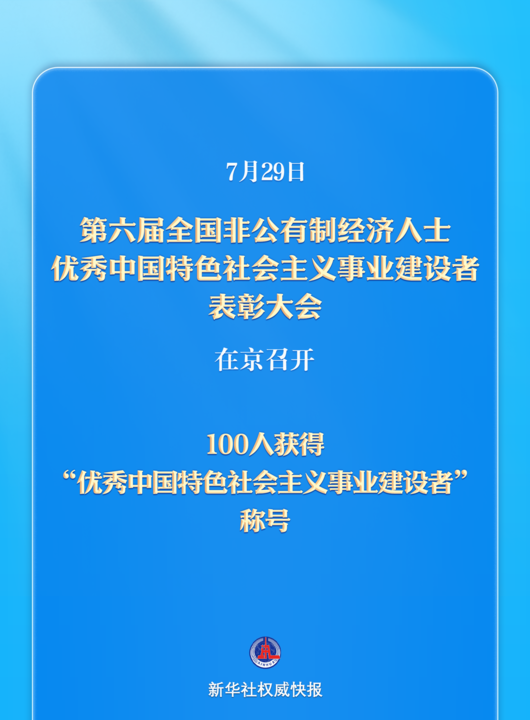
Group 1 - The sixth National Excellent Builders of Socialism with Chinese Characteristics for Non-Public Economic Personnel Award Ceremony was held in Beijing, recognizing 100 individuals for their contributions to the non-public economy [1] - The role of non-public economic entities is crucial for stabilizing growth, promoting innovation, increasing employment, and improving people's livelihoods, as evidenced by the achievements of the awardees [3] - Awardees include leaders from various companies who have made significant contributions to their industries, such as Qin Yinglin from Muyuan Foods, who has focused on independent breeding for over 20 years, and Yang Yongfeng from Hebei Shenghao Optoelectronics, who developed specialized testing equipment for optical communication chips [3][4] Group 2 - The awardees are seen as witnesses and participants in the development of China's non-public economy, integrating personal and corporate growth into the national development framework [3] - The event aims to inspire non-public economic personnel to maintain their ideals, stay committed to development, and take on the responsibilities of the times, thereby uniting efforts for progress [4][5] - The representatives of the awardees issued a call to action for private economic individuals and new social strata to contribute to the modernization of China, emphasizing the importance of responsibility and innovation in their endeavors [5]
奋楫争先立潮头
Ren Min Ri Bao· 2025-07-28 22:30
Group 1 - The Chinese government emphasizes the importance of private enterprises and entrepreneurs in contributing to national modernization and high-quality development [1][4] - Private enterprises account for over 92% of the total number of enterprises in China and contribute more than 70% of technological innovation results [4][5] - The "Three-body Computing Constellation" project aims to enhance satellite capabilities through AI and computing innovations, marking a significant step in China's space technology [2] Group 2 - Companies like Longi Green Energy and Spring Airlines demonstrate the importance of innovation and technology in achieving global competitiveness and operational efficiency [4][6] - The agricultural sector is being transformed through innovative practices, such as the "pig-raising and field-raising" model by Muyuan Foods, which promotes sustainable agriculture [7] - Entrepreneurs are increasingly integrating social responsibility into their business models, as seen in the initiatives by companies like Shengyuan Carpet Group and Good Doctor Pharmacy [8][9] Group 3 - The private sector is seen as a driving force for China's modernization, with a focus on high-quality development and social contributions [11] - The commitment to innovation and transformation is evident across various industries, from digital technology to green energy [5][10] - The entrepreneurial spirit is characterized by a strong sense of national responsibility and a commitment to societal well-being [9][11]